
SLIDE 1
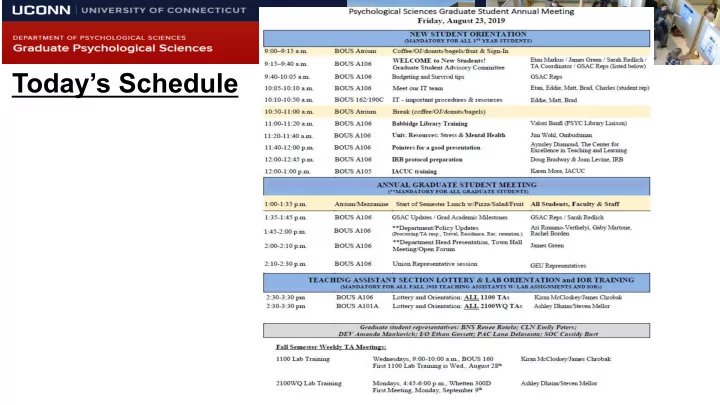
Todays Schedule THE GRADUATE STUDENT ADVISORY COMMITTEE (GSAC) - - PowerPoint PPT Presentation
Todays Schedule THE GRADUATE STUDENT ADVISORY COMMITTEE (GSAC) WELCOMES YOU! GRADUATE STUDENT ADVISORY COMMITTEE (GSAC) In 2007 the Psychological Sciences Department established a Graduate Student Advisory Committee to allow a venue for
GRADUATE STUDENT ADVISORY COMMITTEE (GSAC) In 2007 the Psychological Sciences Department established a Graduate Student Advisory Committee to allow a venue for graduate students to develop ideas and provide feedback to the department about our graduate programs. The committee consists of a student representative from each of the department’s six divisions, the Graduate Coordinator and the Associate Department Head for Graduate Studies. Representatives serve staggered two-year terms with three divisions selecting new representatives in alternating years (except the IO division which selects a new rep each year). Students entering their second year and beyond are eligible to serve as representatives.
GRADUATE STUDENT ADVISORY COMMITTEE (GSAC)
Etan Markus - Associate Department Head for Graduate Studies Sarah Redlich - Graduate Program Coordinator
Division Representative Term Email BN Renee Rotolo 2017-2020 renee.rotolo@uconn.edu CL Emily Peters 2019-2021 emily.a.peters@uconn.edu DV Amanda Mankovich 2019-2021 amanda.mankovich@uconn.edu IO Ethan Gossett 2019-2020 ethan.gossett@uconn.edu PAC Lana Delasanta 2019-2021 lana.delasanta@uconn.edu SO Cassidy Burt 2018-2020 cassidy.burt@uconn.edu
“UConn Psychological Sciences Department” https://www.linkedin.com/groups/8588825 Benefits of Joining:
Recent Committee Activities/Accomplishments: Successfully lobbied to have Instructors of Record (IOR) positions raised from a10 to a15-hour TA Successfully lobbied for increase in departmental Graduate Student Travel Funding Clarified process for IOR mentoring Requested clarification of proctoring responsibilities/authority resulting in new departmental Proctoring Policy (see Grad Student Handbook) Registered GSAC as a university organization to secure additional funding for GSAC activities Created a Graduate Student Resources webpage (http://grad.psych.uconn.edu/ ) Created a grad student “brag board” for current publications Established a new departmental tradition, a Graduate Poster night facilitating cross divisional interaction Established a new departmental tradition, a Cross-Divisional Graduate Colloquium Organized a LinkedIn group for Psychology graduate students Other Activities: Meet with the department head to discuss issues and concerns Coordinate invitation of speakers for Departmental Colloquium (please see your division rep if you have ideas for speakers) Serve as a resource to new students to answer questions and provide information regarding life at UConn in general and in their particular programs. Coordinate interdivisional social activities
GRADUATE STUDENT ADVISORY COMMITTEE (GSAC)
Recent Committee Activities/Accomplishments: Successfully lobbied to have Instructors of Record (IOR) positions raised from a10 to a15-hour TA Successfully lobbied for increase in departmental Graduate Student Travel Funding Clarified process for IOR mentoring Requested clarification of proctoring responsibilities/authority resulting in new departmental Proctoring Policy (see Grad Student Handbook) Registered GSAC as a university organization to secure additional funding for GSAC activities Created a Graduate Student Resources webpage (http://grad.psych.uconn.edu/ ) Created a grad student “brag board” for current publications Established a new departmental tradition, a Graduate Poster night facilitating cross divisional interaction Established a new departmental tradition, a Cross-Divisional Graduate Colloquium Organized a LinkedIn group for Psychology graduate students Other Activities: Meet with the department head to discuss issues and concerns Coordinate invitation of speakers for Departmental Colloquium (please see your division rep if you have ideas for speakers) Serve as a resource to new students to answer questions and provide information regarding life at UConn in general and in their particular programs. Coordinate interdivisional social activities
GRADUATE STUDENT ADVISORY COMMITTEE (GSAC)
GRADUATE RESOURCES
First year:
End of first year / second year:
and another Associate Advisor, not in your program) Two weeks before your defense:
copy of thesis. By the fourth week of your final semester:
No later than two weeks before end of final semester:
Cisco in A106 for meetings
10:05-10:10 BOUS A106
Meet our IT team Etan, Eddie Rivera, Matt Butwill, Charles Davis (student rep)
10:10-10:50 BOUS 190C
Important procedures & resources Eddie, Matt
Also for the Fall semester…
GRADUATE RESOURCES
GRADUATE RESOURCES
Roughly 4-8 PSYC courses are taught by graduate students during academic year; equal number during summer sessions Benefits –
IOR positions requirements:
Resources for IORs:
Rules/Guidelines for IORs
Note – you scan card with your picture not Jonathan!
Presented by: Sarah Redlich, M.A. Graduate Program Coordinator
University of Connecticut
completion of a MS degree as part of the PhD program)
Important Resources/Information:
https://grad.psych.uconn.edu/
https://registrar.uconn.edu/academic-calendar/)
to the Office of the Registrar, located in the Wilbur Cross Building, Garden Level.
First year:
End of first year / second year:
and another Associate Advisor, not in your program) Two weeks before your defense:
copy of thesis. By the fourth week of your final semester:
No later than two weeks before end of final semester:
final semester. Submit a copy to Psych Grad Programs Office.
Office by the published deadline on the Academic Calendar (no later than two weeks before end of final semester). Submit a copy to Psych Grad Programs Office.
deadline on the Academic Calendar (no later than two weeks before end of final semester).
published deadline on the Academic Calendar.
NOTE - Timetable for forming your Advisory Committee & taking General Exam varies by program:
concentration, and another Associate Advisor, not in your program; can be the same as your MS committee)
By the completion of 18 credits:
By the fourth week of your final semester:
No later than two weeks before end of final semester:
(https://opencommons.uconn.edu/dissertations/).
Two weeks prior to your defense date:
One week prior to your defense date:
Day of the defense:
x 11” paper signed by your advisory committee. [Additional participants, examiners, reviewers, and readers do not sign]. Submit
Submit a copy to Psych Grad Programs Office.
After the defense:
University Forms:
Submit a copy to Psych Grad Programs Office. Note: The PhD Plan of Study accompanied by the Breadth of Studies form MUST be signed and approved by the Associate Head of Graduate Studies before it is submitted to the Registrar’s Office.
examination is completed. Submit a copy to Psych Grad Programs Office.
Head of Graduate Studies before it is submitted to the Registrar’s Office.
the date of your oral defense.
dissertation submission checklist by published deadline on the Academic Calendar (no later than two weeks before end of final semester). Submit copy to Psych Grad Programs Office.
dissertation submission checklist by the published deadline on the Academic Calendar.
Submission Checklist (below) by the published deadline on the Academic Calendar.
Academic Calendar (no later than two weeks before end of final semester).
Departmental Forms:
accompany the PhD Plan of Study). Submit to Psych Grad Programs Office.
Dissertation Proposal Form. Submit original to Psych Grad Programs Office with Dissertation Proposal paperwork.
Signature Form. Submit
Programs Office 7 days prior to your defense.
Psych Grad Website
https://grad.psych.uconn.edu/wp-content/uploads/sites/702/2019/05/GradPoliciesRules_2019- 20_updated_7May_final.pdf
Office of the Registrar Website
https://registrar.uconn.edu/graduation/graduate-programs/
https://registrar.uconn.edu/doctoral-degree-programs/dissertation-faqs/ https://registrar.uconn.edu/doctoral-degree-programs/dissertation-information/ https://registrar.uconn.edu/doctoral-degree-programs/dissertation-specifications/
Feel free to stop by the Grad Programs Office in BOUS 101C anytime for help!
(https://www.linkedin.com/groups/8588825/)
Today’s handouts are posted on the Graduate Psychological Sciences website under the Student Resources tab “Incoming Students” section
At: https://grad.psych.uconn.edu/new-students/getting-started/
Psychology Graduate Student Annual Meeting August 23, 2019
IRB Program Director-Douglas Bradway, MA, CIP Post Approval Monitor, Joan Levine, MPH, CIP
Research Compliance Services
research.uconn.edu
Karen Moré, CPIA, Interim Director Pamela Erickson, Ph.D., IRB Chair, Professor and Department Head of Anthropology Douglas (Doug) Bradway, Executive Program Director Policies, Full Board Agenda, Most Full Board & Limited Protocols, Individual Investigator Agreements, Institutional Authorization Agreements, Daily Operations of Office. Joan Levine, MPH, CIP, Post‐Approval Monitor and Education Specialist Exempt Reviews, auditing, education Jerome (Jerry) McMurray, MA, IRB Program Specialist Initial intake of submissions, amendments, continuations Diane Sainsbury, MBA, IRB Program Specialist Expedited Reviews Nicholas (Nick) Lacafta – Records Technician Data entry, InfoEd trouble shooting eRA help desk era‐support@uconn.edu Errors with submission
research.uconn.edu
at UConn.
in research.
the web‐based application system‐InfoEd.
approved protocol, re‐approval, protocol deviations, and adverse events.
research.uconn.edu
An Institutional Review Board is a committee that reviews research protocols to protect the rights and welfare of human participants. Who are the members of the IRB?
Social Behavioral and Bio‐Medical research.
IRB at UConn is responsible for reviewing research at Storrs and regional campuses.
research.uconn.edu
The “Common Rule” (45 CFR 46) is the federal policy for the protection of human subjects in research. It was first published in 1991 and was recently revised. The Common Rule describes the detail of the IRB operations and the types of research that are subject to regulation. There are 4 subparts for additional protections for pregnant women, human fetuses, and neonates, prisoners, and children. UConn requires additional protections for students who take part in research.
research.uconn.edu
Collaborative Institutional Training Initiative (CITI) The web‐based training modules in CITI provide basic education on the history and ethical principles of research. All researchers, including students who are working on the study and are considered “key personnel” must complete the online "CITI Training” course for the protection of human participants in research BEFORE the IRB will approve a study. Research personnel must renew their training every three years.
research.uconn.edu
Additional Training for NIH/NSF Research
The National Science Foundation (NSF) requires the responsible conduct
doctoral fellows who conduct research supported by NSF funds. The National Institutes of Health (NIH) requires that all trainees, fellows, participants, and scholars receiving support through any NIH training, career development award (individual or institutional), research education grant, or dissertation research grant must receive RCR
faculty, mid‐career faculty and senior faculty, and professional and scientific employees receiving funding from these sources. PIs are responsible for ensuring that each undergraduate student, graduate student and postdoctoral researcher who participates in their NSF or NIH funded research completes the training during the course of their participation in the project. These RCR modules can be accessed through the CITI training program. OVPR offers in person training once per year (January). Key Personnel working on Clinical trials funded by the NIH must also take Good Clinical Practice training. Also, available from CITI.
research.uconn.edu
Does your study meet the regulatory definition of research? §46.102 (d) a. Is it research? Research means a systematic investigation, including research development, testing and evaluation, designed to develop or contribute to generalizable
purposes of this policy, whether or not they are conducted or supported under a program which is considered research for other purposes. For example, some demonstration and service programs may include research activities.
research.uconn.edu
(1) Scholarly and journalistic activities (e.g., oral history, journalism, biography, literary criticism, legal research, and historical scholarship), including the collection and use
information is collected. (2) Public health surveillance activities, including the collection and testing of information or biospecimens, conducted, supported, requested, ordered, required,
necessary to allow a public health authority to identify, monitor, assess, or investigate potential public health signals, onsets of disease outbreaks, or conditions of public health importance (including trends, signals, risk factors, patterns in diseases, or increases in injuries from using consumer products). Such activities include those associated with providing timely situational awareness and priority setting during the course of an event or crisis that threatens public health (including natural or man‐made disasters). (3) Collection and analysis of information, biospecimens, or records by or for a criminal justice agency for activities authorized by law or court order solely for criminal justice or criminal investigative purposes. (4) Authorized operational activities (as determined by each agency) in support of intelligence, homeland security, defense, or other national security missions.
research.uconn.edu
45 CFR 46.102 (e)(1) Human subject means a living individual about whom an investigator (whether professional or student) conducting research: (i) Obtains information or biospecimens through intervention or interaction with the individual, and, uses, studies, or analyzes the information or biospecimens; or (ii) Obtains, uses, studies, analyzes, or generates identifiable private information or identifiable biospecimens. IRB submission = Research + Human Subject *However, there are 6 categories of research that may require an Exempt review process‐described in following slides.
research.uconn.edu
What level of review is my study?
Benign Behavioral Interventions
Limited
NEW
research.uconn.edu
Category One Research, conducted in established or commonly accepted educational settings, that specifically involves normal educational practices that are not likely to adversely impact students'
assessment of educators who provide instruction. This includes most research on regular and special education instructional strategies, and research on the effectiveness of or the comparison among instructional techniques, curricula, or classroom management methods. All Exempt Research: IRB‐5 Electronic Application and corresponding IRB‐5 Word Protocol
research.uconn.edu
Category Two Research that only includes interactions involving educational tests (cognitive, diagnostic, aptitude, achievement), survey procedures, interview procedures, or observation of public behavior (including visual
(i) The information obtained is recorded by the investigator in such a manner that the identity of the human subjects cannot readily be ascertained, directly or through identifiers linked to the subjects; (ii) Any disclosure of the human subjects' responses outside the research would not reasonably place the subjects at risk of criminal or civil liability
educational advancement, or reputation; or (iii) The information obtained is recorded by the investigator in such a manner that the identity of the human subjects can readily be ascertained, directly or through identifiers linked to the subjects, and an IRB conducts a limited IRB review to make the determination required by §46.111(a)(7).
research.uconn.edu
the IRB conducts a “Limited IRB Review” and determines that safeguards are in place that appropriately address the privacy
may include audio or video recordings.
educational tests or observations in which the investigator does not participate in activities being observed. Also, children not allowable under the Limited IRB Review (iii).
research.uconn.edu
Benign Behavioral Intervention Research involving benign behavioral interventions in conjunction with the collection of information from an adult subject through verbal or written responses (including data entry) or audiovisual recording if the subject prospectively agrees to the intervention and information collection and at least one of the following criteria is met: (A) The information obtained is recorded by the investigator in such a manner that the identity of the human subjects cannot readily be ascertained, directly or through identifiers linked to the subjects; (B) Any disclosure of the human subjects' responses outside the research would not reasonably place the subjects at risk of criminal or civil liability
educational advancement, or reputation; or (C) The information obtained is recorded by the investigator in such a manner that the identity of the human subjects can readily be ascertained, directly or through identifiers linked to the subjects, and an IRB conducts a limited IRB review to make the determination required by §46.111(a)(7).
research.uconn.edu
(ii) For the purpose of this provision, benign behavioral interventions are brief in duration, harmless, painless, not physically invasive, not likely to have a significant adverse lasting impact on the subjects, and the investigator has no reason to think the subjects will find the interventions offensive or embarrassing. Provided all such criteria are met, examples of such benign behavioral interventions would include having the subjects play an
conditions, or having them decide how to allocate a nominal amount of received cash between themselves and someone else. (iii) If the research involves deceiving the subjects regarding the nature or purposes of the research, this exemption is not applicable unless the subject authorizes the deception through a prospective agreement to participate in research in circumstances in which the subject is informed that he or she will be unaware of
research.uconn.edu
Category 4: Secondary research for which consent is not required: Secondary research uses of identifiable private information or identifiable biospecimens, if at least one of four criteria are met… Category 5: Research and demonstration projects that are
conducted or supported by a Federal department or agency…
Category 6: Taste and food quality evaluation and consumer
acceptance studies…
research.uconn.edu
Why? Allows for certain research to be reviewed under the Exempt category even when identifiable information may be sensitive or potential harm if disclosed. What is a Limited IRB Review? It is an Exempt review that takes place under categories noted below to ensure the protocol meets the regulatory criteria and ensures that here are adequate provisions to protect the privacy of subjects and to maintain the confidentiality of data. When does an IRB conduct a Limited Review? UConn = Exempt Category (2) (iii) & (3)(i)(C) §46.104(d)(2)(iii), (d)(3)(i)(C), and (d)(7), and (8) Who conducts a Limited IRB Review? Limited IRB Review is performed by the IRB Chair or an experienced IRB member designated by the Chair.
research.uconn.edu
Expedited studies involve no greater than minimal risk and fit into one
Word Protocol Examples: Collection of data through non‐invasive procedures or means (MRI, EEG, buccal swab), secondary data analyses of identifiable datasets. Collection of biospecimens. Some research involving drugs/devices where investigational drug/device application/exemption are not needed from FDA. Some research not covered under Exempt‐may present no more than minimal risk. https://www.hhs.gov/ohrp/regulations‐and‐ policy/guidance/categories‐of‐research‐expedited‐review‐procedure‐ 1998/index.html One IRB member reviews this research.
research.uconn.edu
Full committee research is considered to be more than minimal risk. These studies include research that involves physical or psychological risks. The full board reviews these studies at a fully convened meeting. Meetings once every 3 weeks. Dates are listed on the IRB web‐site. These protocols are due 3 weeks prior to the IRB meeting date. This provides time for RCS staff to pre‐review the study to ensure all of the documents have been submitted, and for the IRB members to read through and be prepared for discussion during the meeting. IRB‐1 Electronic Application and corresponding IRB‐1 Word Protocol Examples: research with drugs/supplements, biologics, many devices protocols, certain intervention research that include psychological, physical,
At times, researchers are invited to the IRB meeting to clarify procedures. * Call RCS prior to submitting your protocol to ensure that you are submitting under the correct category and have all necessary forms completed.
research.uconn.edu
1. Risks to subjects are minimized 2. Risks to subjects are reasonable in relation to anticipated benefits, if any, to subjects, and the importance of the knowledge that may reasonably be expected to result. 3. Selection of subjects is equitable. 4. Informed consent will be sought from each prospective subject or the subject's legally authorized representative, in accordance with, and to the extent required by §46.116 5. Informed consent will be appropriately documented, in accordance with, and to the extent required by §46.117 6. When appropriate, the research plan makes adequate provision for monitoring the data collected to ensure the safety of subjects. 7. When appropriate, there are adequate provisions to protect the privacy of subjects and to maintain the confidentiality of data. 8. When some or all of the subjects are likely to be vulnerable to coercion or undue influence, such as children, prisoners, pregnant women, mentally disabled persons, or economically or educationally disadvantaged persons, additional safeguards have been included in the study to protect the rights and welfare of these subjects.
research.uconn.edu
recruitment material?
how to administer consent? c. What safeguards are in place if you are enrolling vulnerable populations?
UITS guidelines? f. Are there additional regulations to consider (FERPA, FDA)? Are there other institutions involved in the research? *Call the IRB office for guidance before you submit your protocol.
research.uconn.edu
Current research practices routinely involve electronic data in a variety of ways. Traditionally, procedures for the confidential handling of research materials involved keeping them in locked file cabinets and in locked offices. These procedures still apply when the research materials are in hard copy form. However, there is growing complexity in how to protect research data that are collected and maintained electronically.
research.uconn.edu
It is the responsibility of all UConn employees and users of data to adhere to the policies established to protect sensitive university data to which they have authorized access. These policies apply to university‐owned computers as well as to personally owned devices used to access sensitive university
https://policy.uconn.edu/2012/06/21/confidential‐data‐ information‐technology/.
research.uconn.edu
Assessment Form must be completed and submitted to the
are data stored? Remember the first option should be a solution provided by UConn (Qualtrics, RedCap, OneDrive, Filelocker‐for identifiable temp storage & transferring data).
computer if no personal identifiers or sensitive information are collected. You must certify that anti‐virus software is installed and up‐to‐date.
removable media, but these tools must be password protected and encrypted to decrease access by others.
research.uconn.edu
responsibility.
to take an initial look at the protocol. IRB staff conduct an administrative review followed by an IRB member who conducts a scientific review.
every three weeks during much of the year. IRB staff conduct an administrative review followed by an IRB member who serves as primary
approval process.
them.
research.uconn.edu
Seek IRB help before preparing submissions and to assist with identifying category of review. Read the protocol applications first before completing them. After reading the protocol section instructions, please respond to the instructions just once. There is no need to repeat information throughout the protocol. Do not copy study information directly from a grant or contract
clarify acronyms and use lay language to describe your research when possible. Review InfoEd How‐to Guides.
research.uconn.edu
Amendments must be submitted before any changes are
changes are being made. Use track‐change function of Word to identify changes. Allow two to three weeks for approval. Review the approval letter for exact time frames for submission of re‐approval material (if applicable). Re‐approvals are generally reviewed within two or three weeks of expiration dates. Review UConn policies for reporting protocol deviations and adverse events. https://ovpr.uconn.edu/services/rics/irb/policies‐ procedures/.
research.uconn.edu
InfoEd is the web based application system used to develop and submit research protocols to the IRB. InfoEd sessions are offered on a regular basis. The IRB strongly encourages all researchers to attend a session prior to submitting a protocol. Students have access to all features in the InfoEd submission
Investigator of the study. The PI is ultimately responsible for ensuring protection of human participants. Tips: Before clicking submit, all studies that are unfunded must be routed to the department head and PI for sign off. For funded studies, routing must go to the PI. Don’t forget to click “submit”!!
research.uconn.edu
samples.
(full board studies only), training, InfoEd how‐to guides, submission process, etc.
research.uconn.edu
1. Human Subjects Regulations 2. Link to IRB help sessions & IRB forms workshops 3. InfoEd How to Guides 4. IRB web‐site 5. UConn IRB CITI program how to page 6. Guidance for Data Security and Internet‐Based Research Involving Human Participants 7. InfoEd www.infoed.uconn.edu 8. UConn IRB Policies & Procedures 9. Forms & Templates (Word document protocols, consent forms, etc.)
De par tme ntal F unding
N
isc a l ye a r
b e re q ue ste d prio r to de pa rture
http:/ / psyc h.uc o nn.e du/ tra ve l/ o r pic k up a t fro nt
t is no w re q uire d that yo u turn in the c o mple te d fo rm BE F ORE yo u trave l
Gr aduate Sc ho ol Doc to r al Awar d
N
a ll T ra ve l b e twe e n July 1 a nd De c e mb e r 31
ra ve l b e twe e n Ja nua ry 1 a nd June 30
http:/ / psyc h.uc o nn.e du/ tra ve l/
(Ye s, it DOE S e xist!)
fro nt o ffic e
he wo rksho p a pplic a tio n is diffe re nt tha n the De pa rtme nta l F unding a pplic a tio n*
unding fo r the sa me trip
unding if yo u ha ve a lre a dy use d yo ur Do c to ra l Awa rd fo r the ye a r o r pla n o n using it within the ye a r
fo r Wo rksho ps o nly (this isn’ t a ne w rule b ut it’ s a rule )
Dire c t link a nd instr
uc tions o n o ur we b site http:/ / psyc h.uc o nn.e du/ tra ve l/
far e
f yo u b o o k o n yo ur o wn a nd inte nd to b e re imb urse d, se nd us the flig ht re c e ipt whe n yo u b uy it
ation
F S a c c o unt
f yo u split lo dg ing / pla n o n splitting lo dg ing , ple a se c o nta c t the fro nt o ffic e fo r g uida nc e
HE ONL Y WAY T O OBT AI N A BRADL E Y PARK I NG PE RMI T I S T O APPL Y ON A PRE
RI P F ORM. T ra ve l will NOT re imb urse yo u fo r Bra dle y pa rking if yo u do no t o b ta in the pa rking pe rmit b e fo re ha nd
Re vie w of what c an be pur c hase d in advanc e by PSYC
ra in, Ho te l, Re nta l Ca r (via Sa nditz)
e e s (a nd simila r fe e s a sso c ia te d with the c o nfe re nc e )
ra ve l.uc o nn.e du
D a nd Pa sswo rd
F S a c c o unt to re duc e o ut-o f-po c ke t e xpe nse
f yo u DO NOT use Sa nditz– ne e d to print o ut Sa nditz c o mpa riso n in o rde r to b e re imb urse d
f yo u a re flying o ut o f a n a irpo rt o the r tha n Bra dle y, the c o mpa riso n sho uld still b e fro m BDL to yo ur de stina tio n. Sho uld the c o st (flig ht, mile a g e , to lls, pa rking , e tc .) e xc e e d the c o st o f tra ve l
tra ve l.
f yo u use a c o mpa ny a side fro m Sa nditz, yo u will o nly b e re imb urse d fo r the c o mpa ra b le Sa nditz a mo unt
e ntal c ar s, b ut no t
ma nda to ry
*T he pa rt whe re yo u g e t yo ur mo ne y*
1.T a ke a T ra ve l Re imb urse me nt Re q ue st e nve lo pe (lo c a te d in the fro nt o ffic e ) 2.F ill o ut the c o ve r she e t & put a ll re c e ipts/ do c ume nta tio n inside the e nve lo pe 3.Dro p o ff a t the fro nt o ffic e 4.Appro ve yo ur T ra ve l We b F
sub mitte d b y a fro nt-o ffic e wo rke r 5.T ha t’ s it! T he n the mo ne y a ppe a rs! I t’ s tha t simple !
e tur n
sub mit a po st-tra ve l we b fo rm a nd no t no tify the fro nt o ffic e / no t turn in re c e ipts
A frie ndly fro nt o ffic e sta ff me mb e r o f yo ur c ho o sing who is thrille d to a nswe r yo ur q ue stio ns An inte llig e nt a nd wo nde rful PSY SCI g ra dua te stude nt who ha s q ue stio ns a b o ut tra ve l & re imb urse me nts