
SLIDE 1
Advisory Group on
Water Trust, Banking, & Transfers
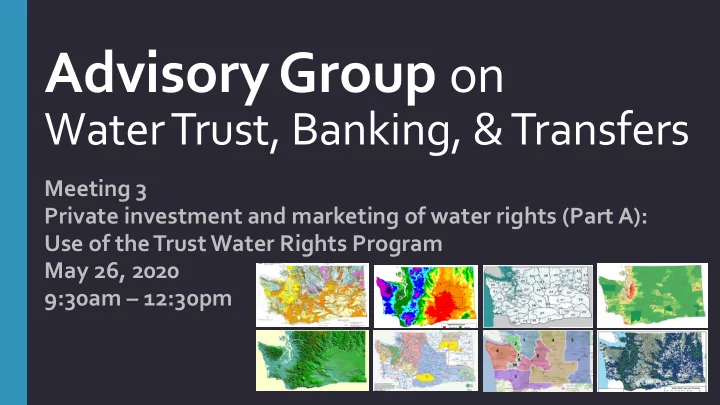
Meeting 3 Private investment and marketing of water rights (Part A): Use of the Trust Water Rights Program May 26, 2020 9:30am – 12:30pm
Todays Agenda Time Topic Presenter 9:30 9:45 Welcome, review - - PowerPoint PPT Presentation
Advisory Group on Water Trust, Banking, & Transfers Meeting 3 Private investment and marketing of water rights (Part A): Use of the Trust Water Rights Program May 26, 2020 9:30am 12:30pm Todays Agenda Time Topic Presenter 9:30
Meeting 3 Private investment and marketing of water rights (Part A): Use of the Trust Water Rights Program May 26, 2020 9:30am – 12:30pm
Time Topic Presenter
9:30 – 9:45 Welcome, review agenda & objectives, introductions, summary of last meeting Carrie Sessions 9:45 – 10:30 Background presentations: History and use of the Trust Water Rights Program (TWRP) Susan Adams (WA Water Trust) Carrie Sessions 10:30 – 11:15 Discussion questions 1 & 2 Dave Christensen 11:15 – 11:30 Break 11:30 – 12:25 Discussion question 3 Carrie Sessions 12:25 – 12:30 Wrap up, look ahead to next meeting, show and open the follow-up poll Carrie Sessions
1.
Build upon the previous meetings by identifying specific concerns (or lack thereof) about private investment and marketing of water rights
2.
Increase understanding of the history, functions, and use of the TWRP in Washington. Specifically, increase understanding of trust water rights, the different ways they are created (including temporary donations, leases, and transfers), and the ways they are used.
3.
Gather feedback on whether changes to the Trust Water statutes, either clarifying or substantive, are needed to address concerns identified in the discussion.
1.
Kickoff (April 16)
2.
Policy discussion: Transparency in water right sales &
3.
Policy discussion: Private investment and marketing of water rights (part A): Use of the state water trust (May 26)
4.
Policy discussion: Private investment and marketing of water rights (part B): Water banking (June 10)
5.
Review session: Draft policy options (June 30)
6.
Wrap-up: Finalization of Advisory Group feedback (July 16)
Meeting 3: Trust Water
(definitions)
stream uses
donations
Meeting 4: Water Banking
banking
6
Click on this symbol to open the chat box Type here to chat with host
7
Click on this symbol to “raise your hand”
County
Conservancy Board
District
Trust
LLP
Public Works
Services
Reclamation District
Irrigation District
Conservation Strategies
Health
Association of Counties
Joint Board
Association
PLLC
State University
PLLC
Reclamation
S'Klallam Tribe
Group
Planning and Public Works
PLLC
Water Resources Association
Tribe
Water Conservancy Board
Dist.
District
Market
Republican Caucus
United Tribes
Environmental Law & Policy
Associates, Inc.
Seattle Public Utilities
State Senate
State Water Resources Association
Latimer
Ground Water Association
Nation
Water Resources
Unlimited
Environmental Law and Policy
Conservancy
Arlington
State University
transfers.
are posted on our webpage.
present them at Meeting 5.
Susan Adams, Washington Water Trust
Trust Water Rights Program: Flexible Streamflow Solutions
Susan Adams, Executive Director
TRWP History & Overview
► Background on trust
water rights and the TRWP
► The types of acquisitions
that end up in the TWRP
► Water banking ► Potential impediments to
goal of the TWRP— restoring flows and flexible water management
What Does the TRWP Solve?
► Prior appropriation often
means over appropriation
► Beneficial use requirement
and fear of relinquishment can be a disincentive to voluntary conservation-- TWRP rewards conservation
► Provides a mechanism to
acquire senior water rights and protect them for instream flow
Authorizing Statutes: TWRP
► Yakima Basin TWRP
adopted 1989.RCW 90.38
► Statewide TWRP adopted
► Trust water is exempt from
relinquishment
► Retains original priority date ► Temporary or permanent ► Legislative funding began in
2003 ($1-3 million/biennium)
Ecology acquires water rights through:
Donation—easiest to accomplish
Parking lot to avoid relinquishment Ecology accepts with no extent & validity requirement Little scrutiny or DOE management (monitoring)
Lease/purchase—high degree of flexibility Ecology may accept
Extent and validity required
Other means
Water banking agreements Irrigation Efficiencies Grant Program (IEGP) Dry-year leasing, crops switches, source changes
Extent & Validity
Verifying Wet Water
Adjudicated certificate (where available) Meter records (best source—but rate) Pump records—convert from KWH used and pump specs Cropping/seed receipts Photographs of water use Affidavits of water use
Technology is helping. . .
Season of use aerial imagery (multiple years) Soil humidity measurements
Restoring Flow Without Drying Agriculture
Agreement type Funded amount Primary Reach Secondary reach Diversion reduction $1,868,188 Yes Yes IEGP $16,200,218 Yes Possible Lease $20,716,975 Yes Yes Other $21,742,587 Yes Yes Purchase $25,654,930 Yes Yes Totals $84,314,710 811,389 acre- feet/year* 26,749 acre feet/year
Not all permanently in stream
Fallowing agreements during salmon
critical periods
Source switches to groundwater Irrigation efficiencies (IEGP) Buying the “odd bits”
Drought forbearance
agreements
Split-season leases Conservation easements Donations
Tools of the Program
Water Banking: Redistributing Liquid Assets
All mitigation banks use Trust Water Rights Program Supply: Need water rights that are:
Senior to unfulfilled juniors downstream Upstream of new uses Similar timing and consumptive profile to new uses (exempt
wells require year-round availability)
Demand:
Create and sell mitigation credits for new uses
Dungeness alone has a restoration component Administration—expensive and ongoing
Lack of Water rights certainty
Adjudicated basins v. unadjudicated Rettowski v. Ecology, 122, Wn. 2nd 219 (1993) “Streamlining Water Rights Adjudications” (2003)
Funding for mitigation favored over restoration (maintaining
rather than improving conditions)
Climate change uncertainty impacting farmers Donation Program intended temporarily protect, while
sometimes used to “rehydrate” Dry Rights
Crown West Realty, LLC v. PCHG, 7 Wash. App. 710 (2019) Lundgren transfer in the Methow Wall Street speculation pricing restoration out
Thank You
Susan Adams, Executive Director 206.755.7162 susan@washingtonwatertrust.org
Definitions and data
RCW 90.42.020 (5): "Trust water right" means any water right acquired by the state under this chapter for management in the state's trust water rights program. Different means of conveyance: Temporary donation Acquisition (lease or purchase) Other means
the donor.
within the last 5 years. “5 year look back”, not a full extent & validity.
1.
Request: A water right holder submits a Temporary Donation Form to us.
2.
Review: We review the most recent five years of beneficial use to determine the quantity available for donation.
3.
Execute: We issue a letter stating that the water right is in trust and protected from relinquishment.
from trust at any time and resume use as before the donation.
Can serve instream or out-of-stream uses.
Requires determination of extent and validity.
Different requirements for leases under 5 years and over 5 years.
Agreement and are deeded to Ecology
Any contract in which Ecology agrees to hold and manage a water right in trust. Water banking agreements Water right swaps Agreements to not divert Other creative contracts
“Type” Action By Ecology Change under RCW 90.03.380? Deeded to ECY? Temporary Donations Letter of Acceptance No No Acquisitions - Leases Executed Lease Agreement Usually No Acquisitions - Purchase Executed Purchase and Sale Agreement Yes Yes “Other means” Executed Agreement
Usually Depends
Common description of what should be described as “held in the TWRP through X means for the purposes of X.” Purpose of use is changed to instream flows (and maybe mitigation) under RCW 90.03.380.
right!
Temporary Donations “Transfer into Trust” * Use or objective Reprieve from relinquishment Mitigate new water uses Change in purpose of use? No Yes under RCW 90.03.380 Examination of the water right quantity “5-year lookback” Extent and validity
* This label is not widely supported as the correct terminology. Discussion is needed to determine the correct verbiage.
Temporary Donations Total #of Rights Median years in Trust 90% of rights are in Trust for less than X years Expired
226 2 5.6
Active
326 4.4 10.6
1.
Listen to the discussion.
2.
Raise your hand to join the discussion group. The moderator will add you.
3.
Stay in the group for ~5 minutes.
4.
The moderator will rotate you
Bill Clarke, Attorney Tyson Carlson, Aspect Consulting Adam Gravely, Van Ness Feldman Jeff Slothower, Attorney
Ecology’s presentation? How do you see these differently?
direction and sideboards as to what type(s) of trust water rights should be used to mitigate for new uses?
For example, temporary donations into trust are not required to undergo a tentative determination of extent and validity. Are there circumstances when temporary donations can (and should) be used for mitigation?
Lisa Pelly, Trout Unlimited Kathleen Collins, Water Policy Alliance Chuck Brushwood, Okanogan Co. Conservancy Board Sarah Mack, Tupper Mack Wells PLLC
3.
Temporary donations under the TWRP are inherently flexible – water rights can remain in trust indefinitely and under terms prescribed by the water right holder.
and speculation in water?
speculative concerns?
speculation, do you think additional restrictions, like time limits or fees on temporary donations, would help to address your concerns?
(part B): Water banking
Comments will be accessible to everyone
https://www.surveymonkey.com/r/advisory3
Contact: Carrie Sessions, Carrie.sessions@ecy.wa.gov, (360) 742-6582