Today Optical flow wrapup Activity in video Actions in video - - PDF document

today
SMART_READER_LITE
LIVE PREVIEW

Today Optical flow wrapup Activity in video Actions in video - - PDF document

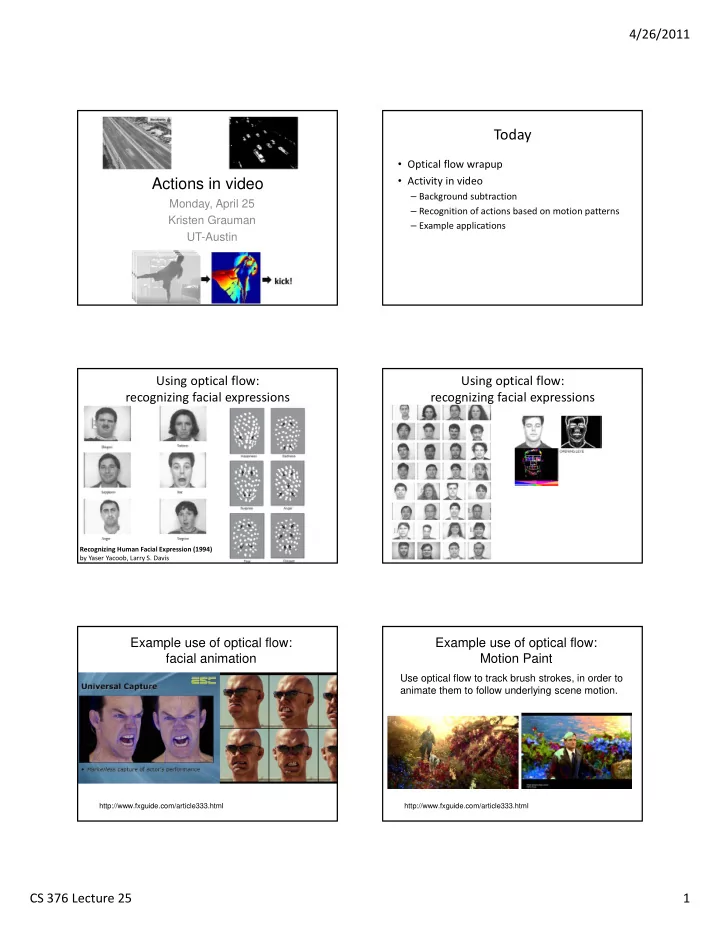
4/26/2011 Today Optical flow wrapup Activity in video Actions in video Background subtraction Monday, April 25 Recognition of actions based on motion patterns Kristen Grauman Example applications UT-Austin Using optical


slide-1
SLIDE 1

4/26/2011 CS 376 Lecture 25 1

Actions in video

Monday, April 25 Kristen Grauman UT-Austin

Today

  • Optical flow wrapup
  • Activity in video

– Background subtraction – Recognition of actions based on motion patterns – Example applications

Using optical flow: recognizing facial expressions

Recognizing Human Facial Expression (1994) by Yaser Yacoob, Larry S. Davis

Using optical flow: recognizing facial expressions

Example use of optical flow: facial animation

http://www.fxguide.com/article333.html

Example use of optical flow: Motion Paint

http://www.fxguide.com/article333.html

Use optical flow to track brush strokes, in order to animate them to follow underlying scene motion.

slide-2
SLIDE 2

4/26/2011 CS 376 Lecture 25 2

Video as an “Image Stack”

Can look at video data as a spatio-temporal volume

  • If camera is stationary, each line through time corresponds

to a single ray in space

t

255

time

Alyosha Efros, CMU

Input Video

Alyosha Efros, CMU

Average Image

Alyosha Efros, CMU Slide credit: Birgi Tamersoy

Background subtraction

  • Simple techniques can do ok with static camera
  • …But hard to do perfectly
  • Widely used:

– Traffic monitoring (counting vehicles, detecting & tracking vehicles, pedestrians), – Human action recognition (run, walk, jump, squat), – Human‐computer interaction – Object tracking

Slide credit: Birgi Tamersoy

slide-3
SLIDE 3

4/26/2011 CS 376 Lecture 25 3

Slide credit: Birgi Tamersoy Slide credit: Birgi Tamersoy Slide credit: Birgi Tamersoy

Frame differences

  • vs. background subtraction
  • Toyama et al. 1999

Slide credit: Birgi Tamersoy

Average/Median Image

Alyosha Efros, CMU

slide-4
SLIDE 4

4/26/2011 CS 376 Lecture 25 4

Background Subtraction

  • =

Alyosha Efros, CMU

Pros and cons

Advantages:

  • Extremely easy to implement and use!
  • All pretty fast.
  • Corresponding background models need not be constant,

they change over time. Disadvantages:

  • Accuracy of frame differencing depends on object speed

and frame rate

  • Median background model: relatively high memory

requirements.

  • Setting global threshold Th…

When will this basic approach fail?

Slide credit: Birgi Tamersoy

Background mixture models

  • Adaptive Background Mixture Models for Real‐Time Tracking, Chris Stauer & W.E.L. Grimson

Idea: model each background pixel with a mixture of Gaussians; update its parameters over time.

Background subtraction with depth

How can we select foreground pixels based on depth information?

Today

  • Optical flow wrapup
  • Activity in video

– Background subtraction – Recognition of action based on motion patterns – Example applications

Human activity in video

No universal terminology, but approximately:

  • “Actions”: atomic motion patterns ‐‐ often gesture‐

like, single clear‐cut trajectory, single nameable behavior (e.g., sit, wave arms)

  • “Activity”: series or composition of actions (e.g.,

interactions between people)

  • “Event”: combination of activities or actions (e.g., a

football game, a traffic accident)

Adapted from Venu Govindaraju

slide-5
SLIDE 5

4/26/2011 CS 376 Lecture 25 5

Surveillance

http://users.isr.ist.utl.pt/~etienne/mypubs/Auvinetal06PETS.pdf

2011

Interfaces

2011

  • W. T. Freeman and C. Weissman, Television control by hand gestures, International Workshop on

Automatic Face‐ and Gesture‐ Recognition, IEEE Computer Society, Zurich, Switzerland, June, 1995, pp. 179‐‐183. MERL‐TR94‐24

1995

Interfaces

  • Model‐based action/activity recognition:

– Use human body tracking and pose estimation techniques, relate to action descriptions (or learn) – Major challenge: accurate tracks in spite of occlusion, ambiguity, low resolution

  • Activity as motion, space‐time appearance patterns

– Describe overall patterns, but no explicit body tracking – Typically learn a classifier – We’ll look at some specific instances…

Human activity in video: basic approaches

Motion and perceptual organization

  • Even “impoverished” motion data can evoke

a strong percept

Motion and perceptual organization

  • Even “impoverished” motion data can evoke

a strong percept

slide-6
SLIDE 6

4/26/2011 CS 376 Lecture 25 6

Motion and perceptual organization

  • Even “impoverished” motion data can evoke

a strong percept

Video from Davis & Bobick

Using optical flow: action recognition at a distance

  • Features = optical flow within a region of interest
  • Classifier = nearest neighbors

[Efros, Berg, Mori, & Malik 2003] http://graphics.cs.cmu.edu/people/efros/research/action/

The 30‐Pixel Man

Challenge: low‐res data, not going to be able to track each limb. Correlation‐based tracking Extract person‐centered frame window

Using optical flow: action recognition at a distance

[Efros, Berg, Mori, & Malik 2003] http://graphics.cs.cmu.edu/people/efros/research/action/

Extract optical flow to describe the region’s motion.

Using optical flow: action recognition at a distance

[Efros, Berg, Mori, & Malik 2003] http://graphics.cs.cmu.edu/people/efros/research/action/ Input Sequence Matched Frames

Use nearest neighbor classifier to name the actions occurring in new video frames.

Using optical flow: action recognition at a distance

[Efros, Berg, Mori, & Malik 2003] http://graphics.cs.cmu.edu/people/efros/research/action/

Using optical flow: action recognition at a distance

Input Sequence Matched NN Frame

Use nearest neighbor classifier to name the actions occurring in new video frames.

[Efros, Berg, Mori, & Malik 2003] http://graphics.cs.cmu.edu/people/efros/research/action/
slide-7
SLIDE 7

4/26/2011 CS 376 Lecture 25 7

Do as I do: motion retargeting

[Efros, Berg, Mori, & Malik 2003] http://graphics.cs.cmu.edu/people/efros/research/action/

Motivation

  • Even “impoverished” motion data can evoke

a strong percept

Motion Energy Images

D(x,y,t): Binary image sequence indicating motion locations

Davis & Bobick 1999: The Representation and Recognition of Action Using Temporal Templates

Motion Energy Images

Davis & Bobick 1999: The Representation and Recognition of Action Using Temporal Templates

Motion History Images

Davis & Bobick 1999: The Representation and Recognition of Action Using Temporal Templates

Image moments

Use to summarize shape given image I(x,y) Central moments are translation invariant:

slide-8
SLIDE 8

4/26/2011 CS 376 Lecture 25 8

Hu moments

  • Set of 7 moments
  • Apply to Motion History Image for global

space‐time “shape” descriptor

  • Translation and rotation invariant
  • See handout

] , , , , , , [

7 6 5 4 3 2 1

h h h h h h h

Pset 5

Nearest neighbor action classification with Motion History Images + Hu moments

Depth map sequence Motion History Image

Summary

  • Background subtraction:

– Essential low‐level processing tool to segment moving objects from static camera’s video

  • Action recognition:

– Increasing attention to actions as motion and appearance patterns – For instrumented/constrained environments, relatively simple techniques allow effective gesture or action recognition

1

h 

2

h 

3

h 

4

h 

5

h 

6

h

Hu moments

7

h