Today My Info : Timings for the class References Pre-Requisites - - PDF document

today
SMART_READER_LITE
LIVE PREVIEW

Today My Info : Timings for the class References Pre-Requisites - - PDF document

Complexity & Analysis of Data Complexity & Analysis of Data Complexity & Analysis of Data Structures & Algorithms Structures & Algorithms Structures & Algorithms Piyush Kumar Piyush Kumar (Lect (Lect ectur ectur


slide-1
SLIDE 1

1

Complexity & Analysis of Data Structures & Algorithms Complexity & Analysis of Data Complexity & Analysis of Data Structures & Algorithms Structures & Algorithms

Piyush Piyush Kumar Kumar

(Lect ectur ure 1: e 1: I Introd

  • duct

uction) (Lect ectur ure 1: e 1: I Introd

  • duct

uction)

Welcome to COP4531

Based on slides from

  • J. Edmonds, S. H. Teng,
  • K. Wayne and my old slides.

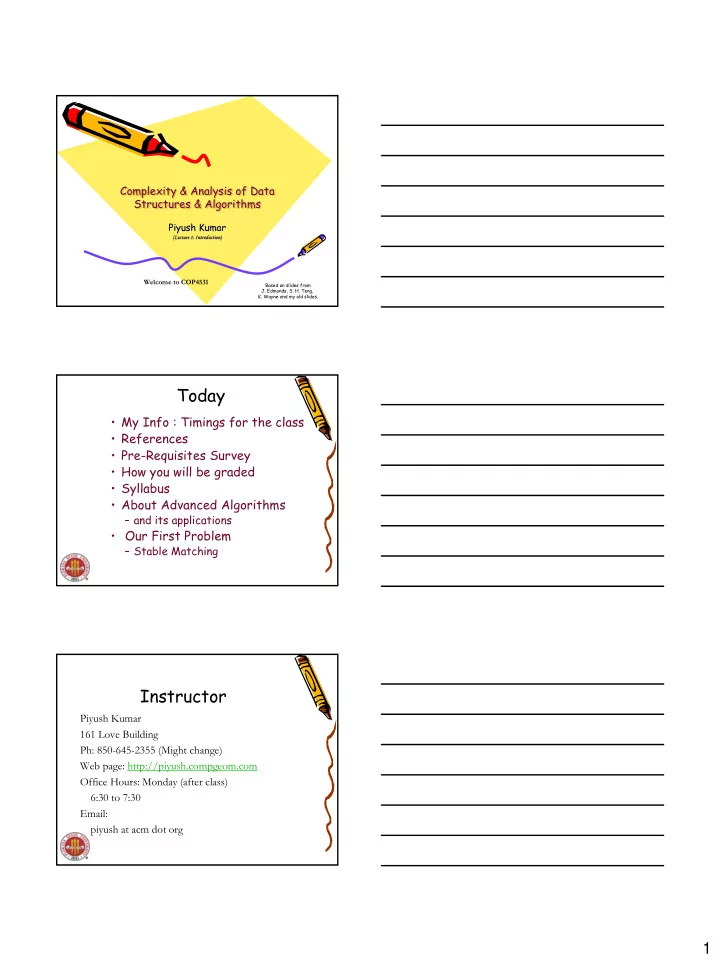
Today

  • My Info : Timings for the class
  • References
  • Pre-Requisites Survey
  • How you will be graded
  • Syllabus
  • About Advanced Algorithms

– and its applications

  • Our First Problem

– Stable Matching

Instructor

Piyush Kumar 161 Love Building Ph: 850-645-2355 (Might change) Web page: http://piyush.compgeom.com Office Hours: Monday (after class) 6:30 to 7:30 Email: piyush at acm dot org

slide-2
SLIDE 2

2

Class/Exam Timings

  • Timings

– Monday , Wednesday

  • ( 5:15pm – 6:30pm ) Love 0101
  • Midterm: 22nd Feb, Love 0101, Class Time
  • Final Exam

– Apr 26th, Wednesday, 5:30 to 7:30pm. – Love 0101

Other Details

  • Course web site:

– http://piyush.compgeom.com/teach/4531

  • Textbook.

References

  • Klienberg / Tardos

– Algorithm Design

  • Other References

– [CLRS] T. Cormen, C. Leiserson, R. Rivest, and C. Stein. Introduction to Algorithms (2nd edition). – My slides and notes

slide-3
SLIDE 3

3

PreReq

  • Data Structures
  • Introduction to Probability (STA 4442/STA 3032)
  • C++
  • Discrete Mathematics II (MAD 3105) or

– Mathematics in Computing (MAD 3107)

  • Basic Math skills
  • Lots of Time…
  • ToDo List:

– Get a LinProg Account – Get a copy of the text book.

PreReq

  • COP 4530 or higher

(What this class does not cover) – Linked Lists, Stacks. – Binary Trees, Heaps. – STL, containers/iterators. – Mathematical Induction. – Basic Probability/Expectations.

What can you expect?

  • After the course expect to

– Know more about algorithms (of course) – Think algorithmically – Know how to solve real world algorithmic problems

  • Both in theory (algorithm) and

practice (code)

– Be better at applications that require algorithms:

  • and apply algorithms to places you

never imagined…

slide-4
SLIDE 4

4

Grading*

  • Homework : 20%
  • Class Participation : 15%
  • Midterm : 20%
  • Final Exam : 30%
  • Programming Assignments : 15%

(two programming assignments) * Modified from original announcement.

Theory Real World

Grading*

  • Homework : 20%
  • Class Participation : 5%
  • Midterm : 15%
  • Final Exam : 25%
  • Programming Assignments : 5% (Only 1)
  • Course Project : 25%
  • Project Presentation : 5%

* Modified from original announcement. Theory Real World With Optional/Conditional Course Project Better for people who want to do graduate school/research

Designing Algorithms Designing Algorithms Designing Algorithms

How to do well in this class? How to do well in this class?

slide-5
SLIDE 5

5

Nope!

  • Study in Groups
  • Assignments are done in pairs
  • Best way to learn is to teach one another.

You are cool. Are you free sometime this weekend?

N O

I took the initiative and asked out a guy in my 4031 class.

Do not get answers from others. Do not do half the assignment and let ur partner do the other half Try all questionson your own. Discuss and write solutions together. Short solutions are better than longer ones! <Blah><Blah> Correct <Blah><Blah> Correct lines hidden in wrong lines are not correct.

Think before you write.

slide-6
SLIDE 6

6

What do you think about 4531?

  • The hardest class ever!
  • Got the worst midterm mark ever!
  • I almost gave up.
  • But, it opened the door to a new and

interesting world for me.

  • I learnt to see things abstractly from

different angles.

  • After working for a few years, I

realized that 4530 was the most useful course I took. What do you think about Piyush? Don’t get fooled into thinking that the material is easy. And he goes way too fast! His slides are great. They are much easier to understand than the text book for sure. It’s your job to ask questions and slow him down.

A few years from now.

May I have a letter of reference? Its awkward for me to write letters for people that I don’t recognize. Make yourself known to SOME professor. Email does not help as I am very bad at remembering names.

slide-7
SLIDE 7

7

Thinking about Algorithms Thinking about Thinking about Algorithms Algorithms Be Creative

  • Ask questions
  • Why is this done this way and not that

way?

  • Guess potential methods to solve the

problem

  • Look for counterexamples.
  • Start Day dreaming: Allow the essence of the

material to seep into your subconscious.

Your Goal

Computer Scientist Mundane Programmer

slide-8
SLIDE 8

8

Your Goal

Or a great leader and thinker.

Boss assigns task.

– Given today’s prices of pork, grain, sawdust, … – Given constraints on what constitutes a hotdog. – Make the cheapest hotdog

Everyday industry asks these questions.

Your Answer:

  • Tell me what to code.

With more suffocated software engineering systems, the demand for mundane programmers will diminish.

slide-9
SLIDE 9

9

Your Answer:

  • I learnt this great algorithm that

will work.

Soon all known algorithms will be available in libraries Soon all known algorithms will be available in libraries

Your answer:

  • I can develop a new algorithm for you.

Great thinkers will always be needed. Great thinkers will always be needed.

Course Content

  • A list of algorithms.

– Learn their code. – Trace them until you are convinced that they work. – Implement them. – Worry about details.

class InsertionSortAlgorithm : public SortAlgorithm { void sort(int a[]) { for (int i = 1; i < a.length; i++) { int j = i; int B = a[i]; while ((j > 0) && (a[j-1] > B)) { a[j] = a[j-1]; j--; } a[j] = B; }}

slide-10
SLIDE 10

10

Course Content

  • A survey of algorithmic design techniques.
  • Abstract thinking.
  • How to develop new algorithms for any problem that may arise.

Syllabus*

  • Asymptotic Analysis and Recursions
  • Graph Algorithms
  • Greedy Algorithms
  • Divide and Conquer
  • Dynamic Programming
  • Network Flows
  • Complexity Classes and Approximation Algorithms
  • Computational Geometry

* Tentative

Stable Marriage Stable Marriage Stable Marriage

Our first problem

Based on S. Rudich, S. H. Teng’s , K. Wayne and my own lecture slides.

slide-11
SLIDE 11

11

WARNING: This lecture contains mathematical content that may be shocking to some students.

The problem

  • There are n men and n women
  • Each man has a preference list, so does

the woman.

  • These lists have no ties.
  • Devise a system by which each of the n men

and n women can end up getting married.

Other Similar problems

  • Given a set of colleges and students pair
  • them. (Internship – Company assignments)
  • Given airlines and pilots, pair them.
  • Given two images, pair the points belonging

to the same point in 3D to extract depth from the two images.

  • Dorm room assignments.
  • Hospital residency assignments**.
  • Your first programming assignment…
slide-12
SLIDE 12

12

Stereo Matching

Fact: If one knows the distance between the cameras And the matching, its almost trivial to recover depth.. A similar Homework Problem Soon…

A Good matching/pairing

  • Maximize the number of people who

get their first match?

  • Maximize the av?
  • Maximize the minimum satisfaction?
  • Can anything go wrong?

Example Preference Lists

Z Y X Man A B A 1

st

B A B 2

nd

C C C 3

rd

C B A Woman X X Y 1

st

Y Y X 2

nd

Z Z Z 3

rd

What goes wrong? Unstable pairs: (X,C) and (B,Y) They prefer each other to current pairs.

slide-13
SLIDE 13

13

Stable Matching

Z Y X Man A B A 1

st

B A B 2

nd

C C C 3

rd

C B A Woman X X Y 1

st

Y Y X 2

nd

Z Z Z 3

rd

No Pairs creating instability.

Another Stable Matching

Z Y X Man A B A 1

st

B A B 2

nd

C C C 3

rd

C B A Woman X X Y 1

st

Y Y X 2

nd

Z Z Z 3

rd

Stability is Primary.

  • Any reasonable list of criteria must

contain the stability criterion.

  • A pairing is doomed if it contains a

shaky couple.

slide-14
SLIDE 14

14

Main Idea

Idea: Allow the pairs to keep Idea: Allow the pairs to keep breaking up and reforming until breaking up and reforming until they become stable they become stable

Can you argue that the couples will not continue breaking up and reforming forever?

Men Propose (Women dispose)

Gale-Shapley Algorithm (men propose)

Initialize each person to be free. while (some man m is free and hasn't proposed to every woman) w = first woman on m's list to whom m has not yet proposed if (w is free) assign m and w to be engaged else if (w prefers m to her fiancé m') assign m and w to be engaged, and m' to be free else w rejects m

Analysis

  • Does the algorithm terminate?
  • Running time?
  • Space requirement?
slide-15
SLIDE 15

15

Improvement Lemma

  • Improvement Lemma: If a woman has a

committed suitor, then she will always have someone at least as good, from that point in time onwards (and on the termination of the algorithm).

Corollary : Improvement Lemma

  • Each woman will marry her

absolute favorite of the men who proposed to her.

Demotion Lemma

  • The sequence of women to whom m

proposes gets worse and worse (in terms of his preference list)

slide-16
SLIDE 16

16

Lemma 1

  • No Man can be rejected by all the

Women.

  • Proof: ??

Suppose Bob is rejected by all the women. At that point: Each women must have a suitor other than Bob (By Improvement Lemma, once a woman has a suitor she will always have at least one) The n women have n suitors, Bob not among them. Thus, there must be at least n+1 men ! Contradiction

Corollary: Lemma 1

  • If m is free at some point in the

execution of the algorithm, then there is a woman to whom he has not yet proposed.

Corollary: Lemma 1

  • The algorithm returns a matching.

(Since no man is free?)

  • The algorithm returns a perfect
  • matching. (Since there is no free

man?)

slide-17
SLIDE 17

17

Lemma 2

  • Consider the execution of the G-S

algorithm that returns a set of pairs

  • S. The set S is a stable matching.
  • Proof?

Lemma 2

Proof by contradiction

Unstable pair : Bob and Mia

– This means Bob likes Mia more than his partner, Alice. – Thus, Bob proposed to Mia before he proposed to Alice. – Mia must have rejected Bob for someone she preferred. – By the Improvement lemma, she must like her parnter Luke Luke more than Bob.

Bob Bob Alice Alice Mia Mia Luke Luke

Question!

Who is better off, the men or the women?

slide-18
SLIDE 18

18

Best (Valid?) Parter for Bob?

  • Best woman for “Bob”?
  • The woman at the top of Bob’s list?

A woman w is a valid partner valid partner of a man m if there is a Stable matching that contains (m,w). A man’s optimal match or best valid partner best valid partner is the highest ranked woman for whom there is some stable pairing in which they are matched She is the best woman he can conceivably be matched in a stable world. Presumably, she might be better than the woman he gets matched to in the stable pairing output by GS.

Example

  • M { w, w’ }
  • M’ { w’ , w }
  • W { m’ , m }
  • W’ { m , m’ }

Two stable matchings: (m,w) (m’,w’) Or (m’,w) (m,w’)

Worst Valid Partner Match.

  • A Man’s worst valid partner is the

lowest ranked woman in his preference list that is a valid partner.

slide-19
SLIDE 19

19

Dating Dilemma

  • A pairing is man-optimal if every man gets

his best valid partner. This is the best of all possible stable worlds for every man simultaneously.

  • A pairing is man-pessimal if every man gets

his worst valid partner. This is the worst

  • f all possible stable worlds for every man

simultaneously.

Dating Dilemmas

  • A pairing is woman-optimal if every woman

gets her best valid partner. This is the best of all possible stable worlds for every woman simultaneously.

  • A pairing is woman-pessimal if every

woman gets her worst valid partner. This is the worst of all possible stable worlds for every woman simultaneously.

Question!

Who is better off, the men or the women?

slide-20
SLIDE 20

20

Mathematical FACT.

The traditional marriage algorithm (a.k.a. G-S alg.) always produces a man-optimal and woman-pessimal pairing.

Theorem 1: GS Produces man-optimal pairing. Theorem 2: GS produced pairing is woman-pessimal. Theorem 1 Proof by contradiction

  • Suppose not: That some man gets rejected by his

best valid partner during the execution of GS. (w.l.o.g. Let Bob be the first such man)

  • Bob gets rejected by his optimal match Mia who

says “maybe” to Luke (whom she prefers)

  • Since Bob was the only man to be rejected by his
  • ptimal match so far, Luke must like Mia at least

as much as his optimal match.

slide-21
SLIDE 21

21

We are assuming that Mia is Bob’s optimal match, Mia likes Luke more than Bob. Luke likes Mia at least as much as his optimal match.

  • We now show that any pairing S in which

Bob marries Mia cannot be stable (for a contradiction).

  • Suppose S is stable:

– Luke likes Mia more than his partner in S

  • Luke likes Mia at least as much as his best

match, but he is not matched to Mia in S – Mia likes Luke more than her partner Bob in S

Luke Luke Mia Mia Contradiction!

  • We’ve shown that any pairing in which Bob

marries Mia cannot be stable.

– Thus, Mia cannot be Bob’s optimal match (since he can never marry her in a stable world). – So Bob never gets rejected by his optimal match in GS, and thus GS is man-optimal. We are assuming that Mia is Bob’s optimal match, Mia likes Luke more than Bob. Luke likes Mia at least as much as his optimal match.

GS is woman-pessimal

  • We know it is man-optimal. Suppose there is a GS

stable pairing S* with (Luke, Alice) such that Luke is not the worst valid partner of Alice.

  • Let Bob be Alice’s worst valid partner.
  • Then there is a stable matching S with (Bob,Alice)
  • Contradiction: S is not stable.

– By assumption, Alice likes Luke better than her partner Bob in S – Luke likes Alice better than his partner in S

  • We already know that Alice is his optimal match !

Luke Luke Alice Alice Contradiction!

slide-22
SLIDE 22

22

Conclusions Conclusions Conclusions

☺ ☺

Marry Well! Advice to females

  • Learn to make the first move.
slide-23
SLIDE 23

23 REFERENCES

  • D. Gale and L. S. Shapley, College

admissions and the stability of marriage, American Mathematical Monthly 69 (1962), 9-15

  • Dan Gusfield and Robert W. Irving, The

Stable Marriage Problem: Structures and Algorithms, MIT Press, 1989