Today CE 473: Artificial Intelligence Autumn 2017 A* Search A* - - PDF document

today ce 473 artificial intelligence autumn 2017
SMART_READER_LITE
LIVE PREVIEW

Today CE 473: Artificial Intelligence Autumn 2017 A* Search A* - - PDF document

10/2/17 Today CE 473: Artificial Intelligence Autumn 2017 A* Search A* Search Heuristic Design Graph search Dieter Fox Based on slides from Pieter Abbeel & Dan Klein Multiple slides from Stuart Russell, Andrew Moore, Luke


slide-1
SLIDE 1

10/2/17 1

CE 473: Artificial Intelligence Autumn 2017

A* Search

Dieter Fox

Based on slides from Pieter Abbeel & Dan Klein Multiple slides from Stuart Russell, Andrew Moore, Luke Zettlemoyer

Today

§ A* Search § Heuristic Design § Graph search

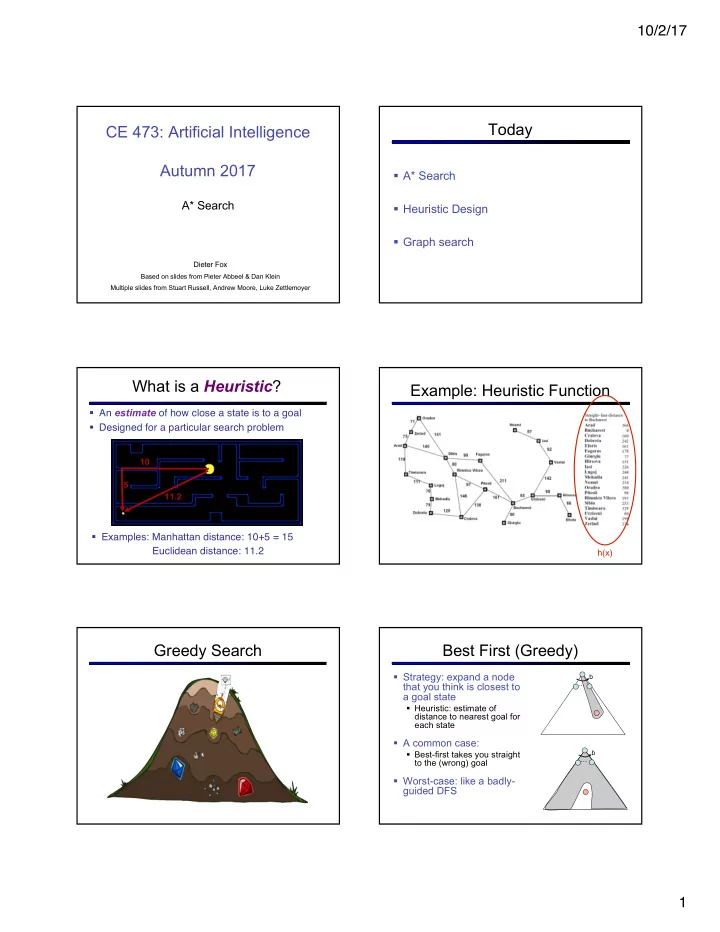
What is a Heuristic?

§ An estimate of how close a state is to a goal § Designed for a particular search problem

10 5 11.2

§ Examples: Manhattan distance: 10+5 = 15 Euclidean distance: 11.2

Example: Heuristic Function

h(x)

Greedy Search Best First (Greedy)

§ Strategy: expand a node that you think is closest to a goal state

§ Heuristic: estimate of distance to nearest goal for each state

§ A common case:

§ Best-first takes you straight to the (wrong) goal

§ Worst-case: like a badly- guided DFS

… b … b

slide-2
SLIDE 2

10/2/17 2

Greedy Search

§ Expand the node that seems closest… § What can go wrong?

A* Search Combining UCS and Greedy

§ Uniform-cost orders by path cost, or backward cost g(n) § Greedy orders by goal proximity, or forward cost h(n) § A* Search orders by the sum: f(n) = g(n) + h(n)

S a d b G h=5 h=6 h=2 1 8 1 1 2 h=6 h=0 c h=7 3 e h=1 1

Example: Teg Grenager

S a b c e d d G G g = 0 h=6 g = 1 h=5 g = 2 h=6 g = 3 h=7

g = 4 h=2 g = 6 h=0 g = 9 h=1 g = 10 h=2 g = 12 h=0

§ Should we stop when we enqueue a goal?

When should A* terminate?

S B A G 2 3 2 2

h = 1 h = 2 h = 0 h = 3

§ No: only stop when we dequeue a goal

Is A* Optimal?

A G S 1 3

h = 6 h = 0

5

h = 7

§ What went wrong? § Actual bad goal cost < estimated good path cost § We need estimates to be less than or equal to actual costs!

Admissible Heuristics

§ A heuristic h is admissible (optimistic) if: where is the true cost to a nearest goal § Example: § Coming up with admissible heuristics is most of what’s involved in using A* in practice.

15

slide-3
SLIDE 3

10/2/17 3

Optimality of A* Tree Search

Assume: § A is an optimal goal node § B is a suboptimal goal node § h is admissible Claim: § A will exit the fringe before B

Optimality of A* Tree Search

Proof: § Imagine B is on the fringe § Some ancestor n of A is on the fringe, too (maybe A!) § Claim: n will be expanded before B

  • 1. f(n) is less or equal to f(A)

Definition of f-cost Admissibility of h

h = 0 at a goal

Optimality of A* Tree Search

Proof: § Imagine B is on the fringe § Some ancestor n of A is on the fringe, too (maybe A!) § Claim: n will be expanded before B

  • 1. f(n) is less or equal to f(A)
  • 2. f(A) is less than f(B)

B is suboptimal h = 0 at a goal

Optimality of A* Tree Search

Proof: § Imagine B is on the fringe § Some ancestor n of A is on the fringe, too (maybe A!) § Claim: n will be expanded before B

  • 1. f(n) is less or equal to f(A)
  • 2. f(A) is less than f(B)

3. n expands before B § All ancestors of A expand before B

[since n will put the next node n’ toward A on the fringe; repeat claim for n’ until you hit A]

§ A expands before B § A* search is optimal

UCS vs A* Contours

§ Uniform-cost expanded in all directions § A* expands mainly toward the goal, but hedges its bets to ensure optimality

Start Goal Start Goal

Which Algorithm?

§ Uniform cost search (UCS):

slide-4
SLIDE 4

10/2/17 4

Which Algorithm?

§ A*, Manhattan Heuristic:

Which Algorithm?

§ Best First / Greedy, Manhattan Heuristic:

Creating Admissible Heuristics

§ Most of the work in solving hard search problems

  • ptimally is in coming up with admissible heuristics

§ Often, admissible heuristics are solutions to relaxed problems, where new actions are available § Inadmissible heuristics are often useful too

15

366

Creating Heuristics

§ What are the states? § How many states? § What are the actions? § What states can I reach from the start state? § What should the costs be?

8-puzzle:

8 Puzzle I

§ Heuristic: Number of tiles misplaced § h(start) = 8

Average nodes expanded when

  • ptimal path has length…

…4 steps …8 steps …12 steps

UCS 112 6,300 3.6 x 10⁶

TILES

13 39 227

§ Is it admissible?

8 Puzzle II

§ What if we had an easier 8- puzzle where any tile could slide any direction at any time, ignoring other tiles? § Total Manhattan distance § h(start) = 3 + 1 + 2 + … = 18

Average nodes expanded when

  • ptimal path has length…

…4 steps …8 steps …12 steps TILES

13 39 227

MANHATTAN 12

25 73

§ Admissible?

slide-5
SLIDE 5

10/2/17 5

8 Puzzle III

§ How about using the actual cost as a heuristic?

§ Would it be admissible? § Would we save on nodes expanded? § What’s wrong with it?

§ With A*: a trade-off between quality of estimate and work per node!

Trivial Heuristics, Dominance

§ Dominance: ha ≥ hc if § Heuristics form a semi-lattice:

§ Max of admissible heuristics is admissible

§ Trivial heuristics

§ Bottom of lattice is the zero heuristic (what does this give us?) § Top of lattice is the exact heuristic

A* Applications

§ Pathing / routing problems § Resource planning problems § Robot motion planning § Language analysis § Machine translation § Speech recognition § …

Tree Search: Extra Work!

§ Failure to detect repeated states can cause exponentially more work. Why?

Graph Search

§ In BFS, for example, we shouldn’t bother expanding some nodes (which, and why?)

S

a b d p a c e p h f r q q c

G

a q e p h f r q q c

G

a

Graph Search

§ Idea: never expand a state twice § How to implement:

§ Tree search + set of expanded states (“closed set”) § Expand the search tree node-by-node, but… § Before expanding a node, check to make sure its state has never been expanded before § If not new, skip it, if new add to closed set

§ Hint: in python, store the closed set as a set, not a list § Can graph search wreck completeness? Why/why not? § How about optimality?

slide-6
SLIDE 6

10/2/17 6

A* Graph Search Gone Wrong

S A B C G 1 1 1 2 3 h=2 h=1 h=4 h=1 h=0 S (0+2) A (1+4) B (1+1) C (2+1) G (5+0) C (3+1) G (6+0) S A B C G State space graph Search tree

Consistency of Heuristics

§ Main idea: estimated heuristic costs ≤ actual costs

§ Admissibility: heuristic cost ≤ actual cost to goal h(A) ≤ actual cost from A to G § Consistency: heuristic “arc” cost ≤ actual cost for each arc h(A) – h(C) ≤ cost(A to C)

§ Consequences of consistency:

§ The f value along a path never decreases h(A) ≤ cost(A to C) + h(C) f(A) = g(A) + h(A) ≤ g(A) + cost(A to C) + h(C) = f(C) § A* graph search is optimal

3

A C G

h=4 h=1 1 h=2 h=3

Optimality of A* Graph Search

§ Sketch: consider what A* does with a consistent heuristic:

§ Nodes are popped with non-decreasing f- scores: for all n, n’ with n’ popped after n : f(n’) ≥ f(n)

§ Proof by induction: (1) always pop the lowest f- score from the fringe, (2) all new nodes have larger (or equal) scores, (3) add them to the fringe, (4) repeat!

§ For every state s, nodes that reach s

  • ptimally are expanded before nodes that

reach s sub-optimally § Result: A* graph search is optimal

… f ≤ 3 f ≤ 2 f ≤ 1

Optimality

§ Tree search:

§ A* optimal if heuristic is admissible (and non-negative) § UCS is a special case (h = 0)

§ Graph search:

§ A* optimal if heuristic is consistent § UCS optimal (h = 0 is consistent)

§ Consistency implies admissibility § In general, natural admissible heuristics tend to be consistent, especially if from relaxed problems

Summary: A*

§ A* uses both backward costs and (estimates of) forward costs § A* is optimal with admissible / consistent heuristics § Heuristic design is key: often use relaxed problems