To use any of these reasons in a proof, you must have already stated - - PowerPoint PPT Presentation

to use any of these reasons in a proof you must have
SMART_READER_LITE
LIVE PREVIEW

To use any of these reasons in a proof, you must have already stated - - PowerPoint PPT Presentation

Review : If two parallel lines are cut by a transversal, then corresponding angles are congruent. If two parallel lines are cut by a transversal, then alternate interior angles are congruent. If two parallel lines are cut by a transversal,


slide-1
SLIDE 1

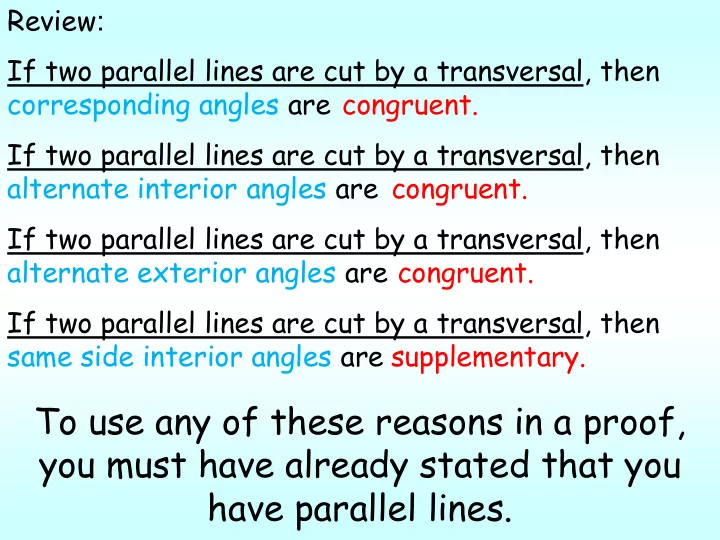
Review: If two parallel lines are cut by a transversal, then corresponding angles are If two parallel lines are cut by a transversal, then alternate interior angles are If two parallel lines are cut by a transversal, then alternate exterior angles are If two parallel lines are cut by a transversal, then same side interior angles are

To use any of these reasons in a proof, you must have already stated that you have parallel lines.

congruent. congruent. congruent. supplementary.

slide-2
SLIDE 2

Postulate

If two lines are cut by a transversal and the corresponding angles are congruent, then the two lines are parallel.

1 2

m n t

slide-3
SLIDE 3

Theorem

If two lines are cut by a transversal and the alternate interior/exterior angles are congruent, then the two lines are parallel.

1 2 3 4 5 6 7 8

m n t

slide-4
SLIDE 4

Theorem - Proof

1 2 3 4

Given: Transversal t cuts m and n; 1 @ 2 Prove: m //n

  • 1. 1 @ 2
  • 1. Given

5 6 7 8

  • 2. 6 @ 2
  • 2. Vertical angles are congruent
  • 3. 6 @ 1
  • 3. Substitution
  • 4. m // n
  • 4. If two lines are cut by a transversal

and corresponding angles are congruent then lines are parallel. m n t

slide-5
SLIDE 5

Theorem

If two lines are cut by a transversal and the same side interior angles are supplementary, then the two lines are parallel.

1 2 3 4 7 8 5 6

m n t

slide-6
SLIDE 6

Theorem - Proof

1 2 3 4

Given: Transversal t cuts m and n; 1 & 5 are supplementary. Prove: m //n

  • 1. 1 & 5 are supplementary 1. Given

5 6 7 8

  • 2. m1 + m5 = 180
  • 2. Definition of supplementary angles
  • 3. m5 + m2 = 180
  • 3. Angle Addition Postulate
  • 6. m // n
  • 4. Substitution
  • 4. m5 + m2 = m1 + m5
  • 5. m2 = m1
  • 5. Subtraction
  • 6. If two lines are cut by a transversal and the

alternate interior angles are congruent then the lines are parallel.

m n t

slide-7
SLIDE 7

Theorem

In a plane two lines perpendicular to the same line are parallel.

k n t

slide-8
SLIDE 8

Theorem - Proof

2 Given: k ^ t; n ^ t Prove: k //n

  • 1. k ^ t
  • 1. Given

5

  • 2. 5 is a right angle.
  • 2. Definition of perpendicular lines.
  • 4. n ^ t
  • 4. Given
  • 8. k // n
  • 5. Definition of perpendicular lines.
  • 6. m2 = 90
  • 7. m2 = m5
  • 7. Substitution
  • 8. If two lines are cut by a

transversal and the corresponding angles are congruent, then the lines are parallel. k n t

  • 3. m5 = 90
  • 5. 2 is a right angle.
  • 3. Definition of a right angle.
  • 6. Definition of a right angle.
slide-9
SLIDE 9

Theorem

Through a point outside a line, there is exactly one line parallel to the given line.

slide-10
SLIDE 10

Theorem

Through a point outside a line, there is exactly one line perpendicular to the given line.

slide-11
SLIDE 11

Theorem

Two lines parallel to a third line are parallel to each other. If a // c and b // c, then a // b. a b c

slide-12
SLIDE 12

Recap – 5 Ways to Prove Lines are Parallel

  • 1. If two lines are cut by a transversal and

CORRESPONDING ANGLES ARE CONGRUENT, then lines are parallel.

  • 2. If two lines are cut by a transversal and

ALTERNATE INTERIOR/EXTERIOR ANGLES ARE CONGRUENT, then the lines are parallel.

  • 3. If two lines are cut by a transversal and SAME

SIDE INTERIOR/EXTERIOR ANGLES ARE SUPPLEMENTARY then the lines are parallel.

  • 4. If two lines are PERPENDICULAR TO A THIRD

LINE, then the lines are parallel.

  • 5. If two lines are PARALLEL TO A THIRD LINE,

then the lines are parallel.

slide-13
SLIDE 13

Practice: What two lines are parallel (if any) according to the given information? m n j k l 1 2 3 4 5 6 7 9 8

  • 5. m1 = m7
  • 6. m8 + m2 + m3 = 180°
  • 7. m7 = m4
  • 8. m2 + m3 = 180°
  • 1. m1 = m4
  • 2. m5 + m6 = 180°
  • 3. m8 = m1
  • 4. m5 + m4 = 180°

l // m j // k j // k None None j // k l // m None

  • 9. m6 + m4 = 180

None