
SLIDE 1
IAEA
International Atomic Energy Agency
to the environment Juan C. Mora IAEA International Atomic Energy - - PowerPoint PPT Presentation
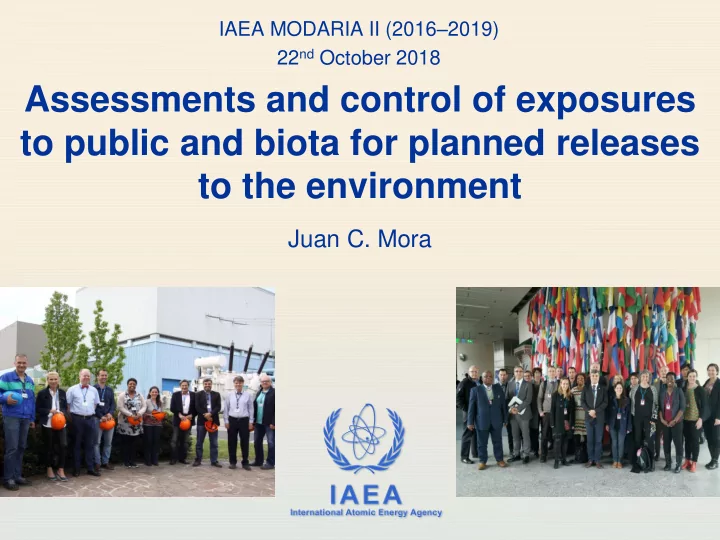
IAEA MODARIA II (2016 2019) 22 nd October 2018 Assessments and control of exposures to public and biota for planned releases to the environment Juan C. Mora IAEA International Atomic Energy Agency Problem The paradigm the
International Atomic Energy Agency
1.
Methodology for biota impact assessments (Valeria Amado).
2.
Identify practical international and national guidance for the demonstration of the compliance with requirements for the protection of the environment against ionizing radiations (Stephanie Bush- Goddard + Maria Psaltaki).
3.
Identify state of the art tools, sources of data and methods for performing dose assessments in routine radioactive discharges which can be used in integrated assessments of the humans and the biota, including uncertainties (Justin Smith).
4.
Study, Validate and Incorporate H3 and C14 state of the art models (Volodymyr Korolevych + Nana Kwamena)
5.
Identify a set of cases and scenarios where explicit assessment of the environment would be necessary (Iuri Bonchuk).
6.
Carry out dose assessments for humans and the biota in those scenarios with associated uncertainty analysis (Benjamin Zorko).
7.
Studies to evaluate if generic organisms are enough to demonstrate that the environment is protected in a dose assessment for routine release (Benoit Charrasse + Amanda Andersson)
8.
Communication with stakeholders (Cecile Boyer + Elisabeth Leclerc)
9.
Evaluate and compare models, approaches, parameters and other characteristics used in the assessments (Benjamin Zorko + JC Mora).
10.
Discuss the results and give advice to the IAEA on needs and gaps (JC Mora).
User Tool 1 Availabili ty Human dose Biota dose rate Atmospheric Lake River Estuary Marine Same dispersion models 2 Same activity concentrations 3 ICRP RAPs
Are ref levels/crit eria for humans
biota included? Com ment s CIEMAT CROM 8 ✓ ✓ ✓ ✓ ✓ ✓ ✓ ✓ X X X ABmerit (Slovak Republic) ESTE ✓ ✓ ✓ ✓ ✓ X ✓ ✓ ✓ ✓ X IRSN/EDF (France) SYMBIOS E ✓ planned ✓ planned ✓ X ✓ ? ? ? X PHE (UK) PC- CREAM ✓ planned ✓ X ✓ X ✓ planned X ✓ X Andra (France) ARIA Impact ✓ X ✓ X X X X n/a n/a n/a X Andra MOM ✓ X X X ✓ X X n/a n/a n/a X CEA (France) CERES ✓ X ✓ ✓ ✓ X X X X n/a X ERICA / SRS19 X ✓ ✓ ✓ ✓ X ✓ X ✓ Korean codes KDOSE60 (based
USNRC 1.109) ENDOS INDAC 2.0 ✓ X ✓ ? ✓ ? ✓ X X n/a X K-BIOTA V3.0 4 X ✓ X X X X X X X BARC (India) Based in part
SRS19 ✓ X ✓ X ✓ X ✓ n/a n/a n/a X
Installation Providing the data To provide Dose assessments Name Type For Humans For Biota Chinon NPP EDF+IRSN ARN (VA) CIEMAT (JCM) EDF+IRSN (CM) ESTE AI (PC) PHE (JS) CEA (BC) CLRP (PK) Iurii Bonchuk (Ukraine) ARN (VA) CIEMAT (JCM) ESTE AI (PC) EDF+IRSN (CM) PHE (JS) CEA(BC) Iurii Bonchuk (Ukraine) USA Millstone NPP USNRC+DoE (SBG & AA) Iurii Bonchuk (Ukraine) DoE+USNRC+ANL (SBG, AA & CY) Mr Gu (China) Iurii Bonchuk (Ukraine) DoE+USNRC+ANL (SBG, AA & CY) Mr Gu (China) L'Aube LILW Surface Repository ANDRA (EL) ANDRA+CEA (EL & BC) ARN+CIEMAT (VA & JCM) PHE (JS) ANDRA+CEA (EL & BC) ARN+CIEMAT (VA & JCM) PHE (JS) Cadarache Labs Large Research Laboratory CEA (BC) Mr Gu (China) CLRP (PK) ESTE-AI PHE EDF+IRSN CEA (BC) Iurii Bonchuk (Ukraine) Mr Gu (China) CLRP (PK) ESTE-AI PHE EDF+IRSN CEA (BC) Iurii Bonchuk (Ukraine) La Hague Spent Nuclear Fuel Reprocessing Plant ANDRA (EL) ARN+CIEMAT+SJI (VA, JCM and BZ) PHE (JS) ANDRA (EL) CEA (BC) ARN+CIEMAT+SJI (VA, JCM and BZ) PHE (JS) ANDRA (EL) CEA (BC) Atucha NPP, Heavy water reactor NRA (VA)
Name of the modeler
Institution ABmerit s.r.o. (Ltd), Slovakia For Human For Biota Model used for the atmospheric dispersion Lagrangian puff trajectory model (PTM), software: ESTE AI. Lagrangian puff trajectory model (PTM), software: ESTE AI. Model used for the liquid dispersion Compartment model, software: ESTE AI. Compartment model, software: ESTE AI.
Model Name(s) for Dose calculation ESTE Limit value used (>0) : Unit of the dose calculated mSv Type of dose calculation (Deterministic/Probabilistic) Deterministic + module for uncertainty analyses Reference area (km x km) Area with radius of 10 km.
Dose due to the Atmospheric release
Exposure Pathways considered Yes / no The average dose to the representative person calculated due to the exposure pathway with respect to the reference area Major nuclides Internal pathway Ingestion of terrestrial foods Yes 1.2E-03 ± 2.00E-04 H3(99%) Inhalation of plume Yes 7.9E-03 ± H3(99%) Inhalation of resuspended material No ± Ingestion of water (contamination from atmospheric deposit) No ± Skin dose (case of tritium) No ± Accidentelly ingested material No ± Model Name(s) for Dose Rate calculation ESTE What is the methodology you are using for the evaluation of the biota (national law, DS472, NUREG…) DS472, ICRP108 Unit of the Dose rate calculated mGy/d Type of dose calculation (Deterministic/Probabilistic) Deterministic Reference area (km x km) Area with radius of 10 km. Organisms considered (RAP, surrogate
and flora The average internal dose rate to the RO/RAP calculated with respect to the reference area Average / max Dose rate for External pathway for RO/RAP calculated with respect to the reference area Average Total Dose rate Reference dose rate (mGy/d) (ICRP 108 and DS427) - upper value of the band where very low probability of effects is expected (ICRP 108) Risk index External cloud shine External ground shine Amphibian 8.0E-06 ± ± 1.7E-12 ± 8.0E-06 ± 10 8.0E-07 ± Bird 8.0E-06 ± ± 3.2E-12 ± 8.0E-06 ± 1 8.0E-06 ± Mollusc-gastropod ± ± ± ± 10 ± reptile ± ± ± ± 1 ± Annelid - earthworm 1.6E-05 ± ± 8.2E-12 ± 1.6E-05 ± 100 1.6E-07 ±