environment Pippa Chapman School of Geography FACULTY OF - - PowerPoint PPT Presentation

environment
SMART_READER_LITE
LIVE PREVIEW

environment Pippa Chapman School of Geography FACULTY OF - - PowerPoint PPT Presentation

School of something School of Geography FACULTY OF OTHER FACULTY OF ENVIRONMENT Impact of peatland restoration on water colour in a changing environment Pippa Chapman School of Geography FACULTY OF ENVIRONMENT Structure of presentation


slide-1
SLIDE 1

School of something

FACULTY OF OTHER

School of Geography

FACULTY OF ENVIRONMENT
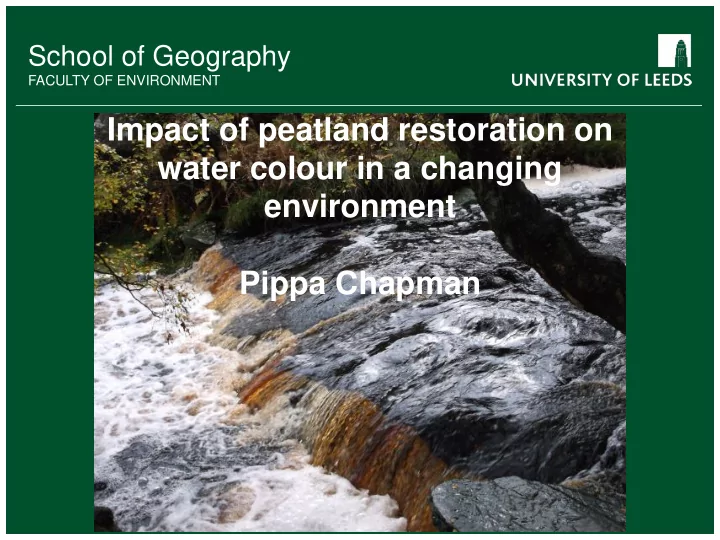
Impact of peatland restoration on water colour in a changing environment Pippa Chapman

slide-2
SLIDE 2

School of Geography

FACULTY OF ENVIRONMENT

Structure of presentation

  • Peatlands and regulation of water quality
  • How water colour has changed over last 30 years
  • Why water colour is an issue
  • Impact of peatland restoration on water colour versus other

environmental changes in the UK uplands

  • Conclusion
slide-3
SLIDE 3

School of Geography

FACULTY OF ENVIRONMENT

Characteristics of water draining peatlands:

  • Low ionic strength - due to low solute concentrations
  • Acidic – low pH
  • Oligotrophic - low nitrogen and phosphorus concentrations
  • Coloured due to the presence of dissolved organic carbon (DOC)

Precipitation = main input of water and solutes

slide-4
SLIDE 4

School of Geography

FACULTY OF ENVIRONMENT

Ecosystem services of peatlands with regard to regulating water quality

1. In the UK 11.4 million people rely on peatlands for their drinking water 2. Source of potable water due to

  • High rainfall amount
  • Low evapotranspiration
  • Remote location
  • Low intensity land use
  • High water quality
  • 3. Peat retains pollutants
  • 4. Source of dilute water: can be

used to dilute pollutants in other water sources

slide-5
SLIDE 5

School of Geography

FACULTY OF ENVIRONMENT

Water picks up colour (dissolved organic carbon) as it passes through the peat Water treatment removes colour so that customers receive a colourless water

slide-6
SLIDE 6

School of Geography

FACULTY OF ENVIRONMENT

Water colour has increased over 20 years

Trend in colour at Water Treatment Works in the southern Pennines

slide-7
SLIDE 7

School of Geography

FACULTY OF ENVIRONMENT

Environmental Implications of increasing water colour

  • Depletion of terrestrial carbon stores, increasing fluxes into more

reactive pools (riverine, marine and ultimately atmospheric).

  • Impact for water treatment works (increased cost) and potential

effects on drinking water quality (production of carcinogenic disinfection by-prodcuts).

  • Local effects on water quality: Water transparency; water

temperature, acidity; heavy metals; ecology.

slide-8
SLIDE 8

School of Geography

FACULTY OF ENVIRONMENT

Why has water colour increased?

Sulphate (mg/L)

4 6 8 10 12 14 16

DOC (mg/L)

2 4 6 8 10 12 14 16

Decline in Acid Rain Carbon more soluble as acidity declines

slide-9
SLIDE 9

School of Geography

FACULTY OF ENVIRONMENT

Can peatland restoration help?

  • YES but often hard to detect from sampling stream water alone

due to seasonal trend and long term trend

slide-10
SLIDE 10

School of Geography

FACULTY OF ENVIRONMENT

Influence of water-table position

High water table Low water table

Anaerobic (no oxygen) Aerobic (oxygen) DOC µg/g soil/day 0.52 1.98 DOC Q10 1.84 3.53

Less colour produced More colour produced

Clark et al., 2009. Global Change Biology

slide-11
SLIDE 11

School of Geography

FACULTY OF ENVIRONMENT

Drainage and water colour/DOC

Wallage et al., 2006. Science of the Total Environment.

slide-12
SLIDE 12

School of Geography

FACULTY OF ENVIRONMENT

Impact of drain-blocking on water colour

  • Many studies observed an

increase in colour shortly after blocking (e.g. Worrall et al. 2007).

  • Large study showed that

blocking generally reduced colour (Armstrong et al., 2010). But not always - Impact of local conditions

  • Re-vegetation of gullies reduces

loss of peat to freshwaters

slide-13
SLIDE 13

School of Geography

FACULTY OF ENVIRONMENT

Re-vegetation of bare peat at Bleaklow

DOC flux t C km-2 yr-1 Bare peat 34.4 – 72.1 Restored 13.1 – 57.7 Vegetated 13.0 – 95.6 Worrall et al. (2011) More peat and colour lost from bare peat less peat and colour lost from vegetated peat

slide-14
SLIDE 14

School of Geography

FACULTY OF ENVIRONMENT

Heather Burning and DOC

Yallop & Clutterbuck, 2009. Science of the Total Environment

However, plot scale experiments have not observed an increase in soil solution DOC following burning

(e.g. Clay et al., 2009; 2010).

slide-15
SLIDE 15

School of something

FACULTY OF OTHER

School of Geography

FACULTY OF ENVIRONMENT

How will water colour change in the future?

slide-16
SLIDE 16

School of Geography

FACULTY OF ENVIRONMENT

Climate Change Air Pollution Land Use Change & Peatland Restoration Surface Water Chemistry

slide-17
SLIDE 17

School of Geography

FACULTY OF ENVIRONMENT

Water colour over next 10 years

  • 2
  • 1.5
  • 1
  • 0.5

0.5 1 1.5 2 1980 1985 1990 1995 2000 2005 2010 2015 2020 2025 2030 2035

Z-score (colour)

  • bserved

Modelled 100yr_rf-sum 50yr_rf-sum 10yr_rf-sum 2yr_rf-sum

1 in 2-year 1 in 10-year 1 in 50-year 1 in 100-year

Major impact of recovery from acid rain has happened Climate change and land use change/restoration will have more influence

slide-18
SLIDE 18

School of Geography

FACULTY OF ENVIRONMENT

A restored peatland is more resilient to climate change Any Questions?

slide-19
SLIDE 19

School of Geography

FACULTY OF ENVIRONMENT

Acknowledgments

  • Yorkshire Water – data and funding for research
  • UK Uplands Water Monitoring Network – River Etherow

data

  • Sheila Palmer, Brian Irvine, Joseph Holden