
SLIDE 1
To Get Lost is to Learn the Way
- Dr. Sainey Faye
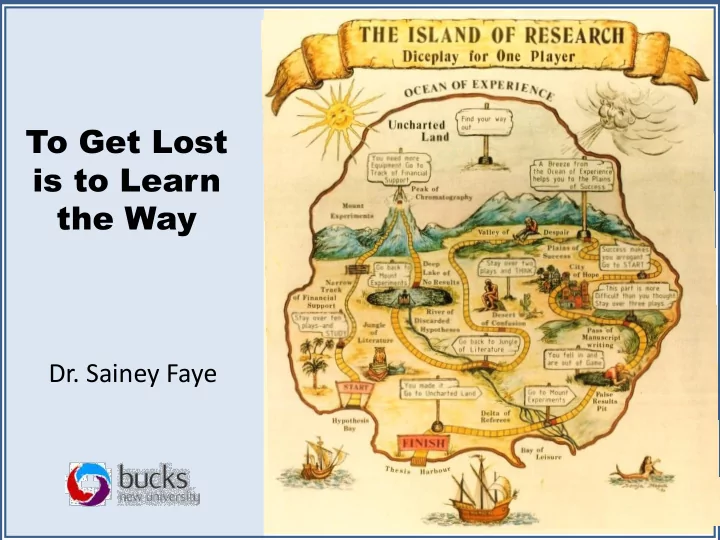
To Get Lost is to Learn the Way Dr. Sainey Faye TO GET LOST IS TO - - PowerPoint PPT Presentation
To Get Lost is to Learn the Way Dr. Sainey Faye TO GET LOST IS TO LEARN THE WAY ( African proverb ): This saying certainly applies to our experiences of our research journeys on The Island of Research . Id like to share some of
To Get Lost is to Learn the Way
2
‘TO GET LOST IS TO LEARN THE WAY’
(African proverb):
This saying certainly applies to our experiences of our research journeys on ‘The Island of Research’ .
I’d like to share some of the insights of research journey on my doctoral thesis: An Examination and Analysis of Bank Corporate Governance Regulation in The Gambia
Overview
3
Focus will be on: 1. The challenges faced when investigating an area where there is lack of literature 2. The grounded theory approach – demystifying it, the rationale for using it and the effort required in using it. Was it worthwhile?
About The Gambia
4 Master Sainey Faye 11 Mungo Avenue Banjul Zambia Master Sainey Faye 11 Mungo Avenue Banjul THE Gambia Sent to Zambia (Gambia not so well known) The Gambia
5
THE GAMBIA
A West African country of 2 million souls
6
7
8
Reasons for the lack of literature Theory and models less scarce but generated in developed countries. Use of parallel literature
9 Using this to draw conclusions about Corporate Governance in The Gambia inevitably invites ecological fallacies – problems with generalisation.
The he Gambia ambia
Some Characteristics of The Gambia Shared with other countries Africa West Africa Sub-Saharan Africa Developing Country Legacy of colonial rule by British Islamic Banking and Finance Small economy
Parallel literature and literature at a higher level
10
https://www.afcgn.org/wp-content/uploads/2016/03/ACGN- Corporate-Governance-Report-Feb-2016.pdf
Covers Corporate Governance in General rather than focus on Regulation of it in the Banking & Finance sector Gambia not one of the 13 countries The majority of research is conducted on countries such as on Nigeria (100 x the population of The Gambia), South Africa, Egypt, Morocco, and Kenya All Very different countries from the Gambia.
Example of the problem
11
The Gambia and Africa
The Gambia How much can conclusions about Africa be applied to The Gambia if they are based on studies Egypt, South Africa, The Congo and Nigeria? Ecological fallacy is a real danger. 200 miles
12
13 Not this:
…but this:
14
Grounded Theory
a general method.
research.
emergence of conceptual categories and theories. Corbin and Strauss
15
GTA Coding Coding Procedures
Open Coding Axial Coding Selective Coding
Selective coding is the process by which all categories are unified around a core category The process of breaking down, examining, comparing, and conceptualising, and categorising data. Involves re-building the data (fractured through open coding) in new ways by establishing relationships between
Enables this research to bring the analysis together, to form a whole. The process of breaking down, examining, comparing, and conceptualising, and categorising data.
16
I. I. Ope Open n Cod Coding ing
The process of breaking down, examining, comparing, and conceptualising, and categorising data.
Results of my open coding:
17
Open Deriving Axial Categories from Open Categories
Open Axial
18
II III.
SELE ELECTIVE CTIVE CODING CODING
It is not until the major categories are finally integrated to form a larger theoretical scheme that the research findings take the form of theory” (Strauss and Corbin, 1998, p.143). Revalida validation and v tion and verifica erification tion Strauss and Corbin (1990, p.116) defined selective coding as “the process of selecting the core category, systematically relating it to the other categories, validating those relationships…the core category is the central phenomenon around which all the other categories are integrated”. This requires further data collection – semi-structured interview of a smaller purposive sample regarding the results of the axial coding
19
PR PRODU ODUCING CING A A GR GROUN OUNDE DED D THE THEOR ORY
There are times when, either through preference or because the analyst is more of a visual person, diagrams are more useful than storytelling for sorting out the relationships amongst concepts.
Strauss and Corbin (1998, p.153)
20
THE HUMAN FACTOR MODEL
21 Ecological validity: Ecological validity is the extent to which research findings accurately represent real-world settings. Grounded theories are usually ecologically valid because the theory is grounded in the data. They are context- specific, detailed, and tightly connected to the data. Novelty: Because grounded theories are not tied to any pre-existing theory, grounded theories are often fresh and new and have the potential for innovative discoveries in science and other areas. Parsimony: Grounded theories aim to provide practical and simple explanations about complex phenomena by converting them into abstract constructs and hypothesizing their relationships. They offer helpful and relatively easy-to-remember layouts for us to understand our world a little bit better. Grounded theory has further significance because: 1.It provides explicit, sequential guidelines for conducting qualitative research. 2.It streamlines and integrates data collection and analysis and 3.It legitimizes qualitative research as scientific inquiry. Grounded theory methods have earned their place as a standard social research method and have influenced researchers from varied disciplines and professions.
22
PERSONAL ASSESSMENT OF GTA
Some of the viva panel were not familiar with the grounded theory approach Originality /Novelty: GTs are not tied to any pre-existing theory I didn’t have to spend so much time having to do a literature review at the beginning… Ecological Validity .
settings.
established.
(since their goal is to explain other similar phenomenon), they are context-specific, detailed, and tightly connected to the data
23
Result of my research
24
It is one of the more time consuming methodologies. Made worse for me by my deliberate decision not to utilise Nvivo software to analyse the data. But once done it was worth it! Thank you all for coming! Over to you Sam