To Be a Boy, To Be a Reader: Engaging Teen and - - PowerPoint PPT Presentation

to be a boy to be a reader engaging teen and preteen boys
SMART_READER_LITE
LIVE PREVIEW

To Be a Boy, To Be a Reader: Engaging Teen and - - PowerPoint PPT Presentation

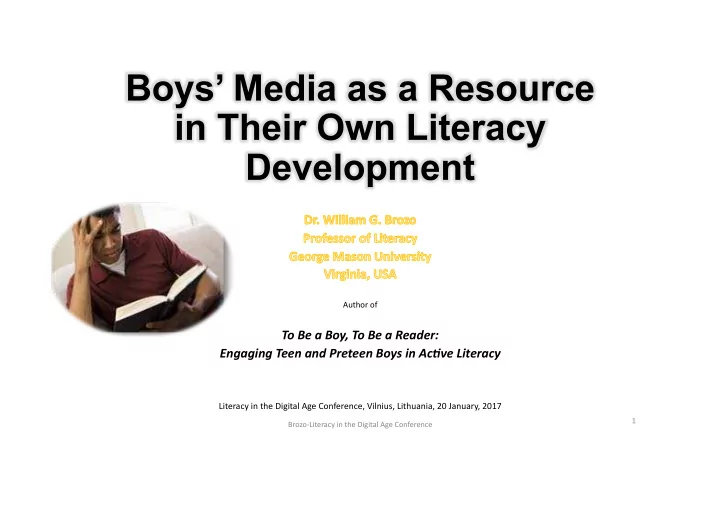
Author of To Be a Boy, To Be a Reader: Engaging Teen and Preteen Boys in Ac6ve Literacy Literacy in the Digital Age Conference, Vilnius,


slide-1
SLIDE 1

Author ¡of ¡

To ¡Be ¡a ¡Boy, ¡To ¡Be ¡a ¡Reader: ¡ ¡ Engaging ¡Teen ¡and ¡Preteen ¡Boys ¡in ¡Ac6ve ¡Literacy ¡

Literacy ¡in ¡the ¡Digital ¡Age ¡Conference, ¡Vilnius, ¡Lithuania, ¡20 ¡January, ¡2017 ¡

Brozo-­‑Literacy ¡in ¡the ¡Digital ¡Age ¡Conference ¡ ¡ 1 ¡

slide-2
SLIDE 2

Jacquis in As You Like It

And then the whining schoolboy with his satchel and shiny morning face creeping like a snail unwillingly to school. (Shakespeare, 1599)

2 Brozo-Literacy in the Digital Age Conference

The image part with relationship ID rId3 was not found in the file.
slide-3
SLIDE 3

Reynaldo, a ninth-grader

I have no idea how my parents or someone else could get me to read, because I don’t like reading. No one ever read to me before I fell asleep. No one ever bought me a book

  • r some reading material they knew I might be into. And

no one ever said, “You can do it, man,” or something like that. (Washington, DC, 2010)

Brozo-Literacy in the Digital Age Conference 3

The image part with relationship ID rId2 was not found in the file.
slide-4
SLIDE 4

2nd Edition of To be a Boy, To be a Reader: Engaging Teen and Preteen Boys in Active Literacy

Brozo-Literacy in the Digital Age Conference 4 To Be a Boy, To Be a Reader

slide-5
SLIDE 5

Brozo-Literacy in the Digital Age Conference 5

“A Boy’s Love of Reading Doesn’t Begin with Scholarship… It Begins with Discovery”

slide-6
SLIDE 6

Why an advocacy position toward boys’ literacy development?

Brozo-­‑Literacy ¡in ¡the ¡Digital ¡Age ¡Conference ¡ ¡ 6 ¡

slide-7
SLIDE 7

Social & Economic Justice

  • Immigrant ¡boys ¡have ¡the ¡lowest ¡levels ¡of ¡

reading ¡achievement ¡

  • Boys ¡from ¡low-­‑income ¡households ¡have ¡very ¡

low ¡reading ¡achievement ¡

7 Brozo-­‑Literacy ¡in ¡the ¡Digital ¡Age ¡Conference ¡ ¡

slide-8
SLIDE 8

Male Sociopathy

  • Males ¡commit ¡most ¡suicides ¡
  • Males ¡perpetrate ¡most ¡homicides ¡
  • Males ¡commit ¡most ¡acts ¡of ¡family ¡violence ¡
  • Males ¡comprise ¡most ¡of ¡the ¡homeless ¡ ¡
  • Males ¡comprise ¡most ¡drug ¡addicts ¡
  • Males ¡comprise ¡most ¡AIDS ¡carriers ¡

*Low ¡levels ¡of ¡literacy ¡are ¡oJen ¡associated ¡with ¡these ¡syndromes ¡

8 Brozo-­‑Literacy ¡in ¡the ¡Digital ¡Age ¡Conference ¡ ¡

slide-9
SLIDE 9

Literacy and academic achievement: The U.S.

  • The ¡average ¡high ¡school ¡grade ¡point ¡average ¡for ¡girls ¡is ¡significantly ¡higher ¡

than ¡for ¡boys ¡ ¡

  • Boys ¡are ¡almost ¡twice ¡as ¡likely ¡as ¡girls ¡to ¡repeat ¡a ¡grade ¡
  • Boys ¡are ¡twice ¡as ¡likely ¡to ¡get ¡suspended ¡as ¡girls, ¡and ¡three ¡Nmes ¡as ¡likely ¡to ¡

be ¡expelled ¡

  • 25% ¡more ¡boys ¡drop ¡out ¡of ¡school ¡than ¡girls ¡
  • Among ¡whites, ¡women ¡earn ¡57% ¡of ¡bachelor’s ¡degrees ¡and ¡62% ¡of ¡master’s ¡

degrees ¡ ¡

  • Among ¡African ¡American ¡women, ¡the ¡figures ¡are ¡66% ¡and ¡72% ¡
  • On ¡naNonal ¡wriNng ¡tests, ¡32% ¡of ¡girls ¡are ¡considered ¡“proficient” ¡or ¡beWer; ¡

for ¡boys, ¡the ¡figure ¡is ¡16% ¡

Brozo-­‑Literacy ¡in ¡the ¡Digital ¡Age ¡Conference ¡ ¡ 9 ¡

The image part with relationship ID rId3 was not found in the file.
slide-10
SLIDE 10

Literacy achievement: Globally

 Boys underperform relative to girls on most measures of verbal

ability at the primary and secondary school levels

 Boys comprise much greater percentage of weak readers on PISA

(Program for International Student Assessment) as compared with girls

 Boys have significantly lower levels of reading engagement than girls  One of the four major “gaps” to be addressed as identified by the

European High Level Group of Literacy Experts report

10 Brozo-Literacy in the Digital Age Conference

slide-11
SLIDE 11

Score Point Difference in favor of Girls on PISA for Selected Nordic & Baltic Countries

Estonia ¡ Finland ¡ Lithuania ¡ Norway ¡ Sweden ¡ OECD ¡ Average ¡ 2000 ¡ 25 ¡ 51 ¡ ¡ 40 ¡ 43 ¡ 37 ¡ 32 ¡ 2009 ¡ 44 ¡ 55 ¡ 59 ¡ 47 ¡ 46 ¡ 39 ¡ 2012 ¡ 44 ¡ ¡ 62 ¡ 55 ¡ 46 ¡ 51 ¡ 38 ¡ 2015 ¡ 28 ¡ 47 ¡ 39 ¡ 40 ¡ 39 ¡ 27 ¡

Brozo-­‑Literacy ¡in ¡the ¡Digital ¡Age ¡Conference ¡ ¡ 11

The image part with relationship ID rId2 was not found in the file.
slide-12
SLIDE 12

Challenges to this position: Insidious sexism

  • Males ¡conNnue ¡to ¡dominate ¡poliNcal, ¡corporate, ¡and ¡insNtuNonal ¡life ¡

in ¡the ¡U.S., ¡Europe ¡and ¡elsewhere ¡in ¡the ¡world ¡

  • As ¡girls ¡make ¡significant ¡strides ¡academically ¡and ¡professionally, ¡

advocates ¡of ¡boys’ ¡academic ¡needs ¡ensure ¡male ¡primacy ¡by ¡regularly ¡ invoking ¡“crisis” ¡to ¡rally ¡popular ¡support ¡

12 Brozo-­‑Literacy ¡in ¡the ¡Digital ¡Age ¡Conference ¡ ¡

slide-13
SLIDE 13

Challenges to this position: Hegemonic masculinity

  • “Boy-­‑friendly” ¡curricular ¡schemes ¡do ¡liWle ¡more ¡than ¡

perpetuate ¡gender ¡myths ¡and ¡stereotypes ¡

  • Binary ¡noNons ¡of ¡gender ¡as ¡a ¡basis ¡for ¡literacy ¡curricular ¡

decisions ¡exclude ¡all ¡the ¡different ¡ways ¡of ¡“being ¡male” ¡or ¡ “being ¡female” ¡ ¡

13 Brozo-­‑Literacy ¡in ¡the ¡Digital ¡Age ¡Conference ¡ ¡

slide-14
SLIDE 14

Framing the issue as a boy “crisis”… Or seeking to find responsive instruction for boys

“Failing ¡to ¡meet ¡the ¡literacy ¡needs ¡of ¡all ¡young ¡boys ¡isn’t ¡so ¡much ¡a ¡crisis ¡ as ¡it ¡is ¡an ¡imperaNve ¡educaNonal ¡challenge. ¡Furthermore, ¡concerns ¡ about ¡boys’ ¡reading ¡aatudes ¡and ¡achievement ¡should ¡be ¡framed ¡around ¡ more ¡responsive ¡literacy ¡instrucNon ¡and ¡interacNons ¡for ¡all ¡children. ¡ Boys ¡need ¡to ¡be ¡engaged ¡and ¡capable ¡readers ¡not ¡solely ¡to ¡be ¡as ¡good ¡as ¡

  • r ¡beWer ¡than ¡girls, ¡but ¡to ¡increase ¡their ¡educaNonal, ¡occupaNonal, ¡and ¡

civic ¡opportuniNes ¡and, ¡above ¡all, ¡to ¡become ¡thoughbul ¡and ¡resourceful ¡ men.” ¡ ¡ ¡ ¡(Bright ¡Beginnings ¡for ¡Boys, ¡Zambo/Brozo, ¡2009) ¡

Brozo-­‑Literacy ¡in ¡the ¡Digital ¡Age ¡Conference ¡ ¡ 14 ¡

The image part with relationship ID rId3 was not found in the file. The image part with relationship ID rId3 was not found in the file.
slide-15
SLIDE 15

Proposed causes for boys’ underachievement

  • Peer ¡pressure ¡exerts ¡a ¡negaNve ¡influence ¡on ¡boys ¡who ¡don’t ¡see ¡

reading ¡as ¡“cool” ¡

  • Boys ¡reading ¡interests ¡clash ¡with ¡more ¡feminine ¡curriculum ¡texts ¡
  • Boys’ ¡media ¡and ¡texts ¡are ¡not ¡valued ¡in ¡schools ¡and ¡classrooms ¡
  • Male ¡reading ¡role ¡models ¡are ¡absent ¡in ¡their ¡peer ¡group ¡and ¡at ¡home ¡
  • A ¡largely ¡female ¡school ¡workforce ¡impacts ¡on ¡boys’ ¡percepNons ¡of ¡

reading ¡and ¡their ¡reading ¡behavior ¡

Brozo-­‑Literacy ¡in ¡the ¡Digital ¡Age ¡Conference ¡ ¡ 15 ¡

The image part with relationship ID rId2 was not found in the file.
slide-16
SLIDE 16

Proposed causes for boys’ underachievement

  • Girls ¡are ¡favored ¡by ¡assessment ¡(See ¡Rauch ¡and ¡HarNg, ¡2010 ¡re: ¡PISA) ¡
  • Boys ¡have ¡more ¡acNve ¡learning ¡styles ¡that ¡are ¡less ¡compaNble ¡with ¡

tradiNonal ¡school-­‑based ¡reading ¡and ¡wriNng ¡literacy ¡

  • Boys’ ¡challenges ¡with ¡proper ¡classroom ¡decorum ¡influences ¡teachers’ ¡

percepNons ¡about ¡their ¡achievement ¡and ¡translate ¡into ¡lower ¡grades ¡ for ¡boys ¡

Brozo-­‑Literacy ¡in ¡the ¡Digital ¡Age ¡Conference ¡ ¡ 16 ¡

The image part with relationship ID rId2 was not found in the file.

Zyngier, ¡D. ¡(2009). ¡Doing ¡it ¡to ¡(for) ¡boys ¡(again): ¡Do ¡we ¡really ¡need ¡more ¡books ¡telling ¡ us ¡there ¡is ¡a ¡problem ¡with ¡boys’ ¡underachievement ¡in ¡educaNon? ¡Gender ¡and ¡Educa4on, ¡ 21(1), ¡11-­‑118. ¡ ¡

slide-17
SLIDE 17

Are classrooms more favorable to girls?

According ¡to ¡Whitmire ¡(Why ¡Boys ¡Fail: ¡Saving ¡Our ¡Sons ¡from ¡an ¡Educa4onal ¡ System ¡That's ¡Leaving ¡Them ¡Behind, ¡2011): ¡ ¡

  • Teaching ¡methods ¡are ¡not ¡designed ¡to ¡engage ¡the ¡minds ¡of ¡boys ¡ ¡
  • Boredom ¡is ¡an ¡all ¡too ¡familiar ¡side ¡effect ¡of ¡classroom ¡teaching, ¡which ¡

leads ¡to ¡frustraNon ¡and ¡causes ¡boys ¡to ¡exhibit ¡behavioral ¡problems ¡and/or ¡ dislike ¡of ¡school ¡ According ¡to ¡Jones ¡and ¡Myhill ¡(2004): ¡

  • Teachers ¡tend ¡to ¡associate ¡boys ¡with ¡underachievement ¡and ¡girls ¡with ¡high ¡

achievement ¡ According ¡to ¡Cornwell, ¡Mustard, ¡and ¡Parys ¡(2013): ¡

  • Boys ¡commonly ¡display ¡worse ¡behavior ¡than ¡girls, ¡which ¡can ¡cause ¡

teachers ¡to ¡assign ¡higher ¡grades ¡to ¡girls ¡over ¡boys ¡

Brozo-­‑Literacy ¡in ¡the ¡Digital ¡Age ¡Conference ¡ ¡ 17 ¡

The image part with relationship ID rId2 was not found in the file.
slide-18
SLIDE 18

Cornwell, C., Mustard, D.B., & Parys, J.V. (2013). Noncognitive skills and the gender disparities in test scores and teacher assessments: Evidence from primary school. Journal of Human Resources, 48(1), 23-264.

  • Analyzed ¡the ¡performance ¡data ¡on ¡more ¡than ¡5,800 ¡students ¡

from ¡kindergarten ¡through ¡fiJh ¡grade ¡on ¡standardized ¡tests ¡in ¡ reading, ¡math ¡and ¡science ¡and ¡linked ¡test ¡scores ¡to ¡teachers' ¡ assessments ¡of ¡their ¡students' ¡progress, ¡both ¡academically ¡and ¡ more ¡broadly ¡

  • Gender ¡dispariNes ¡in ¡teacher ¡grades ¡start ¡early ¡and ¡uniformly ¡

favor ¡girls ¡ ¡

  • In ¡every ¡subject ¡area, ¡boys ¡were ¡represented ¡in ¡grade ¡

distribuNons ¡below ¡where ¡their ¡test ¡scores ¡would ¡predict ¡

Brozo-­‑Literacy ¡in ¡the ¡Digital ¡Age ¡Conference ¡ ¡ 18 ¡

The image part with relationship ID rId2 was not found in the file.
slide-19
SLIDE 19

Cornwell, C., Mustard, D.B., & Parys, J.V. (2013). Noncognitive skills and the gender disparities in test scores and teacher assessments: Evidence from primary school. Journal of Human Resources, 48(1), 23-264.

  • This ¡misalignment ¡is ¡aWributed ¡to ¡non-­‑cogniNve ¡skills, ¡
  • r ¡"how ¡well ¡each ¡child ¡was ¡engaged ¡in ¡the ¡classroom, ¡

how ¡oJen ¡the ¡child ¡externalized ¡or ¡internalized ¡ problems, ¡how ¡oJen ¡the ¡child ¡lost ¡control ¡and ¡how ¡ well ¡the ¡child ¡developed ¡interpersonal ¡skills." ¡ ¡

  • They ¡also ¡report ¡evidence ¡of ¡a ¡grade ¡bonus ¡for ¡boys ¡

with ¡behavior ¡similar ¡to ¡their ¡girl ¡counterparts ¡

Brozo-­‑Literacy ¡in ¡the ¡Digital ¡Age ¡Conference ¡ ¡ 19 ¡

The image part with relationship ID rId2 was not found in the file.
slide-20
SLIDE 20

Brozo-­‑Literacy ¡in ¡the ¡Digital ¡Age ¡Conference ¡ ¡ 20 ¡

The image part with relationship ID rId2 was not found in the file.

Jan ¡Steen’s ¡ ¡ The ¡Feast ¡of ¡Saint ¡Nicholas ¡ 1665-­‑1668 ¡

Crying ¡boy ¡who ¡must ¡ have ¡been ¡“naughty” ¡ receives ¡coal ¡in ¡his ¡ shoe ¡for ¡Christmas ¡ Good ¡liWle ¡ girl ¡receives ¡a ¡ dolly, ¡fruits, ¡ and ¡other ¡ presents ¡ ¡

slide-21
SLIDE 21

Is boys’ underachievement a new phenomenon?

  • In ¡the ¡U.S., ¡gender-­‑based ¡achievement ¡dispariNes ¡evident ¡in ¡the ¡early ¡

1940s ¡(Stroud ¡& ¡Lindquist, ¡1942) ¡

  • There ¡may ¡have ¡always ¡been ¡a ¡significant ¡numbers ¡of ¡boys ¡who ¡have ¡

underachieved; ¡more ¡noNceable ¡since ¡the ¡decline ¡of ¡industry ¡and ¡ manufacturing ¡ ¡

  • Changes ¡in ¡the ¡workplace ¡focus ¡aWenNon ¡on ¡boys’ ¡underachievement ¡
  • ­‑-­‑up ¡unNl ¡the ¡1970s ¡low ¡academic ¡qualificaNons ¡were ¡not ¡necessarily ¡

a ¡barrier ¡to ¡relaNvely ¡high-­‑paying ¡jobs ¡in ¡manufacturing ¡and ¡industry ¡

  • Today ¡there ¡is ¡a ¡direct ¡correlaNon ¡between ¡low ¡qualificaNons ¡and ¡

both ¡joblessness ¡and ¡being ¡trapped ¡in ¡low ¡pay ¡and ¡unskilled ¡work ¡

Brozo-­‑Literacy ¡in ¡the ¡Digital ¡Age ¡Conference ¡ ¡ 21 ¡

The image part with relationship ID rId2 was not found in the file.
slide-22
SLIDE 22

I ¡haven't ¡read ¡any ¡presidenNal ¡

  • biographies. ¡I ¡despise ¡reports ¡that ¡

run ¡more ¡than ¡three ¡pages, ¡and ¡ my ¡office ¡doesn’t ¡have ¡any ¡books ¡

  • n ¡the ¡shelves…except ¡my ¡own. ¡ ¡

Go ¡on, ¡try ¡to ¡sue ¡me! ¡ Who ¡says ¡boys ¡and ¡men ¡need ¡to ¡be ¡acJve ¡engaged ¡readers ¡to ¡be ¡successful? ¡

Brozo-­‑Literacy ¡in ¡the ¡Digital ¡Age ¡Conference ¡ ¡ 22 ¡

“The ¡man ¡who ¡does ¡not ¡read ¡has ¡no ¡advantage ¡over ¡the ¡man ¡who ¡cannot ¡read.” ¡ ¡ ¡ ¡ ¡ ¡ ¡-­‑-­‑Mark ¡Twain ¡

slide-23
SLIDE 23

Privilege and Reading Proficiency

  • Boys ¡who ¡grow ¡up ¡in ¡families ¡and ¡communiNes ¡with ¡high ¡levels ¡of ¡

class ¡and ¡status ¡(according ¡to ¡social ¡theorist ¡Max ¡Weber), ¡and ¡the ¡ privileges ¡that ¡come ¡with ¡these, ¡have ¡financial ¡and ¡social ¡protecNons ¡ against ¡disengaged ¡literacy, ¡aliteracy, ¡poor ¡academic ¡performance, ¡ and ¡lack ¡of ¡academic ¡moNvaNon ¡

  • Boys ¡without ¡these ¡protecNons, ¡need ¡to ¡“read ¡for ¡their ¡

lives” ¡(according ¡to ¡Al ¡Tatum) ¡

Brozo-­‑Literacy ¡in ¡the ¡Digital ¡Age ¡Conference ¡ ¡ 23 ¡

The image part with relationship ID rId3 was not found in the file.

Tatum, ¡A. ¡(2009). ¡Reading ¡for ¡their ¡life: ¡(Re)building ¡the ¡textual ¡lineages ¡of ¡African ¡American ¡adolescent ¡males. ¡ Portsmouth, ¡NH: ¡Heinemann. ¡

slide-24
SLIDE 24

Privilege and Reading Proficiency

  • Hill’s ¡(2014) ¡path ¡analysis ¡of ¡117 ¡African-­‑American ¡males ¡who ¡

parNcipated ¡in ¡PISA ¡2009 ¡revealed ¡a ¡strong ¡and ¡significant ¡direct ¡ effect ¡of ¡their ¡fathers’ ¡status ¡and ¡class ¡on ¡their ¡sons’ ¡print ¡reading ¡ literacy ¡proficiency ¡

  • Overall ¡reading ¡scores ¡of ¡these ¡Black ¡male ¡parNcipants ¡were ¡linked ¡

directly ¡to ¡the ¡financial ¡well-­‑being ¡and ¡occupaNonal ¡status ¡of ¡their ¡ fathers ¡

  • As ¡Hill ¡stated ¡it: ¡“The ¡more ¡material ¡resources ¡Black ¡fathers’ ¡can ¡

provide ¡to ¡support ¡their ¡adolescent ¡sons’ ¡print ¡reading ¡literacy ¡ proficiency, ¡the ¡beWer ¡they ¡performed ¡on ¡PISA ¡2009 ¡reading ¡ examinaNon.” ¡

Brozo-­‑Literacy ¡in ¡the ¡Digital ¡Age ¡Conference ¡ ¡ 24 ¡

The image part with relationship ID rId2 was not found in the file.
slide-25
SLIDE 25

What about those boys without financial and social privileges?

  • Hernandez ¡(2011) ¡determined ¡boys ¡who ¡can’t ¡read ¡on ¡grade ¡level ¡by ¡

3rd ¡grade ¡are ¡four ¡Nmes ¡less ¡likely ¡to ¡graduate ¡by ¡age ¡19 ¡than ¡those ¡ who ¡do ¡read ¡proficiently ¡at ¡that ¡Nme ¡ ¡

  • If ¡boys ¡who ¡can’t ¡read ¡on ¡grade ¡level ¡live ¡in ¡poverty, ¡then ¡they ¡are ¡13 ¡

Nmes ¡less ¡likely ¡to ¡graduate ¡on ¡Nme ¡ ¡

  • Many ¡of ¡these ¡dropouts ¡find ¡themselves ¡among ¡the ¡ranks ¡of ¡the ¡

United ¡State’s ¡growing ¡prison ¡populaNon ¡ ¡ ¡

Brozo-­‑Literacy ¡in ¡the ¡Digital ¡Age ¡Conference ¡ ¡ 25 ¡

The image part with relationship ID rId2 was not found in the file.
slide-26
SLIDE 26

What about those boys without financial and social privileges?

  • Sum ¡and ¡his ¡colleagues ¡(2009) ¡found ¡that ¡about ¡1 ¡in ¡every ¡10 ¡

young ¡male ¡high ¡school ¡dropout ¡is ¡in ¡jail ¡or ¡juvenile ¡ detenNon ¡centers ¡as ¡compared ¡to ¡one ¡in ¡35 ¡young ¡male ¡high ¡ school ¡graduates ¡ ¡

  • The ¡picture ¡is ¡even ¡bleaker ¡for ¡African-­‑Americans, ¡with ¡

nearly ¡1 ¡in ¡4 ¡young ¡black ¡male ¡dropouts ¡incarcerated ¡or ¡

  • therwise ¡insNtuNonalized ¡on ¡an ¡average ¡day ¡ ¡

Brozo-­‑Literacy ¡in ¡the ¡Digital ¡Age ¡Conference ¡ ¡ 26 ¡

The image part with relationship ID rId2 was not found in the file.
slide-27
SLIDE 27

What about those boys without financial and social privileges?

  • There ¡is ¡an ¡undeniable ¡relaNonship ¡between ¡lack ¡of ¡

literacy ¡and ¡the ¡probability ¡of ¡being ¡imprisoned ¡in ¡the ¡ U.S. ¡

  • Cohen ¡(2010) ¡has ¡shown ¡that ¡more ¡than ¡60% ¡of ¡

America’s ¡inmates ¡are ¡illiterate, ¡and ¡85% ¡of ¡all ¡juvenile ¡

  • ffenders ¡have ¡reading ¡problems ¡

Brozo-­‑Literacy ¡in ¡the ¡Digital ¡Age ¡Conference ¡ ¡ 27 ¡

The image part with relationship ID rId3 was not found in the file.
slide-28
SLIDE 28

The higher boys’ PISA scores at age 15, the more likely they are to:

 Enroll in post-secondary education  Choose more complex and higher-status major

areas of study in post-secondary education

 Complete higher education, which slows skill loss as

they age

 Have high earnings and low unemployment rates  Speak two languages resulting in a salary premium

Brozo-Literacy in the Digital Age Conference 28

slide-29
SLIDE 29

What do boys desire in a literacy curriculum?

  • Blair ¡& ¡Sanford ¡(2002) ¡ ¡
  • Canadian ¡elementary ¡school ¡boys ¡were ¡tracked ¡
  • ver ¡three ¡years. ¡ ¡
  • They ¡were ¡interviewed, ¡observed ¡in ¡their ¡

classrooms, ¡and ¡observed ¡during ¡classroom ¡ literacy ¡acNviNes ¡in ¡which ¡the ¡boys ¡were ¡ engaged ¡

Brozo-­‑Literacy ¡in ¡the ¡Digital ¡Age ¡Conference ¡ ¡ 29 ¡

The image part with relationship ID rId3 was not found in the file.
slide-30
SLIDE 30

What do boys desire in a literacy curriculum?

Analysis ¡revealed ¡five ¡themes ¡around ¡which ¡the ¡boys’ ¡literacy ¡ pracNces ¡were ¡constructed ¡and ¡which ¡teachers ¡would ¡need ¡to ¡ incorporate ¡into ¡their ¡instrucNonal ¡acNviNes ¡to ¡engage ¡boys: ¡

  • personal ¡interest ¡ ¡
  • acNon ¡ ¡
  • success ¡
  • fun ¡ ¡
  • purpose ¡ ¡

Brozo-­‑Literacy ¡in ¡the ¡Digital ¡Age ¡Conference ¡ ¡ 30 ¡

slide-31
SLIDE 31

Boys and New Literacies

 Definitions of literacy are expanding to include digital

literacies, youth media, and virtually any act of meaning making as “reading.”

 Evidence can be found for male youth participating

actively in the “mediasphere”

 Boys’ expertise with digital and media literacy may not be

privileged and/ or valued in most academic contexts

Brozo-Literacy in the Digital Age Conference 31

slide-32
SLIDE 32

PISA 2009: Electronic Reading & Gender

  • 16 ¡ ¡OECD ¡ ¡countries ¡took ¡ ¡part ¡ ¡in ¡ ¡both ¡ ¡assessments ¡
  • Girls ¡ ¡outperformed ¡boys ¡by ¡38 ¡points ¡– ¡the ¡equivalent ¡of ¡one ¡year ¡of ¡

formal ¡schooling ¡– ¡in ¡print ¡reading, ¡but ¡by ¡24 ¡points ¡in ¡digital ¡reading. ¡ ¡

  • In ¡each ¡country, ¡the ¡increase ¡in ¡the ¡percentage ¡of ¡top ¡performers ¡in ¡

digital ¡reading ¡over ¡print ¡reading ¡was ¡always ¡greater ¡among ¡boys ¡than ¡ among ¡girls, ¡as ¡was ¡the ¡reducNon ¡in ¡the ¡percentage ¡of ¡poor ¡performers. ¡

  • For ¡girls ¡and ¡boys ¡who ¡were ¡similarly ¡proficient ¡in ¡print ¡reading, ¡boys ¡

scored ¡an ¡average ¡of ¡six ¡points ¡higher ¡in ¡digital ¡reading. ¡ ¡

Brozo-­‑Literacy ¡in ¡the ¡Digital ¡Age ¡Conference ¡ ¡ 32 ¡

The image part with relationship ID rId2 was not found in the file.
slide-33
SLIDE 33

PISA 2009: Electronic Reading & Gender

  • Boys ¡appear ¡to ¡be ¡more ¡competent ¡than ¡girls ¡in ¡

selecNng, ¡organizing, ¡and ¡navigaNng ¡pieces ¡of ¡ informaNon ¡found ¡in ¡hypertexts ¡

  • Boys’ ¡ ¡interest ¡ ¡and ¡ ¡abiliNes ¡ ¡in ¡ ¡digital ¡ ¡reading ¡ ¡could ¡ ¡

be ¡ ¡exploited ¡

  • More ¡frequent ¡reading ¡of ¡digital ¡texts ¡could ¡result ¡in ¡

greater ¡enjoyment ¡of ¡reading ¡and ¡beWer ¡proficiency ¡in ¡ print ¡reading ¡

Brozo-­‑Literacy ¡in ¡the ¡Digital ¡Age ¡Conference ¡ ¡ 33 ¡

The image part with relationship ID rId2 was not found in the file.
slide-34
SLIDE 34

Boys in the Mediasphere

  • O’Brien ¡has ¡demonstrated ¡how ¡boys ¡who ¡fail ¡with ¡tradiNonal ¡school ¡

literacy ¡tasks ¡demonstrate ¡literacy ¡skills ¡and ¡competencies ¡with ¡their ¡

  • wn ¡media ¡and ¡technology ¡
  • Importance ¡of ¡creaNng ¡spaces ¡in ¡schools ¡for ¡striving ¡male ¡readers’ ¡

everyday ¡literacies ¡so ¡they ¡can ¡showcase ¡and ¡build ¡on ¡their ¡strengths ¡ with ¡the ¡print ¡and ¡digital ¡media ¡they ¡use ¡on ¡their ¡own ¡

  • O’Brien, ¡D. ¡(2001, ¡June). ¡“At-­‑risk” ¡adolescents: ¡Redefining ¡competence ¡through ¡the ¡mulNliteracies ¡of ¡intermediality, ¡visual ¡

arts, ¡and ¡representaNon. ¡Reading ¡Online, ¡4(11). ¡

  • O’Brien, ¡D. ¡(2003, ¡March). ¡Juxtaposing ¡tradiNonal ¡and ¡intermedial ¡literacies ¡to ¡redefine ¡the ¡competence ¡of ¡struggling ¡
  • adolescents. ¡Reading ¡Online, ¡6(7). ¡

Brozo-­‑Literacy ¡in ¡the ¡Digital ¡Age ¡Conference ¡ ¡ 34 ¡

slide-35
SLIDE 35

Brozo-­‑Literacy ¡in ¡the ¡Digital ¡Age ¡Conference ¡ ¡ 35

“Dan e”

Science ¡– ¡D ¡ Math ¡– ¡D ¡ English ¡– ¡C ¡ History ¡– ¡D+ ¡ PE ¡-­‑ ¡B ¡ Tardy ¡oUen, ¡ Several ¡detenJons ¡

slide-36
SLIDE 36

Dane’s literate practices outside of school: Rappin’ with his “Wingmen”

This ¡beat ¡ain’t ¡right,” ¡Dane ¡tells ¡Kwame ¡and ¡Jovan, ¡stopping ¡his ¡rap ¡aJer ¡just ¡a ¡ few ¡lines. ¡ ¡“It’s ¡goWa ¡be ¡more ¡lazy ¡for ¡the ¡mood ¡I’m ¡trying ¡to ¡create.” ¡ ¡“That’s ¡ cause ¡you ¡lazy,” ¡Jovan ¡quips, ¡leaving ¡the ¡three ¡of ¡ ¡them ¡laughing. ¡Dane ¡and ¡his ¡ two ¡friends ¡are ¡in ¡a ¡small ¡room ¡adjacent ¡to ¡Dane’s ¡bedroom ¡that ¡has ¡become ¡a ¡ make-­‑shiJ ¡recording ¡studio. ¡ ¡Kwame ¡searches ¡another ¡website ¡where ¡they ¡ usually ¡find ¡the ¡best ¡beats ¡and ¡calls ¡up ¡a ¡slower, ¡almost ¡jazzy ¡one ¡with ¡a ¡muted ¡ though ¡emphaNc ¡bass. ¡ ¡Jovan ¡returns ¡to ¡the ¡cheap ¡Casio ¡keyboard, ¡the ¡one ¡he ¡ had ¡since ¡he ¡was ¡a ¡kid, ¡that ¡he ¡excavated ¡from ¡the ¡back ¡of ¡his ¡closet, ¡and ¡puts ¡ down ¡a ¡repeaNng ¡paWern ¡of ¡chords ¡to ¡go ¡with ¡the ¡beat. ¡ ¡Dane, ¡using ¡the ¡handle ¡ King ¡Negus, ¡smiles, ¡shiJs ¡his ¡head ¡from ¡side ¡to ¡side ¡with ¡the ¡rhythm, ¡and ¡ restarts ¡his ¡rap: ¡ ¡

BROZO, ¡W.G. ¡(2013). ¡The ¡many ¡faces ¡of ¡Dane: ¡Viewing ¡boys ¡as ¡a ¡resource ¡in ¡their ¡own ¡literacy ¡

  • development. ¡In ¡N. ¡Nilsson ¡& ¡S. ¡Gandy ¡(Eds.), ¡Struggling ¡readers ¡can ¡succeed: ¡Teaching ¡solu4ons ¡based ¡on ¡

real ¡kids ¡in ¡classrooms ¡and ¡communi4es. ¡InformaNon ¡Age ¡Publishing. ¡

Brozo-­‑Literacy ¡in ¡the ¡Digital ¡Age ¡Conference ¡ ¡ 36

The image part with relationship ID rId2 was not found in the file.
slide-37
SLIDE 37

Dane’s literate practices outside of school: Rappin’ with his “Wingmen”

¡ ¡ ¡ ¡ ¡ ¡ ¡ ¡ ¡ ¡ ¡ ¡ ¡ ¡ ¡ ¡One ¡plus ¡two ¡plus ¡three ¡ways ¡to ¡be ¡

¡ ¡ ¡ ¡ ¡It ¡don’ ¡maLer ¡to ¡me ¡‘cause ¡I’m ¡divisible ¡by ¡three ¡ ¡ ¡ ¡ ¡ ¡Other ¡brothas ¡wanna ¡be ¡one ¡thing, ¡one ¡thing ¡only ¡ ¡ ¡ ¡ ¡But ¡there’s ¡a ¡whole ¡loLa ¡lonely ¡in ¡ac6ng ¡one ¡way ¡ ¡ ¡ ¡ ¡ ¡Thinking ¡one ¡way ¡like ¡this ¡is ¡yo ¡last ¡day ¡to ¡live ¡ ¡ ¡ ¡ ¡ ¡Give, ¡unable ¡to ¡deliver ¡when ¡somethin’ ¡new ¡ ¡ ¡ ¡ ¡ ¡Comes ¡yo ¡way ¡ ¡ ¡ ¡ ¡ ¡ ¡ ¡ ¡ ¡ ¡ ¡ ¡ ¡ ¡ ¡ ¡ ¡When ¡I ¡was ¡a ¡kid ¡I ¡got ¡these ¡faces ¡from ¡my ¡dad ¡ ¡ ¡ ¡ ¡ ¡ ¡ ¡ ¡ ¡ ¡ ¡ ¡ ¡ ¡ ¡ ¡ ¡ ¡ ¡ ¡ ¡One ¡had ¡a ¡smile ¡one ¡was ¡sad ¡ ¡ ¡ ¡ ¡ ¡ ¡Like ¡my ¡face ¡when ¡my ¡rap ¡goes ¡down ¡ ¡ ¡ ¡ ¡ ¡ ¡ ¡ ¡ ¡ ¡ ¡Or ¡goes ¡down ¡in ¡flames… ¡

Brozo-­‑Literacy ¡in ¡the ¡Digital ¡Age ¡Conference ¡ ¡ 37

slide-38
SLIDE 38

Take ¡advantage ¡of ¡boys’ ¡relaJve ¡strengths ¡with ¡ media ¡and ¡literacy ¡outside ¡of ¡school ¡

  • playing ¡computer ¡and ¡video ¡games ¡
  • reading ¡comic ¡books ¡and ¡graphic ¡novels ¡
  • reading ¡related ¡to ¡their ¡hobbies ¡(skateboarding, ¡

collec4ng, ¡sports, ¡Rubik’s ¡Cube) ¡

  • listening ¡to ¡music ¡and ¡reading ¡and ¡wri4ng ¡song ¡

lyrics ¡

Brozo-­‑Literacy ¡in ¡the ¡Digital ¡Age ¡Conference ¡ ¡ 38

The image part with relationship ID rId3 was not found in the file.
slide-39
SLIDE 39

Brozo-­‑Literacy ¡in ¡the ¡Digital ¡Age ¡Conference ¡ ¡ 39 ¡

Sirasak ¡ By ¡eliminaNng ¡barriers ¡ between ¡students’ ¡ ¡ competencies ¡with ¡outside-­‑

  • f-­‑school ¡texts ¡and ¡classroom ¡

pracNces ¡it ¡is ¡possible ¡to ¡ increase ¡engagement ¡in ¡ learning ¡and ¡expand ¡literacy ¡ abiliNes ¡for ¡striving ¡readers ¡ ¡ (Sturtevant, ¡Boyd, ¡Brozo, ¡ Hinchman, ¡Alvermann, ¡& ¡ Moore, ¡2006). ¡ ¡

Bridge ¡Competencies ¡with ¡Familiar ¡Texts ¡to ¡Academic ¡Literacy ¡

slide-40
SLIDE 40

Readers theater with graphic novel to improve fluency and have fun

Brozo-­‑Literacy ¡in ¡the ¡Digital ¡Age ¡Conference ¡ ¡ 40 ¡

Timofey, ¡Sirasak, ¡Fabrizzio ¡ ¡

slide-41
SLIDE 41

Readers Theater with comic book version

  • f The Odyssey to increase

comprehension and have fun

Brozo-­‑Literacy ¡in ¡the ¡Digital ¡Age ¡Conference ¡ ¡ 41 ¡

slide-42
SLIDE 42

Readers Theater with comic book version

  • f The Odyssey to increase

comprehension and have fun

Brozo-­‑Literacy ¡in ¡the ¡Digital ¡Age ¡Conference ¡ ¡ 42 ¡

slide-43
SLIDE 43

Bridge Books and Texts

  • Goal ¡is ¡to ¡moNvate ¡reluctant ¡and ¡disinterested ¡boys ¡to ¡read ¡

required ¡academic ¡texts ¡

  • Canonical ¡and ¡required ¡texts, ¡even ¡if ¡“readable,” ¡may ¡turn ¡

boys ¡off ¡to ¡reading ¡without ¡prior ¡exposure ¡to ¡bridge ¡texts ¡

  • TransiNon ¡boys ¡into ¡challenging ¡academic ¡texts ¡with ¡texts ¡that ¡

are ¡engaging ¡and ¡put ¡knowledge ¡bases ¡in ¡place ¡for ¡academic ¡ literate ¡tasks ¡

43 Brozo-­‑Literacy ¡in ¡the ¡Digital ¡Age ¡Conference ¡ ¡

slide-44
SLIDE 44

Brozo-­‑Literacy ¡in ¡the ¡Digital ¡Age ¡Conference ¡ ¡ 44

Professional Note

My newest book with Teachers College Press demonstrates how to integrate graphic novels into the four major disciplines. This approach appears to have particular appeal to boys.

slide-45
SLIDE 45

Brozo-­‑Literacy ¡in ¡the ¡Digital ¡Age ¡Conference ¡ ¡ 45 ¡

slide-46
SLIDE 46

46 ¡ Brozo-­‑Literacy ¡in ¡the ¡Digital ¡Age ¡Conference ¡ ¡

slide-47
SLIDE 47
  • United ¡States ¡Poet ¡Laureate, ¡Natasha ¡Trethewey ¡– ¡

poems ¡set ¡in ¡New ¡Orleans ¡in ¡early ¡20th ¡century ¡

  • Graphic ¡Novel ¡about ¡Katrina ¡
  • Story ¡of ¡Islamic ¡man’s ¡generosity ¡aJer ¡the ¡New ¡

Orleans’ ¡flood ¡and ¡then ¡is ¡a ¡vicNm ¡of ¡racial ¡profiling ¡

47 ¡ Brozo-­‑Literacy ¡in ¡the ¡Digital ¡Age ¡Conference ¡ ¡

The image part with relationship ID rId2 was not found in the file.
slide-48
SLIDE 48

48 ¡

The full text of a roadmap to peace in the Middle East, presented to Palestinian and Israeli leaders by Quartet mediators - the United Nations, European Union, United States and

  • Russia. A

performance-based roadmap to a permanent two- state solution to the Israeli-Palestinian conflict

http://newsvote.bbc.co.uk/mpapps/pagetools/print/news.bbc.co.uk/2/hi/middle_east/2989783.stm Brozo-­‑Literacy ¡in ¡the ¡Digital ¡Age ¡Conference ¡ ¡

slide-49
SLIDE 49
  • Poetry ¡of ¡PalesNnian ¡poet, ¡Mahmoud ¡Darwish ¡
  • Graphic ¡Novel ¡about ¡PalesNne ¡
  • Road ¡Map ¡to ¡Peace ¡to ¡seWle ¡the ¡Israeli-­‑

PalesNnian ¡conflict ¡ ¡

49 ¡ Brozo-­‑Literacy ¡in ¡the ¡Digital ¡Age ¡Conference ¡ ¡

The image part with relationship ID rId2 was not found in the file.
slide-50
SLIDE 50

Brozo-­‑Literacy ¡in ¡the ¡Digital ¡Age ¡Conference ¡ ¡ 50 ¡

slide-51
SLIDE 51

The Odyssey

  • Homer’s ¡original ¡epic ¡poem ¡
  • Graphic ¡novel ¡about ¡Ulysses ¡(Roman ¡version ¡of ¡

Odysseus) ¡

  • Enrique’s ¡Journey, ¡Sonia ¡Nazario’s ¡ ¡novel ¡about ¡

a ¡Honduran ¡boy’s ¡own ¡epic ¡journey ¡to ¡find ¡his ¡ mother ¡in ¡the ¡United ¡States ¡

Brozo-­‑Literacy ¡in ¡the ¡Digital ¡Age ¡Conference ¡ ¡ 51 ¡

The image part with relationship ID rId2 was not found in the file.
slide-52
SLIDE 52

Graphic Novel as Bridge Text in History: Case Study

  • “Mr. ¡Brown” ¡– ¡American ¡History ¡teacher ¡
  • Incorporated ¡graphic ¡novels ¡into ¡units ¡and ¡lessons ¡
  • Had ¡students ¡read ¡Incognegro ¡(Pleece, ¡2008) ¡in ¡connecNon ¡with ¡a ¡study ¡of ¡

pre-­‑Civil ¡Rights ¡era ¡southern ¡U.S. ¡

  • Students ¡also ¡read ¡To ¡Kill ¡a ¡Mockingbird ¡and ¡LeUer ¡from ¡a ¡Birmingham ¡Jail ¡
  • “Dane” ¡– ¡10th ¡grader ¡in ¡Mr. ¡Brown’s ¡history ¡class, ¡unmoNvated, ¡

struggling ¡reader, ¡African-­‑American ¡

Brozo-­‑Literacy ¡in ¡the ¡Digital ¡Age ¡Conference ¡ ¡ 52

The image part with relationship ID rId2 was not found in the file.
slide-53
SLIDE 53

53 ¡

“Letter from a Birmingham Jail”

To Kill a Mockingbird

Incognegro

Brozo-­‑Literacy ¡in ¡the ¡Digital ¡Age ¡Conference ¡ ¡

slide-54
SLIDE 54

54 ¡ Brozo-­‑Literacy ¡in ¡the ¡Digital ¡Age ¡Conference ¡ ¡

slide-55
SLIDE 55

Dane’s journal response to Incognegro

The ¡main ¡character ¡is ¡a ¡real ¡light ¡colored ¡Black ¡guy ¡named ¡Zane ¡

  • Pinchback. ¡So ¡am ¡I. ¡ ¡My ¡mother ¡is ¡white. ¡ ¡She’s ¡from ¡Germany ¡and ¡my ¡

father ¡was ¡from ¡Ethiopia. ¡ ¡Some ¡kids ¡with ¡tans ¡look ¡darker ¡than ¡me. ¡ ¡ My ¡hair ¡is ¡curly ¡but ¡not ¡kinky. ¡ ¡My ¡mom ¡is ¡cool ¡about ¡who ¡I ¡hang ¡out ¡

  • with. ¡ ¡My ¡friends ¡are ¡all ¡Black. ¡ ¡I ¡also ¡like ¡this ¡book ¡because ¡it’s ¡a ¡

graphic ¡novel. ¡ ¡For ¡me, ¡these ¡kind ¡of ¡books ¡are ¡a ¡lot ¡easier ¡to ¡read. ¡ ¡I ¡ can ¡read ¡the ¡words ¡and ¡if ¡I’m ¡not ¡sure ¡what’s ¡going ¡on ¡or ¡if ¡the ¡dialog ¡ isn’t ¡too ¡interesNng, ¡I ¡can ¡also ¡look ¡at ¡the ¡illustraNons. ¡ ¡The ¡ illustraNons ¡in ¡this ¡book ¡are ¡awesome. ¡ ¡They ¡really ¡help ¡you ¡get ¡into ¡ the ¡story. ¡ ¡

Brozo-­‑Literacy ¡in ¡the ¡Digital ¡Age ¡Conference ¡ ¡ 55

The image part with relationship ID rId2 was not found in the file.
slide-56
SLIDE 56

Dane’s journal response to Incognegro

I ¡have ¡a ¡lot ¡of ¡respect ¡for ¡Blacks ¡who ¡fought ¡for ¡civil ¡rights. ¡ ¡They ¡risked ¡ their ¡lives. ¡Zane ¡is ¡afraid ¡whites ¡will ¡figure ¡out ¡he’s ¡black, ¡but ¡he ¡does ¡ what ¡he ¡can ¡for ¡his ¡brother ¡anyway. ¡ ¡Reading ¡about ¡Zane ¡and ¡looking ¡ at ¡the ¡drawings ¡of ¡him, ¡his ¡brother, ¡the ¡angry ¡whites ¡and ¡the ¡other ¡ people ¡made ¡the ¡book ¡so ¡real. ¡ ¡Could ¡I ¡ever ¡show ¡the ¡kind ¡of ¡courage ¡ Zane ¡does ¡or ¡all ¡those ¡people ¡who ¡fought ¡for ¡their ¡rights? ¡ ¡I ¡don’t ¡

  • know. ¡ ¡But ¡I ¡think ¡I ¡am ¡strong ¡enough ¡and ¡proud ¡enough. ¡ ¡There’s ¡one ¡

part ¡of ¡the ¡book ¡where ¡Zane ¡is ¡looking ¡right ¡into ¡your ¡eyes. ¡ ¡He ¡is ¡in ¡ Mississippi ¡and ¡he ¡has ¡found ¡out ¡who ¡really ¡killed ¡the ¡white ¡woman. ¡ ¡ When ¡I ¡look ¡into ¡Zane’s ¡eyes ¡in ¡that ¡picture, ¡it’s ¡like ¡I ¡can ¡ ¡see ¡myself. ¡ ¡ He’s ¡scared ¡but ¡confident ¡that ¡he ¡must ¡do ¡the ¡right ¡thing. ¡

Brozo-­‑Literacy ¡in ¡the ¡Digital ¡Age ¡Conference ¡ ¡ 56

The image part with relationship ID rId2 was not found in the file.
slide-57
SLIDE 57

Graphic Novel as Bridge Text in Science: Case Study

  • Where ¡ ¡

¡8th ¡grade ¡science ¡class ¡in ¡a ¡suburban ¡community ¡in ¡the ¡naNonal ¡capital ¡region ¡

  • Who ¡

¡Melissa—the ¡science ¡teacher, ¡doctoral ¡student ¡in ¡literacy/policy, ¡former ¡engineer ¡ ¡Students—culturally ¡and ¡ethnically ¡diverse ¡group; ¡10% ¡Els ¡

  • Gender ¡RaJo ¡

¡ ¡ ¡24 ¡total: ¡17 ¡boys; ¡7 ¡girls ¡ BROZO, ¡W.G., ¡& ¡MAYVILLE, ¡M. ¡(2012). ¡Reforming ¡secondary ¡disciplinary ¡instrucNon ¡ with ¡graphic ¡novels. ¡New ¡England ¡Reading ¡Associa4on ¡Journal, ¡48(1), ¡11-­‑21. ¡ ¡

Brozo-­‑Literacy ¡in ¡the ¡Digital ¡Age ¡Conference ¡ ¡ 57 ¡

The image part with relationship ID rId3 was not found in the file.
slide-58
SLIDE 58

Graphic Novel in Science

  • Background ¡

¡-­‑Melissa ¡concerned ¡about ¡a ¡mismatch ¡between ¡the ¡school-­‑ provided ¡texts ¡and ¡the ¡reading ¡abiliNes ¡and ¡interests ¡of ¡her ¡

  • students. ¡ ¡

¡-­‑Assigned ¡textbook ¡was ¡wriWen ¡at ¡a ¡level ¡that ¡exceeded ¡the ¡ abiliNes ¡of ¡many ¡of ¡her ¡students, ¡especially ¡English ¡Learners ¡ (ELs), ¡struggling ¡readers, ¡and ¡reluctant ¡readers—most ¡of ¡ whom ¡were ¡boys ¡ ¡

Brozo-­‑Literacy ¡in ¡the ¡Digital ¡Age ¡Conference ¡ ¡ 58 ¡

The image part with relationship ID rId2 was not found in the file.
slide-59
SLIDE 59

Graphic Novel in Science

  • Melissa ¡made ¡alternaNve ¡texts ¡available ¡to ¡her ¡students ¡at ¡a ¡

lower ¡reading ¡level ¡than ¡the ¡textbook ¡

  • Many ¡boys, ¡who ¡could ¡have ¡benefited ¡from ¡these ¡texts ¡

rejected ¡them ¡because ¡their ¡peers ¡perceived ¡them ¡as ¡“easy ¡ stuff” ¡or ¡“baby ¡books” ¡

Brozo-­‑Literacy ¡in ¡the ¡Digital ¡Age ¡Conference ¡ ¡ 59 ¡

The image part with relationship ID rId2 was not found in the file.
slide-60
SLIDE 60

Graphic Novel in Science

  • Examined ¡the ¡results ¡of ¡state-­‑level ¡test ¡data ¡to ¡isolate ¡a ¡

curricular ¡area ¡in ¡science—in ¡this ¡case, ¡chemical ¡ reacNons-­‑-­‑which ¡was ¡problemaNc ¡for ¡her ¡students ¡and ¡ decided ¡to ¡use ¡a ¡graphic ¡novel ¡that ¡was ¡related ¡to ¡that ¡ curricular ¡strand ¡

  • Finding ¡a ¡science ¡graphic ¡novel ¡that ¡was ¡appropriate ¡for ¡

her ¡eighth ¡grade ¡science ¡class ¡involved ¡visits ¡to ¡the ¡school ¡ and ¡local ¡public ¡libraries, ¡as ¡well ¡as ¡extensive ¡Internet ¡ searches ¡

Brozo-­‑Literacy ¡in ¡the ¡Digital ¡Age ¡Conference ¡ ¡ 60 ¡

The image part with relationship ID rId2 was not found in the file.
slide-61
SLIDE 61

Graphic Novel in Science

  • The ¡Materials ¡& ¡Method ¡

¡ ¡ ¡ ¡-­‑Graphic ¡novel: ¡Chemical ¡Reac4ons ¡with ¡Max ¡Axiom ¡(Biskup, ¡2011) ¡ ¡-­‑WriWen ¡in ¡a ¡story ¡format, ¡with ¡textbook ¡features ¡that ¡include ¡a ¡table ¡of ¡ contents, ¡a ¡glossary ¡and ¡suggesNons ¡for ¡further ¡reading ¡ ¡-­‑Main ¡character ¡is ¡Max ¡Axiom, ¡an ¡African ¡American ¡scienNst ¡working ¡in ¡an ¡ innovaNve ¡laboratory, ¡and ¡just ¡the ¡kind ¡of ¡character ¡who ¡could ¡make ¡the ¡ science ¡of ¡chemical ¡reacNons ¡interesNng ¡for ¡her ¡students ¡ ¡-­‑IllustraNons ¡are ¡vivid ¡and ¡the ¡vocabulary-­‑rich; ¡text ¡is ¡broken ¡into ¡frames ¡and ¡ supported ¡by ¡insets ¡that ¡reinforce ¡vocabulary ¡and ¡important ¡concepts. ¡ ¡

Brozo-­‑Literacy ¡in ¡the ¡Digital ¡Age ¡Conference ¡ ¡ 61 ¡

The image part with relationship ID rId2 was not found in the file.
slide-62
SLIDE 62

Brozo-­‑Literacy ¡in ¡the ¡Digital ¡Age ¡Conference ¡ ¡ 62 ¡

Using powers he acquired in a freak accident, Max teaches science in ways never before seen in a classroom. Whether shrinking to explore an atom or riding on a sound wave, Max does what it takes to make science super cool.

slide-63
SLIDE 63

Graphic Novel in Science

  • Using ¡the ¡graphic ¡novel, ¡Melissa’s ¡goal ¡was ¡to ¡help ¡students ¡

aWain ¡a ¡deeper ¡understanding ¡of ¡the ¡new ¡vocabulary ¡and ¡to ¡ reinforce ¡the ¡familiar ¡vocabulary ¡on ¡chemical ¡reacNons ¡ ¡

  • One ¡week ¡unit ¡
  • In ¡addiNon ¡to ¡the ¡graphic ¡novel ¡for ¡this ¡unit, ¡a ¡variety ¡of ¡

materials, ¡including ¡class ¡textbook, ¡magazine ¡arNcles, ¡and ¡ video ¡were ¡used ¡

Brozo-­‑Literacy ¡in ¡the ¡Digital ¡Age ¡Conference ¡ ¡ 63 ¡

The image part with relationship ID rId3 was not found in the file.
slide-64
SLIDE 64

Graphic Novel in Science

Overall ¡Findings ¡

  • Of ¡parNcular ¡interest ¡was ¡how ¡a ¡handful ¡of ¡the ¡boys ¡who ¡

were ¡generally ¡indifferent ¡to ¡class ¡acNviNes ¡and ¡assignments ¡ were ¡much ¡more ¡engaged ¡during ¡this ¡unit ¡ ¡ ¡

  • The ¡test, ¡quiz, ¡and ¡assignment ¡grades ¡for ¡these ¡students ¡

were ¡well ¡above ¡their ¡average ¡scores ¡on ¡previous ¡units ¡ ¡ ¡

  • This ¡was ¡encouraging, ¡since ¡the ¡unit ¡on ¡chemical ¡reacNons ¡

always ¡posed ¡significant ¡challenges ¡to ¡the ¡students, ¡ especially ¡struggling ¡ones ¡

Brozo-­‑Literacy ¡in ¡the ¡Digital ¡Age ¡Conference ¡ ¡ 64 ¡

The image part with relationship ID rId2 was not found in the file.
slide-65
SLIDE 65

Boys’ Comments about the Unit

  • Miguel ¡

¡“My ¡English ¡isn’t ¡good, ¡but ¡Max ¡Axiom ¡had ¡pictures ¡that ¡showed ¡ me ¡what ¡I ¡needed ¡to ¡know.” ¡

  • Louis ¡

¡“The ¡book ¡is ¡too ¡hard; ¡this ¡was ¡a ¡lot ¡easier.” ¡

  • Dre ¡

¡ ¡ ¡“Max ¡is ¡cool. ¡ ¡He ¡shows ¡you ¡stuff ¡you ¡can’t ¡get ¡in ¡the ¡book. ¡ ¡I ¡got ¡a ¡ good ¡grade ¡over ¡it.” ¡ ¡

  • Manolo ¡

¡ ¡ ¡“This ¡is ¡the ¡first ¡book ¡(in ¡English) ¡I ¡read ¡all ¡the ¡way ¡ ¡ ¡ ¡ ¡ ¡ ¡through.” ¡

Brozo-­‑Literacy ¡in ¡the ¡Digital ¡Age ¡Conference ¡ ¡ 65 ¡

The image part with relationship ID rId2 was not found in the file.
slide-66
SLIDE 66

With ¡the ¡American ¡rapper ¡Snoop ¡Dogg’s ¡lyrics ¡for ¡“I ¡Love ¡to ¡Give ¡You ¡Light” ¡a ¡7th ¡grade ¡ special ¡reading ¡class ¡of ¡mostly ¡boys ¡found ¡numerous ¡examples ¡of ¡words ¡with ¡/ck/ ¡and ¡/ch/ ¡

  • blends. ¡ ¡These ¡words ¡were ¡wricen ¡into ¡a ¡t-­‑chart ¡in ¡their ¡vocabulary ¡notebooks. ¡ ¡ ¡

Popular Music as Context New Vocabulary

ch ¡ ck ¡ such ¡ preach ¡ chuuch ¡ teachin ¡ watchin ¡ each ¡ preachin ¡ reach ¡ purchase ¡ beach ¡ child ¡ background ¡ jackers ¡ glock ¡ block ¡ locked ¡ black ¡

Brozo-­‑Literacy ¡in ¡the ¡Digital ¡Age ¡Conference ¡ ¡ 66 ¡

Popular ¡Music ¡as ¡Contexts ¡for ¡Learning ¡and ¡Using ¡Vocabulary ¡ ¡

slide-67
SLIDE 67

Popular Music as Context for Learning and Using New Vocabulary

  • The ¡students ¡worked ¡with ¡a ¡partner ¡to ¡think ¡of ¡new ¡words ¡with ¡the ¡/ch/ ¡and ¡/ck/ ¡

sounds ¡and ¡add ¡them ¡to ¡the ¡t-­‑chart. ¡ ¡

  • Student ¡pairs ¡then ¡wrote ¡their ¡own ¡rap ¡lyrics ¡that ¡contained ¡all ¡or ¡some ¡of ¡the ¡new ¡

words ¡they ¡generated ¡for ¡the ¡two ¡word ¡families. ¡ ¡ ¡

  • As ¡one ¡student ¡read ¡the ¡rap ¡the ¡other ¡kept ¡rhythm ¡on ¡his ¡desk ¡top: ¡

¡ ¡ ¡ ¡ ¡ ¡ ¡ ¡ ¡ ¡ ¡ ¡ ¡I ¡put ¡my ¡socks ¡in ¡my ¡backpack ¡when ¡I ¡go ¡to ¡school. ¡ ¡ ¡ ¡ ¡ ¡ ¡ ¡ ¡ ¡ ¡ ¡ ¡ ¡I ¡put ¡my ¡backpack ¡in ¡my ¡locker ¡or ¡I ¡look ¡like ¡a ¡fool. ¡ ¡ ¡ ¡ ¡ ¡ ¡ ¡ ¡ ¡ ¡ ¡ ¡ ¡I ¡get ¡my ¡socks ¡from ¡my ¡backpack ¡when ¡I ¡go ¡to ¡gym ¡ ¡ ¡ ¡ ¡ ¡ ¡ ¡ ¡ ¡ ¡ ¡ ¡ ¡Where ¡I ¡catch ¡the ¡ball ¡then ¡sNck ¡it ¡in ¡the ¡rim. ¡

The image part with relationship ID rId3 was not found in the file.

 As ¡a ¡result, ¡students ¡were ¡beWer ¡able ¡to ¡recognize ¡and ¡ ¡ ¡ ¡ ¡ ¡ ¡ ¡pronounce ¡words ¡with ¡these ¡elements ¡that ¡they ¡ ¡ ¡ ¡ ¡ ¡encountered ¡in ¡their ¡school-­‑related ¡and ¡everyday ¡ ¡ ¡ ¡ ¡ ¡reading. ¡

67 Brozo-­‑Literacy ¡in ¡the ¡Digital ¡Age ¡Conference ¡ ¡

The image part with relationship ID rId3 was not found in the file.
slide-68
SLIDE 68

Cross-age and reading buddies

Brozo-­‑Literacy ¡in ¡the ¡Digital ¡Age ¡Conference ¡ ¡ 68 ¡

“The ¡most ¡potent ¡benefit ¡of ¡such ¡a ¡program ¡(cross-­‑age ¡tutoring ¡partnership ¡program) ¡is ¡that ¡it ¡imbues ¡struggling ¡ ¡ readers ¡with ¡a ¡sense ¡of ¡responsibility ¡and ¡purpose ¡for ¡improving ¡their ¡own ¡abiliJes” ¡ ¡-­‑-­‑Brozo ¡& ¡Hargis, ¡(2003) ¡

slide-69
SLIDE 69
  • Gender-­‑ ¡and ¡cultural-­‑matched ¡role ¡models ¡have ¡the ¡

most ¡posiNve ¡effect ¡on ¡educaNonal ¡outcomes ¡(Zirkel, ¡ 2002) ¡and ¡are ¡sorely ¡needed ¡in ¡the ¡lives ¡of ¡many ¡boys ¡ (Brozo, ¡2010) ¡

Brozo-­‑Literacy ¡in ¡the ¡Digital ¡Age ¡Conference ¡ ¡

Reading ¡Buddies ¡for ¡Boys ¡

69

slide-70
SLIDE 70

Brozo-­‑Literacy ¡in ¡the ¡Digital ¡Age ¡Conference ¡ ¡ 70

COMPONENTS ¡OF ¡A ¡CROSS-­‑AGE ¡BUDDY ¡READING ¡PROGRAM ¡ ¡ FOR ¡BOYS ¡

  • One older struggling male reader paired with one younger novice or struggling

reader

  • Older student prepares reading material and strategies
  • Reads to and with younger male student, helping with word attack and

comprehension

  • Makes a book or some other project together based on younger student’s interests

and experiences

  • One to three sessions per week
  • Can occur in the school or public library
slide-71
SLIDE 71

Reading Buddies

  • 17-year-old Tremayne & 2nd grader LaBron in a cross-age tutoring

program

  • Read about and researched Chicago Bears American football team

and players

  • Led to reading about performance enhancement drugs, steroids
  • Explored the exaggeratedly muscled heroes and villains in

computer games, such as True Crime: Streets of LA (Activision), WWF Wrestlemania (THQ), Take No Prisoners (Red Orb), The Hulk (Vivendi-Universal), Army Men: Sarge's Heroes (3DO), and X-Men: Mutant Academy (Activision)

Brozo-­‑Literacy ¡in ¡the ¡Digital ¡Age ¡Conference ¡ ¡ 71

slide-72
SLIDE 72

Reading Buddies

  • Pictures were then downloaded into Adobe Photoshop so they

could be altered

  • Tremayne and LaBron learned how to rework the main

characters' physiques, reshaping them in ways that were more proportional to normal muscle development

  • They displayed their work in a PowerPoint presentation with

"before" slides, accompanied by captions warning of the dangers

  • f steroids and other illegal substances for building muscle, and

"after" slides with statements about good health, diet, and fitness

Brozo-­‑Literacy ¡in ¡the ¡Digital ¡Age ¡Conference ¡ ¡ 72

slide-73
SLIDE 73

Brozo-­‑Literacy ¡in ¡the ¡Digital ¡Age ¡Conference ¡ ¡ 73

FINAL THOUGHTS ABOUT BOYS AND READING…

  • Discover who each boy is individually
  • Focus attention on boys who are the neediest, the most vulnerable, the most reluctant

readers

  • Find the right reading material, at the right levels, and offer it in the right ways
  • Respect boys’ interests in texts and media and work cooperatively to gain and hold

boys’ interests

  • Support relationships between younger and older boys and men who can model the

pleasures and benefits of active literacy

  • View boys as a resource in their own literacy development to improve the chances of

elevating their achievement

slide-74
SLIDE 74

Brozo-­‑Literacy ¡in ¡the ¡Digital ¡Age ¡Conference ¡ ¡ 74

slide-75
SLIDE 75

References

  • Sarroub, ¡L.K., ¡& ¡Pernicek, ¡T. ¡(2014). ¡Boys, ¡books, ¡and ¡boredom: ¡A ¡case ¡of ¡three ¡

high ¡school ¡boys ¡and ¡their ¡encounters ¡with ¡literacy. ¡Reading ¡& ¡WriNng ¡Quarterly, ¡ 1-­‑29. ¡

  • Tatum, ¡A.W. ¡& ¡Muhammad, ¡G. ¡(2012). ¡African ¡American ¡males ¡and ¡literacy ¡

development ¡in ¡contexts ¡that ¡are ¡characterisNcally ¡urban. ¡Urban ¡EducaNon, ¡47 (2), ¡434-­‑463. ¡

  • Chudowsky, ¡N., ¡& ¡Chudowsky, ¡V. ¡(2010). ¡State ¡text ¡score ¡trends ¡through ¡2007-­‑08, ¡

Part ¡5: ¡Are ¡There ¡differences ¡in ¡achievement ¡between ¡boys ¡and ¡girls? ¡ Washington, ¡DC: ¡Center ¡on ¡EducaNon ¡Policy. ¡

  • Lietz, ¡P. ¡(2006). ¡ ¡A ¡meta-­‑analysis ¡of ¡gender ¡differences ¡in ¡reading ¡achievement ¡at ¡

the ¡secondary ¡school ¡level. ¡Studies ¡in ¡EducaNonal ¡EvaluaNon, ¡32(4), ¡317-­‑344. ¡

  • White, ¡B. ¡(2007). ¡Are ¡girls ¡beWer ¡readers ¡than ¡boys? ¡Which ¡boys? ¡Which ¡girls? ¡

Canadian ¡Journal ¡of ¡EducaNon, ¡30(2), ¡554-­‑581. ¡ ¡

Brozo-­‑Literacy ¡in ¡the ¡Digital ¡Age ¡Conference ¡ ¡ 75 ¡

slide-76
SLIDE 76

References

  • Harris, ¡T. ¡S., ¡& ¡Graves ¡Jr, ¡S. ¡L. ¡(2010). ¡The ¡influence ¡of ¡cultural ¡capital ¡

transmission ¡on ¡reading ¡achievement ¡in ¡African ¡American ¡fiJh ¡grade ¡

  • boys. ¡The ¡Journal ¡of ¡Negro ¡EducaNon, ¡447-­‑457. ¡
  • Logan, ¡S., ¡& ¡Johnston, ¡R. ¡(2009). ¡Gender ¡differences ¡in ¡reading ¡ability ¡

and ¡aatudes: ¡Examining ¡where ¡these ¡differences ¡lie. ¡Journal ¡of ¡ Research ¡in ¡Reading, ¡32(2), ¡199-­‑214. ¡

  • Peterson, ¡S. ¡S., ¡& ¡Parr, ¡J. ¡M. ¡(2012). ¡Gender ¡and ¡literacy ¡issues ¡and ¡

research: ¡Placing ¡the ¡spotlight ¡on ¡wriNng. ¡Journal ¡of ¡WriNng ¡Research, ¡ 3(3), ¡151-­‑161. ¡

  • Wheldall, ¡K., ¡& ¡Limbrick, ¡L. ¡(2010). ¡Do ¡more ¡boys ¡than ¡girls ¡have ¡

reading ¡problems? ¡Journal ¡of ¡Learning ¡DisabiliNes, ¡43(5), ¡418-­‑429. ¡

Brozo-­‑Literacy ¡in ¡the ¡Digital ¡Age ¡Conference ¡ ¡ 76 ¡

slide-77
SLIDE 77

References

  • Husband, ¡T. ¡(2012). ¡Addressing ¡reading ¡underachievement ¡in ¡African ¡

American ¡boys ¡through ¡a ¡mulN-­‑contextual ¡approach. ¡Reading ¡Horizons, ¡52 (1), ¡1-­‑25. ¡

  • Sokal, ¡L. ¡(2010). ¡Long-­‑term ¡effects ¡of ¡male ¡reading ¡tutors, ¡choice ¡of ¡text ¡

and ¡computer-­‑based ¡text ¡on ¡boys’ ¡reading ¡achievement. ¡Language ¡and ¡ Literacy, ¡12(1), ¡116-­‑127. ¡

  • Sokal, ¡L., ¡Thiem, ¡C., ¡Crampton, ¡A., ¡& ¡Katz, ¡H. ¡(2009). ¡DifferenNal ¡effects ¡of ¡

male ¡and ¡female ¡reading ¡tutors ¡based ¡on ¡boys’ ¡gendered ¡views ¡of ¡reading. ¡ Canadian ¡Journal ¡of ¡EducaNon, ¡32(2), ¡245-­‑270. ¡ ¡

  • Sokal, ¡L., ¡Katz, ¡H., ¡Chaszewski, ¡L., ¡& ¡Wojcik, ¡C. ¡(2007). ¡Good-­‑bye, ¡Mr. ¡Chips: ¡

male ¡teacher ¡shortages ¡and ¡boys’ ¡reading ¡achievement. ¡Sex ¡roles, ¡56(9-­‑10), ¡ 651-­‑659. ¡ ¡

Brozo-­‑Literacy ¡in ¡the ¡Digital ¡Age ¡Conference ¡ ¡ 77 ¡

slide-78
SLIDE 78

References

  • Sun, ¡Y., ¡Zhang, ¡J., ¡& ¡Scardamalia, ¡M. ¡(2010). ¡Developing ¡deep ¡

understanding ¡and ¡literacy ¡while ¡addressing ¡a ¡gender-­‑based ¡literacy ¡gap. ¡ Canadian ¡Journal ¡of ¡Learning ¡and ¡Technology/La ¡revue ¡canadienne ¡de ¡ l’apprenNssage ¡et ¡de ¡la ¡technologie, ¡36(1), ¡1-­‑20. ¡

  • Sokal, ¡L., ¡& ¡Katz, ¡H. ¡(2008). ¡Effects ¡of ¡technology ¡and ¡male ¡teachers ¡on ¡

boys' ¡reading. ¡Australian ¡Journal ¡of ¡EducaNon, ¡52(1), ¡81-­‑94. ¡

  • Kirkland, ¡D. ¡E., ¡& ¡Jackson, ¡A. ¡(2009). ¡“We ¡real ¡cool”: ¡Toward ¡a ¡theory ¡of ¡

Black ¡masculine ¡literacies. ¡Reading ¡Research ¡Quarterly, ¡44(3), ¡278-­‑297. ¡

  • Harrison, ¡B. ¡(2010). ¡Boys ¡and ¡literature: ¡Challenging ¡construcNons ¡of ¡
  • masculinity. ¡New ¡Zealand ¡Journal ¡of ¡EducaNonal ¡Studies, ¡45(2), ¡47-­‑60. ¡
  • Moeller, ¡R. ¡A. ¡(2011). ¡“Aren't ¡these ¡boy ¡books?”: ¡High ¡school ¡students' ¡

readings ¡of ¡gender ¡in ¡graphic ¡novels. ¡Journal ¡of ¡Adolescent ¡& ¡Adult ¡ Literacy, ¡54(7), ¡476-­‑484. ¡ ¡

Brozo-­‑Literacy ¡in ¡the ¡Digital ¡Age ¡Conference ¡ ¡ 78 ¡

slide-79
SLIDE 79

References

  • Watson, ¡A. ¡(2011). ¡Not ¡just ¡a ¡‘boy ¡problem’: ¡an ¡exploraNon ¡of ¡the ¡

complexiNes ¡surrounding ¡literacy ¡under-­‑achievement. ¡Discourse: ¡Studies ¡in ¡ the ¡Cultural ¡PoliNcs ¡of ¡EducaNon, ¡32(5), ¡779-­‑795. ¡

  • Steinkuehler, ¡C., ¡& ¡King, ¡E. ¡(2009). ¡Digital ¡literacies ¡for ¡the ¡disengaged: ¡

creaNng ¡aJer ¡school ¡contexts ¡to ¡support ¡boys' ¡game-­‑based ¡literacy ¡skills. ¡ On ¡the ¡Horizon, ¡17(1), ¡47-­‑59. ¡ ¡

  • Moss, ¡G. ¡(2011). ¡Policy ¡and ¡the ¡search ¡for ¡explanaNons ¡for ¡the ¡gender ¡gap ¡

in ¡literacy ¡aWainment. ¡Literacy, ¡45(3), ¡111-­‑118. ¡ ¡

  • Gibb, ¡S. ¡J., ¡Fergusson, ¡D. ¡M., ¡& ¡Horwood, ¡L. ¡J. ¡(2008). ¡Gender ¡differences ¡in ¡

educaNonal ¡achievement ¡to ¡age ¡25. ¡Australian ¡Journal ¡of ¡EducaNon, ¡52(1), ¡ 63-­‑80. ¡

  • Jones, ¡S. ¡(2012). ¡Mapping ¡the ¡landscape: ¡Gender ¡and ¡the ¡wriNng ¡
  • classroom. ¡Journal ¡of ¡WriNng ¡Research, ¡33, ¡161-­‑179. ¡ ¡

Brozo-­‑Literacy ¡in ¡the ¡Digital ¡Age ¡Conference ¡ ¡ 79 ¡

slide-80
SLIDE 80

References

  • Limbrick, ¡L., ¡Wheldall, ¡K., ¡& ¡Madelaine, ¡A. ¡(2011). ¡Why ¡do ¡more ¡boys ¡than ¡girls ¡

have ¡a ¡reading ¡disability? ¡A ¡review ¡of ¡the ¡evidence. ¡Australasian ¡Journal ¡of ¡ Special ¡EducaNon, ¡35(1), ¡1-­‑24. ¡

  • Ma, ¡X. ¡(2008). ¡Within-­‑school ¡gender ¡gaps ¡in ¡reading, ¡mathemaNcs, ¡and ¡science ¡
  • literacy. ¡ComparaNve ¡EducaNon ¡Review, ¡52(3), ¡437-­‑460. ¡
  • Brozo, ¡G.W., ¡Sulkunen, ¡S., ¡Shiel ¡G., ¡Garbe ¡C., ¡Pandian ¡A., ¡& ¡ValNn, ¡R., ¡(2014) ¡

Reading, ¡Gender, ¡and ¡Engagement: ¡Lessons ¡from ¡five ¡PISA ¡countries. ¡Journal ¡of ¡ Adolescent ¡& ¡Adult, ¡57(7), ¡584-­‑593. ¡

  • ¡Stroud, ¡J.B., ¡& ¡E.F. ¡Lindquist, ¡E.F. ¡(1942). ¡Sex ¡differences ¡in ¡achievement ¡in ¡the ¡

elementary ¡and ¡secondary ¡schools. ¡Journal ¡of ¡Educa4onal ¡Psychology, ¡33(9), ¡ 657-­‑667. ¡

  • Jones, ¡S., ¡& ¡Myhill, ¡D. ¡(2004). ¡‘Troublesome ¡boys’ ¡and ¡‘compliant ¡girls’: ¡Gender ¡

idenNty ¡and ¡percepNons ¡of ¡achievement ¡and ¡underachievement. ¡Bri4sh ¡Journal ¡

  • f ¡Sociology ¡of ¡Educa4on, ¡25(5), ¡547-­‑561. ¡

Brozo-­‑Literacy ¡in ¡the ¡Digital ¡Age ¡Conference ¡ ¡ 80 ¡