
SLIDE 1
Title Layout
SUBTITLE
OMS Patient Registry – Natural History Study Details on OMS Onset to Date – August 20, 2017
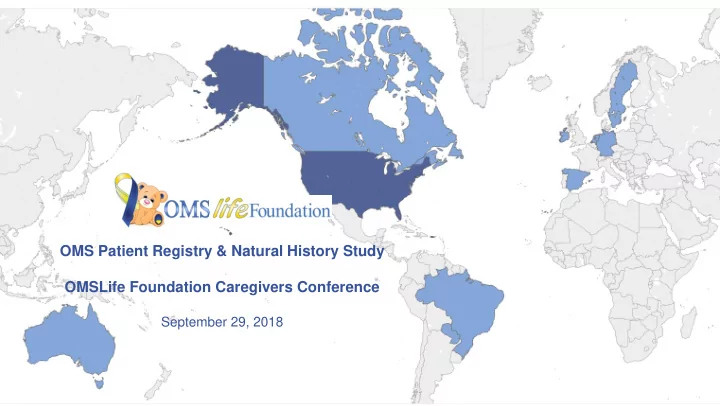
OMS Patient Registry & Natural History Study OMSLife Foundation Caregivers Conference
September 29, 2018
Title Layout Details on OMS Onset to Date August 20, 2017 OMS - - PowerPoint PPT Presentation
OMS Patient Registry Natural History Study Title Layout Details on OMS Onset to Date August 20, 2017 OMS Patient Registry & Natural History Study OMSLife Foundation Caregivers Conference SUBTITLE September 29, 2018 The OMSLife
SUBTITLE
OMS Patient Registry – Natural History Study Details on OMS Onset to Date – August 20, 2017
OMS Patient Registry & Natural History Study OMSLife Foundation Caregivers Conference
September 29, 2018
The OMSLife Foundation - Who we are
Founded in 2012 Our mission is
➢Raise awareness of OMS ➢Provide a support network for patients and caregivers ➢Fund OMS research
We now work with a network of 1,025 OMS patients in 56 countries We have hosted seven OMS caregivers conferences since 2014 We co-host the OMS Medical conference in Abingdon England And now, we are building the first OMS Patient Reported Natural History Study
2 OMS Patient Registry – Natural History Study
Before we discuss our Registry – A special thank you…
Our doctors / presenters:
Kitty Petty
Sue Rossov Brian Cisneros Our Board of Directors: Christy Dennis Hank Holley Becky Jennings Bill Bradley Shandi Riccioti Billy Enochs Anja Norman
3 OMS Patient Registry – Natural History Study
Methodology – The OMS Patient Registry
▪ The OMS Patient Reported Registry is a natural history study over time chronicling changes in treatments, therapies, behaviors, relapses, education, and overall quality of life. ▪ Registry funding is supported by a 5 year cooperative agreement between National Organization of Rare Disorders (NORD) and the U.S. Food and Drug Administration (FDA). ▪ Data input is through an online portal housed and maintained by NORD. The portal allows customized data prompts and questions. ▪ Data are stored in a manner that meet all US government mandated standards for data security and PHI protection. ▪ The data collection forms, processes, and outputs were reviewed and approved by Hummingbird IRB. ▪ Data collection initiated Feb 2017. Data views provided in this presentation were as of April 2018.
4 OMS Patient Registry – Natural History Study
Our Survey Process - The OMS Patient Registry
▪ We had 2 teams assist in the survey generation:
▪ Development team – 4 OMS caregivers/stakeholders ▪ Medical team – Mitchell, Lotze, Gorman, Tardieu, Berg
▪ Surveys were created by development team / modified by medical team ▪ Surveys and reports are sent for IRB approval ▪ Programmed by NORD ▪ Then launched ▪ Analytics for this presentation were done with assistance from Trio Health
5 OMS Patient Registry – Natural History Study
What the Registry means to you
OMS Specialists ▪ Provides view on larger sample sets than they can otherwise access ▪ Allows opportunities to have surveys developed for trends they are seeing ▪ Allows quick turnaround on patient data Clinicians ▪ Provides reference materials on a variety of OMS topics ▪ Give alternative options when typical protocols are not working
6 OMS Patient Registry – Natural History Study
Researchers ▪ Provide secondary mechanism to validate findings
▪ Research ▪ Other OMS registries
▪ Provide a base of potential patients for clinical studies Patients and Caregivers ▪ Provide resource information for discussions with clinicians ▪ Provide data for fighting insurance claims ▪ Give realistic view into patient outcomes
What the Registry means to you
OMS Specialists ▪ Provides view on larger sample sets than they can otherwise access ▪ Allows opportunities to have surveys developed for trends they are seeing ▪ Allows quick turnaround on patient data Clinicians ▪ Provides reference materials on a variety of OMS topics ▪ Give alternative options when typical protocols are not working
7 OMS Patient Registry – Natural History Study
Researchers ▪ Provide secondary mechanism to validate findings
▪ Research ▪ Other OMS registries
▪ Provide a base of potential patients for clinical studies Patients and Caregivers ▪ Provide resource information for discussions with clinicians ▪ Provide data for fighting insurance claims ▪ Give realistic view into patient outcomes
Numbers have increased since February 2017 launch
OMS Patient Registry – Natural History Study 8
Demographics (n=139)
Onset & Diagnosis (n=123)
Therapies (n=97)
Drug Treatments (n=104)
OMS Natural History Study Forms and Fields
148 respondents across 4 primary forms as of April 2018..
9 OMS Patient Registry – Natural History Study
Patient Demographics (n=139)
Female 53% Male 47%
Gender
10 OMS Patient Registry – Natural History Study
Birth Country
Australia 2/139 (2%) Brazil 1/139 (1%) Canada 5/139 (3%) Germany 5/139 (3%) Ireland 1/139 (1%) Netherlands 1/139 (1%) Paraguay 1/139 (1%) Spain 1/139 (1%) Sweden 1/139 (1%) United Kingdom 3/139 (2%) United States 118/139 (84%)
American Indian or Alaska Native 1% Asian 2% Black 2% White 85% Other 10%
Race
Patient Demographics (n=139)
11 OMS Patient Registry – Natural History Study
Family Size
2 family members 4/139 (3%) 3 family members 31/139 (22%) 4 family members 48/139 (36%) 5 family members 35/139 (25%) 6 family members 7/119 (5%) 7 or more family members 8/119 (5%) Not Reported 6/139 (4%)
Yes 96% No 1% No Reply 3%
Health Insurance
49% 4% 10% 4% 4% 1% 1% 27% 0% 20% 40% 60% Private health… State-… Medicaid Medicaid|Privat… Military health… Other… SCHIP… Don't know
Primary Insurance
1% 2% 9% 9% 17% 35% 23% 2% 2% 0% 10% 20% 30% 40% Did not graduate GED High School Grad Trade school Went to College College Grad Post College work Don't Know No Answer
Mother’s Education
2% 3% 13% 5% 15% 35% 18% 5% 4% 0% 10% 20% 30% 40% Did not graduate GED High School Grad Trade school Went to College College Grad Post College work Don't Know No Answer
Father’s Education
24% 27% 18% 6% 8% 17% 0% 10% 20% 30% <$50K $50K<$100K $100K<$150K $150K<$200K $200+ Not reported
Household Annual Income
87% of patients were ≤36 months at symptoms onset; median age of pediatric onset was 18 months
12 OMS Patient Registry – Natural History Study
4% 12% 36% 15% 13% 7% 10% 3% 0% 5% 10% 15% 20% 25% 30% 35% 40% 0-6 months 7-12 months 13-18 months 19-24 months 25-30 months 31-36 months 3-17 years Adult
Age at Onset N=123 Number Summary Overall Pediatric min 2.0 2.0 25th percentile 14.0 14.0 median 18.0 18.0 mean 32.3 24.2 75th percentile 29.8 29.0 max 420.0 120.0 n 123 120 Age at Onset (months)
Neurologist 84% Oncologist 11% Other 5%
Who diagnosed patient n=123
Days to Diagnose has decreased; Initial Diagnosis has become more Accurate
13 OMS Patient Registry – Natural History Study
112 168 27 61 38 14 20 40 60 80 100 120 140 160 180 200 Pre 2010 2010-2014 2015-Present
Days to Diagnosis OMS
Mean Median 27% 44% 58% 45% 33% 22% 28% 23% 20% 0% 20% 40% 60% 80% 100% Pre 2010 2010-2014 2015-Present
Initial Diagnosis Trends
OMS Acute Cerebellar Ataxia Other
Initial Diagnosis (n=118*)
Onset Date Before 2010 2010- 2014 2015 – Present OMS 9 17 26 Misdiagnosed 24 22 19
15 13 10
9 9 9 n 33 39 45
Days to Diagnose OMS (n=118)
Onset Date Before 2010 2010- 2014 2015 – Present Min 1 1 1 25th Per 19 16 5 Median 61 38 14 Mean 112.2 167.6 26.8 75th Per 157 127.5 31 Max 922 2038 280 n 33 40 45 *Note – five people did not respond
Ataxia was the most common symptom at onset, indicated in 85% of patients
14 OMS Patient Registry – Natural History Study
9% 13% 14% 26% 37% 44% 46% 58% 60% 85% 0% 20% 40% 60% 80% 100% Headache Fever Other* Vomiting Temper tantrums Sleep disturbances Tremors Opsoclonus Myoclonus Loss of balance (ataxia)
% Patients with a given symptom at onset (n=123)
*Other includes Clinginess (2), Depression (2), Diarrhea, Excessive Drooling (2), Head Tilt, Hypotonia, Loss of Appetite, Muscle Spams, Nystagmus, Seizures, and Spaced Out.
Association of Symptoms at Onset
15 OMS Patient Registry – Natural History Study n=10 n=12 n=15 n=30 n=41 n=49 n=54 n=65 n=69 n=94 Headache Fever Other Vomiting Temper tantrums Sleep disturbances Tremors Opsoclonus Myoclonus Loss of balance (ataxia) Headache 33% 20% 17% 17% 14% 9% 12% 10% 11% Fever 40% 7% 23% 15% 10% 9% 15% 10% 11% Other 30% 8% 13% 15% 18% 17% 15% 13% 14% Vomiting 50% 58% 27% 29% 24% 28% 29% 29% 28% Temper tantrums 70% 50% 40% 40% 69% 52% 45% 38% 38% Sleep disturbances 70% 42% 60% 40% 83% 69% 57% 51% 46% Tremors 50% 42% 60% 50% 68% 76% 57% 65% 52% Opsoclonus 80% 83% 67% 63% 71% 76% 69% 75% 60% Myoclonus 70% 58% 60% 67% 63% 71% 83% 80% 67% Loss of balance (ataxia) 100% 83% 87% 87% 88% 88% 91% 86% 91%
Frequency of Symptoms at Onset (columns)
83% of patients with Temper Tantrum also had Sleep Disturbances at symptom onset 69% of patients with Sleep Disturbances also had Temper Tantrums at symptom onset
OMS Severity
16 OMS Patient Registry – Natural History Study
2 5 4 3 7 9 9 13 6 5 16 14 14 16 2 4 6 8 10 12 14 16 18 5 6 7 8 9 10 11 12 13 14 15 16 17 18
MITCHELL-PIKE OMS SEVERITY SCALE
OMS Severity by Individual Measures
17 OMS Patient Registry – Natural History Study
Stance Score DESCRIPTION NO. % Standing and sitting balance normal for age 1 1% 1 Mildly unstable standing for age, slightly wide based 19 17% 2 Unable to stand without support but can sit without support 19 17% 3 Unable to sit without using hands to prop or other support 71 65% Total 110 Gait Score DESCRIPTION NO. % Walking normal for age 1 1% 1 Mildly wide-based gait for age, but able to walk indoors and
14 13% 2 Walks only or predominantly with support from person or equipment 34 31% 3 Unable to walk even with support from person or equipment 61 55% Total 110 Arm/Hand Function Score DESCRIPTION NO. % Normal for age 4 4% 1 Mild, infrequent tremor or jerkiness without functional impairment 13 12% 2 Fine motor function persistently impaired for age, but less precise manipulative tasks normal or almost normal 22 20% 3 Major difficulties in all age-appropriate fine motor and manipulative tasks 71 65% Opsoclonus Score DESCRIPTION NO. % None 4 4% 1 Rare or only when elicted by change in fixation or "squeeze test" 16 15% 2 Frequent, interferes intermittently with fixation or tracking 50 45% 3 Persistent, interfering continuosly with function and tracking 40 36% Total 110 Mood/Behavior Score DESCRIPTION NO. % Normal 6 5% 1 Mild increase in irritability but consolable; and/or mild sleep disturbances 18 16% 2 Irritability and sleep disturbances interfering with child and family life 49 45% 3 Persistent severe distress 37 34% Total 110 Speech Score DESCRIPTION NO. % Normal for age, no loss 23 21% 1 Mildly unclear, plateaued in development 14 13% 2 Loss of some words or some grammatical constructs (i.e. from sentences to phrases) but still communicates verbally 22 20% 3 Severe loss of verbal communication and speech 51 46%
OMS SEVERITY SCORES OVER TIME
OMS Patient Registry – Natural History Study 18
* Four (4) participants did not have onset date validated
MITCHELL-PIKE OMS SEVERITY SCALE (N=123) OMS Severity Scores Onset Date Before 2010 2010- 2014 2015 – Present Min 8 5 6 25th Per 13 10.3 10 Median 16 15 12 Mean 14.9 13.3 12.3 75th Per 17 16 15 Max 18 18 18 n 37 38 46
Days to Diagnose has decreased; Initial Diagnosis has become more Accurate; Scores are Down
19 OMS Patient Registry – Natural History Study
112 168 27 61 38 14 20 40 60 80 100 120 140 160 180 200 Pre 2010 2010-2014 2015-Present
Days to Diagnosis OMS
Mean Median 27% 44% 58% 45% 33% 22% 28% 23% 20% 0% 20% 40% 60% 80% 100% Pre 2010 2010-2014 2015-Present
Initial Diagnosis Trends
OMS Acute Cerebellar Ataxia Other
Therapies Consistently Showed Favorable Results (n=97)
20 OMS Patient Registry – Natural History Study
Therapies Consistently Showed Favorable Results (n=97)
21 OMS Patient Registry – Natural History Study
31 32 8 1 1 33 23 11 2 37 25 8 2 1 17 3 2 1
Behavioral Therapy Occupational Therapy Physical Therapy Speech Therapy
Here are the Next Steps on our 5 Year Roadmap
22 OMS Patient Registry – Natural History Study
March 2016
NORD Grant
February 28 2017
Registry launch – Rare Disease Day
2017 Goal: 100 Registered participants 2017 total: 190 Registered participants March 2018
First pass analytics
October 2018
Detailed analytics of 150 OMS patients
December 31, 2018
Goal: 400 registered OMS patients Goal: 150 patients completed all surveys
December 31, 2018
Goal: 5 additional surveys developed Goal: 3 OMS SC surveys developed
2019 - Beyond
Detailed analytics Publications and papers produced
Our next steps
23 OMS Patient Registry – Natural History Study
▪Working on surveys for doctors:
▪ Adolescent and young adult trends (Wendy Mitchell) ▪ Vaccine schedules post remission (Lotze, Mitchell) ▪ Rituximab trends in treatment (frequency, dosage) ▪ Relapse Trends
▪Patient Roadmap ▪Health Tracker
Would you consider participating in the Registry???
24 OMS Patient Registry – Natural History Study
▪Work on your surveys ▪Keep your surveys updated as life events change ▪Suggest topics and/or questions for the registry
Ways you can help OMSLife
25 OMS Patient Registry – Natural History Study
▪Amazon Smile – sign up, tell your friends and family ▪Social media help – YouTube, Instagram, Twitter, OMSLife en Espanol ▪Wiki – help us build the Wiki ▪Donate
▪ Fun runs, walks, Facebook events, write a check, buy a t-shirt, etc…
▪Other help
▪ Web site development, help with conferences, etc…
Special thanks to
26 OMS Patient Registry – Natural History Study
The OMS Registry Project Team Brooke D’Souza Christy Dennis Kellee Miller Our Medical Advisory Team
…And NORD who provided the 5 year grant to The OMSLife Foundation
Trio Health Scott Milligan
The patients and caregivers who contributed to the registry The OMSLife Foundation Board of Directors