TinyOS Hardw are Evolution Miniature hardware devices manufactured - - PDF document

tinyos hardw are evolution
SMART_READER_LITE
LIVE PREVIEW

TinyOS Hardw are Evolution Miniature hardware devices manufactured - - PDF document

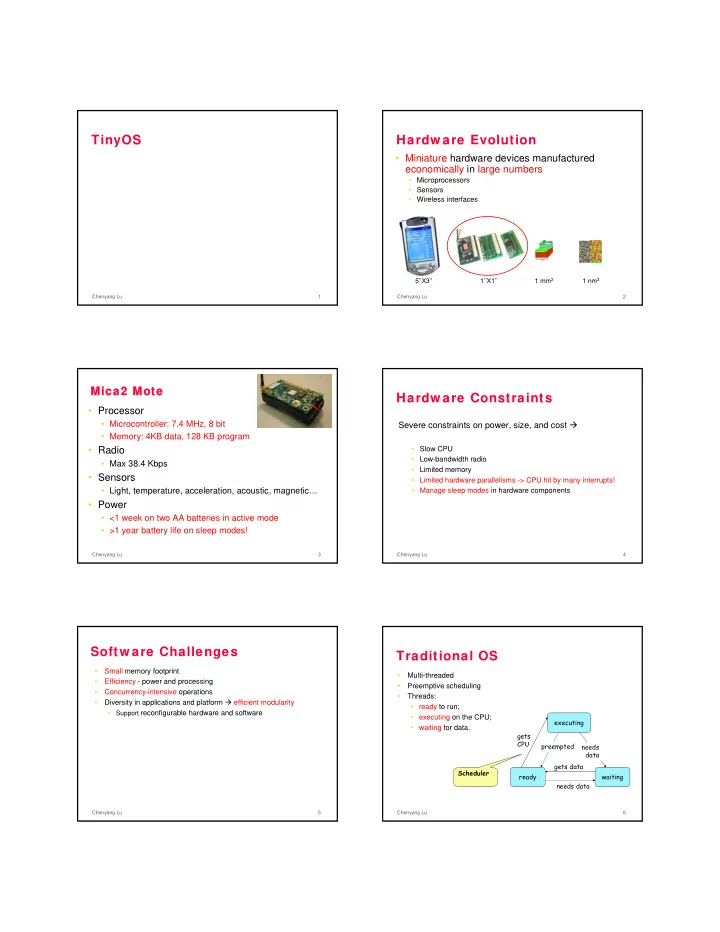
TinyOS Hardw are Evolution Miniature hardware devices manufactured economically in large numbers Microprocessors Sensors Wireless interfaces 5X3 1X1 1 mm 2 1 nm 2 Chenyang Lu 1 Chenyang Lu 2 Mi


slide-1
SLIDE 1

Chenyang Lu 1

TinyOS

Chenyang Lu 2

Hardw are Evolution

  • Miniature hardware devices manufactured

economically in large numbers

  • Microprocessors
  • Sensors
  • Wireless interfaces

5’’X3’’ 1’’X1’’ 1 mm2 1 nm2

Chenyang Lu 3

Mi Mica2 M ca2 Mote te

  • Processor
  • Microcontroller: 7.4 MHz, 8 bit
  • Memory: 4KB data, 128 KB program
  • Radio
  • Max 38.4 Kbps
  • Sensors
  • Light, temperature, acceleration, acoustic, magnetic…
  • Power
  • <1 week on two AA batteries in active mode
  • >1 year battery life on sleep modes!

Chenyang Lu 4

Hardw are Constraints

Severe constraints on power, size, and cost

  • Slow CPU
  • Low-bandwidth radio
  • Limited memory
  • Limited hardware parallelisms -> CPU hit by many interrupts!
  • Manage sleep modes in hardware components

Chenyang Lu 5

Softw are Challenges

  • Small memory footprint
  • Efficiency - power and processing
  • Concurrency-intensive operations
  • Diversity in applications and platform efficient modularity
  • Support reconfigurable hardware and software

Chenyang Lu 6

Traditional OS

  • Multi-threaded
  • Preemptive scheduling
  • Threads:
  • ready to run;
  • executing on the CPU;
  • waiting for data.

executing ready waiting needs data gets data needs data preempted gets CPU Scheduler

slide-2
SLIDE 2

Chenyang Lu 7

Pros and Cons of Traditional OS

  • Multi-threaded + preemptive scheduling
  • Blocked threads waste memory
  • Context switch overhead
  • I/O
  • Blocking I/O: waste memory on blocked threads
  • Polling (busy-wait): waste CPU cycles and power

Chenyang Lu 8

Existing Embedded OS

  • QNX context switch = 2400 cycles on x86
  • pOSEK context switch > 40 µs
  • Creem -> no preemption

Name Code Size Target CPU pOSEK 2K Microcontrollers pSOSystem PII->ARM Thumb VxWorks 286K Pentium -> Strong ARM QNX Nutrino >100K Pentium II -> NEC QNX RealTime 100K Pentium II -> SH4 OS-9 Pentium -> SH4 Chorus OS 10K Pentium -> Strong ARM ARIEL 19K SH2, ARM Thumb Creem 560 bytes ATMEL 8051

System architecture directions for network sensors, J. Hill, R. Szewczyk, A. Woo, S. Hollar, D. Culler, K. Pister. ASPLOS 2000.

Chenyang Lu 9

TinyOS Solutions

  • Efficient modularity
  • Application = scheduler + graph of components
  • Compiled into one executable
  • Only needed components are complied/loaded
  • Concurrency: event-driven architecture

Communication Actuating Sensing Communication Application (User Components) Main (includes Scheduler) Hardware Abstractions

Modified from D. Culler et. Al., TinyOS boot camp presentation, Feb 2001

Chenyang Lu 10

Typical Application

RFM Radio Byte (MAC) Radio Packet i2c Temp photo Messaging Layer clocks bit byte packet Routing Layer sensing application application

HW SW

ADC messaging routing

  • D. Culler et. Al., TinyOS boot camp presentation, Feb 2001

Chenyang Lu 11

Tw o-level Scheduling

  • Events handle interrupts
  • Interrupts trigger lowest level events
  • Events can signal events, call commands, or post tasks
  • Tasks perform deferred computations
  • Interrupts preempt tasks and interrupts

Hardware Interrupts events commands FIFO Tasks POST Preempt Time commands Chenyang Lu 12

Multiple Data Flow s

  • Respond quickly: sequence of event/command

through the component graph.

  • Immediate execution of function calls
  • e.g., get bit out of radio hw before it gets lost.
  • Post tasks for deferred computations.
  • e.g., encoding.
  • Events preempt tasks to handle new interrupts.
slide-3
SLIDE 3

Chenyang Lu 13

Receiving a Message

Timing diagram of event propagation (step 0-6 takes about 95 microseconds total)

Chenyang Lu 14

Scheduling

  • Interrupts preempt tasks
  • Respond quickly
  • Event/command implemented as function calls
  • Task cannot preempt tasks
  • Reduce context switch efficiency
  • Single stack low memory footprint
  • TinyOS 2 supports pluggable task scheduler (default: FIFO).
  • Scheduler puts processor to sleep when
  • no event/command is running
  • task queue is empty

Chenyang Lu 15

Space Breakdow n…

Code size for ad hoc networking application

500 1000 1500 2000 2500 3000 3500

Bytes Interrupts Message Dispatch Initilization C-Runtime Light Sensor Clock Scheduler Led Control Messaging Layer Packet Layer Radio Interface Routing Application Radio Byte Encoder

Scheduler: 144 Bytes code Totals: 3430 Bytes code 226 Bytes data

  • D. Culler et. Al., TinyOS boot camp presentation, Feb 2001

Chenyang Lu 16

Pow er Breakdow n…

  • Lithium Battery runs for 35 hours at peak load and years at

minimum load!

  • That’s three orders of magnitude difference!
  • A one byte transmission uses the same energy as approx

11000 cycles of computation.

3 mA EE-Prom 4.5 mA (RX) 2 mA Idle 200 μA Temperature 200 μA Photo Diode 4 mA LED’s 5 μA 7 mA (TX) Radio 5 μA 5 mA CPU Sleep Active Panasonic CR2354 560 mAh

Chenyang Lu 17

Time Breakdow n…

  • 50 cycle task overhead (6 byte copies)
  • 10 cycle event overhead (1.25 byte copies)

Components

Packet reception work breakdown CPU Utilization Energy (nj/Bit) AM

0.05% 0.20% 0.33

Packet

1.12% 0.51% 7.58

Ratio handler

26.87% 12.16% 182.38

Radio decode thread

5.48% 2.48% 37.2

RFM

66.48% 30.08% 451.17

Radio Reception

  • 1350

Idle

  • 54.75%
  • Total

100.00% 100.00% 2028.66

Chenyang Lu 18

Advantages

  • Small memory footprint
  • Only needed components are complied/loaded
  • Single stack for tasks
  • Power efficiency
  • Put CPU to sleep whenever the task queue is empty
  • TinyOS 2 provides efficient power management for peripherals

and microprocessors.

  • Efficient modularity
  • Event/command interfaces between components
  • Event/command implemented as function calls
  • Concurrency-intensive operations
  • Event/command + tasks
slide-4
SLIDE 4

Chenyang Lu 19

Disadvantages

  • Lack preemptive real-time scheduling
  • Urgent task may wait for non-urgent ones
  • Lack flexibility
  • Static linking only
  • Cannot change parts of the code dynamically
  • Virtual memory?

Chenyang Lu 20

More

  • Multi-threaded vs. event-driven architectures
  • Lack empirical comparison against existing OSes
  • A “standard” OS is more likely to be adopted by industry
  • Jury is still out…
  • Alternative: Native Java Virtual Machine?
  • Java programming
  • Virtual machine provides protection
  • Example: Sun SPOT

Chenyang Lu 21

Reading

  • J. Hill, R. Szewczyk, A. Woo, S. Hollar, D. Culler, and K. Pister,

System Architecture Directions for Network Sensors.