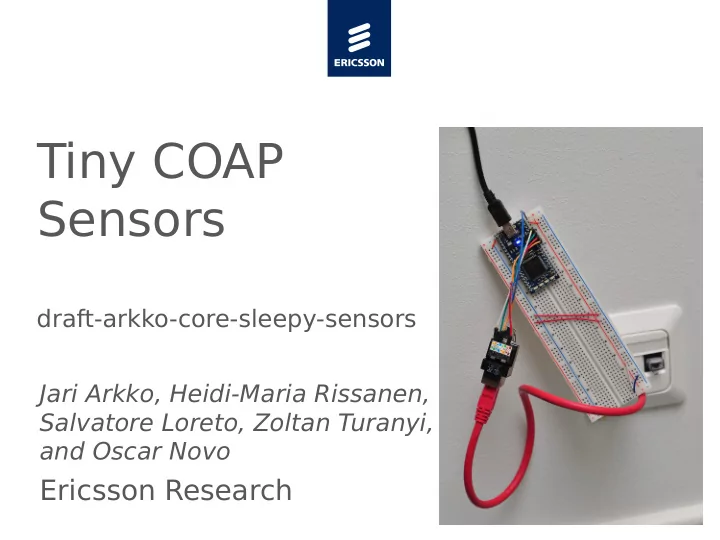
Tiny COAP Sensors draft-arkko-core-sleepy-sensors Jari Arkko, - - PowerPoint PPT Presentation

tiny coap sensors
SMART_READER_LITE
LIVE PREVIEW

Tiny COAP Sensors draft-arkko-core-sleepy-sensors Jari Arkko, - - PowerPoint PPT Presentation

Tiny COAP Sensors draft-arkko-core-sleepy-sensors Jari Arkko, Heidi-Maria Rissanen, Salvatore Loreto, Zoltan Turanyi, and Oscar Novo Ericsson Research Legacy, Non-IP T echnology Can we do the same on IP? YES we can! Motivation The goal


slide-1
SLIDE 1

Tiny COAP Sensors

draft-arkko-core-sleepy-sensors Jari Arkko, Heidi-Maria Rissanen, Salvatore Loreto, Zoltan Turanyi, and Oscar Novo

Ericsson Research

slide-2
SLIDE 2

Legacy, Non-IP T echnology

Can we do the same on IP? YES we can!

slide-3
SLIDE 3

Ericsson Internal | 2011-03-31 | Page 3

Motivation

The goal was to create IP(v6) based sensors with

  • 1. Natural support for sleeping nodes
  • 2. Build something so simple that it could be re-

implemented later with gates (not CPUs)

  • 3. Communication models that fit the problem at hand
  • 4. Good design from user perspective
slide-4
SLIDE 4

Ericsson Internal | 2011-03-31 | Page 4

Non-Goals

This is NOT

  • 1. A general purpose implementation of COAP or any other

protocol; we only implement what is actually needed in the application context

  • 2. An implementation for general purpose computers
  • 3. RFC compliance exercise. It works. 'nuff said.
slide-5
SLIDE 5

Ericsson Internal | 2011-03-31 | Page 5

Highlights from the Implementation

Consists of 48 lines of assembler code Ethernet, IPv6, UDP, COAP, XML, and app Multicast, checksums, msg and device IDs Approaches theoretical minimum power usage No configuration needed

Look for packets to ff02::fe00:1 in the IETF wired network!

slide-6
SLIDE 6

Ericsson Internal | 2011-03-31 | Page 6

Making Small Implementions: Problem 1 – Sleeping Nodes

The device should ideally sleep as much as possible The fundamental issue is having to wait for responses

  • Asking for an address from DHCP, waiting for a prefix from RA, waiting for

DAD responses, waiting for COAP/HTTP requests, or waiting for COAP registrations

The communication model is wrong! Do this instead:

  • 1. Sensors multicast their readings
  • 2. A cache node collects the messages
  • 3. Other nodes access the cache at any time

C S S S S U

slide-7
SLIDE 7

Ericsson Internal | 2011-03-31 | Page 7

Power Savings Comparison

Lets assume periodic messages once per minute. On a 10Mbit/s interface sending one message takes 100 us, i.e., ratio of sleep vs. awake is 600.000x A node that wakes up for one second every minute to listen has a ratio of only 60x 10.000x difference!!! Even if we assume that it takes ten times more to wake up and process the packet than the actual line speed is, we still get a 1.000x difference

slide-8
SLIDE 8

Ericsson Internal | 2011-03-31 | Page 8

Making Small Implementions: Problem 2 – Address Configuration

How do we get an address without having to stay awake? The solution:

  • 1. Use IPv6 link-local source addresses

– No need to wait for RAs or remember prefixes

  • 2. Use MAC-address -based generation of these addresses
  • 3. Do not employ DAD

– Not quite according to the RFC... but works better

slide-9
SLIDE 9

Ericsson Internal | 2011-03-31 | Page 9

Making Small Implementions: Problem 3 – Zero Configuration

How do we avoid having to configure these tiny devices? The solution:

  • 1. Sensor IDs are burned into the hardware at factory
  • 2. Sensors use multicast, no need to know any specific

destination addresses

  • 3. All configuration that might be needed (e.g., sensor X is

at room Y) happens at the gateway/cache node

slide-10
SLIDE 10

Ericsson Internal | 2011-03-31 | Page 10

Draft Schema for HW Implementation

slide-11
SLIDE 11

Ericsson Internal | 2011-03-31 | Page 11

Reflections on COAP

There are areas where additional documention is needed How one should use multicast What data to include (URNs, payloads, options) How to configure COAP nodes in practical networks But there are also fundamental concerns The lightweight nature of COAP is more about small changes to syntax and behavior (TCP=>UDP) than about eliminating reasons behind complexity and power usage Like re-arranging the deck chairs on Titanic! COAP can (perhaps) be used in sleepy nodes, but it requires great care

slide-12
SLIDE 12

Ericsson Internal | 2011-03-31 | Page 12

Communication Models: 1. Send-Only

slide-13
SLIDE 13

Ericsson Internal | 2011-03-31 | Page 13

Communication Models: 1. Send-Only

slide-14
SLIDE 14

Ericsson Internal | 2011-03-31 | Page 14

  • 2. Send & Confirm
slide-15
SLIDE 15

Ericsson Internal | 2011-03-31 | Page 15

  • 2. Send & Confirm
slide-16
SLIDE 16

Ericsson Internal | 2011-03-31 | Page 16

  • 3. Server
slide-17
SLIDE 17

Ericsson Internal | 2011-03-31 | Page 17

  • 3. Server
slide-18
SLIDE 18

Ericsson Internal | 2011-03-31 | Page 18

  • 4. Observer
slide-19
SLIDE 19

Ericsson Internal | 2011-03-31 | Page 19

  • 4. Observer
slide-20
SLIDE 20

Ericsson Internal | 2011-03-31 | Page 20

Suggested Changes to COAP Specs

Multicast and Non-Confirmable requests: Specify better what the re-transmission rules should be for non- confirmable requests Specify what the multicast transmission rules are with respect to congestion (random delays etc) Consider standardizing what destination addresses and target URIs to use Communication models Explain the implication of different models Change the observer model so that it becomes compatible with sleeping nodes

slide-21
SLIDE 21