Time series modelling with MATLAB: the SSpace toolbox Pedregal DJ, - - PowerPoint PPT Presentation

time series modelling with matlab the sspace toolbox
SMART_READER_LITE
LIVE PREVIEW

Time series modelling with MATLAB: the SSpace toolbox Pedregal DJ, - - PowerPoint PPT Presentation

Introduction State Space Framework System implementation in SSpace Examples Conclusion Time series modelling with MATLAB: the SSpace toolbox Pedregal DJ, Villegas MA, Villegas D, Trapero JR Universidad de Castilla-La Mancha ETSII (Ciudad


slide-1
SLIDE 1

Introduction State Space Framework System implementation in SSpace Examples Conclusion

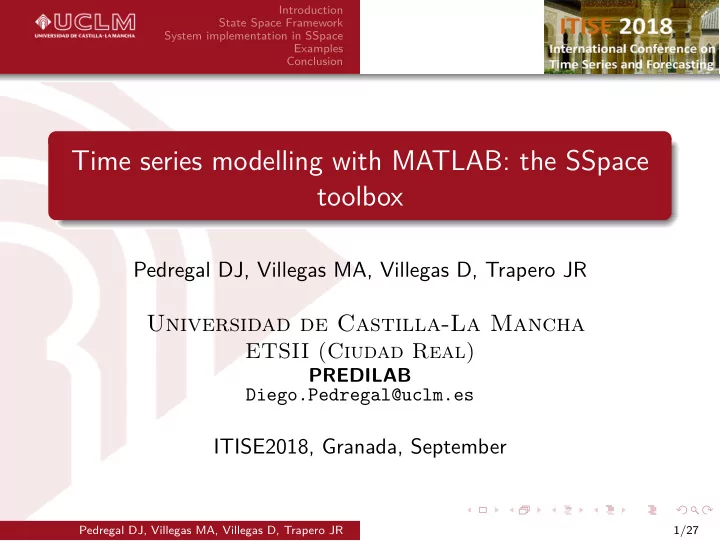
Time series modelling with MATLAB: the SSpace toolbox

Pedregal DJ, Villegas MA, Villegas D, Trapero JR

Universidad de Castilla-La Mancha

ETSII (Ciudad Real)

PREDILAB Diego.Pedregal@uclm.es

ITISE2018, Granada, September

Pedregal DJ, Villegas MA, Villegas D, Trapero JR 1/27

slide-2
SLIDE 2

Introduction State Space Framework System implementation in SSpace Examples Conclusion

Outline

1 Introduction 2 State Space Framework 3 System implementation in SSpace 4 Examples 5 Conclusion

Pedregal DJ, Villegas MA, Villegas D, Trapero JR 2/27

slide-3
SLIDE 3

Introduction State Space Framework System implementation in SSpace Examples Conclusion

Introduction

SSpace is a package that implements linear, non-linear and non-Gaussian State Space systems in a very flexible and powerful way. It is mainly based on the work of Peter C Young and colaborators with other elements, like the books of Harvey (1989), Durbin and Koopman (2012), resembling many well-known alternative packages, but there are some unique interesting elements in it... Download at https://bitbucket.org/predilab/sspace-matlab/ To appear soon at the Journal of Statistical Software

Pedregal DJ, Villegas MA, Villegas D, Trapero JR 3/27

slide-4
SLIDE 4

Introduction State Space Framework System implementation in SSpace Examples Conclusion

Introduction

Statistical features:

1 The statistical framework is very general in the equations

formulation and in the sense that all system matrices are multivariate and potentially time-varying.

2 Exact or diffuse initialisation of Kalman Filtering and state

and disturbance smoothing.

3 Use of exact gradient in Maximum Likelihood estimation,

when possible.

4 Kalman filtering and smoothing based on univariate treatment

  • f multivariate systems.

5 Other estimation procedures, i.e. Concentrated Likelihood and

minimum RMSE of several steps ahead are implemented.

6 ...

Pedregal DJ, Villegas MA, Villegas D, Trapero JR 4/27

slide-5
SLIDE 5

Introduction State Space Framework System implementation in SSpace Examples Conclusion

Introduction

Other advantages:

1 It is free. 2 Simple in its usage, since models are standard functions

written in MATLAB.

3 A wide range of templates for specific models are available

(Unobserved Components, ARIMA, Regression, Exponential Smoothing, Stochastic Volatility, etc.).

4 A full time series analysis may be done with a reduced number

  • f coded functions with names that have been carefully

selected following nemotechnic rules so that the user may remember them easily.

5 Minimizer may be chosen (fminunc). 6 We have a fully MATLAB version, we have coded core

functions in C++ and finishing a R version.

Pedregal DJ, Villegas MA, Villegas D, Trapero JR 5/27

slide-6
SLIDE 6

Introduction State Space Framework System implementation in SSpace Examples Conclusion

Linear-Gaussian State Space system

State equation:

αt+1 = Ttαt + γt + Rtηt

Observation equation:

yt = Ztαt + dt + Ctǫt

ηt: vector of state noises v × 1, N(0; Qt) ǫt: vector of observed noises h × 1, N(0; Ht) St = E(ǫt, η′

t) covariance matrix h × v

γt = f (Γt, ut) and dt = g(Dt, ut), with ut of dimensions k × 1 yt: output vector m × 1 αt: state vector n × 1 Every term is potentially multivariate and time-varying Many different ways to write the same system

Pedregal DJ, Villegas MA, Villegas D, Trapero JR 6/27

slide-7
SLIDE 7

Introduction State Space Framework System implementation in SSpace Examples Conclusion

Non-Gaussian State Space system

State equation:

αt+1 = Ttαt + γt + Rtηt

Observation equation:

yt ∼ p(yt | θt) + dt θt = Ztαt

1 Exponential family distribution, where

p(yt | θt) = exp[y′

tθt − bt(θt) + ct(yt)], −∞ < θt < ∞. 2 Stochastic Volatility models, i.e. yt = exp(1 2θt)ǫt + dt. 3 Observations generated by the relation

yt = θt + ǫt, ǫt ∼ p(ǫt), with p(•) being a distribution of the exponential family.

Pedregal DJ, Villegas MA, Villegas D, Trapero JR 7/27

slide-8
SLIDE 8

Introduction State Space Framework System implementation in SSpace Examples Conclusion

Non-Linear State Space system

State equation:

αt+1 = Tt(αt) + γt + Rt(αt)ηt

Observation equation:

yt = Zt(αt) + dt + Ct(αt)ǫt ηt ∼ N(0, Qt(αt)), ǫt ∼ N(0, Ht(αt))

The system is actually non-linear and/or state-dependent. At the moment the Extended Kalman Filter and state smoothing with exact initialisation are the implemented algorithms (Koopman and Lee, 2009).

Pedregal DJ, Villegas MA, Villegas D, Trapero JR 8/27

slide-9
SLIDE 9

Introduction State Space Framework System implementation in SSpace Examples Conclusion

  • 1. Specify
  • 2. Translate
  • 3. Set up model
  • 4. Estimation, validation, filtering, ...
  • 1. Specify the model

For a local level model: State equation: Lt+1 = Lt + ηt Observation equation: yt = Lt + ǫt We have to fit that model in the general framework: State equation: αt+1 = Ttαt + γt + Rtηt Observation equation: yt = Ztαt + dt + Ctǫt αt = Lt; Tt = 1; Rt = 1; Zt = 1; Ct = 1; γt and dt do not exist. St = 0 and Qt and Ht are two unknown scalar values that have to be positive

Pedregal DJ, Villegas MA, Villegas D, Trapero JR 9/27

slide-10
SLIDE 10

Introduction State Space Framework System implementation in SSpace Examples Conclusion

  • 1. Specify
  • 2. Translate
  • 3. Set up model
  • 4. Estimation, validation, filtering, ...
  • 2. Translate

Translate model to a MATLAB function (e.g. using templates).

1

model= SampleSS(p)

2

model.T= []; model.Gam= []; model.R= []; model.Z= []; model.D= [];

3

model.C= []; model.Q= []; model.H= []; model.S= [];

For the local level model: Lt+1 = Lt + ηt yt = Lt + ǫt

1

model= example1(p)

2

model.T= 1; model.Gam= []; model.R= 1; model.Z= 1; model.D= [];

3

model.C= 1; model.Q= 10.ˆp(1); % This makes variance always positive

4

model.H= 10.ˆp(2); model.S= 0;

Pedregal DJ, Villegas MA, Villegas D, Trapero JR 10/27

slide-11
SLIDE 11

Introduction State Space Framework System implementation in SSpace Examples Conclusion

  • 1. Specify
  • 2. Translate
  • 3. Set up model
  • 4. Estimation, validation, filtering, ...
  • 3. Set up the model

1

sys= SSmodel('y', y, 'model', @example1);

Using duplets it is possible to select the input and output data, the model filename, additional inputs to the function that implements the model, initial values for parameters, fix values for parameters, diffuse or exact initialisatoin of algorithms, objective cost function and analytical or exact score in Maximum Likelihood estimation.

Pedregal DJ, Villegas MA, Villegas D, Trapero JR 11/27

slide-12
SLIDE 12

Introduction State Space Framework System implementation in SSpace Examples Conclusion

  • 1. Specify
  • 2. Translate
  • 3. Set up model
  • 4. Estimation, validation, filtering, ...
  • 3. Set up the model

Inputs to the system (and to SSmodel):

1

y: [1x100 double]

2

u: []

3

model: @example1

4

user_inputs: {}

5

p0: [2x1 double]

6

p: [2x1 double]

7

a1: NaN

8

P1: NaN

9

OBJ_FUNCTION_NAME: {@llik}

10

gradient: 1

11

Nsimul: 300

Pedregal DJ, Villegas MA, Villegas D, Trapero JR 12/27

slide-13
SLIDE 13

Introduction State Space Framework System implementation in SSpace Examples Conclusion

  • 1. Specify
  • 2. Translate
  • 3. Set up model
  • 4. Estimation, validation, filtering, ...
  • 3. Set up the model

Outputs of operations on models:

1

table: []

2

  • bj_value: 0

3

llik: 0

4

covp: []

5

mat: [1x1 struct]

6

a: 740.0149

7

P: 0.7781

8

yfit: []

9

F: []

10

yfor: []

11

Ffor: []

12

v: []

13

Fv: []

14

eta: []

15

eps: []

16

Veta: []

17

Veps: []

Pedregal DJ, Villegas MA, Villegas D, Trapero JR 13/27

slide-14
SLIDE 14

Introduction State Space Framework System implementation in SSpace Examples Conclusion

  • 1. Specify
  • 2. Translate
  • 3. Set up model
  • 4. Estimation, validation, filtering, ...
  • 4. Estimation, validation, filtering, ...

1

sys= SSestim(sys);

2

sys= SSvalidate(sys);

1

sys= SSfilter(sys); % Just for filtering estimates

2

sys= SSsmooth(sys); % For state smoothing estimates

3

sys= SSdisturb(sys); % If disturbance smoothing is required

Results are stored in sys output structure. It stores parametes with covariance matrix, optimal states and covariances, fitted output values and covariances, forecasted values and covariances, innovations, disturbances estimates with covariances. Further statistical diagnostics are advisable.

Pedregal DJ, Villegas MA, Villegas D, Trapero JR 14/27

slide-15
SLIDE 15

Introduction State Space Framework System implementation in SSpace Examples Conclusion Example 1 Example 2 Example 3 Example 4

Example 1: VARMA

The standard VARMA template is:

1

model= SampleVARMA(p)

2

Sigma = ; % Covariance matrix of perturbance

3

DIFFpoly= ; % Difference operator of output(s)

4

ARpoly = ; % (V)AR polynomial

5

MApoly = ; % (V)MA polynomial

6

D= ; % Inputs

1

model= SampleVARMA(p)

2

Sigma = 10.ˆp(1); % Covariance matrix of perturbance

3

DIFFpoly= 1; % Difference operator of output(s)

4

ARpoly = [1 p(2) p(3)]'; % (V)AR polynomial

5

MApoly = [1 p(4)]'; % (V)MA polynomial

6

D= p(5); % Inputs

Pedregal DJ, Villegas MA, Villegas D, Trapero JR 15/27

slide-16
SLIDE 16

Introduction State Space Framework System implementation in SSpace Examples Conclusion Example 1 Example 2 Example 3 Example 4

Example 1: VARMA

1

model= SampleVARMA(p, u)

2

Sigma = 10.ˆp(1); % Covariance matrix of perturbance

3

DIFFpoly= [1 -1]'; % Difference operator of output(s)

4

ARpoly = conv([1 p(2) p(3)]', [1 zeros(1, 11) p(5)]'); % (V)AR

5

MApoly = [1 p(4) -p(4)]'; % (V)MA polynomial

6

D= p(5)*u; % Inputs (row vector)

1

...

2

D= filter(1, [1 -p(5)], u)'; % Inputs

1

...

2

D= p(5)./(exp(-p(6)*u)); % Inputs

Pedregal DJ, Villegas MA, Villegas D, Trapero JR 16/27

slide-17
SLIDE 17

Introduction State Space Framework System implementation in SSpace Examples Conclusion Example 1 Example 2 Example 3 Example 4

Example 1: VARMA

1

model= SampleVARMA(p, u, y)

2

...

3

D= p(5)*u; % Inputs

4

ind= find(y> 0);

5

D(1, ind)= p(6)*u(1, ind);

Pedregal DJ, Villegas MA, Villegas D, Trapero JR 17/27

slide-18
SLIDE 18

Introduction State Space Framework System implementation in SSpace Examples Conclusion Example 1 Example 2 Example 3 Example 4

Example 2: Unobserved Components (DHR)

1

function model= SampleDHR(p, N)

2

m= ;

3

% Trend model

4

I= eye(m); O= zeros(m);

5

TT = [I I;O I]; ZT = [I O]; RT = [I O; O I];

6

QT = blkdiag(varmatrix(), varmatrix());

7 8

% Seasonal/cyclical DHR components

9

Periods = ;

10

Rho = ;

11

Qs = repmat(varmatrix(), [], []);

12 13

% Linear Regression effects

14

D= [];

15 16

% IRREGULAR COMPONENT (often empty if VAR component is included)

17

H = varmatrix();

Pedregal DJ, Villegas MA, Villegas D, Trapero JR 18/27

slide-19
SLIDE 19

Introduction State Space Framework System implementation in SSpace Examples Conclusion Example 1 Example 2 Example 3 Example 4

Example 2: Unobserved Components (DHR)

1

function model= SampleDHR(p, N)

2

m= 3;

3

% Trend model

4

I= eye(m); O= zeros(m);

5

TT = [I I;O I]; ZT = [I O]; RT = [I O; O I];

6

QT = blkdiag(varmatrix(p(1:6)), varmatrix(p(7:12)));

7 8

% Seasonal/cyclical DHR components

9

Periods = repmat([4 2], 3, 1);

10

Rho = ones(3, 2);

11

Qs = repmat(varmatrix(p(19:24)), 1, 2);

12 13

% Linear Regression effects

14

D= [];

15 16

% IRREGULAR COMPONENT (often empty if VAR component is included)

17

H = varmatrix(p(13:18));

Pedregal DJ, Villegas MA, Villegas D, Trapero JR 19/27

slide-20
SLIDE 20

Introduction State Space Framework System implementation in SSpace Examples Conclusion Example 1 Example 2 Example 3 Example 4

Example 2: Variance of seasonal components

1

...

2

Qs= [varmatrix(p(19:24)) varmatrix(p(19:24))];

3

Qs= [varmatrix(p(19:24)) varmatrix(p(25:30))];

4

Qs= [diag(10.ˆp(19:21)) diag(10.ˆp(19:21))];

5 6

% Next code produces a time varying covariance matrix with a sudden change in observation 100

7

...

8

Hc1= varmatrix(p(13:18));

9

H= repmat(Hc1, [1 1 N]);

10

Hc2= varmatrix(p(25:30));

11

H(:, :, 100:N)= repmat(Hc2, [1 1 N-99]);

Pedregal DJ, Villegas MA, Villegas D, Trapero JR 20/27

slide-21
SLIDE 21

Introduction State Space Framework System implementation in SSpace Examples Conclusion Example 1 Example 2 Example 3 Example 4

Example 3: Comparison with other software

(Airline data example of Box and Jenkins)

(All variances are 1e-6)

Variances STAMP SSpace Variance SsfPack SSpace Trend 297.84 297.75 Trend 238 237.97 Slope 0.00 0.00 Slope 0.00 Seas 3.55 3.55 Seas1 11 11.11 Irregular 237.93 237.82 Seas2 5 5.26 Seas3 0.00 Seas4 2 2.30 SEas5 1 1.23 Seas6 0.00 Irr. 327 329.78 LogLik 413.82 216.08 LogLik 223.46 223.27

Pedregal DJ, Villegas MA, Villegas D, Trapero JR 21/27

slide-22
SLIDE 22

Introduction State Space Framework System implementation in SSpace Examples Conclusion Example 1 Example 2 Example 3 Example 4

Example 4: Forecast comparisons

Daily data on sales demand of 261 products of a retailer in Spain Absolute error of 90 runs of 14 days ahead with daily data 36 % of time series are modeled as poisson processes Automatic identification techniques based on BIC:

NAIVE: random walk AR up to 32th order ARIMA (Hyndman & Khandakar, 2008) Exponential Smoothing (ES) Unobserved Components (UC) Poisson Unobserved Components (UCp) Mean combination of ARIMA, ES, UC and UCp Median combination of ARIMA, ES, UC and UCp

Pedregal DJ, Villegas MA, Villegas D, Trapero JR 22/27

slide-23
SLIDE 23

Introduction State Space Framework System implementation in SSpace Examples Conclusion Example 1 Example 2 Example 3 Example 4

Example 4: Forecast comparisons

Pedregal DJ, Villegas MA, Villegas D, Trapero JR 23/27

slide-24
SLIDE 24

Introduction State Space Framework System implementation in SSpace Examples Conclusion Example 1 Example 2 Example 3 Example 4

Forecast comparisons

Table of Mean of Mean Absolute Errors for continuous time series (168 series): 1 2 3 4 7 14 NAIVE 0.4695 1.0833 1.7437 2.4153 4.0597 8.3784 AR 0.3484 0.7198 1.0967 1.4816 2.6518 5.5116 ARIMA 0.3210 0.6634 1.0133 1.3695 2.4550 5.0598 ES 0.3308 0.6849 1.0455 1.4117 2.5241 5.2015 UC 0.3164 0.6539 0.9989 1.3500 2.4225 4.9901 Mean 0.3209 0.6635 1.0127 1.3691 2.4563 5.0740 Median 0.3216 0.6655 1.0163 1.3728 2.4590 5.0774

Pedregal DJ, Villegas MA, Villegas D, Trapero JR 24/27

slide-25
SLIDE 25

Introduction State Space Framework System implementation in SSpace Examples Conclusion Example 1 Example 2 Example 3 Example 4

Example 4: Forecast comparisons

Table of Mean of Mean Absolute Errors for Discrete series (93 series): 1 2 3 4 7 14 NAIVE 1.0128 2.0892 3.1674 4.2484 7.3912 14.9254 AR 0.8304 1.6736 2.5218 3.3707 5.9269 11.9996 ARIMA 0.8285 1.6634 2.5020 3.3425 5.8658 11.8557 ES 0.8338 1.6762 2.5220 3.3694 5.9136 11.9533 UC 0.8147 1.6331 2.4542 3.2784 5.7589 11.6495 Poisson 0.8056 1.6161 2.4284 3.2456 5.7119 11.5940 Mean 0.8089 1.6242 2.4428 3.2642 5.7368 11.6101 Median 0.8104 1.6259 2.4445 3.2660 5.7378 11.6103

Pedregal DJ, Villegas MA, Villegas D, Trapero JR 25/27

slide-26
SLIDE 26

Introduction State Space Framework System implementation in SSpace Examples Conclusion

Conclusion SSpace is a flexible and easy toolbox for full SS system analysis https://bitbucket.org/predilab/ sspace-matlab/ Documentation also available Eight examples in increasing order of complexity You may ’buy’ it by pieces:

Just filtering, smoothing and the general template (SSfilter, SSsample) Previous and additional templates Part of the previous and optimization

Pedregal DJ, Villegas MA, Villegas D, Trapero JR 26/27

slide-27
SLIDE 27

Introduction State Space Framework System implementation in SSpace Examples Conclusion

Thank you for your attention!

e-mail: diego.pedregal@uclm.es blog: www.uclm.es/profesorado/diego/

This work has been supported by the Spanish Ministerio de Econom´ ıa y Competitividad, under Research Grant no. DPI2015-64133-R (MINECO/FEDER/UE)

Pedregal DJ, Villegas MA, Villegas D, Trapero JR 27/27