CNBC Matlab Mini-Course Why Should You Learn Matlab? Data analysis: - - PDF document

cnbc matlab mini course why should you learn matlab
SMART_READER_LITE
LIVE PREVIEW

CNBC Matlab Mini-Course Why Should You Learn Matlab? Data analysis: - - PDF document

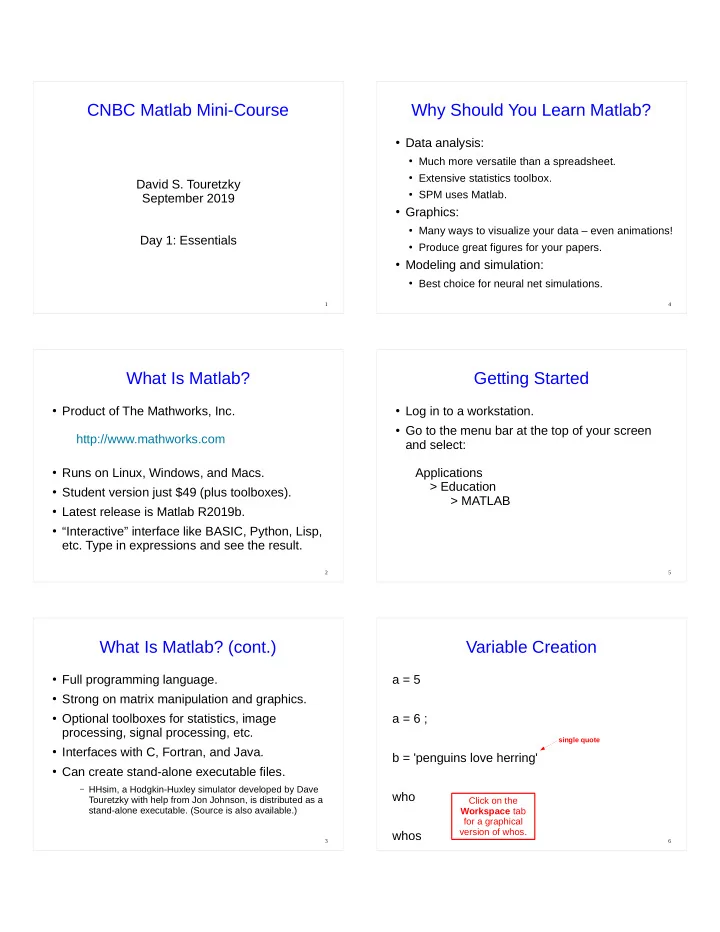
CNBC Matlab Mini-Course Why Should You Learn Matlab? Data analysis: Much more versatile than a spreadsheet. Extensive statistics toolbox. David S. Touretzky SPM uses Matlab. September 2019 Graphics: Many ways to visualize


slide-1
SLIDE 1

1

CNBC Matlab Mini-Course

David S. Touretzky September 2019 Day 1: Essentials

2

What Is Matlab?

  • Product of The Mathworks, Inc.

http://www.mathworks.com

  • Runs on Linux, Windows, and Macs.
  • Student version just $49 (plus toolboxes).
  • Latest release is Matlab R2019b.
  • “Interactive” interface like BASIC, Python, Lisp,
  • etc. Type in expressions and see the result.

3

What Is Matlab? (cont.)

  • Full programming language.
  • Strong on matrix manipulation and graphics.
  • Optional toolboxes for statistics, image

processing, signal processing, etc.

  • Interfaces with C, Fortran, and Java.
  • Can create stand-alone executable files.

– HHsim, a Hodgkin-Huxley simulator developed by Dave

Touretzky with help from Jon Johnson, is distributed as a stand-alone executable. (Source is also available.)

4

Why Should You Learn Matlab?

  • Data analysis:
  • Much more versatile than a spreadsheet.
  • Extensive statistics toolbox.
  • SPM uses Matlab.
  • Graphics:
  • Many ways to visualize your data – even animations!
  • Produce great figures for your papers.
  • Modeling and simulation:
  • Best choice for neural net simulations.

5

Getting Started

  • Log in to a workstation.
  • Go to the menu bar at the top of your screen

and select: Applications > Education > MATLAB

6

Variable Creation

a = 5 a = 6 ; b = 'penguins love herring' who whos

single quote

Click on the Workspace tab for a graphical version of whos.

slide-2
SLIDE 2

7

Matrix Creation

x = [1 2 3 ; 9 8 7] zeros(3, 5) zeros(5) zeros(5, 1) column vector zeros(1, 5) row vector

  • nes, rand, randn, eye

What does eye do?

8

Colon Creates Row Vectors

1 : 5 1 : 3 : 15 10 : -1 : 0 pts = 0 : pi/20 : 4*pi;

9

Size of a Matrix

whos pts size(pts) length(pts)

10

Subscripting

V = [10 20 30 40 50]; V(3) index from 1, not 0 M = [1 2 3; 4 5 6; 7 8 9] M(2,2) M(2) access in column-major order M(6)

M = 1 2 3 4 5 6 7 8 9

11

Matrix Slices

V(2:4) V(2:end) M(1:2, 2:3) M( : ) M(: , :)

12

Expanding a Matrix

a = [1 2 3] a = [a 4] a(7) = 5 a(end+1) = 6 b = [a ; a.^2]

Efficiency tip: Use ZEROS(rows,cols) to preallocate large arrays instead of growing them dynamically.

slide-3
SLIDE 3

13

Reshaping a Matrix

M = reshape(1:15, 5, 3) M' M' ' or (M')'

14

Exercise

  • Create the following matrix using only the

colon, reshape, and transpose operators. 1 2 3 4 5 6 7 8 9 10 11 12 13 14 15

15

Adding Rows vs. Columns

M = [1 2 ; 3 4] M = [M ; 5 6] V = [10 20 30] ' M = [M V] M = [M [99; 98; 97] ]

16

Deleting Rows or Columns

M(: , 3) = [ ] M(2, :) = [ ] size([ ])

17

Command Line Editing

  • Arrow keys work like you expect
  • Basic Emacs commands also work:

Forward/back char ^F / ^B Left/right word alt-F / alt-B Beginning/end of line ^A / ^E Delete forward/back char ^D / backspace Clear line ^U Kill to end of line ^K Undo ^_

  • Environ. > Preferences > Keyboard > Shortcuts

for a list, or to switch to Windows conventions.

18

Command Line History

  • Scrolling through the command history:

Move to previous command ­ Move to next command ¯

  • Can also double click (or click and drag) on an

item in the Command History window

  • Command/function completion:

cle<tab>

  • Interrupt execution: ^C
slide-4
SLIDE 4

19

Editing Files in Matlab

New > Script Put 3+5 on the first line Put m = magic(5) on the second line Save the file as foo.m in the current directory. Type foo in the Command Window

20

Basic Plotting

pts = 0 : pi/20 : 4*pi ; plot(sin(pts)) plot(pts, sin(pts)) axis off / on grid on / off box off / on whitebg(gcf, [0 0 0]) clf clf reset

21

Plot Labeling

pl^P xlabel('Angle \theta') ylabel('y = sin(\theta)') title('The Sine Function')

22

Multiple Plots

clf hold on plot(pts, sin(pts)) plot(pts, cos(pts), 'm') plot(pts, cos(pts), 'go') legend('sin', 'cos', 'pts') Click and drag to position the legend.

23

Summary of Plot Options

  • Colors: r,g,b,w c,m,y,k
  • Symbols: . o x + * s(quare) d(iamond) etc.
  • Line type: - (solid), -- (dashed), : (dotted),
  • . (dash-dot)

help plot

24

Printing

  • On the File pulldown menu, select Print.
  • Or type ^P in the figure window.
  • Printing to a file:

print -djpeg myfig.jpg print -depsc -r300 myfig.ps print -dtiff myfig.tiff

  • To learn more: help print
slide-5
SLIDE 5

25

Plotting With Error Bars

clf y = sin(pts); e = rand(1, length(y)) * 0.4; errorbar(pts, y, e)

26

Multiple Figures

figure bar3(abs(peaks(7))) figure(5) delete(2) Or type ^W in a figure window to close it.

27

Histograms

dat = randn(10000, 1); hist(dat) hist(dat, 50) b = hist(dat, 6) bar(b)

28

Writing Your Own Functions

New > Function Save as parabola.m Try: parabola(5) help parabola clf, plot(parabola(-10 : 10),'r--s') parabola Gives an error message. Why?

function [ y ] = parabola( x ) % PARABOLA Computes a quadratic. % Y = parabola(X) May be called with a vector. y = x .^ 2;

29

Scripts vs. Functions

  • Scripts take no input arguments and produce

no return values.

  • Scripts operate in the workspace of their caller.
  • If called from the command line, scripts operate

in the base workspace.

  • If called from within a function, scripts operate

in the function's local workspace and can see and modify its local variables.

30

Scripts vs. Functions

  • Functions can take zero or more arguments

and return zero or more values.

  • Functions operate in their own local

workspace.

  • Variables created inside a function are local to

that function.

  • Local variables disappear when the function

returns.

slide-6
SLIDE 6

31

Logical Operations

Operators: == ~= < > <= >= Logical values: 0 means “false” 1 (or any non-zero number) means “true” a = (3 >= 1 : 5) What are the type and size of a?

Can't use != as in Java or C

32

Boolean Subscripting

V = [1 2 3 4 5]; V(logical([1 0 1 1 0])) V( V >= 3 ) V( V >= 3) = 0 S = 'banana cabana' S( S == 'a') = [ ]

33

The IF Statement

if x >= 3 y = x; else y = x + 3; hadHelp = true; end Short form – use commas or semicolons: if x>3, y=x; else y=x+3; hadHelp=true; end

Differences from C/C++/Java: No ( ) parens around the condition expression. No { } braces around the then/else clauses. Requires end keyword.

34

Control Structure: FOR Loops

for i = 1 : 5 [ i i^2 ] end clf, hold on for x = pts plot(x, cos(x), 'kd') pause(1) end (you can use ^C to terminate the loop)

35

Control Structure: WHILE Loops

How quickly can a random accumulator reach 5? accum = 0; steps = 0; while accum < 5 steps = steps + 1; accum = accum + rand(1); end steps, accum

36

Element-Wise Arithmetic

Element-wise operators: + − .* ./ .^ M = rand(5,3) M + 100 M .* 5 same as M * 5 M .* M not same as M * M M ./ M M .^ 2

Dot means “element-wise”

slide-7
SLIDE 7

37

Matrix Arithmetic

m1 = rand(5,3) m2 = rand(3, 5) m1 * m2 (5×3) * (3×5)  (5×5) m2 * m1 (3×5) * (5×3)  (3×3) m1 * m1 Error! Shapes don't fit. m1 / m2 Error! Shapes don't fit. m1' / m2 pinv(m1) (5×3)  (3×5)

38

Exercise: Data Plotting Script

x = 0 : pi/20 : 5*pi ; y = sin(x) + x/3 + randn(1,length(x))/4; z = smooth(y,20)' ; clf, hold on plot(x, y, 'bo--') plot(x, z, 'm', 'LineWidth', 3) Save as mydata.m and run it several times.

39

Exercise (cont.)

Now add these additional lines: maxL = [1, z(2:end) > z(1:end-1)] ; maxR = [z(1:end-1) > z(2:end), 1]; localMax = maxL & maxR; % true if point is local maximum px = x(localMax); px(2,:)=0; px(3,:)=NaN; pz = z(localMax); pz(2,:)=z(localMax); pz(3,:)=NaN; plot(px, pz, 'r') For homework: figure out how it works.

40

Reduction Operators

M = rand(5, 3) sum(M) sum(M, 2) sum along 2nd dimension sum, prod, min, max, mean, var min(min(M)) min( M(:) )

41

Expanding with REPMAT

  • REPMAT is often used to expand a vector to fit

the shape of a matrix.

  • Example: adjusting a dataset to have zero

mean. M = rand(5, 3) avgs = mean(M) Mavgs = repmat(avgs, 5, 1) Mzero = M – Mavgs sum(Mzero)

42

Exercise

  • Suppose we want the rows of M to sum to zero,

instead of the columns.

  • How would you do this, without using the

transpose operator?

slide-8
SLIDE 8

43

Matlab Documentation

help cos doc cos clf, peaks click on rotate3D icon which peaks edit peaks lookfor rotate

Yes! You CAN see

  • ur

source code!

44

Browsing Online Documentation

  • Press F1 to bring up the Documentation Browser
  • In the documentation browser:

> Statistics and Machine Learning Toolbox > Probability Distributions > Continuous Distributions > Beta Distribution > (Concepts) Beta Distribution

45

MATLAB Primer, 8th ed. Timothy A. Davis CRC Press $10.86 at Amazon Handy pocket reference.

46

Introductory Text Examines a variety of neuroscience applications, with examples.

47

Ways To Learn Matlab

  • Three more days of this mini-course.
  • Tutorial videos at mathworks.com
  • Built-in demos:

doc demo

  • Browse the online documentation
  • Dozens of books:

Amazon.com reports 7,900 search results!

  • Matlab Central: user community site

http://www.mathworks.com/matlabcentral

  • Questions to support@mathworks.com