
SLIDE 1 Dis Algo 94, F. Ma. 1
Time in Distributed Systems, Distributed Simulation,
and
Distributed Debugging
Friedemann Mattern
Technical University of Darmstadt, Germany
Germany
Darmstadt
S95 Dis Algo 94, F. Ma. 2 S95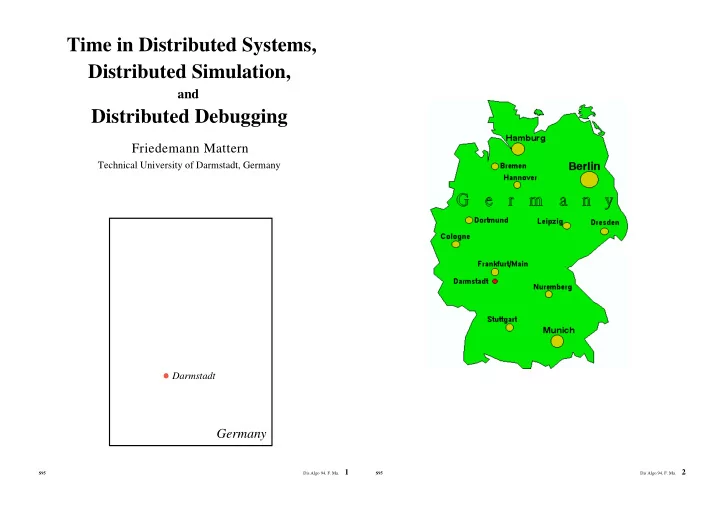
Time in Distributed Systems, Distributed Simulation, and - - PowerPoint PPT Presentation
Time in Distributed Systems, Distributed Simulation, and Distributed Debugging Friedemann Mattern Technical University of Darmstadt, Germany Darmstadt Germany Dis Algo 94, F. Ma. 1 Dis Algo 94, F. Ma. 2 S95 S95 Distributed System About
Time in Distributed Systems, Distributed Simulation,
and
Distributed Debugging
Friedemann Mattern
Technical University of Darmstadt, Germany
Germany
Darmstadt
S95 Dis Algo 94, F. Ma. 2 S95 are located at different places.
communication network
by exchanging messages
process message
Distributed System
S95 Dis Algo 94, F. Ma. 4About the Lectures...
The lectures concentrate on concepts (and algorithms)
Goal: Gain insight into the underlying problems, aspects...
==> apply this to practical problems ==> formalize the concepts to get nice models “homework exercise”
S95 Observer
A Typical Control Problem:
control messages
"Axiom": Several processes can "never" be observed simultaneously "Corollary": Statements about the global state are difficult (with undetermined transmission times)
Observing Distributed Computations
S95 9 3 12 6Consequences for monitoring, debugging...?
Dis Algo 94, F. Ma. 6 S95Deadlock...
1 2 4 3
Four single (partial!) observations of the cars N, S, E, W
1) N waits for W 2) S waits for E 3) E waits for N 4) W waits for S
at different instants in time yields wrong impression as if there were a cyclic wait condition for a single instant in time (--> Deadlock).
An Example: Phantom Deadlocks
S N E W
N W S E E N W S
unique resource
Dis Algo 94, F. Ma. 8Phantom Deadlocks
A B C A B C A B C ==> B waits for C ==> A waits for B ==> C waits for A (C holds exclusive resource) Deadlock!
wrong conclusion!
wait-for relation B C A
t = 1 t = 2 t = 3
S95 (and if so, how efficiently?) (--> consistent snapshots)
S95account $ A B C D 4.17 17.00 25.87 3.76
Σ = ?
An Example: Communicating Banks
(if constant; lower bound if monotonically increasing) (Perhaps at least if message transmission is instantaneous?)
Dis Algo 94, F. Ma. 10red green red green
?
red
L2 L1 Synchron. message
Example: Even More Problems
learned that the other one is red (“now”)
(Atomic: takes no time, action cannot be interrupted) time
Distributed traffic
(mutual exclusion)
light control
With Many Observers!
S95(Token “right to become green” is transmitted by syn. messages)
Copies of an Electronic Newspaper
generated on March 7th, 2012 copied on March 9th May 5th April 9th deleted on March 8th March 7th March 7th
from a local instance and then be distributed.
March, 7 time ---> constantly 0 from there on 1 Total number
Is the total number of instances = 0 ?
==> newspaper “died out”
Termination detection problem March 7th
S95 Dis Algo 94, F. Ma. 12Counting Instances?
create copy delete delete copy copy delete delete =1 +1 +1
+1 -1
1 2 3 2 3 2 1
!
create copy delete =1 +1
1 0 ? Observer:
causal consequence of the copy event (“no delete without preceding copy").
consequence before its cause!
==> Observer may draw wrong conclusions (e.g., “no more instances exist”) location 1 location 2 location 3
Copying by (Remote) Reference
is more sensible than "copy by value".
reference to the unique storage location is copied
storage
location
consistent way! (--> Distributed reference counting)
(In fact, the two problems are equivalent!)
S95 Dis Algo 94, F. Ma. 14Example: Prehistoric Society
a burning torch is in transit --> wait for next thunderstorm
(lightning strikes and a tree catches fire...)
(no warm meals till next thunderstorm...)
S95 Wrong Observations
Two initially burning fire places Observation point Messenger keeping fire Messenger going back
time
For all fire places visited (at some instant in time):
But: There is no single instant in time for which no fire is burning. ==> Observation is wrong! What can we do to get only correct observations? Space-time diagram
(Impossible to observe all processes simultaneously!)
Message driven distributed (“reactive”) computation: passive active
(1) passive --> active only on receipt
(2) active --> passive spontaneously (3) only active processes may send messages
Distributed Termination Detection
message active passive process process
The model:
(no spontaneous reactivations!)
Terminated (at t) iff (1) no messages in transit (2) all processes passive
S95 Dis Algo 94, F. Ma. 20Behind the Back Activation Problem
reactivation message becomes passive soon control message
Problem: Implement faithful observer
visit the processes and report their states
underlying basic computation.
S95 The Atomic Model
Idea: Let the duration of activity phases tend to 0.
not terminated (process is active) not terminated (message in transit) terminated big bang (only once) time P1 P2 P3
Model: Process sends (virtual) message to itself when it is activated. Message is in transit while process is active.
P1 P2 P3
Terminated (atomic model) <==> No message is in transit.
message atomic action
==> Check whether there are messages in transit Termination detection problem
S95 Dis Algo 94, F. Ma. 22 S95 Global Views of Atomic Computations
process message Messages quietly move towards their targets... ...but suddenly a process "explodes" when it is hit by a message.
Terminated if no exists in the global view idealized observer
S95 Dis Algo 94, F. Ma. 24Counting Messages?
P1 P2 P3
non-vertical cut line
1 message sent, 1 message received. In total:
One does not ob- serve all processes simultaneously
But: not terminated! Reason:
NB: counting would be correct for a vertical cut!
(1) Detect inconsistent cuts (2) Avoid inconsistent cuts
The Four Counter Method
P1 P2 P3 W1 W2 S, R S’, R’ t
second wave after the end of the first
claim: S=R=S’=R’ ==> terminated Proof (sketch): S=S’ ==> no message sent between W1 and W2. R=R’ ==> received ==> values S and R at t = values of W1. Hence: S=R ==> at global time instant t: # of messages received = # of messages sent ==> no message in transit at t ==> terminated at t ==> terminated after W1 There exists a more formal proof...
But how does one find such an algorithm?
S95 Dis Algo 94, F. Ma. 26P1 P2 P3 P4
t1 t2 t3 t4 (S*,R*) (S’*,R’*) (t3>t2) Notation:
(1) t ≤ t’ ==> si(t) ≤ si(t’), ri(t) ≤ ri(t’) [Def.] (2) t ≤ t’ ==> S(t) ≤ S(t’), R(t) ≤ R(t’) [Def., (1)]
(3) R* ≤ R(t2) [(1), ri is collected before t2] (4) S’* ≥ S(t3) [(1), si is collected before t3] (5) For all t: R(t) ≤ S(t) [induction on the number of actions]
Proof: R* = S’* ==> R(t2) ≥ S(t3) [(3), (4)] ==> R(t2) ≥ S(t2) [(2)] ==> R(t2) = S(t2) [(5)] Lemmata: ==> terminated at t2
A Formal Proof
Two counters suffice!
S95 Termination Detection for Synchronous Communications
= ? ("same-time": is that possible?)
statep takes values active or passive
Xp/q: {statep = active} stateq := active {"instantaneous” activation} Ip: statep := passive
messages are of P1 P2 P3 P4 (this is indeed justified but it is not obvious!)
two atomic actions:
no concern here
“dual” to the atomic model messages are never in transit
S95 Dis Algo 94, F. Ma. 28The Global Snapshot Problem
Coordination
views --> consistent image?
Dynamic scene too vast to be captured by a single photographer
In reality:
(does not work here).
S95 Consistent Snapshots of Global States
Global state (at a given instant in time) State = a set of circumstances or attributes characterizing a person or thing at a given time. Webster:
But do we have “global time” in a distributed system?
All local process states + all messages in transit. Problem: The states of the processes cannot be
How can we guarantee consistency?
As if everything were observed simultaneously
Applications:
Consistent observer: sequence of consistent snapshots
Dis Algo 94, F. Ma. 30P1 P2 P3
ideal (vertical) cut 5 5 5 3 2 8 1 4 2 4 3 8 4 7 consistent cut inconsistent cut
not attainable equivalent to a vertical cut (can be made vertical) cannot be made vertical (msg "rubber band transformation" from the future)
time
Consistent Snapshots
form a consistent cut?
instant of local
connect local ob- servation points by a (zigzag) line
S95 The Snapshot Problem
Goal: "Instantaneous" snapshot of the global state without "freezing" the distributed system. In reality:
Applications:
(does not work here).
Space-Time Diagrams
Process 1 Process 2 Process 3 internal event message global time send event receive event
A different picture of the same computation: Why is it the same computation? Abstract from real time --> Elastic deformations (“rubber band transformation”) Preserves the causality relation:
Message arrows must ne- ver go backwards in time! (--> no cycles possible)
e < e’ if there is a left-to-right path from e to e’
e1 e2 e3 e3 e2 e1
Example: e1 < e3, but not e1 < e2
partial order!
e || e’ (“concurrent”, “causally independent”) if not ‘<‘ and not ‘>’.
stretch / compress e4 e4
S95vertical cut line
The Causality Relation
“Smallest” relation on E such that x < y if:
(causally) precedes
1) x and y happen at the same process and x comes before y, or 2) x is a send event and y is the corresponding receive event,
3) ∃ z such that: x < z ∧ z < y.
(i.e., why is it cycle-free?)
be avoided (--> confusion)
S95 Consistent and Vertical Cut Lines
P1 P2 P3 P4 P1 P2 P3 P4
rubber band- transformation
line, then this cut line can be drawn vertically in such
past future
the new cut line.
also be moved ==> no message arrows go backwards in time! cut event such cut lines are called consistent informal graphical proof!
a way that no messages go from right to left!
pair of sicors, move right part far to the right; repair cut arrows...
Dis Algo 94, F. Ma. 36The Snapshot Algorithm
P1 P2 P3 Processes and messages: black or red. Snapshot instant: black --> red then: report local state to the observer. Process becomes red if a) it is visited b) receives a red message. Proposition: Snapshot is consistent. Proof.: No "message from the future" Yields a consistent view without freezing the system
messenger of the processes in sequence
S95messengers do this in parallel
!
“Do not read tomorrow’s newspaper today”
S95 Dis Algo 94, F. Ma. 38Initiator receipt of the last (black) copy (snapshot complete) copy
The Snapshot Algorithm - Messages
copy red
?
x := 1 y := 2 x := 0 y := 1
But, then: Do we get x = y or x ≠ y for our computation?
(i.e., which “possible” state do we get with the algorithm?) How many consistent global states does this computation have? termination de- tection problem
black
S95Can we simply count the number of sent and received black messages?
s2 s1
Detecting Predicates with Snapshots
that first yields s1 and then s2?
predicate is true here
NB: The snapshot algorithm is also useful for other purposes, such as determining recovery points, allowing consistent monitoring etc.
S95 Dis Algo 94, F. Ma. 40Distributed Computations
1) [Events] All Ei are pairwise disjoint. 5) < is an irreflexive partial order on E 3) < is a linear order on each Ei For Γ ⊆S×R with S,R ⊆E and S∩R = ∅ one has:
4) (s,r) ∈Γ ==> s < r 6) < is the smallest relation which fulfills 3) - 5)
not possible because of (5) not possible because of (2) not possible because of (2) (i.e., there are no other events related by ‘<‘)
message transmissions) = (E1,...En,Γ,<) such that:
S952) [Messages] Let E = E1∪...∪En. [Causality relation]
Remarks
is possible with space-time diagrams
model in-transit messages:
m1 m2 e < e’:
end interpretations
transmissions are modeled in a sligthly different way:
transmissions (--> deadlock)
P1 P2
S95Lamport, 1978
Dis Algo 94, F. Ma. 42a b c d f g P1 P2 a b c d f a b c f g a b f g a b c d e e e e e
?
a f g e
Prefixes of Computations
distributed computation A distributed computation B as a prefix of A distributed computation C as a prefix of A distributed computation D as a prefix of B E, prefix of D no computation a b c f e F, prefix of B and D (receive event without corresponding send event - message was never sent!)
S95 Prefixes and Consistent Cuts
with respect to ‘<‘: ∀ x ∈ E’, y ∈ E: y < x ==> y ∈ E’
associated cut line consistent cut E’
parts define a consistent cut!
The set of events to the left of the cut line is not left-closed --> inconsistent cut r s x y
==> a local predecessor of an event is also in the cut ==> also the send event corres- ponding to a receive event
(with cut events )
S95 Dis Algo 94, F. Ma. 44The Prefix Relation
A B C F E
==> Prefix relation is a partial order!
event g event d g d
contains no cycle.
intermediate state of computation A?
==> (Executions of) distributed computations are not sequences of global states (or of events)!
The Prefix Lattice
M N K L I J H F G D E B C α ω
"maximal" "minimal" computation (no event has yet been executed) Here we would have an “imposs- ible” space- time diagram computation
predecessor and successor states!
(More “dimensions”
==> Uncertainty about the “true” global state!
For two (or more) consistent cuts (i.e., ≈ global states), there is always a common later and a common earlier consistent cut. Lattice property: dim 1 dim 2 processes) for more than two (i.e., a partial order with some additional properties) (--> Substitute for “sequence”,
S95Parallel and Distributed Simulation
Executing a programmed dynamic model.
real system input
parameter model input
parameter abstraction interpretation correspondence
S95 Parallel Simulation?
S95shared memory distributed memory distributed simulation
Dis Algo 94, F. Ma. 48Simulation Principles
simulation continuous discrete time driven asynchronous quasi- event activity process transaction driven
continuous (synchronous)
Example of an Event-Driven Simulation
“Booking planes by telephone in a travel agency” System specification:
waiting too long.
1 min for one way, 2 minutes for round trip ticket).
3 2 4 5 6 min. relative number normal distribution Typical arrival and service rates
S95 Dis Algo 94, F. Ma. 501) More clerks--> effects? 2) Less clerks --> consequences? 3) Consequences of reducing the service time to 55 sec.? 4) ...
Simulation Experiments
Possible experiments: Analysing the system:
Event Driven Simulation
Basic assumption: Model state remains constant between two events
advancement of the simulation clock) Typical events
Event:
lation time!) changes the state of the model
S95 Dis Algo 94, F. Ma. 52The Experiment
08:00 18 5 end of service 08:03 call client 1 08:03 call client 1 08:09 client 1 08:05 call client 2 08:03 17 4 end of service 08:09 client 1 08:05 call client 2 08:05 16 3 08:06 call client 3 end of service 08:07 client 2
The initial state List of events that are currently scheduled
not occupied One first call of a client has been scheduled Time jumps, driven by the next event End of service event is already scheduled at the beginning of service! Each call already schedules the next call ==> there is always one scheduled call event! initially
S95 08:47 13
And so on until:
08:49 12 client 41 give up event 08:55 client 41
waiting clients
08:57 9 client 44 client 45 client 46 client 47
first client will be served next client 46 gave up Is scheduled by a call event when all lines were busy
S95 Dis Algo 94, F. Ma. 54The Simulation Cycle
initialize Is there one more event? CLOCK := time
remove the event from the event list Execute the event (i.e., update the model’s state) final statistics yes no end statistics etc.
put al least one initial event in the event list possibly insert new events into the event set
Idea: - Execute the next event (i.e., the event of the event list with the smallest time).
then inserted into the event list.
S95 Event-Driven Simulation
19 17 11 event list 4 Clock state of the model
autonomous submodels.
simulation cycle
Example: Traffic Simulation of a City
Where should the new bridge be built?
(remote event scheduling)
S95 Example: Logic Simulation
by event messages
S95(very important to get significant speed-up values!)
Dis Algo 94, F. Ma. 58Distributed Simulation
T=7 T=4 T=3
t=8 t=5 local sequential simulator
T=9
timestamped event messages for scheduling
==> distributed simulation / synchronization schemes
S95 Distributed Simulation Schemes
temporal guarantees time reversal conservative methods (from 1980)
(from 1985)
(Briant/Chandy/Misra) (Jefferson) guarantees, lookahead, null-messages, deadlock,... time-warp, rollback, GVT,...
hybride methods (?)
increased research activities since 1985.
respect causal
guarantee causal
Rollback:
simulation execution time clock value
Optimistic Simulation, Time-Warp
receiver is received: Rollback
T=17 local clock T=21 T=39 T=53 local event queue local state at T=17 local state at T=15 local state at T=12 local state at T=9 List of checkpoints
t=60 t=49 t=60 sent at 15 to B t=49 sent at 13 to D t=55 sent at 11 to C List of sent event messages with send- time and receiver
B D
t=15 sent at 11 from A t=13 sent at 10 from C t=7 sent at 4 from A List ofprocessed messages with send- time and sender to other simulators t=89 t=12 t=25 from other simulators
Time-Warp
S95 Dis Algo 94, F. Ma. 62t=60 t=49
12 12
anti-message anti- message
Receipt of an anti-message:
(what if anti-message arrives first?)
Problems:
Time-Warp - More Aspects
==> anything is possible!
==> incremental state saving?
dedicated anti messages
Global Virtual Time (GVT)
GVT(τ) = mini CLOCKi(τ)
execution time instant
Ii: CLOCKi := CLOCKi + d (d > 0)
internal action
Xij: if CLOCKi < CLOCKj then
remote event scheduling action
CLOCKj := CLOCKi
computation by two types of atomic actions:
Minimum of all clocks (ignore message time- stamps for synchronous communications)
“current” GVT value is meaningless synchronous (simplified: message timestamp = sender’s clock) Function of the global state!
S95 An Illustration of the GVT Approximation Problem
before after
"behind the back" winking “Axiom” of distri- buted computing
certain height: spontaneously: ==>
with his eyes at another person --> the other person is reduced to the height
min = ?
!
S95 Dis Algo 94, F. Ma. 66GVT Approximation with
CLOCK=20 CLOCK=12 CLOCK=2 2-active 3-active ...
all CLOCKs > t GVT > t
Termination detection problem!
Termination Detection Algorithms
process can make another process t-active
Was 2-passive, but will become 2-active now t is a lower bound appro- ximation of GVT! t=2 stable property: time t is over... (t-passive otherwise) Spontaneously: CLOCK=5 --> CLOCK=9. Was 5-active, becomes 5-passive (“t-termination”) Idea: termination detection is binary version of GVT approximation e.g., 0 and ∞
S95 t-Termination as a Bound for GVT
Idea:
Example: 3 termination detection algorithms with
(Instead of a single message: transmit a whole bundle of messages)
t1=5, t2=10, t3=100 are executed in parallel. Return max ti of those which reported t-termination. NB: Lower bound is a stable (and hence observer independent) predicate. ==> Why not use a snapshot algorithm?
This is possible. However, it turns out that consistent cuts are not required - inconsistent cuts will also work! Hence, snapshot algorithms are perhaps too “heavy” for that problem!
S95 Dis Algo 94, F. Ma. 68Speedup ?
==> Limits the attainable speedup!
S95Faithful speedup measurements: Parallel simulator should be compared to true sequential simulator (not to the parallel simulator running on a single processor!)
Critical Path Speedup
Sequential simulation --> measure the duration of events:
1.5 3.5 6.5 7.5 9 11.0 13.0 15.5
“Distributed sequential” simulation: “Optimal” distributed simulation:
critical path tseq tpar
speedup =
tseq tpar Push everything as far to the left as possible
S95arrows = causal dependencies (event messages) respects causal dependencies Calculated speedup is much too optimistic: It abstracts from communication overhead, from wait conditions, from control overhead...
Dis Algo 94, F. Ma. 70Observing Distributed Computations
Observer
control messages
"Axiom": Several processes can "never" be observed simultaneously "Corollary": Statements about the global state are difficult (with undetermined transmission times)
S95 9 3 12 6Consequences for monitoring, debugging...?
The real computation
Observation
S95 Dis Algo 94, F. Ma. 72The (global)
The object to be observer Idealistic view: global perspective
S95 Obser- ver
messages image
S95 Dis Algo 94, F. Ma. 74Observer 2 Obser- ver 1
messages Conceptual problems:
equivalent? Technical problems:
image
S95 “sensor”
External Observation
analysis
pump pressure gauge small leak “increase pressure” pump pressure gauge
loss of increase activity pressure
Wrong conclusion of the observer:
An unmotivated activity by the pump (led to increased pressure and the occurrence of a leak, which)
A B A’ B’ Problem: Realization of causally consistent observers
effect is observed before its cause! resulted in a loss of pressure event notifica- tion message time
pipe
S95 Dis Algo 94, F. Ma. 76X
Object X must have a consistent “view” of how many references are pointing towards it
“Internal” Observation
processes within the computation must have a causally consistent view reference in transit
A B
process 1 process 2 disks should be
S95equivalent (=?)
Monitoring and Visualization
Motivation
Purpose
Capture useful data during execution (for later use...) Provide an adequate image Present monitoring data
S95Snapshot <--> animation
time events control trace data trace file messages
Monitoring
Collecting infor-
mation about:
S95 What is an event?
What information is associated to an event?
Any atomic action which significantly affects the local state of a process
Events
Combined events
Avoid generation of unwanted information at
Processing of Monitoring Information
P1 P2 Pn merging / combination local filter local traces ==> discard information ==> increase level global filter global trace MIB report, trace file management information base monitoring control
feedback loop
various levels (e.g., activate / deactivate filters)
S95 The Intrusiveness Problem
the behavior of the monitored system
Hardware and Software Monitors
memory ports, I/O-channels...
source code (requires recompilation)
independent of language or compiler)
S95 Visualization
Systems:
!
Dis Algo 94, F. Ma. 84ParaGraph [Heath, Etheridge (Oak Ridge)]
Animation ==> Sequence of global snapshots
Consistent
(sufficiently well) synchronized local clocks? timestamped events!
view?
S95 Message queues
(or approximation of global time?)
S95 Dis Algo 94, F. Ma. 86Kiviat profile
would wrongly yield “load 0” for all processors!
S95 Spacetime diagram
Critical path
Monitoring and Visualization: Problems
Execution Replay may help with some of the technical problems
Dis Algo 94, F. Ma. 90Another Application: Debugging
Problems:
Execution Replay helps:
“sensor” central debugger Debugger “observes” the computation.
Main focus of a distributed debugger:
More serious conceptual problems:
Use a sequential debugger for purely local errors Confusion: often not well understood! Relativistic effects (observation of the original run!)
S95 Commercial Multiprocess Debugger
S95 Dis Algo 94, F. Ma. 92BBN “TotalView” Multiprocess Debugger
S95 Execution Replay
capture relevant information in a log-file
(e.g., deliver the “right” message to the process)
= ?
Applications of Execution Replay
behavior remains unchanged
a stopped state.
Nondeterministic Situations
P1 P2 e1 P3 e2
was received at e1 and e2.
the correct message.
(sender, event seq. number of sender, receiver, event seq. number of receiver)
messages, indirect overtakings) possible
contents (“control driven replay”)
the contents of messages must be logged (“data driven replay”)
(= consistent snapshot)
(expensive solution: register and trigger the instruction counter)
S95 Dis Algo 94, F. Ma. 96Receiver-Driven Reproduction
P7 P9 8 9 10 23 24 (P7, 10) (P7, 10, P9, 24) log file
Original run
P7 P9 8 9 10 23 24 (P7, 10) log file
Reproduction run:
(P9, 24)? (P7, 10)!
?
receiver consults the log
S95 P7 P9 10 23 24 (P7, 10, log file
Reproduction run:
P9)? (24)! (24) 9
Sender consults the log
Receiver counts receive events and accepts the message which matches the next receive number
sequence number of the receiver? 1) Receiver told the
P7 P9 10 24 (P7, 10) log file (24) (24) 11
sender during the
2) Receiver put the information (P7, 10, P9, 24) in its local log file during the original run. All log files are merged, sorted according to the sender, and distributed to the relevant processes (after
Sender-Driven Reproduction
the run).
S95 Dis Algo 94, F. Ma. 98Determining Race Conditions
P1 P2 r P3 r’ P1 P2 r1 P3 r3 r2
during the original run (m and m’ are “concurrent”)
m m’
precede the send event of the message currently being received”
whether two messages are concurrent or not
race: no race: m1 m2 m3
Further Aspects of Execution Replay
?
Problem: Hidden causal dependencies (may e2 be reproduced before e1 ?) e1 e2
from a log file
is suppressed log file ==> during replay a message might be received before it is sent (possibly violating causality and causing strange effects)
S95 Dis Algo 94, F. Ma. 100Concepts Relevant to Distributed Debugging
e1 e2 e3 e
be the cause of e
but not e1 or e2
past cone future cone
TRAPPER Graphical Design Tool for PVM
S95 Dis Algo 94, F. Ma. 102TRAPPER Performance Tools
S95 Paragraph+ by PALLAS
S95 Dis Algo 94, F. Ma. 104Valid and Invalid Observations
Process 1 Process 2
a) Idealized observation - instantaneous notification:
e11 e12 e13 e14 e21 e22 e11 e21 e12 e22 e13 e14
Process 1 Process 2
b) Invalid observations - violation of causality:
e11 e12 e13 e14 e21 e22 e11 e21 e12 e22 e13 e14
Effect is observed before its cause --> inconsistent view!
(What we want but can’t get) (What we can get but don’t want)
S95 Process 1 Process 2
e11 e12 e13 e14 e21 e22 e11 e21 e12 e22 e13 e14
Process 1 Process 2
e11 e12 e21 e22 e13 e14
The virtual image
no message backwards in time
Valid Observations
perception = vertical projection valid inter- pretation
notification delays (What we hope to get)
S95 Dis Algo 94, F. Ma. 106Image and Reality
image (virtual position) true position water line
Does the image preserve the essential properties
= ?
vertical projection earth true position image sun
S95 Letter to George Hale, Mount Wilson Observatory, Passadena
Dis Algo 94, F. Ma. 108“When a spectator watches a battalion exercising from a distance he sees the men suddenly moving in concert before he hears the word of command or bugle-call, but from his knowledge of causal connections he is aware that the movements are the result of the command, hence that objectively the latter must have preceded the former.” Christoph von Sigwart (1830-1904) Logic (1889)
Causally Consistent Observations
battalion commander spectator command move effect cause
??
The observation problem if not new...
hear see time
S95 e11 e12 e21 e22 e11 e21 e12 e22 e11 e12 e21 e22
Images of Invalid Observations
message is received which has not yet been sent!
effect cause
Detecting Global Predicates
Process 1 Process 2 x := 1 y := 2 x := 0 y := 1
Example: Does (x=y) hold for the following computation? “properties”
S95 ? x = 1 x = y = 1 x = 0 y = 2 y = 1 x = 0 “YES, it does!” Obs 1
S95 Dis Algo 94, F. Ma. 112x = 0 ? x = 1 x = 0 y = 1 y = 2 y = 2 y = 1 “NO, it does not!” Obs 2
S95 P 1 P 2 x := 1 y := 2 x := 0 y := 1 P 1 P 2 P 1 P 2
Reconstructing the Views
x := 0 y := 1 x := 1 y := 2 x := 0 y := 1 x := 1 y := 2
Obs 1 Obs 2
So what? Do we have x=y or x=/=y for the computation?
S95 Dis Algo 94, F. Ma. 114A distributed program A single distributed computation nondeterminism relativistic
might be meaningless! Consequences: It is naiv (i.e., wrong), to try to construct a distributed debugger which can answer such a question. (Which is a "good" question in the traditional sequential case!) Reason: Computation and observation is the same thing in the sequential case. But not for distributed systems!
effects several computations several
Set of observers, for which a specific predicate is true
Possible Worlds
No privileged observer This is not due to nondeterminism! e.g., “stop when x = y”
S95 A B a b a b A B a b a b Obs1 Obs2 Obs1 Obs2
Relativity of Simultaneity
Two “causally independent” events can be
Lightcone paradigm of relativistic physics:
impos- Observer independent ==> objective fact space time sible A and B are concurrent B lies in the cone of A --> B causally depends on A --> All observers see B after A
S95 Dis Algo 94, F. Ma. 116Observation 2 Observation 1 Observation 3 The “true” computation
(all) observations?
in our case: causality
Observations, Images and Reality
(“multi dimensional”) (single dimension)
“inconsistent”
Incoherent Observations
The observed object might be “in reality” much stranger than we would expect!
S95 Dis Algo 94, F. Ma. 118 S95An Inconsistent Image
M.C. Escher: Belvedere (1958)
S95 Dis Algo 94, F. Ma. 122The Evidence!
S95 The Global State Lattice
Process 1 Process 2
e11 e12 e13 e14 e21 e22 e11 e21 e12 e22 e13 e14
Process 1 Process 2
e11 e12 e13 e14 e21 e22
inconsistent global state consistent global state space
Observation = path in the state lattice
Observation will not detect a predicate that is only valid here = linear extension of partial order (Which remains in the gray area
(i.e., observation must res- pect the causality relation!)
P1 P2 P2 P1 time
The Eroded State-Hypercube
available (and the corresponding sent has thus been executed) eroded area eroded area
S95b a c d b c d a
The Lattice of Consistent States
S95final state initial state A B C 2 5 3 4 4 3
concurrent” global states A, B, C
computation passed through A, B, or C makes no sense!
[A, B, C] (all states with 7 events)
computation went through this class first dimension second dimension
lattice (but it is unknown if exact global time is unavailable)
Dis Algo 94, F. Ma. 126[Claude Jard et al., Rennes, France]
The 3-Dimensional Lattice
The Dualism of the Diagrams
global state global state event
Points --> global states Slices --> events
event
Points --> events Slices --> global states Both diagrams represent the computation
Eroded hypercube Time diagram
Path --> chain of states Path --> chain of events
S95 Dis Algo 94, F. Ma. 128Serious Consequences...
Debugging: “Next step” is not well-defined Debugging: “stop when <condition>” meaningless!
(Although immediate halting is possible using execution replay!)
Predicates are satisfied relative to observers only
certain predicate holds
hopeless in general!
Example: No observer must observe a state where more than one traffic light shows green: --> Possibly Φ should be false.
“good” predicates
S95Modal Operators and
φ holds here possibly φ holds definitely φ holds
Observer Independent Predicates
number of events number of processes More efficient determination of pos / def only for some predicate classes α α ω ω gray areas cannot be avoided by going from α to ω
Dis Algo 94, F. Ma. 130Local Predicates
Process 2 Process 1
x = 1
Process 2 Process 1
y = 3 x = 2 x = 1 x = 0 y = 1 x = 1 x = 0
Whatever events the other processes execute,
Example: Φ = (x = 1)
this does not change the value of Φ.
Every path from the initial to the final state necessarily meets all hyperplanes --> inevitable
Disjunctions of inevitable (i.e., observer independent) predicates are also inevitable...
Local predicates are not very interesting, however...
S95y=3 receive y=1 send x=2 x=1 send x=0 rec. x=1 x=0
Conjunction of Local Predicats
Process 2 Process 1 local predicat Φ1 of process 1 is valid here local predicat Φ2 of process 2 is valid here
Idea: try to find a rubber band transformation such that there is a vertical line which cuts all processes in a state where the local predicat holds.
S95NB: Each consistent cut line can be made vertical
“traffic light 2 = green” should be false! Idea for that: All processes execute in parallel, but a process stops as soon as its local predicate holds. Question: Does this idea work?
Dis Algo 94, F. Ma. 132“Semantic filter”: Only relevant events (change
Filter for causal consistency: An event can only pass, if all causal predecessors of it have already been observed. Dimension reduction filter: keeps back all events of a process as soon as the local
“cube”) is reduced by one dimension F1 F2 F3
Stop! (F2) Stop! (F3)
Determining “possibly Φ1 ∧ Φ2 ∧...”
predicat of that process holds.
P1 P2 P1 P2
Applications of the Detection
(simultaneously!) passive, the computation has terminated.
Local predicate Φi: process Pi is passive.
(where Xi is a local variable of Pi)
P1 P2 Φ1 Φ1 Φ2 s1 s2 If P1 does not advance after its predicate Φ1 becomes true, the computation would block in global state s1.
Algorithm for “possibly Φ1 ∧ Φ2 ∧...”
STOP WHEN X1 = 3 or X2 > 0 ?
Dis Algo 94, F. Ma. 134Earliest State “Φ1 ∧ Φ2 ∧...”
Φ2 Φ2’ Φ1 Φ1’ 2 1 4 3
P1 P2 P1 P2
Φ1 Φ1’ Φ2 Φ2’ 1 3 2 4 there is always a common earliest such state.
Stable Predicates
For some global predicates
Example: stable predicate φ on global states
final state initial state process 1 process 2
φ holds here φ
(some observers will detect it earlier than others)
“sub-hypercube”
lattice of consistent states
is sufficient --> snapshot algorithm makes sense!
φ is still true “now”!
(e.g., “object is garbage”, computation has terminated,...)
S95 Dis Algo 94, F. Ma. 136Other Observer-Independent Predicates?
1) Some rather artificial predicates
2) “Inevitable” global states
predicate is true only at these points
each process waits until all other processes have also reached the barrier (“bottleneck”)
a state is “definitely” true
The problem is not so much to verify whether the predicate holds in this particular state, but to make sure that such a state is eventually reached (before some action is executed)! Typical realization: A process reaching the barrier informs a coordinator and blocks until it receives an ack. ack ack “At” the synchronization point all processes know that all other processes have also reached it (simultaneously?).
S95 What if Global Time Exists?
e.g., perfectly synchronized local clocks (but how good is “perfect”?) ==> 1) Obtain “vertical” snapshots 2) Virtual image = real computation Dual problem: races!
a b
1)
b
2)
a
Different execution of the same deterministic program This global state (“after b but before a”) is not observable in 1)
First process is “slower” this time...
S95exact instantaneous snapshot Hence the observed global state is not “absolute” or “definite”!
Dis Algo 94, F. Ma. 138Do We Need Consistent
Distributed traffic light control: Do all observers see at most one green light?
Detection of Global Predicates?
Sometimes inconsistent observations are acceptable Examples: 1) Performance debugging 2) load(P1) + h > load(P2)
“inherently global”
==> “weakly stable” ==> (slightly) inconsistent views do not harm But: For deadlock detection, distributed recovery point,... inconsistent views are not acceptable!
S95 Observations...
all other predicates are difficult / impossible to detect
Observing parallel and distributed programs is much more difficult than observing sequential programs!
==> Global property may escape to a debugger!
e.g., snapshot algorithm
S95 Dis Algo 94, F. Ma. 140Time in Distributed Systems
S95 Time ?
Quid est ergo tempus? Si nemo ex me quaerat, scio, si quaerenti explicare velim, nescio.
Augustine (354-430)
Time is money.
Benjamin Franklin (1706-1790)
Time is how long we wait.
Richard Feynman (*1918, Nobel prize in physics 1965)
The indefinite continued progress of existence, events, etc., in past, present, and future regarded as a whole.
Concise Oxford Dictionary, 8th Ed.
What then is time? If no one asks me (what it is), I know (what it is), but if I want to explain it to someone, (I find that) I do not know.
S95 Dis Algo 94, F. Ma. 142The Arrow of Time:
This is the melancholic dimension of time...
Tempus fugit Time goes, you say? Ah no! Alas, time stays, we go.
Austin Dobson, The Paradox of Time Present linear past possible "branching" future
Two roads diverged in a yellow wood, And sorry I could not travel both. And be one traveler, long I stood And looked down one as far as I could To where it bent in the undergrowth; ... Then took the other, as just as fair, ... I shall be telling this with a sigh Somewhere ages and ages hence: Two roads diverged in a wood, and I - I took the one less traveled by, And that has made all the difference. Robert Frost (1874-1963) The Road Not Taken (1916) (Time flees / flies)
Past, Present, and Future
S95 ω0 Divergence from ideal frequency +γ
a) set clock back / forward (--> C(t) jumps and is non-monotonic) (age, temperature,...) t
C(t) = k ω(τ) dτ + C(t0)
t0 t Value of clock C at t
i.e. ω(t) = constant.
Clocks and Real Time
S95C ω b) increase / decrease oscillator frequency
Dis Algo 94, F. Ma. 144Time is Powerful
t x
300000 km/s “speed limit of causality” (P. Langevin)
alibi event crime max speed line
causality
We don’t have (real) time in distributed systems
Time: Properties and Models
What is the correct / appropriate model?
atomic events
S95 Dis Algo 94, F. Ma. 146Time and Clocks in Computer Science
Clock value “real” time
Hence: We call concepts / devices “time” / “clocks” even though they do not have all the ideal properties!
S95but what are the essential properties?
Logical Timestamps
Clock condition: e < e’ ==> C(e) < C(e’)
Clock “Time domain”: ‘<‘ partially ordered set
N (linear order) R (REAL datatype) power set of E (i.e., 2E)
If an event e may influence another event e’, then e must get a lower timestamp than e’.
Set of events with partially ordered causality relation
Interpretation:
Nn (product lattice) ?
“time respects causality” causally precedes
S95 Dis Algo 94, F. Ma. 148Lamport’s Logical Clocks
C: (E,<) --> (N,<)
Assigns timestamp
e < e’ ==> C(e) < C(e’)
Clock condition 1 2 1 1 3 4 3 causality relation (“potential” causality)
2 1 3 4
Communications of the ACM 1978: Time, Clocks, and the Ordering of Events in a Distributed System 5 before the clock ticks
Properties of Lamport-Timestamps
+ lin. order, unbounded + respects causality (clock condition)
From the timestamps we cannot (always) conclude whether two events are causally dependent or not!
see example Future cannot in- fluence the past!
"critical path" --> concurrency measure, causally independent
the only structure we have in our abstract distributed computations)? as does real time! Proof.: b < a ==> C(b) < C(a) ==> ¬(C(a) < C(b))
i.e., ¬(a < b) ∧ ¬(a > b)
(e.g., mutual exclusion) time complexity
S95 Dis Algo 94, F. Ma. 150Lamport-Timestamps: “Non-Properties”
< || > < = >
E N
(Causally independent events may become comparable!)
2) Loss of structural information: 1) Mapping is not injective:
denotes the process number, on which e happens
==> Now
Important defect since one purpose
draw conclusions on the structural rela- tion among events!
E N
j k Is there a “better” timestamp- ing scheme?
Also note that “=” is transitive, but “||” is not! (only causally independent events are ordered by their second component)
S95 Realizing Causally Consistent
Observers with Real-Time
Process 1 Process 2
e11(1) e12(14) e21(5) e22(11) e11(1) e21(5) e22(11) e12(14)
5 10 15 20
e11(1) e21(5) e22(11) e12(14)
5 10 15 20 sorting
==> Sorting by global time = “sorting by causality”
!
(--> topological sorting)
Realizing Causally Consistent
Observers with Lamport Time
Process 1 Process 2
e11(1) e13(4) e21(2) e22(3) e11(1) e21(2) e22(3) e12(2) e11(1) e12(2) e22(3) e13(4)
sorting
Sorting yields a linear extension of the causality relation.
!
e13(4) e12(2) e21(2)
no event with a smaller timestamp will arrive later (see e13 and e12)!
==> Find a more suitable model of logical time!
Vector Time(stamps)
==> Define the n-dimensional vector τ(e) as follows: τ(e)[i] := |{e’∈Ei| e’ ≤ e}|
1 2 4 3 1 e Set of events on process Pi Quot tempora tot astra.
Time vector τ(e)
formal light cone
Formal light cone: set
which can affect e
P1 P2 P3 P4 P5
reasonable definition in our model (“device” to keep current time) Formal light cones are consistent cuts (--> cut line in the shape of a cone)
!
S95 Dis Algo 94, F. Ma. 1541 2 3 4 5 1 2 3 2 5 3
Vector Timestamps
==> Vector represents whole causal past. ==> Encodes knowledge about each past event.
past event on process i.
causality relation
P1 P2 P3 “Vector time”: isomorphic representation of the causality relation (partial order --> lattice structure)
sparse arrays, send only delta-values, use topological knowledge...)
S95 1 3 4 3 2 1 7 4 6 2 1 3 4 3 7 5 3 8 3 2
|| ≤
1 4 2 3 7 8 3 4 3 2 8 4 4 3 7
=
sup
comparable concurrent
Timestamp “Arithmetic”
sup = componentwise maximum
Interpretation of τ(e) < τ(e):
‘<‘ is defined as “≤ but ≠” e e’
,
4 1 3 4 3
S95 Dis Algo 94, F. Ma. 156Vector Time and Ideal Observers
e 1 2 4 3 1 1 3 4 3 2
τ(e) = id(e) =
2 4 5 4 3
...
Observations of the ideal observer
knowledge: vector / array
componentwise
S95NB: The causel past of an event forms a consistent cut!
1 1 2 1 1 2 2 3 3 1 1 1 2 1 2 1 2 1 3 1 1 2
Propagation of Time Knowledge
increment the own component
increment the own component and piggyback the new vector
increment the own component and build componentwise supremum of the two vectors union of the two cones
componentwise
monotonic w.r.t. time vectors!
do not influence each other iff they are concurrent
P1 P2 P3 P4
(w.r.t. the time domain) not related (--> Implementation of vector time) (--> keeps knowledge about past events) Isomorphic representation
. . . . . . . . . . . . . . . .
⇔
∩ ∪ ⊆ sup, inf, ≤
causality time
Events Time vectors Set theoretic Algebraic operations
(--> “compute”)
⇔
Lattice structure
Product lattice on Nn
⇔
Order theoretic properties Algebraic properties
⇔ Computing with Sets of Events
S95Vector clocks / vector timestamps -->
Clocks were standing or hanging wherever Momo looked - not only conventional clocks but spherical timepieces showing what time it was anywhere in the world... “Perhaps one needs a watch like yours to recognize these critical moments,” said Momo. Professor Hora smiled and shook his head. “No, my child, the watch by itself would be no use to anyone. You have to Michael Ende, Momo
Applications of Vector Time
know how to read it as well.”
<Momo meets Professor Hora>:
The Cut Matrix
$ := (τ(c1), τ(c2),...,τ(cn))
(i.e., take time vectors of cut events ci as the columns) 3 1 1 0 0 0 4 3 0 0 0 0 5 0 0 0 1 3 4 0 0 0 1 1 3
c1 c2 cn C C consistent ⇔ dia($) = sup($)
diagonal vector for each line: maximal value (i.e., the maximum of a row is the diagonal element) dia sup 3 4 5 4 3
S95 The “sup = dia” Consistency Criterion
x x 4 x x x 6 x x x 6 x x x 6 x
c1 c1[3] = 6 > dia[3] =4 P1 P2 P3 P4 c3[3] = 4
x x x x x x x x 6 x 4 x x x x x
c1 c3 c3 sup[3] > dia[3] A process (P1) other than P3 knows (at cut event c1) something about local events on P3, on which P3 itself does not yet know anything (i.e., which happen after c3). <==> There exists a path from a P3-event after c3 to an event before c1. <==>
[generalization over all indices i≠j]
The cut is inconsistent.
inconsistent
= dia[3]
S95 Dis Algo 94, F. Ma. 1621
P1 P2 P3 P4
2 0 0 0 0 1 0 0 1 0 2 0 0 0 0 0
3 1 2 2
x4 x3 x2
Identify cut event with locally preceding event.
(x2, x4, but not x3)
dia($), except diagonal component
Observer
Implementing Consistent Observers
?
Which event x2, x3, x4 can be observed next (without violating causality)? currently
global state currently observed global state
(i.e., observation is a linear extension of the causality relation)
S95to identify the currently observed state!
Realizing Causally Consistent Observers with Vector Time
1
P1 P2 P3 P4
3 1 2 2
x4 x3 x2
Observer
?
2 1 2 Events which have already been observed
(without violating causality)?
Vectors are rather clumsy. Do we really need them to guarantee consistency and to make correct statements about the system?
S95 Dis Algo 94, F. Ma. 164The Communication Hierarchy
Typical questions:
general asynchronous FIFO causally
synchronous allows more computations more restrictive not FIFO (but asynchronous) not causally (but FIFO)
not synchronous (but causally ordered) informally: computation respects the causality relation (“global FIFO”)
⊇ ⊇ ⊇ 1) Given a computation with asynchronous communications
(i.e., does it respect the FIFO property?)
(e.g., does it run on a transputer with occam? Or does it block?)
2) Is a given algorithm, which is correct for synchronous communications, still correct for a more general model?
What are synchronous communications?
(relative to asynchronous communications)
same time
receive happen simultaneously?
transmission is unrealistic!
with synchronous message passing?
Synchronous = virtually simultaneous = as if msg transmission were instantaneous
suitable rubber band trans- formation ?
≡
S95 Dis Algo 94, F. Ma. 166“As if” Messages were Instantaneous
If for a distributed computation a phenomenon can be
==> message passing should then not be called “synchronous”
messages, the computation must not be realizable with synchronous message passing semantics. A B
Obs
A B Obs
1 msg sent 0 msg received
Observer learns that a message from A to B is in
how many received? how many sent? a b c d a b c d
transit for a certain duration ==> not synchronous!
The observer first asks A about the number of messages it sent to B. Then it asks B about the number
Example:
S95 A B Obs
way by a chain of other messages.
vertical by a rubber band transformation.
synchronous communications (==> deadlock):
Although each single arrow can be made vertical, it is not possible to draw the diagram in such a way that both arrows are vertical!
Vertical Message Arrows
(A message of the chain would then go backwards in time)
S95 Dis Algo 94, F. Ma. 168(Without clocks, it is not possible to prove that a message
Various Characterizations of Synchronous Communications
1) Best possible approximation of instantaneous communications.
was not transmitted instantaneously)
2) Space-time diagrams can be drawn such that all message arrows are vertical. 3) Communication channels always appear to be empty.
(i.e., messages are never seen to be in transit)
4) Corresponding send-receive events form one single atomic action.
wave
“atomic” mean?
happen before or after the wave? Should this be possible with synchronous communication?
S95 5) Send action blocks until an acknowledgement from the receiver is received.
ack
communication be implemented (on a system with asynchronous communications) without blocking?
6) ∃ linear extension of (E, <) such that ∀ corresponding
s1 r1 s2 r2 s1,s2,r2,r1 s2,s1,r2,r1 s2,s1,r1,r2 s1,s2,r1,r2 blocked
corresponding send-receive events is separated by other events. Hence this computation cannot be realized synchronously.
7) Define a (transitive) scheduling relation ‘<‘ on messages: m ‘<‘ n iff send(m) < receive(n) The graph of ‘<‘ must be cycle-free.
can be scheduled at once (s before r), otherwise this is not possible.
S95 Dis Algo 94, F. Ma. 1707) No cycle is possible by moving along message arrows in either direction, but always from left to right
8) Synchronous causality relation << is a partial order. Definition of << :
for all corresp. s, r and for all events x Interpretation: corresponding s, r are not related, but with respect to the synchronous causality relation they are "identified" s1 r1 s2 r2
Example:
a) s1 << r2 (1) b) r1 << r2 (a, 3) c) s2 << r1 (1) d) r2 << r1 (b, 3) r1 ≠ r2 ! Compare this characterization to the earlier one "no cycle in the message scheduling relation”.
cycle, but they have the same past and future
S95 Dis Algo 94, F. Ma. 172Causally Ordered Computations
(Similarly as FIFO respects causality on a single channel,
Informally: “Globalizing” the FIFO-property
causal order respects causality in general)
Formal requirement: ∀ (s,r), (s’,r’): s < s’ ==> ¬(r’ < r). Equivalent characterizations: 1) “Triangle inequality”: No message is bypassed by a chain of other messages.
2) “Empty interval”: ∀ (s,r): ¬∃ x: s < x < r.
3) “Weakly instantaneous”: ∀ messages m ∃ space-time diagram where m is a vertical arrow.
this message was transmitted instantaneously. Problem: What are appropriate generalizations for multicast / broadcast?
S95 Causal Order Message Delivery Problem
m2 m1 s1 s2
P (Obs)
causally preceding messages (w.r.t. send events) sent to the same process have already been delivered.
Not causally ordered: s1 depends on s2
i j
i j q p number of known messages sent from process i to process j
messages ==> “Global FIFO property”.
Matrix on channel pq:
S95r1 r2
Dis Algo 94, F. Ma. 174Causality Preserving Message Delivery without Vector Time
Q Qin P Pout
send receive message to other process An output buffer waits for an acknowledgment (from the input buffer) before transmitting the next message. Rule:
ack Pout is then responsible for transmitting the message to the receiver.
shake protocol, no indirect msg overtaking is possible. ==> Correct and efficient implementation of causal
Date: Fri, 3 Nov 89 16:46:55 +0100 From: Bernadette Charron <charron@...fr> To: mattern DATE : (101,5,5) Bonjour a tous, Me revoila... Au fait, avec vos estampilles vectorielles, les processus ‘‘lents’’ sont tout de suite detectes...On ne peut plus dormir en silence, sans etre repere, a moins d’accuser le reseau. Comme j’ai BEAUCOUP reflechi, je rajoute 100 actions internes pour ma composante.
Causal Broadcast
Utrecht Paris Saar- brücken U P S
??
rect communication was sometimes faster than direct communication.
is a consistent observer
!
S95 Dis Algo 94, F. Ma. 176Implementing Snapshots with Vector Time
Idea: Population cencus paradigm:
==> Does this work with logical time? c1 P1 P2 P3 c2 P4 c3 c4
cut line does not exist: τ(y) > τ(x) ≥ T contradicts the
x y
assumption that no event before c1 has a timestamp ≥ T.
first event ≥ T on P1
S95 Choosing the Snapshot Time
Strategy: broadcast,...) to all processes.
its clock jumps to a value ≥ T. Problems: (1) Eventually, each local clock must reach or bypass T. (2) Processes must learn about T “in time”. Solutions: (1) Initiator increments its clock to vector time T and sends messages (wave...) to all processes. The timestamping scheme automatically pushes all “late” clocks to a value ≥ T. (2) Using vector clocks:
(Or it sets its own component in T to ∞, which will “never” be reached)
(1)) until it learns (by acknowledgments, wave...) that all processes know T.
liveness safety (i.e., before T happens!)
P1 P2 P3 Init.
... ... ... t’-1 ... ... ... t’
T=
announcement of T push clocks to a value ≥T that all pro- cesses know T “ack” Initiator knows NB: Set t’ = ∞ inΤ if initia- tor should not freeze its local clock component application message snapshot event
==> Yields the snapshot algorithm presented earlier! Using vector time and a well known protocol from our “distributed real world” yields a consistent snapshot scheme!
The Snapshot Scheme
(Vector time is a good substitute for real time)
S95 Vector Time and
post-cone pre-cone
P Q R t x
“present” of P (not transitive!)
R > P, but P || Q space-time
Partial order 2-dimensional cones build a lattice (w.r.t. intersection) Lorentz-transformation leaves light cone invariant Space time coordnates enable to test for (potential) causal relationship: with u= (x1, t1), v= (x2, t2) check c2(t2-t1)2 - (x2-x1)2 >= 0
vector time
Partial order Time vectors build a lattice (sup) (cuts also w.r.t. inclusion) Rubber band transformation leaves causality relation invariant Time vectors enable a simple test, whether two events are (potentially) causally dependent (check, whether in all components smaller)
Minkowski’s Space-Time
Space-time / vector time yield a more accurate view
Lightcone Order and Vector Time Order
P R Q R P Q
x2 x1 45o
X=(x1,x2), Y=(y1,y2)
(left picture) ⇔ x1< y1 ∧ x2< y2 (right picture) ⇔ (x1,x2) < (y1,y2) ⇔ X < Y. ==> At least for 2 dimensions, space-time and vector time have essentially the same structure!
vectors = coordinates of the points ==> 2 dimensional cones ≈ 2 dimensional cubes 90o light cones (normalize the maxi- mum speed to “1 space unit per time unit”, e.g., “light year / year”)
Friedemann Mattern FB 20 - Dept. of Computer Science Technical University of Darmstadt
D 64283 Darmstadt Germany email: mattern@informatik.th-darmstadt.de Most papers (and abstracts) by the author are available at: http://www.informatik.th-darmstadt.de/VS/Publikationen.html Postscript copies of the slides will be available at: http://www.informatik.th-darmstadt.de/VS/pub/slides/siena95.ps
S95 Dis Algo 94, F. Ma. 182(eds): Proc. Workshop on Parallel and Distributed Algorithms, North-Holland / Elsevier,
Buchmann, H. Ganzinger, W.J. Paul (Eds.): Informatik -Festschrift zum 60. Geburtstag von Günter Hotz, Teubner, pp. 309-331, 1992. English translation “On the Relativistic Structure of Logical Time in Distributed Systems” is available from the author.
Search of the Holy Grail. Distributed Computing 7:3, 149-174, 1994.
Technical University of Darmstadt, 1995 (to be published in Distributed Computing).
Distributed Termination Detection Algorithms. Technical Report RUU-CS-91-32, Department of Computer Science, University of Utrecht, 1991.
“Global States and Time in Distributed Systems”, edited by Z. Yang und T.A. Marsland (IEEE Computer Society Press, 1994), contains a collection of reprinted papers and conference contributions. “Distributed Systems (second edition)”, edited by S. Mullender (Addison-Wesley, 1993), contains the paper “Consistent Global States of Distributed Systems: Fundamental Concepts and Mechanisms” (pp. 55-96) by Ö. Babaoglu and K. Marzullo. Robert H. B. Netzer and Barton P. Miller: Optimal Tracing and Replay for Debugging Message-Passing Parallel Programs. Brown University, Department of Computer Science, TR CS-94-32, 1994, ftp://ftp.cs.brown.edu/pub/techreports/94/cs94-32.ps.Z “Session Summaries”. Proceedings of ACM/ONR Workshop on Parallel and Distributed Debugging, ACM SIGPLAN Notices 18:12, pp. vii-xix, 1993. D.R. Jefferson: Virtual Time. ACM TOPLAS 7:3, pp. 404-425, 1985.
Most of the author’s papers are available via WWW: http://www.informatik.th-darmstadt.de/VS/Publikationen.html (or send an email to mattern@informatik.th-darmstadt.de).
Bibliography (Selected Items)
S95