
SLIDE 1
Tim eline Deliverable 1 - PHASE I TO DO TO DO Processing of the - - PowerPoint PPT Presentation
Tim eline Deliverable 1 - PHASE I TO DO TO DO Processing of the Further processing Formal presentation of feedback received on and implementation of Delivery of the the Guidelines at the first draft feedback & of points
Meeting 10/ 04
Tim eline Deliverable 1
Meeting 14/ 02 Meeting 25/ 02 Meeting 18-19/ 03 20 March
Delivery of the Guidelines to the European Commission
9 April DDIII
Formal presentation of the Guidelines at Digital Day III & Kick off of Phase I I : Piloting the Guidelines and gathering “practical” feedback AGENDA
draft & major feedback
principle on Chapters I & I I
preliminary feedback Assessment List AGENDA
& major feedback
principle on Chapter I I I
signing-up / piloting procedure for stakeholders
1/ 02
TO DO
feedback received on the first draft
discussion points Deadline Consultation TO DO
and implementation of feedback & of points agreed on 14/ 02
summary with main points of feedback &
AGENDA
& Finalisation of the docum ent
Recommendations
Meeting 8/ 04
AGENDA 8 & 1 0 / 0 4 Working on Deliverable 2
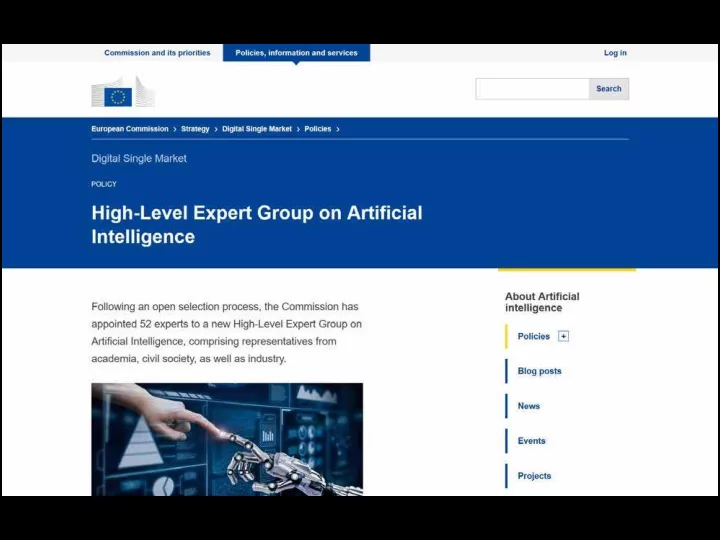
Com position of the AI HLEG
52 experts
23 companies 19 academia 10 civil society Chair: Pekka Ala-Pietilä
Working Group 1
Product: draft AI Ethics Guidelines Chair: Nozha Boujemaa
Working Group 2
Product: Policy & Investment Recommendations Chair: Barry O'Sullivan
a. in order to delay, b. postpone, c. avoid, d. deter from, e.
→ The current situation needs rules which are binding,
enforceable and encompass the legitimacy of a full democratic process.
I ntroduction
Regulatory patchworks may give rise to ‘ethics shopping’, resulting in the relocation of AI development and use to regions with lower ethical standards. Allowing the debate to be dominated by certain regions, disciplines, demographics or industry actors risks excluding a wider set of societal interests and perspectives.
European Group on Ethics in Science and New Technologies (2018). Statement on Artificial Intelligence, Robotics and ‘Autonomous’ S ystems: 14. doi:10.2777/ 531856
Deliverable 1 : The Guidelines
Guidelines should be:
acceptable trade-offs are available.
1. Ethics Guidelines are strongly industry-dominated. 2. No real normative substance on the level of concrete recommendations (e.g., Red Lines). 3. M any unsolved issues:
a. „ explicability“ (rhetorically glossed over by „traceability“, „ auditability“, etc.), b. synthetic phenomenology (artificial consciousness), c. AGI (artificial general intelligence), d. (… )
4. Short-sighted.
the Applied Ethics of AI.
the Ethics Guidelines on a less biased and more professional (i.e., academic) level.
a. Communication to the general public,
http:/ / www.wayofthefuture.church/