City of Greeley Broadband Presentation City of Greeley Broadband - - PDF document

city of greeley broadband presentation
SMART_READER_LITE
LIVE PREVIEW

City of Greeley Broadband Presentation City of Greeley Broadband - - PDF document

3/5/2020 City of Greeley Broadband Presentation City of Greeley Broadband Initiative Tim eline Phase I Phase II Phase III N W E S 2020 - 2016 2017 2018 2019 Feasibility Study City Network Direction on City Initiative to


slide-1
SLIDE 1

3/5/2020 1

City of Greeley Broadband Presentation

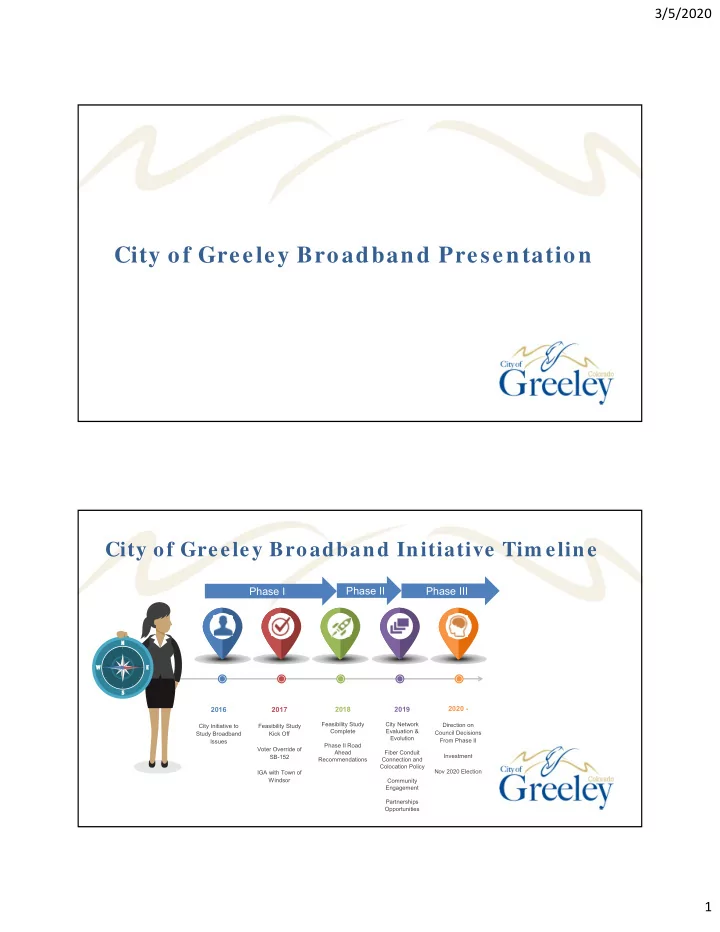
City of Greeley Broadband Initiative Tim eline

N E S W

2016

City Initiative to Study Broadband Issues

2017

Feasibility Study Kick Off Voter Override of SB-152 IGA with Town of Windsor

2018

Feasibility Study Complete Phase II Road Ahead Recommendations

2019

City Network Evaluation & Evolution Fiber Conduit Connection and Colocation Policy Community Engagement Partnerships Opportunities

2020 -

Direction on Council Decisions From Phase II Investment Nov 2020 Election

Phase I Phase II Phase III

slide-2
SLIDE 2

3/5/2020 2

20 18 Feasibility Study: Road Ahead Recom m endations

1. Broadband Friendly Policies and Ordinances 2. Connect Remaining City Assets to Fiber 3. Discussions with Community Anchor Institutions 4. Create Forum for Public Engagement

City of Greeley Fiber Optic Backbone

  • 1. City backbone includes 45 miles of fiber
  • 2. 95% of the City buildings are connected to City fiber. Will be at 100% by end of 2021. *
  • 3. Traffic system is 90% connected
  • 4. Planned expansion to SCADA, Firestation 6, Traffic signals on the west side by 2021

* Does not include Boyd and Bellevue water treatment plants

slide-3
SLIDE 3

3/5/2020 3

Broadband Task Force

Task Force Mission

Greeley’s City Council, business leaders, local institutions and city management recognize the increasing importance of how high-speed connectivity affects our community. The purpose of this committee is to better understand the community’s current and future expectations regarding residential, business and governments’ access to the internet. We will use that information to define a strategy for how these expectations and needs can best be met.

slide-4
SLIDE 4

3/5/2020 4

May – July

  • Kick off Task Force
  • Review existing

data

  • Review P3 Report
  • Review models

under consideration

  • P3 Report
  • Building Survey
  • Focus Groups

October

  • Presentation by

Uptown on survey results

  • Survey Report and

discussion - What are the needs and takeaways

Aug – Sept.

  • Presentations by

Fort Morgan and Fort Collins

  • Discussion on

City ISP Model

  • Survey launched

November

  • Presentation by

Allo

  • Discussion on P3

Model option

December

  • Presentation by

Comcast (Century Link invited but did not attend)

  • Working with

current provider model options

January 2020

Presentations by:

  • 1. Vantage Point
  • n City-Run ISP

Business Model

  • 2. Hilltop Securities
  • n financing and

bonding options

Research Phase

Broadband Task Force Tim eline Broadband Task Force Tim eline

Jan - Feb 2020

  • Review of Models

and Financial Impacts

  • Discussion and

Decision Matrix scoring

  • Options for

Council

March 2020

  • Recommendations

made on options

  • Presentation to

Council

March

  • Review

feedback from Council

  • Ballot language

development if necessary

  • Marketing starts

April - Nov

  • Task Force

continues

  • Implementation of

Council recommendations

Decision Phase Implementation Phase

slide-5
SLIDE 5

3/5/2020 5

Models Evaluated by the Task Force

  • Overall, 85% of households use Internet at home, (78%

for households earning under $50k)

  • Internet service satisfaction levels benchmark below

average.

  • Lower pricing = predominant need for

improvement with current Internet service

  • Speed is important for those most likely to switch
  • Forecasted residential take rates of 32% (Internet) and

14% (voice) with Gig Internet at $70

  • The City is the preferred provider, but by a narrower

margin than other studies

  • A majority of households support the issuance of a

revenue bond to fund construction

Market Survey Key Findings

slide-6
SLIDE 6

3/5/2020 6

City-Run ISP Public-Private Partnership (P3) Work with Current Providers Establish a Grant Program Maintain Status Quo The City would finance a FTTP Network throughout the City. The City would own and

  • perate the system.

The City would issue an RFP to develop a P3 with a private provider. Terms and Conditions TBD. The City would work with Century Link and Comcast to better improve access and

  • services. This could include

new programs. The City would set-aside money to establish one or more grant programs to help close the digital divide. The City would not take any new action.

Overview of Models

There are two m ain types of m unicipal networks that serve end-users:

  • Middle-Mile (City Backbone)
  • connections to facilities and/ or

anchor institutions

  • Last-Mile (retail model)
  • Connections to facilities and/ or

anchor institutions

  • And connections to homes and

residents

Technology is typically fiber and m ay have som e w ireless com ponents as w ell

Municipal Network Options

slide-7
SLIDE 7

3/5/2020 7

  • Data Network Requirements
  • Connectivity to the Outside World
  • Administrative Requirements (back
  • ffice)
  • Staffing Requirements (technicians,

customer service, engineering, marketing, etc.)

  • Regulatory and Reporting

Requirements

City-Run ISP Operational Overview

10 Year Financial Feasibility Study

  • Utilized the estimates from NEOConnect Study
  • 32% Penetration Rate - Uptown Services Market Study
  • Total Capital Expenditure = $120 Million (5-year build)

Assum ptions and Findings

  • Only one offering - 1 Gigabit at $70.00
  • Operating Expenses not including depreciation = $6

Million

  • Cumulative earnings of $-33,468,691 over ten years
  • Return on Investment = - 27.83%
  • Earnings Before Interest, Taxes, Depreciation, and

Amortization (EBITDA) averages $3,034,424 per year over ten years

  • 20 Year Debt Amortization
  • 2.5% interest rate in year 1 with increase of .25% each

following year

City-Run ISP Financial Overview

slide-8
SLIDE 8

3/5/2020 8

Prim ary reason - Greeley does not have a m unicipal electric system

  • Impacts cost to deploy network
  • Operating systems are not in place to absorb

broadband system administrative operations

  • Financing options are limited

City-Run ISP – Why Not Viable in Greeley

  • Cities have operated their own electric utilities

for decades and all of their utilities are an established Enterprise as defined by TABOR.

  • Issued enterprise utility revenue bonds to fund

broadband networks which are secured by revenues from both the electric and broadband systems

  • Due to electric systems - bonds on all four

municipalities received investment grade ratings which helped reduce the risk profile of the bonds for a better rate.

Com parison to:

Fort Collins, Fort Morgan, Loveland and Longm ont

slide-9
SLIDE 9

3/5/2020 9

Steps Required? Challenges of Financing Option Potential Risks

Utility Revenue Bonds Potentially needed to expand definition

  • f utility

Potential charter issues and legal challenges by existing bondholders; may be challenging to meet the additional bonds test This may place a burden on rate payers to support the broadband network and to fund water and wastewater improvements in the future General Obligation Bonds Voter Approval for Tax Increase and Debt Authorization Property tax owners that do not subscribe will be paying debt service for a network they are not using This may limit the City’s ability to utilize GO Bonds in the future for projects that are more suitable for the financing Sales Tax Revenue Bonds Voter Approval for Tax Increase and Debt Authorization In addition to approving a sales tax increase, voters would also need to authorize the issuance of debt (two questions) If sales tax revenues decline this could place a burden on the City’s general

  • perations if revenues are not sufficient

to pay debt service from the broadband system Certificates of Participation Need to identify leased property equivalent to the amount financed Need to determine if General Fund can support all or a portion of projected debt service payments If the broadband system is not successful it will strain the City’s General Fund and operations Pay-As-You Go/ Cash None The City can only build out the system as funds become available If significant funds are not available upfront to put in the base-level infrastructure, the City may not have a usable asset

Financing Options for Greeley

Projected revenues from the broadband system would not be sufficient to solely support an issuance of revenue bonds to fully fund the entire project.

The City could work with a provider to build a FTTP network. Potential model options:  City provides resources and in-kind assistance; provider finances and invests in 100% of network.  City builds out backbone. Provider invests in the rest.  City builds out backbone/ middle-mile plus all roads. Provider invests in drops to premise.  Provider builds out entire network. Possible City buy-back

  • ver 20+ year period.

Details, Terms and Conditions would depend on proposals submitted through RFP Process and contract negotiation.

P3 Basic Options
slide-10
SLIDE 10

3/5/2020 10

 Lower financial risk than a City-run network  A provider has experience owning and operating networks  Provider could deploy a network more cost effectively and quicker  A provider should keep up to date on new innovations and update technology as needed.  A new provider could bring down pricing and increase competition.

Benefits of a P3

The City a lrea d y ha s a n interested p rov id er in Allo. This is a ra re

  • p p ortunity .

Task Force Presentation

slide-11
SLIDE 11

3/5/2020 11

Task Force Recom m endation

Model Priority Ranking

Public Private Partnership (P3)

1st

Work with current providers to improve service/price/accessibility

2nd

Grant Program

3rd

City-run ISP

4th

Maintain Status Quo

5th

Questions for Council

1. Does City Council have any questions regarding the review undertaken by the Broadband Task Force? 2. Does City Council want staff or the Broadband Task Force to conduct further review or consideration of anything additional? 3. Based on the recommendation, does the City Council support directing staff to move forward with the developm ent and release of a Request for Proposals to seek proposals for a Public-Private Partnership? 4. Does the City Council support shifting the Broadband Task Force to a role of advisory committee to aid in providing community insight and feedback on future recommendations around this model?