Thursday 26 th September, 2019 Kampala, Uganda 1 Presentation - - PowerPoint PPT Presentation

thursday 26 th september 2019
SMART_READER_LITE
LIVE PREVIEW

Thursday 26 th September, 2019 Kampala, Uganda 1 Presentation - - PowerPoint PPT Presentation

The role of Natural Capital Accounting in Ugandas development planning and policy implementation Kaggwa Ronald Water and Environment Joint Sector Review meeting Thursday 26 th September, 2019 Kampala, Uganda 1 Presentation Outline #


slide-1
SLIDE 1

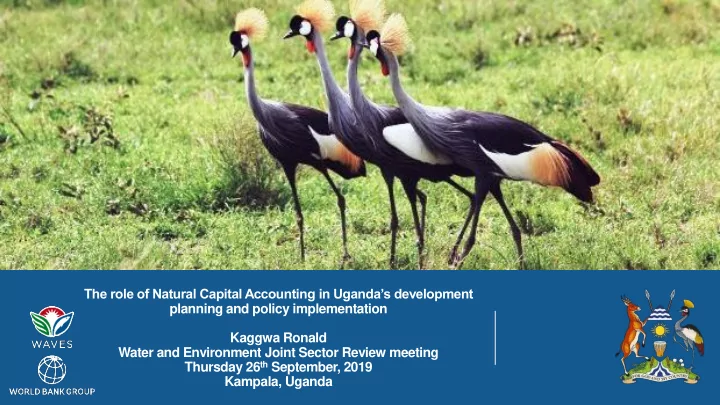
1 The role of Natural Capital Accounting in Uganda’s development planning and policy implementation Kaggwa Ronald Water and Environment Joint Sector Review meeting Thursday 26th September, 2019 Kampala, Uganda
slide-2
SLIDE 2

2

Presentation Outline

#

Context and rationale for natural capital accounting in Uganda

#

NCA initiatives in Uganda

#

Institutional arrangements for implementation of NCA

#

NCA implementation, progress and challenges

#

NCA Policy priorities in Uganda

#

Key policy messages

slide-3
SLIDE 3

3

Context and Rationale for NCA in Uganda

slide-4
SLIDE 4

4

What is Natural Capital Accounting (NCA)? Natural capital accounts are a set of objective data showing how natural resources contribute to the economy and how the economy affects natural resources. Natural capital accounting integrates natural resources and economic analysis, providing a broader picture

  • f

development progress than standard measures such as GDP .

slide-5
SLIDE 5

5

Natural capital accounting (NCA), is needed to sustain growth. Long-term development is a process of accumulation and sound management

  • f

a portfolio

  • f

assets — manufactured capital, natural capital and human capital. As Joseph Stiglitz, a Nobel Laureate noted, a private company is judged by both its income and balance sheet, but most countries

  • nly

compile an income statement (GDP) and know very little about the national balance sheet.

Long Term prosperity and well-being

slide-6
SLIDE 6

6

NCA Initiatives in Uganda

slide-7
SLIDE 7

7

In 2005, government undertook a study to assess the feasibility of introducing environmental sustainability into the national accounts. Uganda published the world's first species diversity accounts in March 2017. These ‘species accounts’ were developed for three NTFPs (Gum Arabic, Shea butter nuts, and Prunus Africana) and two flagship mammals (Chimpanzees and Elephants)

Overview of previous NCA/SEEA initiatives in Uganda

Source Source Source

(SDG). Uganda has been an associate member

  • f

the Gaborone Declaration for Sustainability in Africa (GDSA) since 2015. In 2017, Uganda expressed interest in becoming a full GDSA signatory member.

Source

This level of engagement and activity confirms that there is broad interest and support for further development and institutionalization of NCA, a base of knowledge and capacity to build upon, and a range partners to work with and share resources. The Uganda NCA Program is instrumental in galvanizing this momentum.

slide-8
SLIDE 8

8

In November 2013, Uganda participated in the Expert Group Meeting ‘Modelling Approaches and Tools for Testing

  • f

the SEEA Experimental Ecosystem Accounting at UN Headquarters’. In December 2017, UBOS presented a Draft National Plan for the Implementation

  • f

SEEA in a Conference in Nairobi organized by United Nations Statistics Division (UNSD).

Overview of previous NCA/SEEA initiatives in Uganda

Source Source

In March 2018, GoU agencies and supporting stakeholders met to take stock

  • f

NCA efforts and to seek feedback

  • n

establishment

  • f

the Uganda Natural Capital Forum to facilitate institutionalizing NCA.

The MoWE undertook an economic valuation of Uganda’s forests and their contribution to the economy,.

Source

slide-9
SLIDE 9

9

Implementation of NCA in Uganda Building a coherent picture

Natural Capital Accounts

Water Energy Land Forests Wetland and Forest Ecosystems Species Fisheries

Experimental Ecosystem Accounts for Uganda (2017) and Darwin Project UG-NCA, World Bank - WAVES Partnership (2018) UBOS, UNSD

slide-10
SLIDE 10

10

WAVES is a global partnership that aims to mainstream Natural Capital in development planning WAVES aims to:

1) Help countries adopt and implement accounts that are relevant for policies and compile a body of experience; 2) Develop ecosystem accounting methodologies; 3) Establish a global platform for training and knowledge sharing; and 4) Build international consensus around NCA.

The Global Partnership for Wealth Accounting and Valuation of Ecosystem Services (WAVES)

slide-11
SLIDE 11

11

Uganda Natural Capital Accounting program – WAVES Program Support

− The objective the Uganda Natural Capital Accounting (NCA) Program is to mainstream NCA into development policy dialogue and planning by integrating a set of accounts that will inform the NDPIII and

  • ther

national and sectoral policies. − The initial focus will be

  • n

forests and wetlands. − The aim

  • f

the program is to increase understanding on; the real contribution of natural assets and the ecosystem services to the economy and how the economy and its sectors affect this natural asset base.

International commitments

  • Nationally Determined Contributions
  • Sustainable Development Goals

National agendas

  • National Development Plan
  • Green growth Strategy
  • Reporting systems and legal frameworks.

Sectoral agendas

  • Conservation policy
  • Forest policy
  • Energy policy
  • Other sectoral policies (e.g. tourism)

Regional and local agendas

  • Water Resource Management
  • Transboundary agendas
slide-12
SLIDE 12

12

Expected Outputs The program has three main components, namely:-

− Accounts development − Studies and activities to enhance accounts development − Institutional engagement, capacity building and policy dialogue

Uganda Natural Capital Accounting program – WAVES Program Support

1.Accounts development Land accounts Forest resource accounts Forest and wetland ecosystem accounts National SEEA Compendium

  • 2. Studies and

activities to enhance accounts development Woodfuels assessment Assessment of ecosystem services at watershed level (Albertine Rift) Macroeconomic indicators Tourism assessment

  • 3. Institutional

engagement, capacity building and policy dialogue

Technical training for each component i.e SEEA Training

Exchanges Awareness raising and communication s activities Coordination – TWG meetings, public events

slide-13
SLIDE 13

13

Institutional arrangements for NCA

slide-14
SLIDE 14

14

The program builds on existing structures and work activities organized around two key elements

− The institutional arrangements, including the Steering Committee, the Technical working group, and other aspects − The support activities of coordination, communications and technical support

slide-15
SLIDE 15

15

− Ministry

  • f

Finance, Planning and Economic Development (MOFPED) and the National Planning Authority (NPA) as the chairs − Uganda Bureau of Statistics (UBOS), the co-chair and ensuring technical oversight − Ministry of Water and Environment (MWE) as the chair of the National Steering Committee − National Environmental Management Authority (NEMA), National Forest Authority (NFA), Uganda Wildlife Authority (UWA)

Program policy oversight is led by the National Steering Committee while implementation is led by the Technical working Group comprised of;

slide-16
SLIDE 16

16

NCA implementation progress challenges and lessons learnt

slide-17
SLIDE 17

17

Progress of WAVES supported activities

  • Land (physical asset) account developed – launch

planned for November

  • Supportive studies on the (i) woodfuels assessment,

(ii) Macroeconomic indicators and (ii) issue paper on NCA and the National Development Plan (NDP III) completed

  • National Plan for Advancing Environmental

Economic Accounting updated – launch planned during NatCap week in November 2019 (hosted in Uganda)

slide-18
SLIDE 18

18

Progress of WAVES supported activities

− Continuous capacity building (specific trainings and learning by doing), local capacity is emerging in Government agencies and the academia − Exposure to NCA international experiences and best practices − Communications strategy developed and being implemented

slide-19
SLIDE 19

19

NCA Policy Priorities in Uganda

slide-20
SLIDE 20

20

  • Are there adequate resources to sustain the natural resource led industrialization drive in the

medium to long terms? In other words, have we counted the resources we are counting on?

  • How will this mode of industrialization affect the country’s environment and natural resource

base? − To make a case for increased budget allocation and investment in biodiversity rich sectors for conservation and management e.g., Forest and Wetlands, Tourism etc − To increase awareness and appreciation of natural capital assets and implications of their degradation on economic growth and human well-being amongst decision makers and the public. − To assess national progress and reporting towards international commitments e.g. the SDGs and Aichi targets, Vision 2040 and NDP targets.

NCA Policy Priorities

slide-21
SLIDE 21

21

Key Policy Messages

slide-22
SLIDE 22

22

Key policy messages

  • NCA offers empirical and quantitative information to support evidence-based

policymaking and development planning

  • Through time series data, NCA assists in monitoring resource stocks and user

trends over time, which can be used to analyze the impacts of various development and resource policies.

  • NCA information can also be used to generate future development scenarios

(e.g. resource intensity by sector).

  • Natural resources and biodiversity offer new opportunities for green growth

and development, which can be estimated through the NCA.

slide-23
SLIDE 23

23

Key policy messages

  • NCA derives indicators on resource efficiency, monitor the development over

time and explore how development policies may affect resource use.

  • NCA can be applied at different spatial levels, making it relevant for national

development planning as well as sectoral development planning and local government planning.

  • NCA shows the country’s changing natural wealth and its use.
  • It shows the degree of sustainable development and contributes to the

monitoring of NDP III and various SDG indicators, including the level of savings and investments adjusted for depletion and degradation of assets (ANSI or SBI).

slide-24
SLIDE 24

24

Challenges in implementation

  • Inadequate Capacity in compilation
  • f NCA
  • Capacity in use of NCA for economic

modelling and forecasting for policy and decision making.

  • Data gaps
  • Weak institution collaboration and

coordination.

  • Inadequate but increasing

appreciation of NCA by policy makers

  • Bureaucracy and government

hierarchy

  • Difficulty in shifting from business as

usual

slide-25
SLIDE 25

25

Going beyond – instituionalizing NCA

  • Draft National Plan for the Implementation of SEEA which aligns

with the Plan for National Statistical Development (PNSD)

  • UBOS has established an operational unit for satellite accounting
  • Institutionalized NCA related data collection and analysis
  • Established the Uganda Natural Capital Forum
  • Capacity building in MDAs especially in the UBOS
slide-26
SLIDE 26

26

Long term expectations

  • NCA influencing sector and national decision

making and resource allocation.

  • Tax policies on forest and products, subsidies in

agriculture, environmental policy development and enforcement

  • Annual dissemination of NCA alongside other

National accounts.

  • NCA balances guiding and being reflected in the

NDPIII and its monitoring and results framework

  • NCA balances being used to model and forecast

major economic indicators at macroeconomic level

slide-27
SLIDE 27

27

Thank you!