Thought Leader Track Peers in the Workforce: Invasion or Innovation? - - PDF document

thought leader track
SMART_READER_LITE
LIVE PREVIEW

Thought Leader Track Peers in the Workforce: Invasion or Innovation? - - PDF document

PRA Recovery Workforce Summit, Thought June 25, 2014 Leader Session, Baltimore, MD Thought Leader Track Peers in the Workforce: Invasion or Innovation? June 25, 2014 1 T HOUGHT L EADER S ESSION : 2 B ALTIMORE , MD. J UNE 25, 2014 Welcome


slide-1
SLIDE 1

PRA Recovery Workforce Summit, Thought Leader Session, Baltimore, MD June 25, 2014 Peers in the Workforce: Invasion or Innovation? 1

Thought Leader Track

Peers in the Workforce: Invasion or Innovation?

June 25, 2014 1

THOUGHT LEADER SESSION: BALTIMORE, MD. JUNE 25, 2014

2

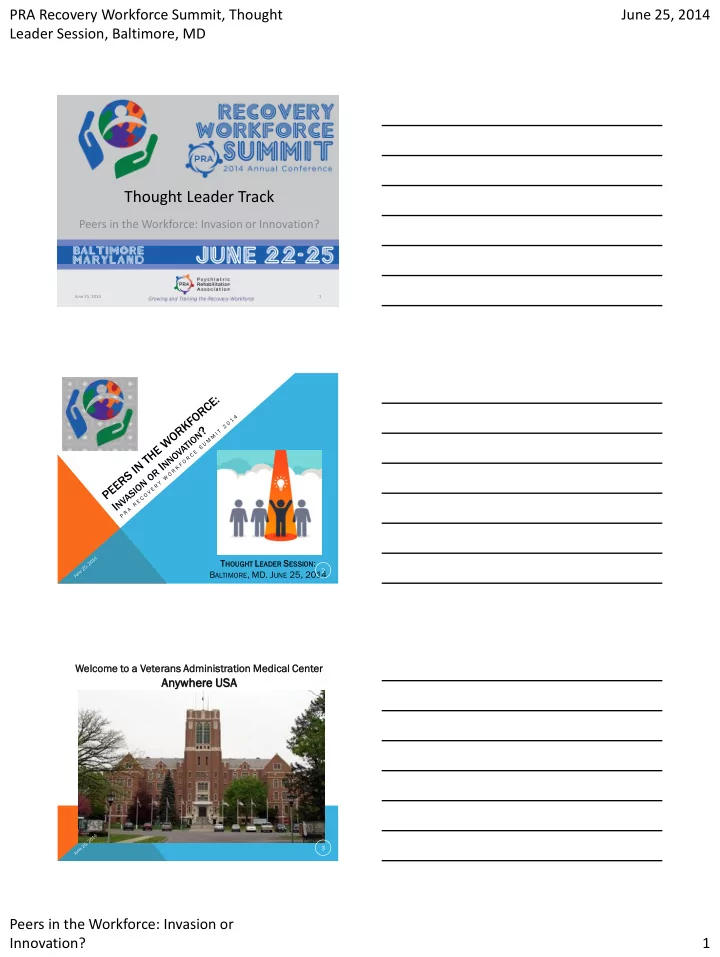
Welcome

  • me to a Veterans

s Ad Administra istratio ion Medica cal l Center er

Anywhere ere USA

3

slide-2
SLIDE 2

PRA Recovery Workforce Summit, Thought Leader Session, Baltimore, MD June 25, 2014 Peers in the Workforce: Invasion or Innovation? 2

INVASION

Certified Peer Specialist Certified Peer Specialist Certified Peer Specialist Certified Peer Specialist Certified Peer Specialist Certified Peer Specialist Certified Peer Specialist Certified Peer Specialist

Current t Op Openings

Peer Support Apprentice Peer Support Apprentice Peer Support Apprentice Peer Support Apprentice Peer Support Apprentice Peer Support Apprentice Peer Support Apprentice Peer Support Apprentice 4

Certified Peer Specialist Certified Peer Specialist Certified Peer Specialist Certified Peer Specialist Certified Peer Specialist Certified Peer Specialist Certified Peer Specialist Certified Peer Specialist

Cu Current Op Openings

Peer Support Apprentice Peer Support Apprentice Peer Support Apprentice Peer Support Apprentice Peer Support Apprentice Peer Support Apprentice Peer Support Apprentice Peer Support Apprentice

5 6

slide-3
SLIDE 3

PRA Recovery Workforce Summit, Thought Leader Session, Baltimore, MD June 25, 2014 Peers in the Workforce: Invasion or Innovation? 3

Panel Presenters

Rita Cronise, MS

Instructional Design Consultant iNAPS; Adjunct Faculty, Rutgers University

Reneé Kopache, MS, CPRP

Coordinator of Wellness Management for the Hamilton County Mental Health and Recovery Services Board

June 25, 2014 7

Panel Presenters (cont.)

Liz Smithhart, LPC, CPRP Regional Director, Recovery Innovations Kathleen O’Donnell, MS, CPRP, Volunteer

June 25, 2014 8

  • The role and value of peers in the

behavioral health workforce

  • Authentic peer support
  • Key factors to effectively integrate

peer services

  • The difference between “invasion”

and “innovation” when employing peers in psychiatric rehabilitation and behavioral health workforce. LEARNIN

NING OBJECT ECTIVES

Participants will be able to describe:

slide-4
SLIDE 4

PRA Recovery Workforce Summit, Thought Leader Session, Baltimore, MD June 25, 2014 Peers in the Workforce: Invasion or Innovation? 4

Question

  • n 1

What at is the purpos

  • se,

e, ro role, e, and value ue of peers in the workfor

  • rce?

ce?

10

Question 1:

What is the purpose, role, and value of peers in the workforce?

Purpose

  • Hope, connection, encouragement, communication, empowerment (AEB)
  • Disruptive innovators (Deegan)

Role

  • Peers support is intentionally different from conventional care. (Mead, Davidson)
  • Peers draw upon lived experience to share ‘been there’ empathy, insights, and

engage people along the spectrum of support needs. (Mazza, Salzer)

Value

  • Peers offer something no one else can (lived experience of recovery).
  • If successful, peers break down stigma and transform the mental health system

(Ragins)

June 25, 2014 11

Question

  • n 2

What at is authent entic ic peer suppor

  • rt?

12

slide-5
SLIDE 5

PRA Recovery Workforce Summit, Thought Leader Session, Baltimore, MD June 25, 2014 Peers in the Workforce: Invasion or Innovation? 5

Question 2

What is Authentic Peer Support?

Basic Criteria Lived experience + desire to support others + specialized training + supervision

June 25, 2014 13

Authentic Peer Support is…

  • Not Clinical
  • Not a “junior” position
  • Not a token
  • Not hierarchical, forced, mandated, or coerced
  • Not driven by funding, policy, or program structure
  • Not a low cost substitute for conventional treatment

(Davidson)

  • Not well-researched (Cochrane Collaboration report)

June 25, 2014 14

Authentic Peer Support is… Not a service If support is “the service…” …then peers are just one of many (family, friends, neighbors, community, etc..) who can provide “the service” of support -- each from a unique yet valuable perspective.

June 25, 2014 15

slide-6
SLIDE 6

PRA Recovery Workforce Summit, Thought Leader Session, Baltimore, MD June 25, 2014 Peers in the Workforce: Invasion or Innovation? 6

Core values

  • Voluntary
  • Honest and direct
  • Mutual and reciprocal
  • Equally shared power
  • Strengths-focused
  • Transparent
  • Person-driven
  • Hopeful
  • Open-minded

(non-judgmental)

  • Empathetic
  • Respectful
  • Agents of change

(National Practice Guidelines for Peer Supporters, iNAPS)

Peer support is Peer supporters are

June 25, 2014 16

SOURCE: Equipping Behavioral Health Systems & Authorities to Promote Peer Specialists/Peer Recovery Coaching Services. (2012). Expert Panel Meeting Report. BRSS-TACS.

Authentic ic Peer Support: A Comparis rison Chart Peer Identity ity and Peer er Drif ift in the VA

(SOURCE: VA Peer Specialist Toolkit. (2014). Implementing Peer Support Services in VHA. A Collaboration between VISN 1 New England MIRECC Peer Education Center and the VISN 4 MIRECC Peer Resource Center.)

slide-7
SLIDE 7

PRA Recovery Workforce Summit, Thought Leader Session, Baltimore, MD June 25, 2014 Peers in the Workforce: Invasion or Innovation? 7

Question

  • n 3

What at are the key y factor

  • rs that must be

addres essed ed for the e integr egratio ation n of peers?

19

KEY FACTORS

  • Environment/culture
  • Programs/services
  • Staffing
  • Evaluation/outcomes
  • Research
  • Advancement of discipline

20

Environment / Culture

  • Recovery driven philosophy

–From the top down (mission, vision, values, policies) –Peer involvement in all aspects (from administration to program development to service delivery, evaluation, and outcomes)

June 25, 2014 21

slide-8
SLIDE 8

PRA Recovery Workforce Summit, Thought Leader Session, Baltimore, MD June 25, 2014 Peers in the Workforce: Invasion or Innovation? 8

Environment / Culture

  • Avoid ‘false philosophy’ of recovery

–Changing the words but not the deeds –Recovery-oriented approaches are not ‘business as usual’ under the medical model

June 25, 2014 22

Environment / Culture

  • Address/eliminate stigma

–Toward people with mental illness –Toward peer providers –From peers and peer providers toward professionals

June 25, 2014 23

Programs/Services

  • Unique role peers can play in service delivery
  • Peer involvement in service design
  • Services based on peer to peer support
  • Not provide services offered by other

professions unless with equal salary/benefits

  • Eliminate role confusion

(UPENN study)

June 25, 2014 24

slide-9
SLIDE 9

PRA Recovery Workforce Summit, Thought Leader Session, Baltimore, MD June 25, 2014 Peers in the Workforce: Invasion or Innovation? 9

Staffing

  • Training (for peers and non-peers)
  • Job descriptions (not one-size-fits-all)
  • Boundaries
  • Supervision
  • Salaries/hours

June 25, 2014 25

Evaluation/outcomes

  • Person-centered (not system-centered)
  • Dimensions of wellness/quality of life
  • Community inclusion

June 25, 2014 26

Research

  • Peer support services not well researched
  • Research needs to be more rigorous
  • Research needs to be more setting-specific
  • Research that explores qualitative as well as

quantitative questions

June 25, 2014 27

slide-10
SLIDE 10

PRA Recovery Workforce Summit, Thought Leader Session, Baltimore, MD June 25, 2014 Peers in the Workforce: Invasion or Innovation? 10

Advancement of discipline

  • Define services peer workers can/should

provide

  • Guard against ‘infection’
  • Avoid co-optation and mission drift
  • Pace number of certified peer graduates to

the number of available job openings

June 25, 2014 28

Advocate against inappropriate use of peers

“Peer staff should not be low cost substitutes for treatment as usual, but are being used that way across the country” – Larry Davidson – “I often sit in on clients’ appointments when the case manager can’t. I help fill medication boxes…I file paper work, do encounter notes when I see a client, and make myself available to the case managers for ‘other’ jobs.” – “I take clients to doctors’ appointments, shopping for groceries, and

  • ut to lunch. I bring clients into the ACT office for injections. I help fill

pill boxes with medication.” – “Most of our work is transporting clients.” – “I counsel patients with mental health issues. I also act as support staff for doctors, nurses and the social workers.”

June 25, 2014 29

Advocate against inappropriate use of peers

– “I am involved with crisis management, and do paperwork, lots of it.” – “I collaborate with clients to develop plans best suited to their needs according to the objectives assigned by the case managers.” – “I get together with my clients once a week. My main goal is to help keep people out of the hospital.” – “I help people fill out their paperwork…I talk to people who won’t help themselves and let them hear my story.” – “Unfortunately, I am a glorified bus driver and check writer.”

June 25, 2014 30

slide-11
SLIDE 11

PRA Recovery Workforce Summit, Thought Leader Session, Baltimore, MD June 25, 2014 Peers in the Workforce: Invasion or Innovation? 11

Advancement of discipline

  • Strengthen eligibility criteria
  • Standardize core training / CE requirements
  • Standardize criteria for exams / certification
  • Separate the training process from exam
  • Accept CPRP as substitute for CPS
  • Require CPRP (or equivalent) for supervisors
  • Charge fee for certification / re-certification
  • Hire full-time trainers to train multiple courses

June 25, 2014 31

INNOVATION

Certified Peer Specialist Certified Peer Specialist Certified Peer Specialist Certified Peer Specialist Certified Peer Specialist Certified Peer Specialist Certified Peer Specialist Certified Peer Specialist

Current t Op Openings

Peer Support Apprentice Peer Support Apprentice Peer Support Apprentice Peer Support Apprentice Peer Support Apprentice Peer Support Apprentice Peer Support Apprentice Peer Support Apprentice 32

Role Players s

  • Lori Ashcraft, Gene Johnson, and Lisa St. George,

Leadership Team, Recovery Innovations, Phoenix, Arizona

  • Andy Bernstein, Clinical Director, RISE, University of Arizona

Health and Wellness Center (Camp Wellness)

  • Scott Heller, Executive Director, Pennsylvania Association of

Psychiatric Rehabilitation Services (PAPRS)

  • Gina Calhoun-Heller, Director or Training and Education,

Copeland Center for Wellness and Recovery

33

slide-12
SLIDE 12

PRA Recovery Workforce Summit, Thought Leader Session, Baltimore, MD June 25, 2014 Peers in the Workforce: Invasion or Innovation? 12

34

REFERENCES

  • Ashcraft, L. (2014). Thoughts on the future of peer-run services: Part 3. Behavioral
  • Healthcare. June 11, 2014.
  • Ashcraft, L. & Anthony, W. (2012). Lessons learned in peer workforce development.

Behavioral Healthcare. February 2, 2012.

  • Chinman, M. & Salzer, M. & O’Brien-Mazza, D. (2012). National Survey on

Implementation of Peer Specialists in the VA: Implications for Training and Facilitation. Psychiatric Rehabilitation Journal. Vol. 35(6) 470-473.

  • Davidson, L. & Harrington, S. (2011). Common Practitioner Concerns and Myths About

Peer Support. Part 2 of a Three-Part Series. SAMHSA Recovery to Practice Weekly Highlight, Vol. 2(10).

  • Deegan, P. (2011). Peer Staff as Disruptive Innovators.
  • Dougherty, R., Lyman, R., George, P., Ghose, S., Daniels, A., Delphin-Rittmon, M. (2014)

Assessing the Evidence Base for Behavioral Health Services: Introduction to the Series.

  • Equipping Behavioral Health Systems & Authorities to Promote Peer Specialists/Peer

Recovery Coaching Services. (2012). Expert Panel Meeting Report. Prepared by BRSS TACS for SAMHSA.

  • Evans, I. (2014). Peer Support, Peer Problems. Psych Central.
  • Johnson, G., Magee, C., Maru, M., Furlong-Norman, K., Rogers, S. & Thompson, K.

(2014). Personal and Societal Benefits of Providing Peer Support: A Survey of Peer Support Specialists. Psychiatric Services. May 2014. Vol. 65(5). 678-680. 35

REFERENCES (CONTINUED)

  • Harrington, S. (2013). National Practice Guidelines for Peer Supporters. Issued in April

2013 by the International Association of Peer Supporters. (www.inaops.org.)

  • Harrington, S. (2014). Psychiatrists and Peer Supporters: Adversaries or Allies?

International Association of Peer Supporters Newsletter, April 2014.

  • Ragins, M. (2006). Hiring and Supporting Peer Staff. From Exploring Recovery: The

Collective Village Writings of Mark Ragins.

  • Schwenk, E.B., Brusilovskiy, E. & Salzer, M.S. (2009). Results from a National Survey of

Certified Peer Specialist Job Titles and Job Descriptions: Evidence of a Versatile Behavioral Health Workforce. The University of Pennsylvania Collaborative on Community Integration: Philadelphia, P.A.

  • Spagnolo, A., Murphy, A. & Librera, L. (2008). Reducing Stigma. Psychiatric

Rehabilitation Journal. Vol. 31(3). 186-193.

  • The Carter Center. Waging Peace. Fighting Disease. Building Hope. (website)
  • VA Peer Specialist Toolkit. (2014). Implementing Peer Support Services in VHA. A

Collaboration between VISN 1 New England MIRECC Peer Education Center and the VISN 4 MIRECC Peer Resource Center.

  • Walker, G. & Bryant, W. (2013). Peer Support in Adult Mental Health Services:

A Metasynthesis of Qualitative Findings. Psychiatric Rehabilitation Journal. Vol. 36(1). 28-34. 36
slide-13
SLIDE 13

PRA Recovery Workforce Summit, Thought Leader Session, Baltimore, MD June 25, 2014 Peers in the Workforce: Invasion or Innovation? 13

CONCLUSION: WE ALL WANT THE SAME THING!

37 Click to play on You Tube http://www.youtube.com/watch?v=KdtjZLgZVMc