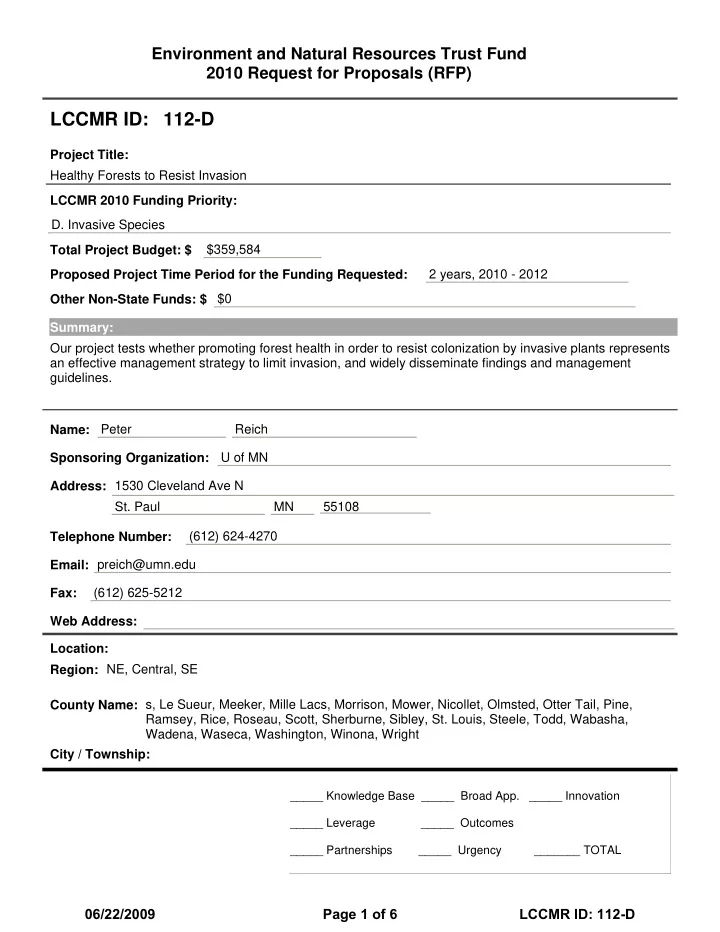
SLIDE 1 Environment and Natural Resources Trust Fund 2010 Request for Proposals (RFP)
Healthy Forests to Resist Invasion $359,584 2 years, 2010 - 2012 $0 Peter Reich U of MN 1530 Cleveland Ave N
MN 55108 (612) 624-4270 (612) 625-5212 preich@umn.edu s, Le Sueur, Meeker, Mille Lacs, Morrison, Mower, Nicollet, Olmsted, Otter Tail, Pine, Ramsey, Rice, Roseau, Scott, Sherburne, Sibley, St. Louis, Steele, Todd, Wabasha, Wadena, Waseca, Washington, Winona, Wright Our project tests whether promoting forest health in order to resist colonization by invasive plants represents an effective management strategy to limit invasion, and widely disseminate findings and management guidelines. Project Title: Total Project Budget: $ Proposed Project Time Period for the Funding Requested: Other Non-State Funds: $ Name: Sponsoring Organization: Address: Telephone Number: Email: Fax: Web Address: County Name: City / Township: Region: Summary: NE, Central, SE
LCCMR ID: 112-D
LCCMR 2010 Funding Priority:
Location:
_____ Knowledge Base _____ Broad App. _____ Innovation _____ Leverage _____ Outcomes _____ Partnerships _____ Urgency _______ TOTAL
06/22/2009 Page 1 of 6 LCCMR ID: 112-D
SLIDE 2 Healthy Forests to Resist Invasion
MAIN PROPOSAL PROJECT TITLE: I. PROJECT STATEMENT Healthy Forests to Resist Invasion The capacity to adaptively manage forests in the face of invasive threats is limited by lack of knowledge of what makes forests vulnerable to invasion, including the roles played by disturbance history, native diversity, site resources (light, water, nutrients), and climate. The degree of disturbance, the ecological integrity of an ecosystem, and the native diversity of forests all likely influence how easily they are colonized by invasive plant species. Although there is some evidence to support this view, a comprehensive assessment has not been made, and would be especially useful in Minnesota. Here we propose the idea of “preventive environmental care”. Much like preventive health care– which may be an effective societal strategy by enhancing “wellness” in addition to treating “illness”, rather than merely doing the latter- managing forests for “wellness” to resist invasion may be a key strategy, especially given the enormous and expensive challenges of controlling invasive species once they have established. This project will increase our understanding of invasion processes and our capacity to effectively manage to slow the pace of invasion. The project will:
- Establish 80 forest study sites located throughout Minnesota (see Map). Sites will be
chosen to standardize as possible forest stand age, site type, and soils.
- On 16 plots at all 80 sites a set of key indicators relevant to invasion will be assessed.
- These indicators will include: level and type of prior disturbance; degree of tree canopy
cover; maturity of vegetation; native overstory and understory plant diversity; functional and structural traits of dominant species; specific levels of light and soil resources; distance to roads, settlements, and the like; and the local climate regime.
- Census invasive plant species at each site (how many species, their identity, and their
relative abundance).
- Determine the links between forest attributes and plant invasion
- Evaluate whether forests in remote, northern parts of the state are less invaded because of
distance from development (towns, highways, etc), colder climate, or both.
- Address whether restoration activities that promote forest health and integrity can be
effective in limiting invasion.
- Develop management guidelines for optimizing resistance to invasion.
II. DESCRIPTION OF PROJECT RESULTS Result 1: Finalize research plans, select 80 sites, and establish 16 research plots in each site. Budget: $45,000. Information such as regional and state-wide forest inventories (i.e. FIM and MCBS native plant community data) will be used to select candidate sites. Deliverable Completion Date
- 1. Identify, locate 80 forest sites 12/15/2010
- 2. Establish 16 plots at each site
6/30/2011 06/22/2009 Page 2 of 6 LCCMR ID: 112-D
SLIDE 3 Healthy Forests to Resist Invasion
Result 2: Assess degree of plant invasion, disturbance history, and health and structural integrity of native plant communities. Budget: $228,000. Over the course of two years, all plots in all sites will be censused for ecosystem attributes and the native and invasive plant community. Other data on climate and distance from development will be obtained and maintained in a geographical information system. Deliverable Completion Date
- 1. Field data collection completed on forest health and invasion status 9/30/2012
- 2. Final data base on plant invasion, forest health and integrity 12/31/2012
Result 3: Analyze data, develop management guidelines, disseminate results via outreach presentations, workshops, and reports, DNR/UM web site, scientific publications. Budget: $86,584. Guidelines for forest management to resist invasion will be developed. These will be provided to resource managers and the public through a series of presentations and workshops as well as via an interactive web site. Deliverable Completion Date
- 1. Final report, “Do Healthy Forests Resist Invasion?” 6/30/2013
- 2. Forest management guidelines
6/30/2013
- 3. Outreach via presentations, workshops, web site 6/30/2013
- 4. Scientific publications written 6/30/2013
- III. PROJECT STRATEGY AND TIMELINE
- A. Project Partners. P. Reich is project manager. Additional project partners: Ann Pierce,
Conservation Management and Rare Resources Unit, Ecological Resources, MNDNR, with biodiversity conservation and invasive species expertise; Luke Skinner, Invasive Species Unit, Ecological Resources, MNDNR, with invasive species expertise; Susan Burks, Invasive Species Coordinator, Forestry, MNDNR, with expertise on invasive species; and Cynthia Osmundson, Forest Wildlife Program, Fisheries and Wildlife, MNDNR, with forest and wildlife management
- expertise. Additionally, Kathleen Knight, U.S. Forest Service scientist with expertise on invasive
species, will cooperate on the project, as will several other university faculty.
- B. Timeline Requirements. This is proposed as a three-year project. Budget request is for 2
years, but to be spent over 3 years.
- C. Long-Term Strategy. In the long term this information can be used to help land managers
develop management prescriptions that incorporate the current invasive status of the plant community and the health and integrity of the ecosystem, which will serve as an indicator of vulnerability to invasion. Results of this project can be used to inform silvicultural interpretations being developed based on the Ecological Classification System. This information is critical to maintaining a resilient forest system in the face of future climate change coupled with invasive species. 06/22/2009 Page 3 of 6 LCCMR ID: 112-D
SLIDE 4 J:\SHARE\WORKFILE\ML2010\RFP\2010 Proposals - JUNE FINALS\112-D - Reich Peter 0509-2-060 - Budget
BUDGET ITEM Personnel: 1 Research associate, 100%, coordination of day to day project activities ($44,596 salary + $14,405 fringe) for 2 years 1 Graduate student, 50%, develop dissertation research project from some aspect of project research ( $21,000 salary + $3,536 health insurance + $ 11,170 tuition for 2 years 1 Project assistant, 50% ($36,000 salary + $6,660 fringe) for 2 years $49,320 4 undergrad students (summer, 100%) 2000 hours @ $11/hour + $1,795 fringe) for 2 summers 3 undergrad students (academic year, 25%) 8 hrs/week, 960 hours @ $11/hour for 2 academic years 21,120 $ Equipment/Tools/Supplies: Misc. field supplies and tools (data sheets, labels, bags, vials, etc.) for 2 years; and laser range finders (2) and light sensors (2) Travel: Intensive in-state travel to 80 scattered and remote field sites, for 2 years, includes lodging and mileage on personal vehicles Chemical analyses of plants and soils: cost based on one vegetation and one soil sample per plot (16 plots x 80 sites, at a total cost of $11 for the two analyses), for 2 years TOTAL PROJECT BUDGET REQUEST TO LCCMR SOURCE OF FUNDS AMOUNT Status Other Non-State $ Being Applied to Project During Project Period:
Indicate: Secured or Pending Other State $ Being Applied to Project During Project Period:
Indicate: Secured or Pending In-kind Services During Project Period: Time that the Project Manager, partners, and participants spend on the project. 60,000 $ Remaining $ from Current Trust Fund Appropriation (if applicable): Indicate: Unspent? Not Legally Obligated? Other? Funding History:
$16,000 $22,060
$71,412 359,584 $ 14,080 $ 47,590 $
Project Budget
Healthy Forests to Resist Invasion
- IV. TOTAL PROJECT REQUEST BUDGET (2 years)
AMOUNT $118,002
06/22/2009 Page 4 of 6 LCCMR ID: 112-D
SLIDE 5
The “healthy forests to resist invasion health” project will focus on both the Laurentian mixed and eastern broadleaf forest provinces of Minnesota. The 80 field sites will be distributed throughout the region and will be selected from more than 200 candidate sites, including the 150 candidate sites shown on the map.
06/22/2009 Page 5 of 6 LCCMR ID: 112-D
SLIDE 6
Project Manager Qualifications and Organization Description Project Manager: Professor Peter B. Reich Regents Professor, Distinguished McKnight University Professor, and F.B. Hubachek, Sr., Professor of Tree Physiology and Forest Ecology Department of Forest Resources, University of Minnesota, St. Paul, MN 55108 E-mail: preich@umn.edu; Phone: 612-624-4270; FAX 612-625-5212 Professional Appointments and Preparation F.B. Hubachek, Sr., Professor, Dept of Forest Resources, U. Minnesota, 1991- Assistant/Associate Professor, Dept of Forestry, U. Wisconsin-Madison, 1985-1991 Post-doc (1985) and Ph.D. (1983) Cornell University M.S. (1977) University of Missouri B.A. (1974) Goddard College Honors, Professional Recognition and Service (Selected) Invited speaker > 120 symposium, conferences, and seminars; e.g., Harvard; Duke; Penn State; Princeton; Stanford; Texas A&M; Cornell; Michigan State; Washington Institute for Scientific Information (ISI) Science Citation Index, List of Top 10 Ecologists and Environmental Scientists in the World, 2002 – present Advisor to numerous Federal science and policy agencies Member of numerous editorial review boards and federal science agency panels Areas of Expertise Forest ecosystem ecology and management; global environmental change and terrestrial ecosystem responses, including invasive species, climate, biodiversity, wildfire, elevated CO2 , N pollution, land use change, and sustainability; Carbon cycling; Plant physiology, production; forest ecology, soil fertility and biogeochemistry. Systems studied: forests, woodlands, grasslands, agricultural row crops. Project Management Experience Lead PI or co-PI on forest and grassland science projects (total funding, >$18 million 2000- present, from federal [NSF, DOE, USDA, NASA], state, and private sources. Peer-reviewed publications: > 310 scientific articles and book chapters, including > 15 in high profile general journals (Nature, Science, etc.) as well as >250 in specialized technical journals Project Management Qualifications for this Project Background in forest ecosystem ecology and management, including studies of invasive and exotic species. Extensive experience successfully leading science projects and managing large research teams. Organization Description The University of Minnesota is both the state land-grant university, with a strong tradition of education and public service, and the state's primary research university 06/22/2009 Page 6 of 6 LCCMR ID: 112-D