SLIDE 1
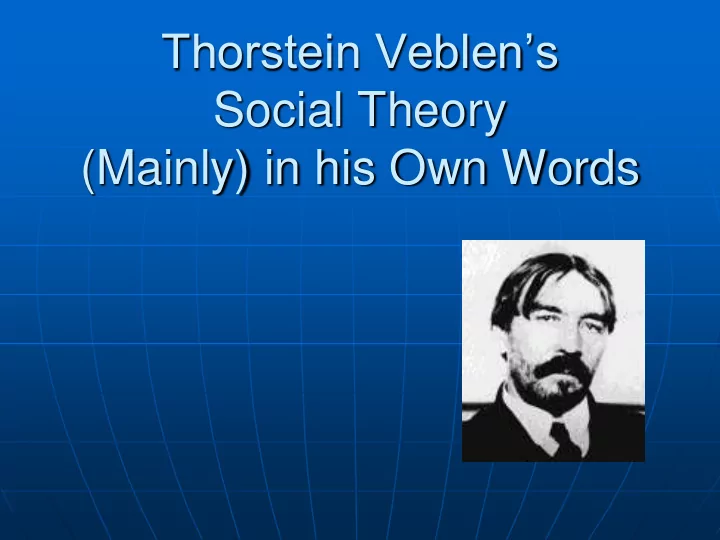
Thorstein Veblen’s Social Theory (Mainly) in his Own Words
SLIDE 2
Thorstein Veblen
(1857-1929)
SLIDE 3 Assumption: Human Nature
“The psychological and anthropological preconceptions of the economists have been those which were accepted by the psychological and social sciences some generations ago. The hedonistic conception of man is that of a lightning calculator of pleasures and pains who
- scillates like a homogeneous globule of
desire of happiness under the impulse of stimuli that shift him about the area, but leave him intact.”
SLIDE 4
Assumption: Human Nature
“Spiritually, the hedonistic man is not a prime mover. He is not the seat of a process of living, except in the sense that he is subject to a series of permutations enforced upon him by circumstances external and alien to him.”
SLIDE 5
Assumption: Human Nature
“The later psychology, re-enforced by modern anthropological research, gives a different conception of human nature. According to this conception, it is the characteristic of man to do something, not simply to suffer pleasures and pains through the impact of suitable forces.”
SLIDE 6
Assumption: Human Nature
“He is not simply a bundle of desires that are to be saturated by being placed in the path of the forces of the environment, but rather a coherent structure of propensities and habits which seeks realization and expression in an unfolding activity.”
SLIDE 7
Assumption: Economic Behavior
Economic behavior, Veblen contended, had to be analyzed in terms of its social context. Human beings are active participants within this holistic context, they are not merely the passive repository of social and economic forces.
SLIDE 8
Assumption: A Social Animal
“Sensitiveness to rebuke or approval is a matter of selective necessity under the circumstances of associated life. Without it no group of men could carry on a collective life in a material environment that requires shaping to the ends of man. In this respect, again, man shows a spiritual relationship with the gregarious animals rather than with the solitary beasts of prey.”
SLIDE 9
Assumption: Adaptation
Societies make constant adaptations of their technology to meet their economic ends.
SLIDE 10
Social Evolution
Adaptations to the natural and social environment take the form of technological innovation. The invention or diffusion of more powerful technologies is the driving force behind social evolution.
SLIDE 11 Social Evolution
“The process of cumulative change that is to be accounted for is the sequence of change in the methods
- f doing things—the methods of
dealing with the material means of life.”
SLIDE 12
Social Evolution
“The life of man in society, just like the life of other species, is a struggle for existence, and therefore it is a process of selective adaptation. The evolution of social structure has been a process of natural selection of institution.”
SLIDE 13
Social Evolution
“The progress which has been and is being made in human institutions and in human character may be set down, broadly, to a natural selection of the fittest habits of thought and to a process of enforced adaptation of individuals to an environment which has progressively changed with the growth of the community and with the changing institutions under which men have lived.”
SLIDE 14 Social Evolution
“Institutions are not only themselves the result of a selective and adaptive process which shapes the prevailing
- r dominant types of spiritual
attitude and aptitudes; they are at the same time special methods of life and of human relations, and are therefore in their turn efficient factors of selection.”
SLIDE 15
Social Evolution
“So that the changing institutions in their turn make for a further selection of individuals endowed with the fittest temperament, and a further adaptation of individual temperament and habits to the changing environment through the formation of new institutions.”
SLIDE 16 Social Evolution
Social evolution, therefore, is a pattern
- f institutional adaptation (and
ultimately human adaptation)—to changing technology and the economy of a society.
SLIDE 17 Social Evolution
Technology and economy affect all
- ther institutions within a society.
SLIDE 18 Social Evolution
“A study of …primitive cultures…shows a close correlation between the material (industrial and pecuniary) life of any given people and their civic, domestic, and religious scheme
- f life; the myths and the religious
cult reflect the character of these
- ther—especially the economic and
domestic—institutions in a peculiarly naïve and truthful manner.”
SLIDE 19 Social Evolution
Veblen places economic (pecuniary) and technological interests in
- pposition to one another. Contrary
to many evolutionists of his day, he did not see the capitalist or the businessman as being at the pinnacle
- f an evolutionary pyramid, but
rather as a parasite on technological advance.
SLIDE 20 Social Evolution
“The leisure class lives by the industrial community rather than in
- it. Its relations to industry are of a
pecuniary rather than an industrial
- kind. Admission to the class is gained
by exercise of the pecuniary aptitudes—aptitudes for acquisition rather than for serviceability.”
SLIDE 21
Social Evolution
“There is, therefore, a continued selective sifting of the human material that makes up the leisure class, and this selection proceeds on the ground of fitness for pecuniary pursuits.”
SLIDE 22 The Leisure Class
“The quasi-peaceable gentleman of leisure, then, not only consumes of the staff of life beyond the minimum required for subsistence and physical efficiency, but his consumption also undergoes a specialization as regards the quality of the goods consumed. He consumes freely and
- f the best, in food, drink, narcotics,
shelter, services, ornaments, apparel, weapons and accoutrements, amusements, amulets, and idols or divinities.”
SLIDE 23
The Leisure Class
“Since the consumption of these more excellent goods is an evidence of wealth, it becomes honorific; and conversely, the failure to consume in due quantity and quality becomes a mark of inferiority and demerit.”
SLIDE 24 The Leisure Class
“This growth of punctilious discrimination as to qualitative excellence in eating, drinking, etc., presently affects not only the manner of life, but also the training and intellectual activity of the gentleman
- f leisure. He is no longer simply the
successful, aggressive male,--the man of strength, resource, and intrepidity. In
- rder to avoid stultification he must also
cultivate his tastes, for it now becomes incumbent on him to discriminate with some nicety between the noble and the ignoble in consumable goods.”
SLIDE 25 The Leisure Class
“Closely related to the requirement that the gentleman must consume freely and of the right kind of goods, there is the requirement that he must know how to consume them in a seemly manner. His life of leisure must be conducted in due
- form. Hence arise good manners in the
way pointed out in an earlier chapter. High-bred manners and ways of living are items of conformity to the norm of conspicuous leisure and conspicuous consumption.”
SLIDE 26 The Leisure Class
“As wealth accumulates, the leisure class develops further in function and structure, and there arises a differentiation within the class. There is a more
- r less elaborate system of rank and grades. This
differentiation is furthered by the inheritance of wealth and the consequent inheritance of
- gentility. With the inheritance of gentility goes
the inheritance of obligatory leisure; and gentility
- f a sufficient potency to entail a life of leisure
may be inherited without the complement of wealth required to maintain a dignified leisure.”
SLIDE 27 The Leisure Class
“The leisure class stands at the head
- f the social structure in point of
reputability; and its manner of life and its standards of worth therefore afford the norm of reputability for the community. The observance of these standards, in some degree of approximation, becomes incumbent upon all classes lower in the scale.”
SLIDE 28 Conspicuous Consumption
“The basis on which good repute in any highly organized industrial community ultimately rests is pecuniary strength; and the means
- f showing pecuniary strength, and
so of gaining or retaining a good name, are leisure and a conspicuous consumption of goods.”
SLIDE 29
Conspicuous Consumption
“In modern civilized communities the lines of demarcation between social classes have grown vague and transient, and wherever this happens the norm of reputability imposed by the upper class extends its coercive influence with but slight hindrance down through the social structure to the lowest strata.”
SLIDE 30
Conspicuous Consumption
“The result is that the members of each stratum accept as their ideal of decency the scheme of life in vogue in the next higher stratum, and bend their energies to live up to that ideal. On pain of forfeiting their good name and their self-respect in case of failure, they must conform to the accepted code, at least in appearance.”
SLIDE 31
Conspicuous Consumption
“From the foregoing survey of the growth of conspicuous leisure and consumption, it appears that the utility of both alike for the purposes of reputability lies in the element of waste that is common to both. In the one case it is a waste of time and effort, in the other it is a waste of goods. Both are methods of demonstrating the possession of wealth, and the two are conventionally accepted as equivalents.”
SLIDE 32
Conspicuous Consumption
“The exigencies of the modern industrial system frequently place individuals and households in juxtaposition between whom there is little contact in any other sense than that of juxtaposition. One's neighbors, mechanically speaking, often are socially not one's neighbors, or even acquaintances; and still their transient good opinion has a high degree of utility.”
SLIDE 33 Conspicuous Consumption
“The only practicable means of impressing
- ne's pecuniary ability on these
unsympathetic observers of one's everyday life is an unremitting demonstration of ability to pay. In the modern community there is also a more frequent attendance at large gatherings of people to whom one's everyday life is unknown; in such places as churches, theatres, ballrooms, hotels, parks, shops, and the like.”
SLIDE 34 Conspicuous Consumption
“In order to impress these transient
- bservers, and to retain one's self-
complacency under their
- bservation, the signature of one's
pecuniary strength should be written in characters which he who runs may read.”
SLIDE 35
Conspicuous Consumption
“It is evident, therefore, that the present trend of the development is in the direction of heightening the utility of conspicuous consumption as compared with leisure.”
SLIDE 36 Absolute & Relative Poverty
“The modern industrial system is based on the institution of private property under free competition, and it cannot be claimed that these institutions have heretofore worked to the detriment of the material interests of the average member of
- society. The ground of discontent cannot
lie in a disadvantageous comparison of the present with the past, so far as material interests are concerned.”
SLIDE 37 Absolute & Relative Poverty
“It is notorious, and, practically, none
- f the agitators deny, that the
system of industrial competition, based on private property, has brought about, or has at least co- existed with, the most rapid advance in average wealth and industrial efficiency that the world has seen.”
SLIDE 38 Absolute & Relative Poverty
“Especially can it fairly be claimed that the result of the last few decades of our industrial development has been to increase greatly the creature comforts within the reach of the average human
- being. And, decidedly, the result has been
an amelioration of the lot of the less favored in a relatively greater degree than that of those economically more fortunate.”
SLIDE 39 Absolute & Relative Poverty
“The claim that the system of competition has proved itself an engine for making the rich richer and the poor poorer has the fascination of epigram; but if its meaning is that the lot of the average, of the masses of humanity in civilized life, is worse to-day, as measured in the means
- f livelihood, than it was twenty, or fifty,
- r a hundred years ago, then it is farcical.
The cause of discontent must be sought elsewhere than in any increased difficulty in obtaining the means of subsistence or
SLIDE 40
Absolute & Relative Poverty
“But there is a sense in which the aphorism is true, and in it lies at least a partial explanation of the unrest which our conservative people so greatly deprecate. The existing system has not made, and does not tend to make, the industrious poor poorer as measured absolutely in means of livelihood; but it does tend to make them relatively poorer, in their own eyes, as measured in terms of comparative economic importance, and, curious as it may seem at first sight, that is what seems to count.”
SLIDE 41 Absolute & Relative Poverty
“Human nature being what it is, the struggle
- f each to possess more than his neighbor
is inseparable from the institution of private property. And also, human nature being what it is, one who possesses less will, on the average, be jealous of the one who possesses more; and "more" means not more than the average share, but more than the share of the person who makes the comparison.”
SLIDE 42 References
Lewis A. Coser, Masters of Sociological Thought. New York: Harcout, Brace, Jovanovich Publishers, 1977. Retrieved from http://www2.pfeiffer.edu/~lridener/DSS/INDEX.HTML on August 31, 2005.
The Theory of the Leisure Class, http://xroads.virginia.edu/~HYPER/VEBLEN/veblenhp.html
The Instinct of Workmanship and the Irksomeness of Labor http://socserv2.mcmaster.ca/~econ/ugcm/3ll3/veblen/irksome
“Why is Economics Not an Evolutionary Science” ttp://socserv2.mcmaster.ca/~econ/ugcm/3ll3/veblen/econevol.txt