Thomas Hammer, President National Oilseed Processors Association - - PDF document

thomas hammer president national oilseed processors
SMART_READER_LITE
LIVE PREVIEW

Thomas Hammer, President National Oilseed Processors Association - - PDF document

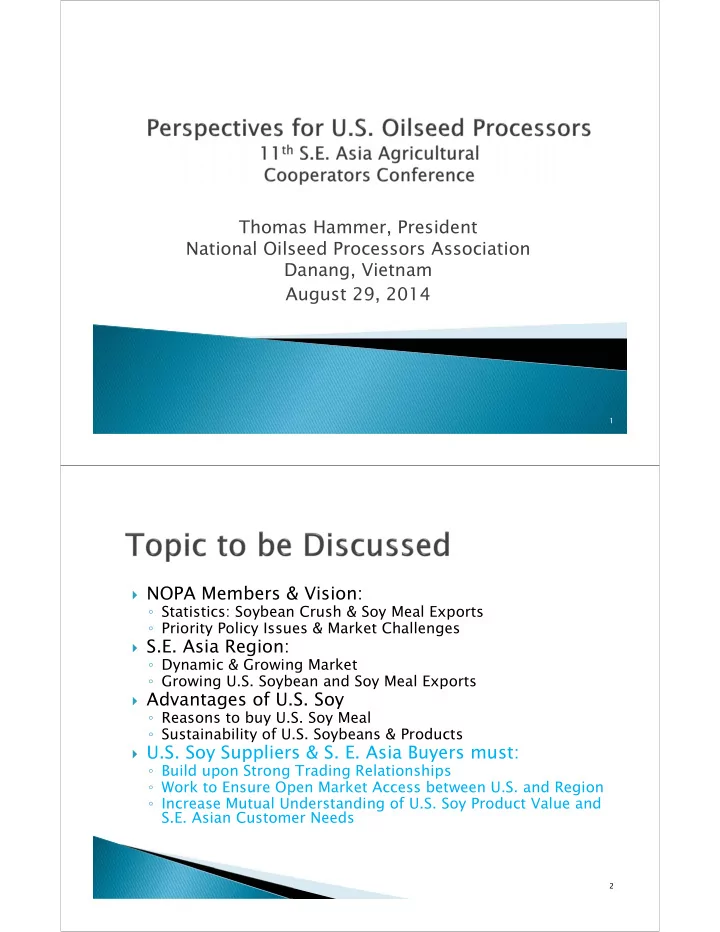
Thomas Hammer, President National Oilseed Processors Association Danang, Vietnam August 29, 2014 1 NOPA Members & Vision: Statistics: Soybean Crush & Soy Meal Exports Priority Policy Issues & Market Challenges S.E.


slide-1
SLIDE 1

Thomas Hammer, President National Oilseed Processors Association Danang, Vietnam August 29, 2014

1

 NOPA Members & Vision:

  • Statistics: Soybean Crush & Soy Meal Exports
  • Priority Policy Issues & Market Challenges

 S.E. Asia Region:

  • Dynamic & Growing Market
  • Growing U.S. Soybean and Soy Meal Exports

 Advantages of U.S. Soy

  • Reasons to buy U.S. Soy Meal
  • Sustainability of U.S. Soybeans & Products

 U.S. Soy Suppliers & S. E. Asia Buyers must:

  • Build upon Strong Trading Relationships
  • Work to Ensure Open Market Access between U.S. and Region
  • Increase Mutual Understanding of U.S. Soy Product Value and

S.E. Asian Customer Needs

2

slide-2
SLIDE 2

 13 NOPA member

companies

 Account for 95% of

US soybean crush

 Operate 63

processing plants in 19 states, including 57 that process soybeans

 Crush 1.63 billion

bushels, comprising

  • ver 47% of U.S.

soybean farmers’ production in 2012/13

3

 Ag Processing Inc.  Archer Daniels

Midland Company

 Bunge North

America

 Cargill, Incorporated  CHS  Consolidated Grain

and Barge Company

 Incobrasa Industries,

Ltd.

 Louis Dreyfus

Commodities

 Northstar Agri Industries  Owensboro Grain

Company

 Perdue Grain & Oilseed,

LLC

 Riceland Foods, Inc.  Zeeland Farm Soya

4

slide-3
SLIDE 3
  • NOPA favors a market-based

trading environment that encourages the efficient production

  • f an abundant, safe and high-

quality supply of oilseeds and

  • ilseeds products for domestic and

world consumers of food, feed- ingredients and renewable fuels.

5

 Soybean Crush  Soybean Meal

Exports

slide-4
SLIDE 4

100000 110000 120000 130000 140000 150000 160000 170000 JAN FEB MAR APR MAY JUN JUL AUG SEP OCT NOV DEC 2011 2012 2013 2014

7

200000 300000 400000 500000 600000 700000 800000 900000 1000000 1100000 1200000 JAN FEB MAR APR MAY JUN JUL AUG SEP OCT NOV DEC 2011 2012 2013 2014

8

slide-5
SLIDE 5

 Food/Feed Safety Regulations  Environmental & Safety/Health Regulations  Market-Oriented Farm Policies (Farm Bill)  Threats to Animal Agriculture  Global Trade Issues:

  • Differential Export Taxes – Argentina, et al.
  • Sanitary/Phyto-Sanitary Issues – Meat Products
  • WTO – Doha Agreement; Dispute Settlement
  • Regional Free Trade Agreements – TPP, TTIP
  • Enforcement of International Trade Rules

 Agricultural Biotech Releases & Acceptance

9

 Battle for acreage between corn and soybeans

in the U.S. (including ethanol, DDG)

 Increasing soybean demand in China  Argentine Differential Export Taxes  Lost soy oil market share in baking and frying

industries

 Non-tariff trade barriers – especially U.S. meat

and poultry exporters

 Lack of asynchronous approvals and/or low

level presence (LLP) policy for biotech crops

 How will we collectively deal with potentially

record global grain crops?

10

slide-6
SLIDE 6

 Politically & economically

stable – market-driven.

 Good relations with U.S.  Strong affinity for trading

with the U.S.

 Quick to adopt new

technologies and managements systems.

 Biotech acceptance is not

a major issue.

11

 Population of 620M – growing to 676M by 2020  5th largest trading partner & 4th largest export

market for U.S.

 Healthy economies with 6% annual average growth

rate

 Meat consumption to grow 50% by 2020  U.S. enjoys 61.5% share of soybean market and

17.5% share of the soybean meal market in the region.

 S.E. Asia market is growing and very dynamic for

US soybean and soybean meal exporters

slide-7
SLIDE 7

Soy Soybea eans 2008/ 2008/09 2009/ 2009/10 2010/ 2010/11 2011/ 2011/12 2012/ 2012/13 2013/ 2013/14 Ind Indone nesi sia 1,472,393 1,674,548 1,939,074 1,773,497 1,551,991 2,255,400 Malay laysia ia 236,451 383,759 380,280 191,869 319,694 199,400 Philippin lippines 49,651 80,171 57,016 55,760 43,012 61,700 Thailand iland 209,528 475,705 505,294 375,007 568,025 424,400 Sing Singapore 1,030 8,173 1,143 3,399 25,184 36,600 Vietna Vietnam 156,437 136,276 191,032 327,759 653,612 506,300 Tot Total 2,125,490 2,758,632 3,073,839 2,727,292 3,161,518 3,483,800 13

Source: U.S. Census Bureau

Soy Soymea eal 2008/ 2008/09 2009/ 2009/10 2010/ 2010/11 2011/ 2011/12 2012/ 2012/13 2013/ 2013/14 Ca Cambodia 919 5,421 5,615 Ind Indone nesi sia 141,820 528,871 29,313 109,274 91,412 30,200 Malay laysia ia 22,002 123,786 21,565 15,184 14,045 20,200 Philippin lippines 493,350 957,514 862,842 1,159,491 1,039,271 1,206,900 Sing Singapore 24 368 877 1,526 1,168 500 Thailand iland 116,639 203,937 11,949 28,314 29,649 368,400 Vietna Vietnam 126,004 474,442 36,828 66,725 275,035 315,300 Tot Total 899,839 2,288,918 964,292 1,385,934 1,456,195 1,941,500 14

Source: U.S. Census Bureau

slide-8
SLIDE 8

Soy Soy oil

  • il

2008/ 2008/09 2009/ 2009/10 2010/ 2010/11 2011/ 2011/12 2012/ 2012/13 2013/ 2013/14 Ind Indone nesi sia 206 489 277 347 309 200 Malay laysia ia 7,012 65,106 2 2,005 14,996 5,000 Philippin lippines 543 256 405 454 87 400 Sing Singapore 182 135 300 431 43 300 Thailand iland 52 56 16 41 3 Vietna Vietnam 15,000 49,012 12 11 Tot Total 22,995 115,054 1,011 3,288 15,439 5,900 15

Source: U.S. Census Bureau

500 1,000 1,500 2,000 2,500 3,000 3,500 4,000 Soy Beans Soymeal Soy Oil

16

Source: U.S. Census Bureau

slide-9
SLIDE 9

1. 1.

Nutritional Advantages Nutritional Advantages

2. 2.

Availability o Availability of Supply Supply

3. 3.

Reliability o liability of Pro Product uct

4. 4.

Consi Consisten tency of Product y of Product

5. 5.

Quality ality/Claims Claims P Process

6. 6.

Quality Adjustm Quality Adjustments for nts for Feed Ingredi Feed Ingredient Buyer Buyer

7. 7.

Transportation Diversity Transportation Diversity

8. 8.

Sustai Sustainable Producti nable Production

  • n

9. 9.

Market-Driven Polici Market-Driven Policies

10.

  • 10. USSEC Real

USSEC Real-Ti

  • Time Support

e Support to to Foreign Buyers with “Boots Foreign Buyers with “Boots

  • f the Ground”
  • f the Ground”

17 17 17 17 17

 Balanced Amino Ac

lanced Amino Acid Pro id Profile: ile: Soybean meal has high levels of amino acids, which balance well with those in cereal grains for poultry and swine feed applications.

 Amino Ac

Amino Acid id Digestibility.

  • Digestibility. Lysine in soybean meal is typically

estimated to be over 85% digestible. Similarly high digestibility levels are true for other amino acids found in soybean meal, like threonine.

 Ot

Other Nutritional Characteristics. her Nutritional Characteristics. In addition to serving as a source of amino acids, soybean meal provides additional nutritional value by contributing energy, minerals and vitamins.

 Nutritional Value Pro

Nutritional Value Proposition.

  • ition. For over half a century, U.S.

soybean meal has been extensively used in livestock feeds because it delivers nutrients critical to animal health and performance at a competitive cost.

18

slide-10
SLIDE 10

 Availability:

Availability: With about 60 domestic soybean processing plants, soybean meal has multiple providers delivering a consistent product over a wide area that provides geographic and weather diversity in terms of both growing conditions and shipping options.

 Reliability:

liability: The consistency and “everyday known product quality” can provide a source of highly digestible amino acids that is easily formulated with little or no adjustments for quality differentials or inconsistencies.

 Quality

ality/Claims Claims P Process: s: The long-established NOPA Trading Rules provide a proven process to ensure that what is paid for is received in terms of protein, fiber and moisture value. Any reductions in quality are offset financially in a fair, consistent and proven system.

19

 He

Hedgeability: dgeability: All parts of the U.S. soybean complex – beans, meal and oil – trade in large volumes, with known and relatively predictable price relationships, so soybean meal can reduce risk of ingredient exposure in terms of both market price fluctuation and hedgeability.

 Transportation Diversity:

Transportation Diversity: Due to the diversity of U.S. soybean processing plants, multiple delivery means are available to ensure consistent and timely soybean meal deliveries, reducing overbuying to ensure availability. Shorter logistical trails allow for less lead-time and less freight expense. Truck, rail or barge delivery is available on a daily basis from multiple sources. Rail delivery is available on multiple rail lines, in various size cars, and can effectively increase the usable storage space of a feed plant.

20

slide-11
SLIDE 11

 Grind:

Grind: Soybean meal is ground by the processor, enabling it to be used without additional grinding expense prior to use. This also facilitates blending, bulk bin utilization and minimizes dust and fines at the feed mill. Customers can partner with their processor to achieve the specific grind characteristics that meet their individual needs.

 Moisture:

Moisture: Although consistent moisture is a key advantage of U.S. soybean meal, plants have the ability to increase or decrease moisture based on the feed formulator’s demands.

 Flowability:

  • wability: Soybean meal has many characteristics that

enable consistent flow from rail cars, storage bins and feed

  • mixers. Limited hang-ups ease feed manufacturing, enable

delivery of a more consistent feed and lower feed production costs.

21

 Soybean Processing Plant Quality Adjustments:

Soybean Processing Plant Quality Adjustments: If a feed ingredient buyer is willing to work with a processor, there are many soybean meal traits that can be adjusted to fit a particular end use. Beyond moisture and grind, protein and fiber can be adjusted in the process—within certain limits and based on crop year soybean quality factors—to provide a more valuable feed ingredient. Flow coating agents that ease handling could be changed. Toasting can be adjusted to change color, digestibility or palatability. There is a cost/benefit analysis to all of these, and a processor can work with an end user to optimize costs relative to value.

22

slide-12
SLIDE 12

 Sustainability:

Sustainability: Domestic soybean meal has a proven track record of being a protein/amino acid source that does not negatively affect the environment. And, U.S. soybean producers have improved the sustainability of their

  • perations in recent years with reduced weed control,

reduced trips across the field (requiring less fuel), more no- till, and improved land rotation and yield for other crops, reducing weed/insect control and fertilizer for corn.

 Market Driven:

Market Driven: U.S. soybeans are a relatively low- or no- subsidy crop compared to other crops and industries. World supply and demand are the primary determinants of the final value of soybeans and soybean meal. Many competing protein sources receive heavy subsidies from foreign governments or from short-term domestic government programs.

23

 “All Vegetable” Considerations.

“All Vegetable” Considerations. U.S. soybean meal is an all- vegetable product, increasing marketing opportunities for some end users. “All Natural” and “Vegetable Diet” labels are increasing in quantity and many consumers are willing to pay more for these products.

 U.S. Soybean

U.S. Soybean Industry Support: Industry Support: The soybean checkoff works to support animal agriculture through programs to enhance soybeans, improve soybean meal, emphasize the economic importance of animal agriculture to influencers at the local, state and national level, increase meat and poultry exports, and to provide reliable, third-party educational information about today’s food system to consumers. When we “value add” to soybeans, it is good for the entire value chain from farmers, truckers, livestock producers, processors and seed technology companies to consumers.

24

slide-13
SLIDE 13

Adding Value for our Global Customers

 Best farm-to-market

system in world

 Best farm crop

management

 Best delivery system  Best risk management

programs

 Diverse growing areas  Overall quality of the

soybean is world- class

25

 U.S. soybeans & meal are

the most sustainable in the world.

 U.S. laws & regulations

governing farmers, grain handlers, processors & exporters are the most rigorous in the world.

 US soybean meal is the

best overall value in the

world.

26

slide-14
SLIDE 14

 Strengthen Trading Relationships

  • Bring decision makers closer together via trade

conferences & direct visits.

 Improve Market Access

  • Work together to resolve any trade irritants that

may unduly or unfairly inhibit mutually beneficial trade.

 Increase Understanding of Product Value

  • Help customers to recognize & utilize quality

advantages of U.S. soybean meal via quality measurement and feeding demonstrations.

27

USSEC has the platform to continue these conversations

 Continue to bring the key

U.S. & S.E. Asia soy value chain partners together to discuss their specific needs & concerns.

 Develop a much deeper

understanding of each party’s priorities & goals.

 Work diligently to link the

supply chains together to: Achieve the common goals that create the greatest

  • verall value & profitability

for all.

28

slide-15
SLIDE 15

 Thank you for allowing

me to be a part of this important conference.

 On behalf of NOPA’s

soybean processing members, I thank you for our past relationships and look forward to a closer partnership in the future.

 Questions…

Questions…

Thomas A. Hammer, President National Oilseed Processors Ass’n 1300 L Street, NW, Suite 1020 Washington, DC 20005 USA Phone: 202.842.0463 ext.1 Email: thammer@nopa.org Fax: 202.842.9126

30