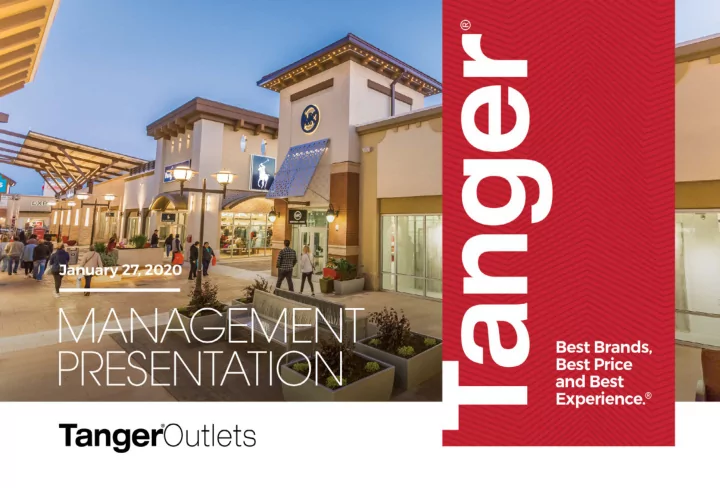
This presentation contains certain forward-looking statements within - - PowerPoint PPT Presentation
This presentation contains certain forward-looking statements within the meaning our properties are subject to ownership interests held by third parties, whose of Section 27A of the Securities Act of 1933, as amended, and Section 21E of interests
2 This presentation contains certain forward-looking statements within the meaning
- f Section 27A of the Securities Act of 1933, as amended, and Section 21E of
the Securities Exchange Act of 1934, as amended. The Company intends such forward-looking statements to be covered by the safe harbor provisions for forward-looking statements contained in the Private Securities Litigation Reform Act of 1995 and includes this statement for purposes of complying with the safe harbor provisions. Forward-looking statements, which are based on certain assumptions and describe the Company’s future plans, strategies and expectations, are generally identifiable by use of the words “believe,” “expect,” “intend,” “anticipate,” “estimate,” “project,” “will,” “forecast” or similar expressions. You should not rely on forward-looking statements since they involve known and unknown risks, uncertainties and other important factors which are, in some cases, beyond our control and which could materially affect our actual results, performance or achievements. Important factors which may cause actual results to differ materially from current expectations include, but are not limited to: our inability to develop new outlet centers or expand existing outlet centers successfully; risks related to the economic performance and market value of our
- utlet centers; the relative illiquidity of real property investments; impairment
charges affecting our properties; our dispositions of assets may not achieve anticipated results; competition for the acquisition and development of outlet centers, and our inability to complete outlet centers we have identified; the bankruptcy of one or more of the retailers in our centers; the fact certain of our lease agreements include co-tenancy and/or sales-based provisions that may allow a tenant to pay reduced rent and/or terminate a lease prior to its natural expiration; environmental regulations affecting our business; risks associated with possible terrorist activity or other acts or threats of violence and threats to public safety; our dependence on rental income from real property; our dependence on the results of operations of our retailers; the fact that certain of
- ur properties are subject to ownership interests held by third parties, whose
interests may conflict with ours; risks related to uninsured losses; the risk that consumer, travel, shopping and spending habits may change; risks associated with our Canadian investments; risks associated with attracting and retaining key personnel; risks associated with debt financing; risks associated with our guarantees of debt for, or other support we may provide to, joint venture properties; the effectiveness of our interest rate hedging arrangements; uncertainty relating to the potential phasing out of LIBOR; our potential failure to qualify as a REIT; our legal obligation to make distributions to our shareholders; legislative or regulatory actions that could adversely affect our shareholders, including the recent changes in the U.S. federal income taxation of U.S. businesses; our dependence on distributions from the Operating Partnership to meet our financial obligations, including dividends; the risk of a cyber-attack or an act of cyber-terrorism and other important factors set forth under Item 1A – “Risk Factors” in the Company’s and the Operating Partnership’s Annual Report on Form 10-K for the year ended December 31, 2018, as may be updated or supplemented in the Company’s Quarterly Reports on Form 10-Q and the Company’s other filings with the SEC. Accordingly, there is no assurance that the Company’s expectations will be realized. The Company disclaims any intention
- r obligation to update the forward-looking statements, whether as a result of
new information, future events or otherwise. You are advised to refer to any further disclosures the Company makes or related subjects in the Company’s Current Reports on Form 8-K that the Company files with the SEC. We use certain non-GAAP supplemental measures in this presentation, including FFO, AFFO, same center net operating income (“Same Center NOI”), and portfolio net operating income (“Portfolio NOI”). See definitions and reconciliations beginning on page 41.
3
4
5
6
7
8
9
10
11
12
(1) Number of new outlet centers per Value Retail News; Tanger portion represents centers in which Tanger owns or has an ownership interest
2011 2012 2013 2014 2015 2016 2017 2018 2019
1 2 1 1 4 2 1 2 7 9 8 10 3 4 1 1
By Tanger By Others
By Tanger 27%
By Tanger By Others
Number of New Outlet Centers Supplied by Industry, Since 2011 (1) While as many as 50 new centers may be announced at any point in time, far fewer ever open for business
Tenants want a developer that can deliver, and Tanger has a proven, 39 year track record of delivering quality outlet centers
13
Diversified tenant base
Properties are easily reconfigured to minimize tenant turnover downtime & capex requirements
5.9% 4.6% 4.1% 2.8% 2.8% 2.7% 2.6% 2.4% 2.2% 2.0% 67.9%
The Gap Ascena Retail PVH Tapestry Under Armour Nike American Eagle Outfitters G-III Apparel Carter's Michael Kors Others
Chart is in terms of annualized base rent as of December 31, 2019 and includes all retail concepts of each tenant group for consolidated outlet centers
(1) Excludes Dressbarn, which closed all stores subsequent to December 31, 2019 (1)
15
16
1995 2000 2010 2015 2016 2017 2018 2019
$226 $281 $354 $395 $387 $380 $385 $395
Sales are for stabilized outlet centers in the consolidated portfolio and are based on reports by retailers leasing outlet center stores for the trailing 12 months for tenants which have occupied such stores for a minimum of 12 months. For periods subsequent to 2010, sales per square foot are based on all tenants less than 20,000 square feet in size.
17
Occupancy of 95% or Greater for More Than 25 Years
98% 99% 99% 99% 98% 97% 97% 96% 96% 98% 96% 97% 97% 98% 98% 97% 96% 98% 99% 99% 99% 98% 98% 98% 97% 97% 97% 1993 1994 1995 1996 1997 1998 1999 2000 2001 2002 2003 2004 2005 2006 2007 2008 2009 2010 2011 2012 2013 2014 2015 2016 2017 2018 2019
Represents period end occupancy for consolidated outlet centers
18
2030+ 2029 2028 2027 2026 2025 2024 2023 2022 2021 2020 2% 4% 6% 7% 9% 13% 11% 11% 13% 14% 10%
Percentage of Annual Base Rent (1)
2030+ 2029 2028 2027 2026 2025 2024 2023 2022 2021 2020 3% 4% 8% 6% 9% 12% 9% 11% 13% 14% 11%
Percentage of Total GLA (1)
(1) As of December 31, 2019 for consolidated outlet centers, net of renewals executed
19 M o s t r e c e n t l y r e p o r t e d a s o f J a n u a r y 2 4 , 2 0 2 0
SKT WPG MAC PEI SPG TCO 10.0% 11.2% 11.7% 12.2% 12.7% 12.8%
21
22
23
24
25
27
28
30
31
32
34
35 A S O F D E C E M B E R 3 1 , 2 0 1 9
6% 94%
Limited Use of Secured Financing (1)
Square feet encumbered Square feet unencumbered
(1) Consolidated outlet centers
$0 $599.8
Line of Credit Capacity (2)
Outstanding Unused capacity
(2) In millions; excludes debt discounts, premiums, and
- rigination costs; unused capacity reduced by $0.2
million related to outstanding letters of credit
36
KEY BOND COVENANTS AS OF DECEMBER 31, 2019 ACTUAL LIMIT Total debt to adjusted total assets 48% < 60% Secured debt to adjusted total assets 3% < 40% Unencumbered assets to unsecured debt 198% > 150% Interest coverage 5.1 x > 1.5 x
Agency Rating Latest Action S&P BBB, stable outlook Rating revised on February 15, 2019 Moody’s Baa1, negative outlook Outlook revised on March 12, 2019
37
$0.0 $0.0 $0.0 $3.9 $3.0 $51.4 $10.6 $13.4 $350.0 $250.0 $250.0 $350.0 $300.0
'20 Nov '21 Dec '21 Oct '22 Apr '23 Dec '23 Apr '24 Dec '24 '25 Sept '26 Dec '26 Jul '27
Lines of Credit Mortgage Debt Term Loans Bond Debt
- Assumes all extension options are exercised; although some mortgage debt is amortizing, outstanding balance is shown in the month of final maturity
- Excludes debt discounts, premiums, and origination costs
- Excludes pro-rata share of debt maturities related to unconsolidated joint ventures
(1)
Weighted average; includes the impact of discounts and premiums and interest rate swaps, as applicable
(2)
Weighted average; includes applicable extensions available at the Company’s option A S O F D E C E M B E R 3 1 , 2 0 1 9 i n m i l l i o n s
$600.0 in
commitments
Effective Interest Rate (1) 3.5% Years to Maturity (2) 5.5
38
99% 1%
Outstanding Debt (1)
Fixed Rate Variable Rate $11.4
LIMITED FLOATING RATE EXPOSURE
$1,570.9
(1) As of December 31, 2019; excludes debt discounts,
premiums, origination costs, letters of credit under the lines and the Company’s share of unconsolidated joint venture debt i n m i l l i o n s
38%
Common Dividends Excess FFO $139.7 $82.0
62%
REINVESTING IN THE COMPANY 2019 FFO Payout Ratio
39
$0.1338 $0.4500 $0.4900 $0.5150 $0.5425 $0.5875 $0.6039 $0.6070 $0.6094 $0.6121 $0.6146 $0.6227 $0.6402 $0.6713 $0.7100 $0.7500 $0.7639 $0.7727 $0.7938 $0.8300 $0.8850 $0.9450 $1.0950 $1.2600 $1.3525 $1.3925 $1.4150 1993 1994 1995 1996 1997 1998 1999 2000 2001 2002 2003 2004 2005 2006 2007 2008 2009 2010 2011 2012 2013 2014 2015 2016 2017 2018 2019 *
Tanger has increased its dividend each year and paid an all-cash dividend every quarter since its IPO Dividend increased 0.7% in 2020 to $1.43 per share annually from $1.42
*Excludes $0.2100 per share special dividend paid on January 15, 2016.
8%
5-Year CAGR
40
Net Income AFFO
(1)
2017 2018 2019 $0.71 $0.45 $0.93 $2.46 $2.48 $2.31
(2) (3) (4)
(1) Charts are based on net income and AFFO, available to common shareholders; refer to reconciliation of net income to FFO and AFFO on pages 41-48 (2) Net income available to common shareholders in 2017 was impacted by charges of $44.6 million ($0.45 per share) related to the early redemption of senior notes due 2020
and non-cash impairment charges, and a gain of $6.9 million ($0.07 per share) on the sale of an outlet center
(3) Net income available to common shareholders in 2018 was impacted by non-cash impairment charges totaling $56.9 million ($0.58 per share) (4) Net income available to common shareholders in 2019 was impacted by a gain on the sale of four outlet centers totaling $43.4 million ($0.44 per share), a non-cash
impairment charge of $37.6 million ($0.39 per share), $4.4 million ($0.04 per share) of general and administrative expense for the accelerated recognition of compensation cost related to the retirement of an executive officer, and a foreign currency loss from the sale of a joint venture property of $3.6 million ($0.04 per share)
$ Per Share
42
Funds From Operations (“FFO”) is a widely used measure of the operating performance for real estate companies that supplements net income (loss) determined in accordance with GAAP. We determine FFO based on the definition set forth by the National Association of Real Estate Investment Trusts (“NAREIT”), of which we are a member. In December 2018, NAREIT issued “NAREIT Funds From Operations White Paper - 2018 Restatement” which clarifies, where necessary, existing guidance and consolidates alerts and policy bulletins into a single document for ease of use. NAREIT defines FFO as net income/(loss) available to the Company’s common shareholders computed in accordance with generally accepted accounting principles in the United States (“GAAP”), excluding (i) depreciation and amortization related to real estate, (ii) gains or losses from sales of certain real estate assets, (iii) gains and losses from change in control, (iv) impairment write-downs of certain real estate assets and investments in entities when the impairment is directly attributable to decreases in the value of depreciable real estate held by the entity and (v) after adjustments for unconsolidated partnerships and joint ventures calculated to reflect FFO on the same basis. FFO is intended to exclude historical cost depreciation of real estate as required by GAAP which assumes that the value of real estate assets diminishes ratably over time. Historically, however, real estate values have risen or fallen with market conditions. Because FFO excludes depreciation and amortization of real estate assets, gains and losses from property dispositions and extraordinary items, it provides a performance measure that, when compared year over year, reflects the impact to operations from trends in occupancy rates, rental rates, operating costs, development activities and interest costs, providing perspective not immediately apparent from net income. We present FFO because we consider it an important supplemental measure of our
- perating performance. In addition, a portion of cash bonus compensation to certain
members of management is based on our FFO or Adjusted Funds From Operations (“AFFO”), which is described in the section below. We believe it is useful for investors to have enhanced transparency into how we evaluate our performance and that of our
- management. In addition, FFO is frequently used by securities analysts, investors and
- ther interested parties in the evaluation of REITs, many of which present FFO when
reporting their results. FFO is also widely used by us and others in our industry to evaluate and price potential acquisition candidates. We believe that FFO payout ratio, which represents regular distributions to common shareholders and unit holders of the Operating Partnership expressed as a percentage of FFO, is useful to investors because it facilitates the comparison of dividend coverage between REITs. NAREIT has encouraged its member companies to report their FFO as a supplemental, industry-wide standard measure of REIT operating performance. FFO has significant limitations as an analytical tool, and you should not consider it in isolation, or as a substitute for analysis of our results as reported under GAAP. Some of these limitations are:
- FFO does not reflect our cash expenditures, or future requirements, for capital
expenditures or contractual commitments;
- FFO does not reflect changes in, or cash requirements for, our working capital needs;
- Although depreciation and amortization are non-cash charges, the assets being
depreciated and amortized will often have to be replaced in the future, and FFO does not reflect any cash requirements for such replacements; and
- Other companies in our industry may calculate FFO differently than we do, limiting its
usefulness as a comparative measure. Because of these limitations, FFO should not be considered as a measure of discretionary cash available to us to invest in the growth of our business or our dividend paying capacity. We compensate for these limitations by relying primarily on our GAAP results and using FFO only as a supplemental measure.
43 Adjusted Funds From Operations We present AFFO as a supplemental measure of our performance. We define AFFO as FFO further adjusted to eliminate the impact of certain items that we do not consider indicative of our ongoing operating performance. These further adjustments are itemized in the table below. You are encouraged to evaluate these adjustments and the reasons we consider them appropriate for supplemental analysis. In evaluating AFFO you should be aware that in the future we may incur expenses that are the same as or similar to some of the adjustments in this presentation. Our presentation of AFFO should not be construed as an inference that our future results will be unaffected by unusual
- r non-recurring items.
We present AFFO because we believe it assists investors and analysts in comparing our performance across reporting periods on a consistent basis by excluding items that we do not believe are indicative of our core operating
- performance. In addition, we believe it is useful for investors to have enhanced
transparency into how we evaluate management’s performance and the effectiveness of our business strategies. We use AFFO when certain material, unplanned transactions occur as a factor in evaluating management’s performance and to evaluate the effectiveness of our business strategies, and may use AFFO when determining incentive compensation. AFFO has limitations as an analytical tool. Some of these limitations are:
- AFFO does not reflect our cash expenditures, or future requirements, for
capital expenditures or contractual commitments;
- AFFO does not reflect changes in, or cash requirements for, our working
capital needs;
- Although depreciation and amortization are non-cash charges, the assets
being depreciated and amortized will often have to be replaced in the future, and AFFO does not reflect any cash requirements for such replacements;
- AFFO does not reflect the impact of certain cash charges resulting from
matters we consider not to be indicative of our ongoing operations; and
- Other companies in our industry may calculate AFFO differently than we
do, limiting its usefulness as a comparative measure. Because of these limitations, AFFO should not be considered in isolation or as a substitute for performance measures calculated in accordance with GAAP. We compensate for these limitations by relying primarily on our GAAP results and using AFFO only as a supplemental measure.
44 Portfolio Net Operating Income and Same Center Net Operating Income We present portfolio net operating income (“Portfolio NOI”) and same center net operating income (“Same Center NOI”) as supplemental measures of our
- perating performance. Portfolio NOI represents our property level net
- perating income which is defined as total operating revenues less property
- perating expenses and excludes termination fees and non-cash adjustments
including straight-line rent, net above and below market rent amortization, impairment charges and gains or losses on the sale of assets recognized during the periods presented. We define Same Center NOI as Portfolio NOI for the properties that were operational for the entire portion of both comparable reporting periods and which were not acquired or subject to a material expansion or non-recurring event, such as a natural disaster, during the comparable reporting periods. We believe Portfolio NOI and Same Center NOI are non-GAAP metrics used by industry analysts, investors and management to measure the operating performance of our properties because they provide performance measures directly related to the revenues and expenses involved in owning and
- perating real estate assets and provide a perspective not immediately
apparent from net income, FFO or AFFO. Because Same Center NOI excludes properties developed, redeveloped, acquired and sold; as well as non-cash adjustments, gains or losses on the sale of outparcels and termination rents; it highlights operating trends such as occupancy levels, rental rates and operating costs on properties that were operational for both comparable periods. Other REITs may use different methodologies for calculating Portfolio NOI and Same Center NOI, and accordingly, our Portfolio NOI and Same Center NOI may not be comparable to other REITs. Portfolio NOI and Same Center NOI should not be considered alternatives to net income (loss) or as an indicator of our financial performance since they do not reflect the entire operations of our portfolio, nor do they reflect the impact
- f general and administrative expenses, acquisition-related expenses, interest
expense, depreciation and amortization costs, other non-property income and losses, the level of capital expenditures and leasing costs necessary to maintain the operating performance of our properties, or trends in development and construction activities which are significant economic costs and activities that could materially impact our results from operations. Because
- f these limitations, Portfolio NOI and Same Center NOI should not be viewed
in isolation or as a substitute for performance measures calculated in accordance with GAAP. We compensate for these limitations by relying primarily on our GAAP results and using Portfolio NOI and Same Center NOI
- nly as supplemental measures.
45 Below is a reconciliation of net income available to common shareholders to FFO available to common shareholders (in thousands, except per share information): YEAR ENDED DECEMBER 31, 2019 2018 2017 NET INCOME AVAILABLE TO COMMON SHAREHOLDERS
$86,519 $42,444 $66,793 Noncontrolling interests in Operating Partnership 4,678 2,329 3,609 Noncontrolling interests in other consolidated partnerships 195 (421) 265 Allocation of earnings to participating securities 1,336 1,211 1,209
NET INCOME $92,728 $45,563 $71,876
Adjusted for: Depreciation and amortization of real estate assets – consolidated 120,856 129,281 125,621 Depreciation and amortization of real estate assets – unconsolidated joint ventures 12,512 13,314 13,857 Impairment charges 37,610 49,739 — Impairment charges – unconsolidated joint ventures — 7,180 9,021 Foreign currency loss from sale of joint venture property 3,641 — — Gain on sale of assets (43,422) — (6,943)
FFO $223,925 $245,077 $213,432
FFO attributable to noncontrolling interests in other consolidated partnerships (195) 421 (265) Allocation of earnings to participating securities (1,991) (2,151) (1,943)
FFO AVAILABLE TO COMMON SHAREHOLDERS (1) $221,739 $243,347 $211,224 FFO AVAILABLE TO COMMON SHAREHOLDERS PER SHARE – DILUTED (1) $2.27 $2.48 $2.12
Diluted weighted average common shares (for earnings per share computations) 92,808 93,310 94,522 Diluted weighted average common shares (for FFO and AFFO per share computations) (1) 97,766 98,303 99,549
46 Below is a reconciliation of FFO available to common shareholders to AFFO available to common shareholders (in thousands, except per share information): YEAR ENDED DECEMBER 31, 2019 2018 2017 FFO AVAILABLE TO COMMON SHAREHOLDERS (1) $221,739 $243,347 $211,224
As further adjusted for: Compensation related to executive officer retirement (2) 4,371 — — Impact of above adjustment to the allocation of earnings to participating securities (35) — — Abandoned pre-development costs — — 528 Recoveries from litigation settlement — — (1,844) Make-whole premium due to early extinguishment of debt (3) — — 34,143 Write-off of debt discount and debt origination costs due to repayment of debt prior to maturity (3) — — 1,483 Impact of above adjustments to the allocation of earnings to participating securities — — (238)
AFFO AVAILABLE TO COMMON SHAREHOLDERS (1) $226,075 $243,347 $245,296 AFFO AVAILABLE TO COMMON SHAREHOLDERS PER SHARE – DILUTED (1) $2.31 $2.48 $2.46
Diluted weighted average common shares (for FFO and AFFO per share computations) (1) 97,766 98,303 99,549
47 Below is a reconciliation of net income to Portfolio NOI and Same Center NOI for the consolidated portfolio (in thousands): YEAR ENDED DECEMBER 31, 2019 2018 NET INCOME $92,728 $45,563
Adjusted to exclude: Equity in earnings of unconsolidated joint ventures (7,839) (924) Interest expense 61,672 64,821 Gain on sale of assets (43,422)
—
Other non-operating (income) expense 2,761 (864) Impairment charge 37,610 49,739 Depreciation and amortization 123,314 131,722 Other non-property expenses 1,049 1,001 Corporate general and administrative expenses 53,881 43,291 Non-cash adjustments (4) (6,237) (3,191) Lease termination fees (1,615) (1,246)
PORTFOLIO NOI $313,902 $329,912
Non-same center NOI (5) (4,024) (17,900)
SAME CENTER NOI $309,878 $312,012
48 (1) Assumes the Class A common limited partnership units of the Operating Partnership held by the noncontrolling interests are exchanged for common shares of the Company. Each Class A common limited partnership unit is exchangeable for one of the Company’s common shares, subject to certain limitations to preserve the Company’s REIT status. (2) Represents the accelerated recognition of compensation cost entitled to be received by the Company’s former President and Chief Operating Officer per the terms of a transition agreement executed in connection with his retirement. (3) Charges in 2017 relate to the early redemption of our $300.0 million 6.125% senior notes due 2020. (4) Non-cash items include straight-line rent, above and below market rent amortization, straight-line rent expense on land leases and gains or losses on outparcel sales, as applicable. (5) Consolidated centers excluded from Same Center NOI:
OUTLET CENTERS SOLD:
Nags Head, Ocean City, Park City, Williamsburg March 2019
ABOUT TANGER FACTORY OUTLET CENTERS, INC.
Tanger Factory Outlet Centers, Inc. (NYSE: SKT), is a publicly-traded REIT headquartered in Greensboro, North Carolina that presently operates and owns, or has an ownership interest in, a portfolio of 39 upscale outlet shopping centers. Tanger’s
- perating properties are located in 20 states and in Canada, totaling approximately 14.3
million square feet, leased to over 2,800 stores which are operated by more than 510 different brand name companies. The Company has more than 39 years of experience in the outlet industry. Tanger Outlet Centers continue to attract more than 181 million visitors annually. For more information on Tanger Outlet Centers, call 1-800-4TANGER
- r visit the Company’s website at www.TangerOutlets.com.