SLIDE 1
SLIDE 2 4
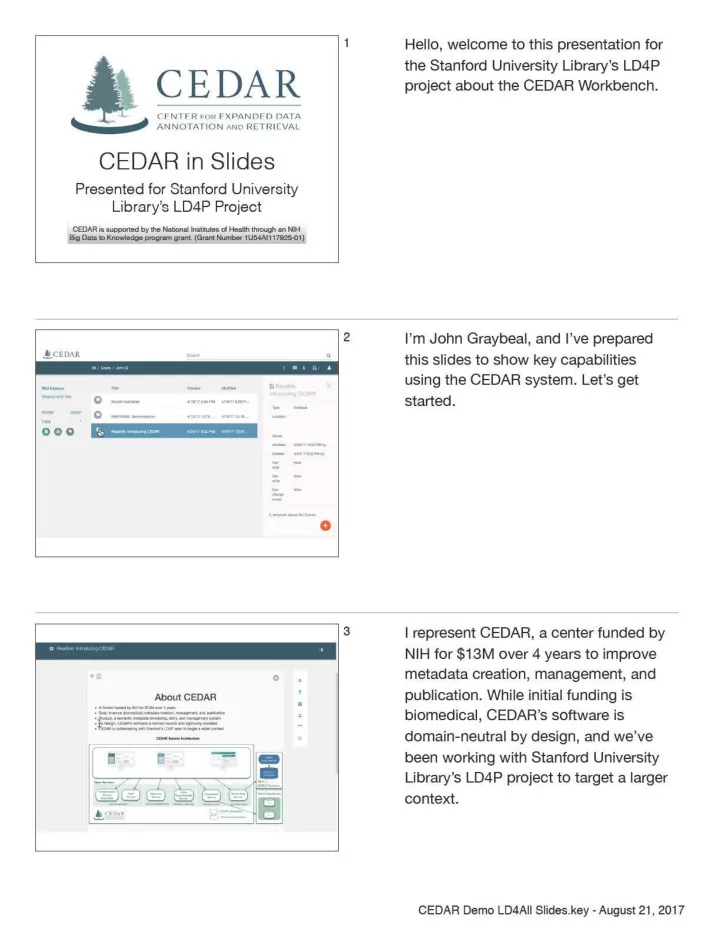
This is the CEDAR Workbench, which helps easily build, modify, and extend semantically rich metadata templates that library catalogers can then fill out. Let’s start with a quick look at what CEDAR produces— …
5
filled out metadata, here representing a Sound Recording Instance.
6
Nancy Lorimer, a cataloger at Stanford, produced this metadata, and the template which underlies it. Superficially CEDAR looks like a form entry tool, though it has some
- ptimizations, with more coming.
CEDAR Demo LD4All Slides.key - August 21, 2017
SLIDE 3 7
To this CEDAR adds semantic capabilities to describe fields and specify values. In this form, Nancy used the BIBFRAME ontology and the RDA cataloging standard, with some ad-hoc vocabularies for demonstration.
8
This completed form can be accessed using this user interface, or via a REST API, as JSON-LD text (our internal format)…
9
, the Resource Description Framework language.
CEDAR Demo LD4All Slides.key - August 21, 2017
SLIDE 4 10
So that’s great, but what if you need a variant of this form, say to add a ‘place
- f origin’, where the recording was
created, and change the contributor model? Let’s do that!
11
Returning to the Workbench desktop, first I control-click on the the original template and select the copy option, …
12
…make the copy, …
CEDAR Demo LD4All Slides.key - August 21, 2017
SLIDE 5
13
…select it, …
14
…and open it for editing.
15
We’ll fix the name first.
CEDAR Demo LD4All Slides.key - August 21, 2017
SLIDE 6
16
That’s better. You can also create a custom description for each entry.
17
To add a text field for the location where the recording was created, we click on the text icon, and the new field is added to our template.
18
I know the BIBFRAME property I want has something to do with origin, so we enter that as a name for the field. Then we select the property entry icon.
CEDAR Demo LD4All Slides.key - August 21, 2017
SLIDE 7
19
CEDAR opens up a search interface for properties in BioPortal that match my concept.
20
I can choose to see only those properties that are in BIBFRAME.
21
Here’s the one I want to pick, based on the additional metadata CEDAR offers.
CEDAR Demo LD4All Slides.key - August 21, 2017
SLIDE 8
22
I choose the one I want by double- clicking on it.
23
We fixed the field title, now let’s select the possible values for the Place of Origin using the VALUES tab.
24
When I click on SEARCH…
CEDAR Demo LD4All Slides.key - August 21, 2017
SLIDE 9
25
it starts by searching for that “Place of Origin” string.
26
Here’s a trick—I’ve entered a proper location name, and CEDAR found a gazetteer in BioPortal that contains that location.
27
Looking at the ontology information, I see this ontology has 680,000 entries. That should be enough. We select the ONTOLOGY tab to tell CEDAR to use all the classes from that ontology.
CEDAR Demo LD4All Slides.key - August 21, 2017
SLIDE 10
28
Now CEDAR shows the value options we have selected. It only stores the information about the values—the actual values are obtained later, when the user fills out the form.
29
Let’s make one more change. We want to replace this Contributor entry with a Contribution entry, to specify both the actor and the role.
30
We are going to search for CEDAR elements that define a Contribution entry.
CEDAR Demo LD4All Slides.key - August 21, 2017
SLIDE 11
31
We enter “Contribution” into the search field, …
32
… and find someone has created and shared such an element. We select it,…
33
…bring it into our template, …
CEDAR Demo LD4All Slides.key - August 21, 2017
SLIDE 12
34
…and grab it to reorder it, moving it earlier in the template.
35
Finally, we want to allow as many Contributions as the user wants to enter.
36
Selecting MULTIPLE tab, we choose YES and set the Max(imum) to unlimited…
CEDAR Demo LD4All Slides.key - August 21, 2017
SLIDE 13
37
…and the Min(imum) to none.
38
Now we save our changes and return to the desktop view.
39
We’re notified the save succeeded.
CEDAR Demo LD4All Slides.key - August 21, 2017
SLIDE 14 40
Let’s see how it looks for a user to fill
41
We scroll down to our additions, with the new Contribution, and see we can enter multiple instances of it.
42
This drop down menu is populated from the controlled terms in a (pre- configured) BioPortal ontology.
CEDAR Demo LD4All Slides.key - August 21, 2017
SLIDE 15
43
Finally we have the location field, with all those locations. CEDAR gets them from BioPortal, and doesn’t try to display all of them at once,…
44
but lets you auto-complete based on your typing.
45 CEDAR Demo LD4All Slides.key - August 21, 2017
SLIDE 16
46
When we save, our metadata is created.
47
We can share this modified template with anyone who wants to use it, …
48
…or with a particular group, like the Everybody group, which allows everyone in CEDAR to see it,…
CEDAR Demo LD4All Slides.key - August 21, 2017
SLIDE 17
49
… allowing collaborative creation of templates and metadata.
50
I can share different privileges with different groups, …
51
…so trusted parties can edit my content while everyone else can only view it.
CEDAR Demo LD4All Slides.key - August 21, 2017
SLIDE 18
52
By clicking on Shared with Me (upper left), …
53
… we can see the artifacts shared with me on this staging platform.
Thank You
For more information please see…
Web site: http://metadatacenter.org Workbench: https://cedar.metadatacenter.net Technical site: https://metadatacenter.github.io API docs: https://resource.metadatacenter.net/api
54 CEDAR Demo LD4All Slides.key - August 21, 2017