THIS FORM HAS IMPORTANT LEGAL CONSEQUENCES AND THE PARTIES SHOULD - - PDF document

this form has important legal consequences and the
SMART_READER_LITE
LIVE PREVIEW

THIS FORM HAS IMPORTANT LEGAL CONSEQUENCES AND THE PARTIES SHOULD - - PDF document

1 This form has been approved by the Colorado Bar Association for use by Real Estate Brokers in Colorado in accordance with any 2 guidelines provided with this form. This form has NOT been approved by the Colorado Real Estate Commission.


slide-1
SLIDE 1

COVID-19 ADDENDUM (COVID19-3-20) Page 1 of 2

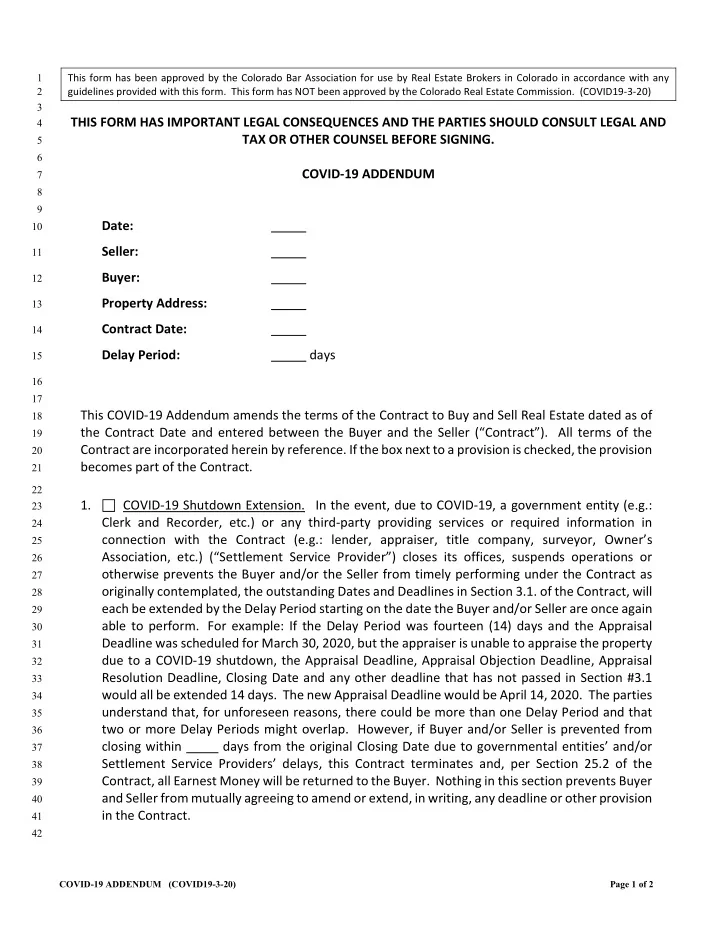
This form has been approved by the Colorado Bar Association for use by Real Estate Brokers in Colorado in accordance with any 1 guidelines provided with this form. This form has NOT been approved by the Colorado Real Estate Commission. (COVID19‐3‐20) 2 3

THIS FORM HAS IMPORTANT LEGAL CONSEQUENCES AND THE PARTIES SHOULD CONSULT LEGAL AND

4

TAX OR OTHER COUNSEL BEFORE SIGNING.

5 6

COVID‐19 ADDENDUM

7 8 9

Date:

10

Seller:

11

Buyer:

12

Property Address:

13

Contract Date:

14

Delay Period: days

15 16 17

This COVID‐19 Addendum amends the terms of the Contract to Buy and Sell Real Estate dated as of

18

the Contract Date and entered between the Buyer and the Seller (“Contract”). All terms of the

19

Contract are incorporated herein by reference. If the box next to a provision is checked, the provision

20

becomes part of the Contract.

21 22

1.

COVID‐19 Shutdown Extension. In the event, due to COVID‐19, a government entity (e.g.:

23

Clerk and Recorder, etc.) or any third‐party providing services or required information in

24

connection with the Contract (e.g.: lender, appraiser, title company, surveyor, Owner’s

25

Association, etc.) (“Settlement Service Provider”) closes its offices, suspends operations or

26

  • therwise prevents the Buyer and/or the Seller from timely performing under the Contract as

27

  • riginally contemplated, the outstanding Dates and Deadlines in Section 3.1. of the Contract, will

28

each be extended by the Delay Period starting on the date the Buyer and/or Seller are once again

29

able to perform. For example: If the Delay Period was fourteen (14) days and the Appraisal

30

Deadline was scheduled for March 30, 2020, but the appraiser is unable to appraise the property

31

due to a COVID‐19 shutdown, the Appraisal Deadline, Appraisal Objection Deadline, Appraisal

32

Resolution Deadline, Closing Date and any other deadline that has not passed in Section #3.1

33

would all be extended 14 days. The new Appraisal Deadline would be April 14, 2020. The parties

34

understand that, for unforeseen reasons, there could be more than one Delay Period and that

35

two or more Delay Periods might overlap. However, if Buyer and/or Seller is prevented from

36

closing within days from the original Closing Date due to governmental entities’ and/or

37

Settlement Service Providers’ delays, this Contract terminates and, per Section 25.2 of the

38

Contract, all Earnest Money will be returned to the Buyer. Nothing in this section prevents Buyer

39

and Seller from mutually agreeing to amend or extend, in writing, any deadline or other provision

40

in the Contract.

41 42

slide-2
SLIDE 2

COVID-19 ADDENDUM (COVID19-3-20) Page 2 of 2

2.

COVID‐19 Quarantine Extension. In the event either Buyer or Seller is subject to a voluntary

43

quarantine, mandatory quarantine or shelter in place or equivalent order (“Quarantine” or

44

“Quarantined”) in accordance with Colorado or federal recommendations concerning COVID‐19,

45

the then outstanding Dates and Deadlines in Section 3.1. of the Contract will be extended for the

46

Delay Period from the date the non‐Quarantined party receives written notice from the

47

Quarantined party. For example: If the Delay Period was fourteen days (14) and the Closing Date

48

was scheduled for March 30, 2020, but the Buyer sends written notice that Buyer is in

49

Quarantine, then the Closing Date would be extended to April 13, 2020. Nothing in this provision

50

terminates or otherwise excuses a party's performance under the Contract as amended. If the

51

Quarantined party will not be able to perform the terms of the Contract in person (e.g.: attend

52

closing, etc.), the Quarantined party must make other accommodations (e.g.: power of attorney,

53

non‐contact closing, etc.). Nothing in this section prevents Buyer and Seller from mutually

54

agreeing to amend or extend, in writing, any deadline or other provision in the Contract. By

55

signing below, both Buyer and Seller waive all confidentiality Buyer and Seller may have regarding

56

COVID‐19.

57 58

All other terms and conditions of the Contract remain the same.

59 60 61 62

Seller: Buyer:

63 64 65 66

Signature Date Signature Date

67 68 69 70 71

Signature Date Signature Date

72

slide-3
SLIDE 3

Force Majeure – Contract Clause In the event that either Seller or Buyer is rendered unable, by reason of an event of force majeure, to perform, wholly or in part, any obligation or commitment set forth in this Contract, then upon such party’s giving notice and full particulars of such event as soon as practicable after the occurrence thereof, the obligations of both parties, except for unpaid financial obligations arising prior to such event of force majeure, will be suspended to the extent and for the period of such force majeure condition.

slide-4
SLIDE 4

Force Majeure – Long Form The term “force majeure” as employed in this Contract will mean acts of God, strikes, lockouts

  • r industrial disputes or disturbances, civil disturbances, arrests and restraint of rulers of people,

interruptions by government or court orders, necessity for compliance with any court order, law, statute, ordinance or regulation promulgated by a governmental authority having jurisdiction, acts of the public enemy, wars, riots, blockades, insurrections, inability to secure labor or inability to secure materials, including inability to secure materials by reasons of allocations promulgated by authorized governmental agencies, epidemics, landslides, lightning, earthquakes, fire, storms, floods, washouts, inclement weather that necessitates extraordinary measures and expense to construct facilities and/or maintain operations, explosions, breakage or accident to machinery or lines of pipe, freezing of wells or pipelines, inability to obtain or delays in

  • btaining easements or rights-of-way, shutting-in facilities for the making of repairs, alterations
  • r maintenance to wells, pipelines or plants, partial or entire failure of gas supply or any other

cause, whether of the kind herein enumerated or otherwise, not reasonably within the control of the party claiming force majeure.

slide-5
SLIDE 5

Force Majeure Definition Short Form The term “force majeure” as employed herein will mean any cause not reasonably within the control of the party claiming suspension and which by the exercise of due diligence such party is unable to prevent or overcome. Such term will likewise include, but not be limited to: (a) the inability of either party to acquire, or the delays on the part of such party in acquiring, at reasonable cost and after the exercise of reasonable diligence, servitudes, right-of-way grants, permits or licenses, and (b) the inability of either party to acquire, or the delays on the part of such party in acquiring, at reasonable cost and after the exercise of reasonable diligence, materials and supplies, permits and permissions.

slide-6
SLIDE 6

Impossibility of Performance The law recognizes impossibility of performance as a defense to an action for breach of contract. City of Littleton v. Employers Fire Ins. Co., 169 Colo. 104, 108, 453 P.2d 810, 812 (1969). According to the Restatement, impossibility means not only strict impossibility but impracticability because of extreme and unreasonable difficulty, expense, injury or loss involved. As elaborated in the comment, ‘impossible’ must be given a practical rather than a scientifically exact meaning. Impracticability rather than absolute impossibility is enough. Restatement s 454 and comment a thereunder. Commenting on the Restatement s 454, Williston has stated that: ‘(t)he true distinction is not between difficulty and impossibility. A man may contract to do what is impossible * * *. The important question is whether an unanticipated circumstance has made performance of the promise vitally different from what should reasonably have been within the contemplation of both parties when they entered into the contract. If so, the risk should not fairly be thrown upon the promisor.’ 6 Williston, Contracts s 1931 (Rev. ed.) See 6 Corbin, Contracts s 1325. After reviewing the authorities which have subscribed to the Restatement definition of impossibility, we hereby adopt the definition of impossibility contained in the Restatement s 454 as interpreted by Williston. City of Littleton v. Employers Fire Ins. Co., 169 Colo. 104, 109, 453 P.2d 810, 812 (1969). Generally, a change in economic circumstances does not excuse performance of a contract. Id.; see also Seago v. Fellet, 676 P.2d 1224, 1227 (Colo. App. 1983) (where an intervening government action merely renders performance more costly, a party is not excused under the doctrine of impossibility). Rather, situations that are “so unforeseeable as to be outside the risks assumed under the contract” may excuse a party's performance because of impossibility or

  • impracticability. Ruff v. Yuma Cnty. Transp. Co., 690 P.2d 1296, 1298 (Colo. App. 1984).

Madison Park Townhouses Homeowners Ass'n v. Country Mut. Ins. Co., No. 14-CV-01915- MEH, 2015 WL 5221515, at *7 (D. Colo. Sept. 8, 2015). Impossibility of performance is determined by whether “an unanticipated circumstance has made performance of the promise vitally different from what should reasonably have been within the contemplation of both parties when they entered into the contract.” Littleton v. Employers Fire Insurance Co., 169 Colo. 104, 453 P.2d 810 (1969); Town of Fraser v. Davis, 644 P.2d 100 (Colo.App.1982). A change in economic conditions does not provide a basis for rescission of a

  • contract. Beals v. Tri-B Associates, 644 P.2d 78 (Colo.App.1982). Competition, delay in ICC

approval, and changed economic circumstances are not situations which are so unforeseeable as to be outside the risks assumed under the contract and do not excuse Yuma's performance because of impracticability. Ruff v. Yuma Cty. Transp. Co., 690 P.2d 1296, 1298 (Colo. App. 1984).

slide-7
SLIDE 7
  • !
  • "
  • #
  • !
  • "

$

  • $
  • !

"

  • %
  • &

'

  • (

) * +

  • ,
  • .!

/ #

  • 1
  • 1

2 3

  • 4

5 6 7 8 9 : ;

  • <
  • &
  • &
  • &
  • &
  • =
  • (
  • (
  • >
  • ?
  • &
  • &
  • &
  • ?
  • ?
  • &
  • @
  • A
  • &
  • ?
  • (
  • &
  • (
  • &
  • &
  • &
  • ?
  • B

C D EF

  • 4

G H I J K

  • D

I C

  • L

M N N M O F G I

  • 4

G H I J K

  • D

O M

  • I

G P

  • D

Q Q M R J S I T

  • M

U M Q J O G I S Q

  • O

M Q G O C S I T F V

  • &
  • W

H M X U G

  • 4

G H I J K ?

  • <
  • =
  • <
  • &
  • >
  • O

M N O D S I

  • N

O G E F H X ES J J S I T

  • C

G Q H EM I J F

  • M

U M Q J O G I S Q D U U K

  • ;
  • <
  • &
  • (
  • (
  • ?
  • <
  • &
  • (
  • &
  • (
  • /
  • Y
  • 4

1 2 8 Z 9 B 2 9 4 1 2 8 Z 4 7 3 6 [ 6 4 B 6 1 8 \ B 7 >

  • &
  • &
  • >
  • #

]

  • )
  • ?
  • !
  • ?
  • <
  • @
  • =
  • &
  • &
  • ^

!

  • #

! @ !

  • _
  • <
  • <
  • `
  • <
  • &
  • <
  • @
  • =
  • !
  • !
  • >
  • (
  • &
  • )
  • a
  • <
  • @
  • ;
  • !
  • $
  • !
  • !
  • b
  • &
  • >
  • b
  • &
  • (
  • &
  • &
  • >
  • c
  • &
  • <
  • &
  • &
  • A
  • >
  • !
  • !
  • b
  • (
  • &
  • )
  • !
  • (
  • (
  • &
  • <
  • &
  • >
  • #
  • (
  • &
  • a
  • @
  • !
  • /
  • =
  • (
  • &
  • )
  • `
  • <
  • @
  • !
  • !
  • /
  • &
  • (
  • &
  • )
  • `
  • <
  • @
  • !
  • #

]

  • *
  • (
  • &
  • ;
  • /
  • <
  • @
  • &
  • <
  • &
  • !
  • !
  • *
  • c
  • &
  • @
  • `
  • /
  • =
  • (
  • +
  • )
  • =
  • (
  • =
  • =
  • !
slide-8
SLIDE 8
  • !
  • "
  • #
  • !
  • "

$

  • $
  • !

"

  • %
  • &

'

  • (

) * +

  • ,
  • .!

/

  • *
  • )
  • 1
  • 1
  • 2
  • &
  • 3
  • &
  • 4
  • 2
  • &
  • &
  • 2
  • !
  • #

$

  • ,
  • &
  • )
  • !
  • !
  • 1
  • 4
  • 2
  • &
  • &
  • 5

!

  • #

$ 4 !

  • 6
  • &
  • 4
  • 1
  • 1
  • &
  • !
  • !
  • 7
  • (
  • &
  • )
  • !
  • 8

&

  • 8

&

  • (
  • &
  • &
  • 9
  • 1
  • 9
  • 2
  • &
  • !
  • )
  • &
  • &
  • :
  • 4
  • &
  • 4
  • 4

&

  • 2
  • ;
  • &
  • 2
  • &
  • !
  • &
  • 9
  • 4
  • *
  • &
  • 2
  • :
  • &
  • &
  • &
  • !
  • 3
  • &
  • <
  • !
  • ;
  • &
  • 8
  • 8
  • 4
  • !
  • #

=

  • >

?

  • &
  • 2
  • &
  • &
  • 3
  • &
  • (
  • &
  • )

@ 7 /

  • A

B

  • C
  • D

C E F G H C I

  • J

G KKL M N F C I

  • O

L M P F N L B

  • G

Q L M C E F G H R

  • S

L

  • T

C P L

  • F

H U G M KC E F G H

  • C

V G W E

  • G

Q L H X N I G B L Y

  • B

E C E W B

  • C

H Y

  • L

I L N E M G H F N M L N G M Y F H Z

  • N

C Q C V F I F E F L B

  • G

U

  • L

P L M [

  • N

G W H E [

  • F

H

  • E

T L

  • \

H F E L Y

  • O

E C E L B ] O T G W I Y

  • [

G W

  • H

L L Y

  • E

T F B

  • F

H U G M KC E F G H R

  • Q

I L C B L

  • Y

G

  • H

G E

  • T

L B F E C E L

  • E

G

  • N

G H E C N E

  • G

W M ^ F Y L I F E [

  • D

C E F G H C I

  • _

F E I L

  • `
  • D

C E F G H C I

  • J

G KKL M N F C I

  • O

L M P F N L B

  • _

L C K aL

  • C

M L

  • T

L M L

  • U

G M

  • [

G W ]

  • b
  • :
  • 3
  • 5
  • !
  • 6
  • 3
  • &
  • &
slide-9
SLIDE 9

STATE OF COLORADO Department of State

1700 Broadway

Suite 200 Denver, CO 80290

Jena Griswold

Secretary of State

Ian Rayder Deputy Secretary of State

Main Number Administration Fax (303) 894-2200 (303) 860-6900 (303) 869-4860 TDD Web Site E-mail (303) 869-4867 www.sos.state.co.us administration@sos.state.co.us

Notice of Temporary Adoption

Office of the Secretary of State Notary Program Rules 8 CCR 1505-11 March 30, 2020 I. Adopted Rule Amendments As authorized by the Colorado Notaries Public Act1 and the State Administrative Procedure Act2, the Colorado Secretary of State gives notice that the following amendments to the Notary Program Rules3 are adopted on a temporary basis and effective immediately. (SMALL CAPS indicate proposed additions to the current rules. Stricken type indicates proposed deletions from current

  • rules. Annotations may be included):

Current 8 CCR 1505-11 is amended as follows: New Rule 5:

RULE 5 – REMOTE NOTARIZATION 5.1 DEFINITIONS AS USED IN THESE RULES, UNLESS STATED OTHERWISE: 5.1.1 “AUDIO-VIDEO COMMUNICATION” MEANS COMMUNICATION BY WHICH AN INDIVIDUAL IS ABLE TO

SEE, HEAR, AND COMMUNICATE WITH A REMOTELY LOCATED INDIVIDUAL IN REAL TIME USING ELECTRONIC MEANS.

5.1.2 “OUTSIDE THE UNITED STATES” MEANS A LOCATION OUTSIDE THE GEOGRAPHIC BOUNDARIES OF

THE UNITED STATES, PUERTO RICO, THE UNITED STATES VIRGIN ISLANDS, AND ANY TERRITORY OR INSULAR POSSESSION SUBJECT TO THE JURISDICTION OF THE UNITED STATES.

5.1.3 “REAL TIME” OR “IN REAL TIME” MEANS, WITH RESPECT TO AN INTERACTION BETWEEN

INDIVIDUALS BY MEANS OF AUDIO-VIDEO COMMUNICATION, THAT THE INDIVIDUALS CAN SEE AND HEAR EACH OTHER SUBSTANTIALLY SIMULTANEOUSLY AND WITHOUT INTERRUPTION OR

  • DISCONNECTION. DELAYS OF A FEW SECONDS THAT ARE INHERENT IN THE METHOD OF

COMMUNICATION DO NOT PREVENT THE INTERACTION FROM BEING CONSIDERED TO HAVE OCCURRED IN REAL TIME.

1 Article 21, Title 24 of the Colorado Revised Statutes. 2 Section 24-4-103(3)(a), C.R.S. (2019). 3 8 CCR 1505-11.

slide-10
SLIDE 10

Page 2 of 6

5.1.4 “REMOTELY LOCATED INDIVIDUAL” MEANS AN INDIVIDUAL WHO IS NOT IN THE PHYSICAL

PRESENCE OF THE NOTARY PUBLIC WHO PERFORMS A NOTARIAL ACT UNDER THIS RULE 5.

5.1.5 “REMOTE NOTARIZATION” MEANS AN ELECTRONIC NOTARIAL ACT PERFORMED WITH RESPECT TO

A RECORD BY MEANS OF REAL-TIME AUDIO-VIDEO COMMUNICATION IN ACCORDANCE WITH RULE

5. 5.1.6 “REMOTE NOTARIZATION SYSTEM” MEANS ANY ELECTRONIC DEVICE OR PROCESS THAT ALLOWS

A NOTARY PUBLIC AND A REMOTELY LOCATED INDIVIDUAL TO COMMUNICATE WITH EACH OTHER SIMULTANEOUSLY BY SIGHT AND SOUND SUCH AS MAINSTREAM VIDEOCONFERENCING TECHNOLOGIES, INCLUDING THOSE IN PHONE APPLICATION FORM, THAT WILL RECORD THE ENTIRE COMMUNICATION.

5.1.7 “REMOTE PRESENTATION” MEANS THE TRANSMISSION TO THE NOTARY PUBLIC THROUGH THE

DEVICES OR PROCESSES REFERENCED IN RULE 5.1.6 OF AN IMAGE OF A GOVERNMENT-ISSUED IDENTIFICATION THAT IS SUFFICIENT QUALITY TO ENABLE THE NOTARY PUBLIC TO IDENTIFY THE REMOTELY LOCATED INDIVIDUAL SEEKING THE NOTARY PUBLIC’S SERVICES.

5.2 REQUIREMENTS TO PERFORM REMOTE NOTARIZATION 5.2.1 A NOTARY PUBLIC MAY PERFORM A REMOTE NOTARIZATION ONLY FOR A REMOTELY LOCATED

INDIVIDUAL WHO IS LOCATED IN THE STATE OF COLORADO.

5.2.2 EXCLUSIONS A NOTARY PUBLIC MUST NOT USE A REMOTE NOTARIZATION SYSTEM TO NOTARIZE: (A) A RECORD RELATING TO THE ELECTORAL PROCESS; OR (B) A WILL AS DEFINED UNDER SECTION 15-10-201(59), C.R.S., EXCEPT AS REQUIRED IN

ACCORDANCE WITH 5.2.9(C).

5.2.3 A NOTARY PUBLIC WHO PERFORMS A NOTARIAL ACT FOR A REMOTELY LOCATED INDIVIDUAL BY

MEANS OF AUDIO-VIDEO COMMUNICATION MUST BE CURRENTLY COMMISSIONED IN THE STATE OF

COLORADO AND LOCATED IN THE STATE OF COLORADO AT THE TIME THE NOTARIAL ACT IS

PERFORMED.

5.2.4 THE REMOTE NOTARIZATION SYSTEM USED TO PERFORM REMOTE NOTARIZATIONS MUST BE

SUFFICIENT TO:

(A) ENABLE THE NOTARY PUBLIC TO VERIFY THE IDENTITY OF THE REMOTELY LOCATED

INDIVIDUAL AND ANY REQUIRED WITNESS BY MEANS OF PERSONAL KNOWLEDGE OR SATISFACTORY EVIDENCE OF IDENTITY;

(B) ENABLE THE NOTARY PUBLIC TO VERIFY THAT THE NOTARY PUBLIC, THE REMOTELY

LOCATED INDIVIDUAL, AND ANY REQUIRED WITNESS ARE VIEWING THE SAME RECORD AND THAT ALL SIGNATURES, CHANGES, AND ATTACHMENTS TO THE RECORD MADE BY THE REMOTELY LOCATED INDIVIDUAL AND ANY REQUIRED WITNESS ARE MADE IN REAL TIME; AND

(C) RECORD THE INTERACTION SUCH THAT THE VERIFICATIONS MAY BE CLEARLY VIEWED AT

A LATER DATE.

5.2.5 REQUIREMENTS FOR ENSURING SATISFACTORY EVIDENCE OF IDENTITY

slide-11
SLIDE 11

Page 3 of 6

(A) A NOTARY MUST DETERMINE FROM PERSONAL KNOWLEDGE OR SATISFACTORY

EVIDENCE THAT THE REMOTELY LOCATED INDIVIDUAL APPEARING BEFORE THE NOTARY PUBLIC BY MEANS OF AUDIO-VIDEO COMMUNICATION IS THE INDIVIDUAL THAT HE OR SHE CLAIMS TO BE.

(B) A NOTARY PUBLIC HAS SATISFACTORY EVIDENCE OF IDENTITY IF THE NOTARY PUBLIC

CAN IDENTIFY THE REMOTELY LOCATED INDIVIDUAL BY MEANS OF AUDIO-VIDEO COMMUNICATION BY USING AT LEAST ONE OF THE FOLLOWING METHODS:

(1) THE OATH OR AFFIRMATION OF A CREDIBLE WITNESS WHO PERSONALLY KNOWS

THE REMOTELY LOCATED INDIVIDUAL, IS PERSONALLY KNOWN TO THE NOTARY PUBLIC OR PRESENTS EVIDENCE OF IDENTITY WITH GOVERNMENT-ISSUED IDENTIFICATION AS REQUIRED BY SECTION 24-21-507, C.R.S., AND IS IN THE PHYSICAL PRESENCE OF THE NOTARY PUBLIC OR THE REMOTELY LOCATED INDIVIDUAL;

(2) REMOTE PRESENTATION OF A GOVERNMENT-ISSUED IDENTIFICATION AND THE

DATA CONTAINED ON THE IDENTIFICATION OF THE REMOTELY LOCATED INDIVIDUAL AS REQUIRED BY SECTION 24-21-507, C.R.S..

5.2.6 CONSISTENT WITH SECTION 24-21-508, C.R.S., A NOTARY PUBLIC MAY REFUSE TO PERFORM A

NOTARIAL ACT UNDER RULE 5 IF THE NOTARY PUBLIC IS NOT SATISFIED THAT THE REQUIREMENTS OF THIS RULE 5 ARE MET.

5.2.7 THE CERTIFICATE OF NOTARIAL ACT FOR A REMOTE NOTARIZATION MUST, IN ADDITION TO

COMPLYING WITH THE REQUIREMENTS OF SECTION 24-21-515, C.R.S., INDICATE THAT THE NOTARIAL ACT WAS PERFORMED USING AUDIO-VIDEO TECHNOLOGY.

5.2.8 REQUIREMENTS FOR AUDIO-VIDEO RECORDING (A) A NOTARY PUBLIC MUST CREATE AN AUDIO-VIDEO RECORDING OF A REMOTE

NOTARIZATION AND MUST:

(1)

FIRST DISCLOSE TO THE REMOTELY LOCATED INDIVIDUAL THE FACT OF THE RECORDING AND THE DETAILS OF ITS INTENDED STORAGE, INCLUDING WHERE AND FOR HOW LONG IT WILL BE STORED;

(2) ENSURE THAT THE REMOTELY LOCATED INDIVIDUAL EXPLICITLY CONSENTS TO

BOTH THE RECORDING AND THE STORAGE OF THE RECORDING; AND

(3) SECURELY STORE THE RECORDING FOR A PERIOD OF TEN YEARS IN

COMPLIANCE WITH SECTION 24-21-519, C.R.S.

(B) THE NOTARY MUST MAKE A GOOD FAITH EFFORT TO ONLY INCLUDE THE INFORMATION

REQUIRED IN RULE 5.2.8(C).

(C) THE AUDIO-VIDEO RECORDING MUST CONTAIN : (1) AT THE BEGINNING OF THE RECORDING, A RECITATION BY THE NOTARY PUBLIC

SUFFICIENT TO IDENTIFY THE NOTARIAL ACT INCLUDING:

(A) THE NAME OF THE NOTARY PUBLIC; (B) THE DATE AND TIME OF THE NOTARIAL ACT;

slide-12
SLIDE 12

Page 4 of 6

(C) A DESCRIPTION OF THE DOCUMENT OR DOCUMENTS TO WHICH THE

NOTARIAL ACT RELATES;

(D) THE IDENTITY OF THE REMOTELY LOCATED INDIVIDUAL WHOSE

SIGNATURE WILL BE THE SUBJECT OF THE NOTARIAL ACT;

(E) THE IDENTITY OF ANY PERSON WHO WILL ACT AS A CREDIBLE

WITNESS, IF REQUIRED, TO IDENTIFY THE SIGNER; AND

(F) THE METHOD OR METHODS BY WHICH THE REMOTELY LOCATED

INDIVIDUAL AND ANY WITNESS, IF REQUIRED, WILL BE IDENTIFIED TO THE NOTARY PUBLIC.

(2) A DECLARATION BY THE REMOTELY LOCATED INDIVIDUAL THAT HIS OR HER

ACTIONS BEFORE THE NOTARY PUBLIC ARE KNOWINGLY AND VOLUNTARILY MADE;

(3) IF THE REMOTELY LOCATED INDIVIDUAL FOR WHOM THE NOTARIAL ACT IS BEING

PERFORMED IS IDENTIFIED BY PERSONAL KNOWLEDGE, AN EXPLANATION BY THE NOTARY PUBLIC AS TO HOW THE NOTARY PUBLIC KNOWS THE REMOTELY LOCATED INDIVIDUAL AND FOR HOW LONG;

(4) IF THE REMOTELY LOCATED INDIVIDUAL IS IDENTIFIED BY A CREDIBLE WITNESS: (A) A STATEMENT BY THE NOTARY PUBLIC AS TO HOW THE NOTARY

PUBLIC KNOWS THE CREDIBLE WITNESS AND FOR HOW LONG THE NOTARY PUBLIC HAS KNOWN THE CREDIBLE WITNESS OR EVIDENCE OF IDENTITY USING GOVERNMENT-ISSUED IDENTIFICATION AS REQUIRED BY SECTION 24-21-507, C.R.S.; AND

(B) AN EXPLANATION BY THE CREDIBLE WITNESS AS TO HOW THE

CREDIBLE WITNESS KNOWS THE REMOTELY LOCATED INDIVIDUAL;

(5) ANY OTHER STATEMENTS, ACTS, AND CONDUCT NECESSARY TO PERFORM THE

REQUESTED NOTARIAL ACT.

(D) THE PROVISIONS OF SECTION 24-21-519, C.R.S., THAT RELATE TO THE SECURITY,

INSPECTION, COPYING, RETENTION, AND DISPOSITION OF A NOTARY PUBLIC’S JOURNAL APPLY EQUALLY TO THE SECURITY, INSPECTION, COPYING, RETENTION, AND DISPOSITION OF AUDIO-VIDEO RECORDINGS REQUIRED BY THIS SECTION.

5.2.9 TRANSMITTAL OF RECORD TO BE NOTARIZED (A) AFTER THE NOTARY PUBLIC PERFORMS THE NOTARIAL ACT, THE REMOTELY LOCATED

INDIVIDUAL MUST TRANSMIT A LEGIBLE COPY OF THE RECORD BY FAX, EMAIL, OR OTHER ELECTRONIC MEANS DIRECTLY TO THE NOTARY ON THE SAME DATE THAT THE ACT TOOK PLACE; AND

(B) THE NOTARY PUBLIC MUST NOTARIZE THE TRANSMITTED COPY OF THE DOCUMENT AS

SOON AS RECEIVED AND TRANSMIT THE SAME BACK TO THE PERSON.

(C) IF THE RECORD IS A WILL, AS DEFINED UNDER SECTION 15-10-201(59) C.R.S.: (1) THE ORIGINAL SIGNED RECORD MUST BE PRESENTED TO THE NOTARY PUBLIC

WITHIN 15 CALENDAR DAYS OF THE DATE OF THE REMOTE NOTARIZATION; AND

slide-13
SLIDE 13

Page 5 of 6

(2) WITHIN THREE CALENDAR DAYS OF RECEIVING THE SIGNED RECORD, THE

NOTARY PUBLIC MUST CONFIRM THAT SUCH RECORD IS IDENTICAL TO THE RECORD REMOTELY NOTARIZED UNDER RULE 5.2, AND, IF SO, AFFIX THE NOTARY PUBLIC’S SIGNATURE AND SEAL ON TO THE ORIGINAL SIGNED RECORD, REFLECTING THE DATE OF THE REMOTE NOTARIZATION.

(3) A WILL OF A REMOTELY LOCATED TESTATOR IS NOT ACKNOWLEDGED IN

ACCORDANCE WITH SECTION 15-11-502(1)(C)(II), C.R.S. UNLESS IT IS NOTARIZED PURSUANT TO ALL THE REQUIREMENTS OF 5.2.9(C).

5.3 A NOTARY PUBLIC MUST RECORD ALL REMOTE NOTARIZATIONS IN HIS OR HER NOTARY JOURNAL. 5.4 NOTARIES PERFORMING REMOTE NOTARIZATION, MAINSTREAM VIDEOCONFERENCING TECHNOLOGY

COMPANIES AND REMOTE NOTARIZATION VENDORS MUST NOT USE, SELL, OR OFFER TO SELL TO ANOTHER PERSON OR TRANSFER TO ANOTHER PERSON ANY PERSONAL INFORMATION, INCLUDING RELATED TO THE INDIVIDUAL OR THE TRANSACTION, OBTAINED UNDER THIS RULE 5 THAT PERTAINS TO THE REMOTELY LOCATED INDIVIDUAL, A WITNESS TO A REMOTE NOTARIZATION, OR AN INDIVIDUAL NAMED IN A RECORD PRESENTED FOR REMOTE NOTARIZATION, EXCEPT:

5.4.1 AS NECESSARY TO FACILITATE PERFORMANCE OF A NOTARIAL ACT; 5.4.2 TO EFFECT, ADMINISTER, ENFORCE SERVICE, OR PROCESS A RECORD PROVIDED BY OR ON

BEHALF OF THE INDIVIDUAL OR THE TRANSACTION OF WHICH THE RECORD IS A PART;

5.4.3 IN ACCORDANCE WITH THIS RULE 5 OR OTHER APPLICABLE FEDERAL, STATE OR LOCAL LAW; 5.4.4 TO COMPLY WITH A LAWFUL SUBPOENA OR COURT ORDER; OR 5.4.5 IN CONNECTION WITH A PROPOSED OR ACTUAL SALE, MERGER, TRANSFER, OR EXCHANGE OF ALL

OR A PORTION OF A BUSINESS OR OPERATING UNIT OF THE PROVIDER IF THE PERSONAL INFORMATION CONCERNS ONLY CUSTOMERS OR THE BUSINESS OR UNIT AND THE TRANSFEREE AGREES TO COMPLY WITH THE RESTRICTIONS SET FORTH IN THIS RULE 5.4.

slide-14
SLIDE 14

Page 6 of 6 II. Basis, Purpose, and Specific Statutory Authority A Statement of Basis, Purpose, and Specific Statutory Authority follows this notice and is incorporated by reference. III. Statement of Justification and Reasons for Adoption of Temporary Rules A statement of the Secretary of State’s findings to justify the immediate adoption of this new rule

  • n a temporary basis follows this notice and is incorporated by reference.4

IV. Effective Date of Adopted Rules These rule amendments are effective immediately. Dated this 30th day of March, 2020, Ian Rayder Deputy Secretary of State For Jena Griswold Colorado Secretary of State

4 Section 24-4-103(6), C.R.S. (2019).

slide-15
SLIDE 15

STATE OF COLORADO Department of State

1700 Broadway

Suite 200 Denver, CO 80290

Jena Griswold

Secretary of State

Ian Rayder Deputy Secretary of State

Main Number Administration Fax (303) 894-2200 (303) 860-6900 (303) 869-4860 TDD Web Site E-mail (303) 869-4867 www.sos.state.co.us administration@sos.state.co.us

Statement of Basis, Purpose, and Specific Statutory Authority

Office of the Secretary of State Notary Program Rules 8 CCR 1505-11 March 30, 2020 I. Basis and Purpose This statement explains amendments to the Colorado Secretary of State Notary Program Rules. The purpose of the changes is to ensure the uniform and proper administration, implementation, and enforcement of the Colorado Revised Uniform Law On Notarial Acts (RULONA)1 and to answer questions arising under the Act. Specifically, the changes include:

  • New Rule 5 - Remote Notarization

On March 10, 2020, the Colorado Governor declared a disaster emergency due to the COVID-19

  • contagion. On March 28, 2020, the Colorado Governor issued Executive Order D 2020 019,

suspending the requirement for personal appearance before a notary officer as set forth in Section 24-21-506, C.R.S. Adoption of these rules on a temporary basis is necessary to authorize and establish minimum standards for remote notarizations, while the personal appearance requirement of RULONA is temporarily suspended due to health and safety precautions. II. Rulemaking Authority The statutory and constitutional authority is as follows:

  • Section 24-21-527(1)(a), C.R.S., (2019), which authorizes the Secretary of State to

“[p]rescribe the manner of performing notarial acts regarding tangible and electronic records[.]”

  • Section 24-21-527(1)(c), C.R.S., (2019), which authorizes the Secretary of State to

“[i]nclude provisions to ensure integrity in the creation, transmittal, storage, or authentication of electronic records or signatures[.]”

  • Section 24-21-527(1)(e), C.R.S., (2019), which authorizes the Secretary of State to

“[i]nclude provisions to prevent fraud or mistake in the performance of notarial acts[.]”

1 Article 21, Title 24 of the Colorado Revised Statutes.

slide-16
SLIDE 16

STATE OF COLORADO Department of State

1700 Broadway

Suite 200 Denver, CO 80290

Jena Griswold

Secretary of State

Ian Rayder Deputy Secretary of State

Main Number Administration Fax (303) 894-2200 (303) 860-6900 (303) 869-4860 TDD Web Site E-mail (303) 869-4867 www.sos.state.co.us administration@sos.state.co.us

Statement of Justification and Reasons for Adoption of Temporary Rules

Office of the Secretary of State Notary Program Rules 8 CCR 1505-11 March 30, 2020 New Rule: 5 The Secretary of State finds that certain amendments to the existing notary program rules must be adopted and effective immediately to ensure the uniform and proper administration, implementation, and enforcement of the Colorado Revised Uniform Law on Notarial Acts (RULONA)1. On March 10, 2020, the Colorado Governor declared a disaster emergency due to the COVID-19

  • contagion. On March 28, 2020, the Colorado Governor issued Executive Order D 2020 019,

suspending the requirement for personal appearance before a notary officer as set forth in Section 24-21-506, C.R.S. Adoption of these rules on a temporary basis is necessary to authorize and establish minimum standards for remote notarizations, while the personal appearance requirement of RULONA is temporarily suspended due to health and safety precautions. The rules are immediately effective as is necessary to provide clear guidance to interested parties, including, but not limited to: notaries and the general public. For these reasons, and in accordance with the State Administrative Procedure Act, the Secretary

  • f State finds that temporary adoption of the amendments to existing notary program rules is

imperatively necessary to comply with state and federal law and to promote public interests.2

1 Article 24, Title 21 of the Colorado Revised Statutes. 2 Section 24-4-103(3) (6), C.R.S. (2019).

slide-17
SLIDE 17

D 2020 031

EXECUTIVE ORDER Amending and Extending Executive Order D 2020 012 Limiting Evictions, Foreclosures, and Public Utility Disconnections and Expediting Unemployment Insurance Claim Processing to Provide Relief to Coloradans Affected by COVID-19 Pursuant to the authority vested in the Governor of the State of Colorado and, in particular, pursuant to Article IV, Section 2 of the Colorado Constitution and the relevant portions of the Colorado Disaster Emergency Act, C.R.S. § 24-33.5-701 et seq., I, Jared Polis, Governor of the State of Colorado, hereby issue this Executive Order amending and extending Executive Order D 2020 012 limiting evictions, foreclosures, and public utility disconnections and expediting unemployment insurance claim processing due to the presence of coronavirus disease 2019 (COVID-19) in Colorado. I. Background and Purpose On March 5, 2020, the Colorado Department of Public Health and Environment’s (CDPHE) public health laboratory confirmed the first presumptive positive COVID-19 test result in Colorado. Since then, the number of confirmed cases has continued to climb, and we have evidence of community spread throughout the State. I verbally declared a disaster emergency on March 10, 2020, and issued the corresponding Executive Order D 2020 003 on March 11, 2020. On March 25, 2020, I requested that the President of the United States declare a Major Disaster for the State of Colorado, pursuant to the Stafford Act. The President approved that request on March 28, 2020. My administration, along with other State, local, and federal authorities, has taken a wide array of action to mitigate the effects of the pandemic, prevent further spread, and protect against

  • verwhelming our health care resources.

The economic impacts of COVID-19 are significant, and threaten to undermine the economic stability of many Coloradans and local businesses. The risk of contamination posed by COVID-19 has necessitated closure of multiple businesses. Employers and employees in virtually all sectors of the economy have been hard hit. We must take action to shore up economic security, employment, community cohesion, and community recovery. This Executive Order amends and extends Executive Order D 2020 012 to help Coloradans’ financial security and stability by permitting the Public Trustees to extend deadlines in foreclosure proceedings and County Treasurers to waive delinquent interest that may accrue as a result of delinquent tax payments as well as clarifying utility directives.

slide-18
SLIDE 18

Executive Order D 2020 031 April 6, 2020 Page 2 of 3 II. Amendments Sections II and III of Executive Order D 2020 012 are amended to read as follows:

  • 1. Replace Paragraph II.H with the following:

I authorize the Public Trustees of the State of Colorado to temporarily extend the deadlines up to and including April 30, 2020 in the following provisions: § 38-38-102 (concerning the deadline for recordation of a Notice of Election and Demand for sale); § 38-38-103 (concerning the deadline for mailing a Combined Notice); § 38- 38-104 (concerning the deadline for a party to file a Notice of Intent to Cure and the time within which a Trustee must mail the notice to the note holder or its attorney, and the deadline for tendering funds to cure); § 38-38-302 (concerning the deadline to tender redemption funds); and § 38-38-501 (concerning the deadline to execute and record a confirmation deed). Any action by a Public Trustee concerning these extensions should be made available on the Public Trustee’s website, electronic mail, or automated messages.

  • 2. Replace Paragraph II.I with the following:

I authorize the County Treasurers of the State of Colorado to take action to suspend or waive delinquent interest through April 30, 2020 that may accrue pursuant to the provisions of C.R.S. § 39-10-104.5 as a result of delinquent tax

  • payments. I further authorize county treasurers to accept multiple payments from

any taxpayer ahead of payment deadlines and encourage any taxpayer to make second-installment payments ahead of the June 15 deadline established in C.R.S. § 39-10-104.5(2). Any action by a Treasurer to waive delinquent interest shall be made with advance notice to any entity that imposes a mill levy within the county and shall be made available on the Treasurer’s website, electronic mail, or automated messages. This Executive Order does not authorize County Treasurers to waive delinquent interest pursuant to the provisions of C.R.S. § 39-10-104.5 that accrues after April 30, 2020.

  • 3. Add the following sentence to the end of Paragraph III.A:

This directive does not cover disconnections necessary for safety purposes.

  • 4. Amend Paragraph III.F. by striking the words: “or a public utility customer who is

seeking such tariff status” and adding the following sentence to the end of Paragraph III.F.: Those public utilities without a tariff established by the PUC shall establish their

  • wn definition of “small business consumers,” as necessary for purposes of

implementing this Executive Order.

slide-19
SLIDE 19

Executive Order D 2020 031 April 6, 2020 Page 3 of 3 III. Duration Executive Order D 2020 012, as amended and extended by this Executive Order, shall expire on April 30, 2020, unless modified, rescinded, or extended further by Executive Order. In all other respects, Executive Order D 2020 012 shall remain in full force and effect as originally promulgated. GIVEN under my hand and the Executive Seal of the State of Colorado, this sixth day of April, 2020 Jared Polis Governor

slide-20
SLIDE 20

Assistance Programs Resource List

Rent Assistance

County Housing Authority The contact information is different in each county. Colorado Department of Human Services, Heat Help 1-866-432-8435 Catholic Charities Rent assistance if meets requirements Westminster (720) 974-1579 Carpenter’s Cupboard Rent assistance if meets requirements, also distributes clothing, household items, and baby things Wheat Ridge (303) 431-8295 Crossroads Community Church Possible rent assistance, possible water and energy bill assistance For Westminster, Thornton, Northglenn, and Federal Heights residents only (303) 962-5712 The Denver Rescue Mission Family and Senior Homeless Initiative First month’s rent and deposit For those who are currently homeless Denver (303) 297-1815

Medical Assistance

Colorado Department of Human Services For mental illness, developmental disabilities, at risk/abused children

  • r women Clinics. Offering free and

reduced medical assistance for the insured and underinsured (303)-866-5890 Colorado Aids Project Must have been diagnosed with AIDS Offers help with the rent and other bills (303) 837-0166 Jeffco Action Center For Jefferson County residents only: general medical assistanceLakewood (303) 237-7704 Clinica Tepeyec Low income medical assistance for uninsured and underinsured North Denver (303) 458-5302 Clinica Family Health Services Low income medical assistance for uninsured and underinsured Locations in Federal Heights, Lafayette, Boulder, Denver, Thornton (303)-650-4460

Food Assistance

Colorado Department of Human Services Food Bank of the Rockies Carpenter’s Cupboard Wheatridge (303) 431-8295 Crossroads Community Church Northglenn (303) 962-5712 Care & Share Food Bank Colorado Springs (719) 528-1247 Food Bank for Larimer County Fort Collins (970) 493-4477 Weld Food Bank Greeley (970) 356-2199 Community Food Share Longmont (303) 652-3663 colorado.gov/cdle

slide-21
SLIDE 21

Free & Reduced Legal Services

Colorado Legal Services 1905 Sherman St. #400 (Intake Center) (303) 837-1313 Colorado Public Defender’s Offjce (303) 620-4888 Metro Volunteer Lawyers 1905 Sherman St. Denver, CO (303) 830-8210 Legal Center Serving Persons with Disabilities and Older People 455 Sherman St., #130 (303) 722-0300 University of Denver, Student Law Offjce No services are available during summer and winter breaks. You must contact the offjce when classes are in session (303) 871-6140 Metropolitan Lawyer Referral Service (303) 831-8000 Justice and Mercy Legal Aid Clinic 2330 W. Mulberry Place., Denver, CO 80204 (303) 839-5198 x 6 Denver Urban Ministries Free legal consulting for those who

  • qualify. Every other Tuesday, from

12:15pm-3:15pm Central Denver (303) 355-4896

Emergency Eviction Assistance

For Denver county residents: rent assistance, 1st month’s rent and deposit Denver (720) 944-3666 First Mennonite Ministry For Denver residents only: offers possible rent assistance and public services Denver (303) 892-1038 Growing Home For Adams County residents: rental assistance, homeless assistance, bill assistance, fjnancial education, child care Westminster (303) 426-0430 Jeffco Action Center For Jefferson County residents only: rent assistance, energy assistance Lakewood (303) 237-7704 Jewish Family Services Possible rent assistance Denver (303) 597-5000 Labor Community Agency Inc Rent assistance (303) 744-6169 x 12

General Assistance

United Way Employment services, affordable housing connections, fjnancial/ savings education, other education. Dial 211 to connect with assistance programs. Colorado Department of Human Services Child care assistance, cash assistance, youth leaving penalty system, families needing help with care of elderly (303)-866-5890 Salvation Army Rent assistance, homeless shelter, holiday assistance colorado.gov/cdle

slide-22
SLIDE 22

D 2020 024

EXECUTIVE ORDER

Amending and Extending Executive Order D 2020 017 Ordering Coloradans to Stay at Home Due to the Presence of COVID-19 Pursuant to the authority vested in the Governor of the State of Colorado and, in particular, pursuant to Article IV, Section 2 of the Colorado Constitution and the relevant portions of the Colorado Disaster Emergency Act, C.R.S. § 24-33.5-701 et seq., I, Jared Polis, Governor of the State of Colorado, hereby issue this Executive Order amending and extending Executive Order D 2020 017 ordering Coloradans to stay at home due to the presence of coronavirus disease 2019 (COVID-19) in the State. I. Background and Purpose On March 5, 2020, the Colorado Department of Public Health and Environment’s (CDPHE) public health laboratory confirmed the first presumptive positive COVID-19 test result in Colorado. Since then, the number of confirmed cases has continued to climb, and we have evidence of community spread throughout the State. I verbally declared a disaster emergency on March 10, 2020 and issued the corresponding Executive Order D 2020 003 on March 11,

  • 2020. On March 25, 2020, I requested that the President of the United States declare a Major

Disaster for the State of Colorado, pursuant to the Stafford Act. The President approved that request on March 28, 2020. My administration, along with other State, local, and federal authorities, has taken a wide array of actions to mitigate the effects of the pandemic, prevent further spread, and protect against overwhelming our health care resources. COVID-19 also physically contributes to property loss, contamination, and damage due to its propensity to attach to surfaces for prolonged periods of time. On March 25, 2020, I issued Executive Order D 2020 017 ordering Coloradans to stay at home (Stay at Home Order) and CDPHE issued its corresponding Public Health Order (PHO) 20-24 implementing stay at home requirements. The evidence shows that social distancing and the Stay at Home Order are working. The increase in cases and rate of infection are slowing. In addition, there has been a 60% reduction of cars on the road since the beginning of March, which means that there are fewer person-to- person interactions and fewer opportunities for Coloradans to spread the virus. Simply put, by staying home, Coloradans are saving lives. This Executive Order amends and extends Executive Order D 2020 017 to require Coloradans to stay at home until April 26, 2020.

slide-23
SLIDE 23

Executive Order D 2020 024 April 6, 2020 Page 2 of 3

  • II. Amendments

Section II of Executive Order D 2020 017 is amended to read as follows:

  • 1. Replace Paragraph II.B. with the following:

I direct all Coloradans to stay at home, unless necessary to provide, support, perform, or operate Necessary Activities, Minimum Basic Operations, Critical Government Functions, Necessary Travel or Critical Businesses as such terms are defined in PHO 20-24, as amended, or any PHO issued pursuant to this Executive Order.

  • 2. Strike Paragraph II.D.1.e.
  • 3. Add a new Paragraph II.E. that states the following:

Nothing in this Executive Order prevents a local public health authority from issuing an order more protective of public health than this Executive Order. To the extent that provisions in a local public health order are more protective of public health than this Executive Order or PHO 20-24, as amended, or any PHO issued pursuant to this Executive Order, such provisions in the local public health

  • rder shall remain in full force and effect.

III. Duration Executive Order D 2020 017, as amended and extended by this Executive Order, expires

  • n April 26, 2020, unless modified, rescinded, or extended further by Executive Order. In all
  • ther respects, Executive Order D 2020 017 shall remain in full force and effect as originally

promulgated. GIVEN under my hand and the Executive Seal of the State of Colorado, this sixth day of April, 2020 Jared Polis Governor