thickened, specialized segments. Secrete a mucus ring into which - - PowerPoint PPT Presentation

thickened specialized
SMART_READER_LITE
LIVE PREVIEW

thickened, specialized segments. Secrete a mucus ring into which - - PowerPoint PPT Presentation

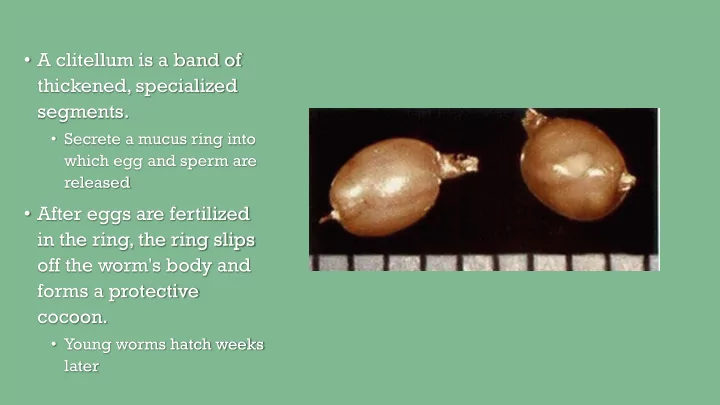
A clitellum is a band of thickened, specialized segments. Secrete a mucus ring into which egg and sperm are released After eggs are fertilized in the ring, the ring slips off the worm's body and forms a protective cocoon.


slide-1
SLIDE 1
  • A clitellum is a band of

thickened, specialized segments.

  • Secrete a mucus ring into

which egg and sperm are released

  • After eggs are fertilized

in the ring, the ring slips

  • ff the worm's body and

forms a protective cocoon.

  • Young worms hatch weeks

later

slide-2
SLIDE 2

GROUPS OF ANNELIDS

  • Annelids are divided into three classes
  • Oligochaetes
  • Leeches
  • Polychaetes
slide-3
SLIDE 3

CLASS OLIGOCHAETA

  • Earthworms and their relatives
  • Typically have streamlined

bodies

  • Relatively few setae compared to

polychaetes

  • Most oligochaetes live in soil or

fresh water.

  • Giant Earthworm
slide-4
SLIDE 4

CLASS HIRUDINEA

  • The class Hirudinea contains the

leeches.

  • Leeches are typically external

parasites that suck the blood and body fluids of their host

  • Powerful suckers at each end
  • Uses pharynx to suck blood
  • Some release anesthesia so prey

do not know they have been bit

  • Also release substances to

prevent blood clotting

slide-5
SLIDE 5

USE OF LEECHES IN MEDICINE

slide-6
SLIDE 6

CLASS POLYCHAETA “MANY BRISTLES”

  • Marine annelids that have paired,

paddlelike appendages(parapodia) tipped with setae.

  • The setae are brush like structures on the

worm.

  • Found most commonly in crevices in coral

reefs, sand, mud and rocks

  • Feather duster worm
  • More
slide-7
SLIDE 7

ECOLOGY OF ANNELIDS

  • Earthworms
  • “Intestines of the Earth”
  • Burrow through the soil
  • Aerate it, mixing it to depths of 2 m
  • Create tunnels
  • Provide passageway for plant roots, water and beneficial bacteria
  • Pull plant material down in the soil
  • Earthworm castings (feces)
  • As earthworms pass soil through gut they grind it, digest it and mix it

with bacteria

  • Bring nutrients from deeper to shallow soil
  • Nitrogen, phosphorous, potassium, micronutrients and beneficial bacteria