They didnt do it like that in my day! Do your children ask for help - - PowerPoint PPT Presentation

they didn t do it like that in my day
SMART_READER_LITE
LIVE PREVIEW

They didnt do it like that in my day! Do your children ask for help - - PowerPoint PPT Presentation

They didnt do it like that in my day! Do your children ask for help with their maths homework and start talking in a foreign language, using words like partitioning, chunking, grid multiplication.? It will depend on


slide-1
SLIDE 1

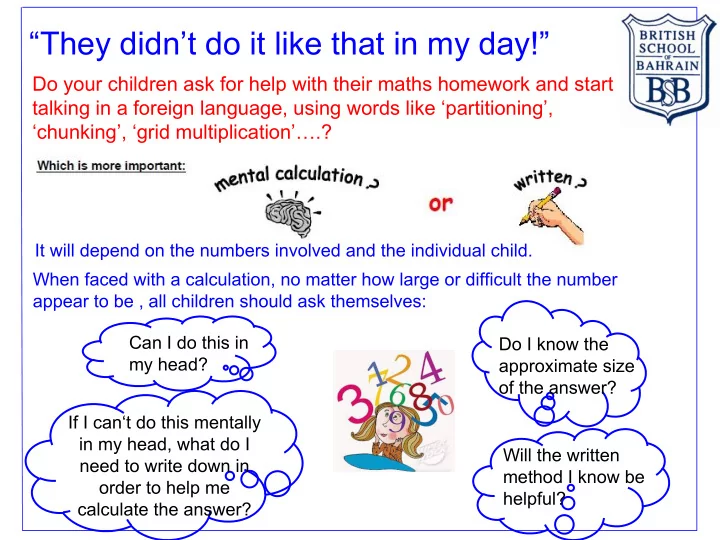
“They didn’t do it like that in my day!”

Do your children ask for help with their maths homework and start talking in a foreign language, using words like ‘partitioning’, ‘chunking’, ‘grid multiplication’….?

It will depend on the numbers involved and the individual child. When faced with a calculation, no matter how large or difficult the number appear to be , all children should ask themselves: Can I do this in my head? If I can‘t do this mentally in my head, what do I need to write down in

  • rder to help me

calculate the answer? Do I know the approximate size

  • f the answer?

Will the written method I know be helpful?

slide-2
SLIDE 2

Empowering parents to support their children in Maths

The British School of Bahrain

Presented by Martin Drennan & Stephen Greene

slide-3
SLIDE 3

Aims

❖ To discuss the importance of positive attitudes towards Mathematics and the impact it plays on a child’s understanding

  • f Mathematics.

❖ To share types of recording that your child will be introduced to, to support their written calculation methods when problem solving. ❖ To show you some possible activities and resources that you may be able to make/use to support your child/children at home.

slide-4
SLIDE 4

How do you feel about Mathematics?

‘I love Maths!’ or ‘I can’t do Maths!’

What are your experiences of Mathematics at school? How have they affected your attitude towards the subject? Do you have a positive attitude?

slide-5
SLIDE 5

Children learn in different ways

Each child is an individual and all children develop their mathematical understanding at a different pace. Visual – learns best by seeing Audio – learns best by hearing Kinaesthetic- learns best by feeling or experiencing There is no right or wrong way. We facilitate the skills, equipping the children with the strategies to help themselves.

slide-6
SLIDE 6

Problem Solving Questions

Children regularly have to make decisions about what mathematics to use when solving problems. Children use jottings to solve problems. Jottings are understood as an; ❖ Opportunity to take risks ❖ Explore different solutions ❖ Make mistakes ❖ Try something else RUCSAC Method - Click Here

slide-7
SLIDE 7

Problem Solving Strategies

  • Act it out
  • Make a model
  • Work backwards
  • Guess, check and improve
  • Solve a simpler, related problem
  • Look for a pattern
  • Try all possibilities
  • Seek an exception
  • Break it into more manageable

parts

  • Draw a picture or a graph
  • Make a list or table
  • Have I seen a similar problem?
  • Use a sum or number sentence

How did you answer the question? Which method did you use? Why did you use that method? Would you be able to explain how you solved the problem? How did you feel about solving the problem? Did you check your answer?

slide-8
SLIDE 8

Real Life Maths

Mental Addition and Subtraction at the mall. Who can estimate closest to the real total? Calculate cost of family holidays: (Flights + Hotel + Spending Money) x Number of people in your family. Work out the total price per person. Plan a trip for family member to come to Bahrain For football lovers, talk about the transfer fees. Eg Manchester United bought Paul Pogba for 89 million pounds. If he plays for 5 years, how much will that work out at per year/month/week/day?

slide-9
SLIDE 9

Key Messages

❖Children are taught to use mental methods as a first resort when faced with a calculation. ❖Informal written methods are developed from mental methods. ❖Formal written methods are developed from informal written methods. ❖Teachers continue to develop children’s mental methods and informal written methods even when formal written methods are established. ❖Through demonstration, visual models and images are used together with practical hands on resources to support mathematical learning at all age ranges.

slide-10
SLIDE 10

How can you continue to support your child?

Meaningful real life contexts are used to engage children in learning in mathematics. ❖ It is most important that you talk & listen to your child about their work in maths. It will help your child if they have to explain to you. ❖ Share the maths activity with your child and discuss it with them. ❖ Be positive about maths, even if you don’t feel confident about it yourself. ❖ Remember, you are not expected to teach your child maths, but please share, talk and listen to your child. ❖ If your child cannot do their homework do let the teacher know by either writing a note in your child’s book or telling the teacher. ❖ A lot of maths can be done using everyday situations and will not need pencil and paper methods. ❖ Play games and have fun with maths!