
SLIDE 1
Thesis 2005
Cira Centre – Philadelphia Structural Redesign of Lateral Force Resisting System Andrew Kauffman Structural Option
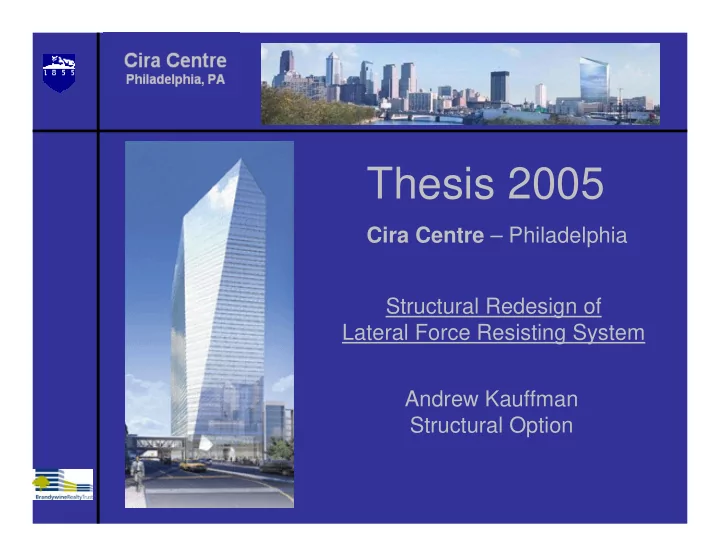
Thesis 2005 Cira Centre Philadelphia Structural Redesign of - - PowerPoint PPT Presentation
Thesis 2005 Cira Centre Philadelphia Structural Redesign of Lateral Force Resisting System Andrew Kauffman Structural Option Presentation Outline Introduction Building Description Structural System Problem Statement Solution Overview
Cira Centre – Philadelphia Structural Redesign of Lateral Force Resisting System Andrew Kauffman Structural Option
Presentation Outline Introduction Building Description Structural System Problem Statement Solution Overview Structural Redesign Mechanical Redesign Conclusion
Introduction
Adjacent to 30th Street Train Station - Philadelphia, PA 291,000 s.f., 28 story high rise office building Convention center, restaurants and retail space Tallest building in Philadelphia, outside Center City Scheduled for completion – October 2005 Total Projected Cost – $200 million
Building Description – Project Team
Architects – Cesar Pelli and Assoc./Bower Lewis Thrower General Contractor – Turner Construction Co. Structural Engineer – Ingenium Inc. Civil Engineer – Pennoni Assoc. MEP Engineer – Jaros Baum and Bolles Lighting Design - Cline Bettridge Bernstein Acoustic Consultant - Cerami and Associates Curtain Wall Consultant - Israel Berger and Associates
Building Description- Architectural Features
725,000 s.f. rentable space Open plan office levels: 727,725 s.f. (average) 9 ft. floor to ceiling heights Pedestrian bridge connecting to 30th Street train station Single point of entrance in main lobby, added security Highly reflective glass curtain wall
Building Description – Building Systems
Electrical – 13.2 KV primary voltage 480Y/277 volt, 3 phase, 4 wire Secondary system Mechanical – Fan powered, VAV system Includes 4 cooling towers located in top mezzanine Conveying – 14 high speed traction elevators Low-rise, mid-rise, high-rise Configuration
Structural System – Overview Steel frame super-structure Composite floor system Drilled pier foundation Lateral System: Combination of braced and moment frames
Structural System – Floor System
Fully composite, 5 ¼ in. floor system, with LW concrete, metal decking, 50 ksi steel framing members W18x35 and W24x76 typical beams and girders, 30’x30’ bays, typ.
1 3 4 5 6 8 D C B A 2 7 9 10 E F 7'-11" 30' 12'-6" 30' 7'-8" 12'-6" 30' 30' 30' 30' 30' 30' 30' 30'
N Structural System – Vertical Framing
Drilled concrete piers with up to 21.5’ penetration into bedrock Large built-up column sizes including W36x1202 wide flange members and 829 lb/ft. built-up box sections Forking Columns Leaning Columns
Structural System – North/South Building Section
1 3 4 5 6 8 D C B A 2 7 9 10 E F 7'-11" 30' 12'-6" 30' 7'-8" 12'-6" 30' 30' 30' 30' 30' 30' 30' 30'
N North/South Section
Structural System - East/West Section
1 3 4 5 6 8 D C B A 2 7 9 10 E F 7'-11" 30' 12'-6" 30' 7'-8" 12'-6" 30' 30' 30' 30' 30' 30' 30' 30'
N East-West Section
MEC H RO O M MAC H RO O M MAC H RO O M C O NFERENC E Structural System – Lateral System
East/West - Located in building core Combination of braced frames and moment connections
2 7 9 10 E F
N EL EVAT O RS ST AI R T O WERS LAT ERAL FRAMES LAT ERAL FRAME1 3 4 5 6 8 D C B A
Structural System – Lateral System East – West Direction
Along column lines C & D Located in structural core Exterior braced frames Interior moment frames
Structural System – Lateral System
North/South – Located in building core Combination of braced frames and moment connections
2 7 9 10 E F
N EL EVAT O RS ST AI R T O WERS LAT ERAL FRAMES LAT ERAL FRAME1 3 4 5 6 8 D C B A
North - South Lateral System
Along column lines 4 & 7 Located in Structural Core Exterior Moment Frames Interior Braced Frames
Structural System – Lateral System
2 7 9 10 E F
N EL EVAT O RS ST AI R T O WERS LAT ERAL FRAMES LAT ERAL FRAME1 3 4 5 6 8 D C B A
North/South – Located along exterior frames Only moment frames
Structural System – Lateral System
2 3 4 5 6 7 8 9 10 11 12 13 14 15 16 17 18 19 20 22 23 24 25 26 27 28 21
North - South Lateral System
Along column lines 1 & 10 All moment frames Varying stiffness
Problem Statement – Overview
Complicated Structure to Analyze
Complicated Lateral System 1. Combination of braced and moment frames 2. Lateral frames with varying stiffness
Problem Statement – Lateral Load Assumptions
Lateral Loads used in actual design were developed using a wind tunnel analysis Wind Tunnel results yielded 65% of total shear and 75% of the overturning moment, compared to ASCE7-02, analytical method. Strength considerations did not control the
Torsional acceleration at corner offices was the limiting factor that controlled the design
Solution Overview – Lateral System Redesign Develop wind and seismic loads based on ASCE7-02 Redesign Lateral System based on these loads. Compare cost of redesign to cost of original structure
Solution Overview – Design Goals Gain a better understanding of lateral force resisting system design for steel buildings Investigate alternative lateral system configurations Meet the design criteria of IBC 2003. Limit interstory drift Limit overall building drift to L/400 criteria Achieve an economically feasible design Optimization of original design was not a goal
Solution Overview - Procedure Develop wind loads using Analytical Procedure Model 2-D lateral frames using GT Struddle Determine relative stiffness based on virtual loads Distribute loads based on stiffness and torsion analysis Analyze frames for deflection and interstory drift Redesign lateral frames based on drift criteria - iterative Compare cost of redesign to original structural system
Solution Overview – Mechanical Breadth Study
Analyze feasibility of adding enthalpy wheels to the original mechanical system. Goal: Utilize the properties of building exhaust to save $$$
Structural Redesign – Stiffness Analysis
Created model of each lateral frame in GT Struddle 100k virtual load at top of each frame to measure relative stiffness
2 7 9 10 E F N EL EVAT O RS ST AI R T O WERS LAT ERAL FRAMES LAT ERAL FRAME 1 3 4 5 6 8 D C B A Structural Redesign – East/West Lateral Frames
Equal Stiffness Distribute half of total story load to each frame Equal distance from center of plan Torsion had minimal effect in this direction
Column Lines C & D
Structural Redesign – Load Distribution
Structural Redesign - Results
Total Deflection: 13.25” L/400 = 13.08” Acceptable based on
Structural Redesign – North/South Direction Modeled lateral frames along Column Lines 1,4,7,10 Applied Virtual Load at levels 28,20,10
2 7 9 10 E F N EL EVAT O RS ST AI R T O WERS LAT ERAL FRAMES LAT ERAL FRAME 1 3 4 5 6 8 D C B A Structural Redesign – North/South Direction
CL 1 CL 4/CL 7 CL 10
Relative stiffness varied with height. Applied uniform 10 kip load to verify stiffness Plotted results and fit equation Solved equation for stiffness in terms of height
Structural Redesign – North/South Direction
Relative Lateral Frame Stiffness
y = 23584x - 2049.3 y = 2088.6x - 122.41 y = -3839.6x + 1640.3 50 100 150 200 250 300 350 400 0.1 0.2 0.3 0.4 0.5 K - Relative Stiffness Building Height (ft.) CL4 CL10 CL1 Linear (CL1) Linear (CL10) Linear (CL4)
Structural Redesign – North/South Direction
Performed torsion analysis at each level based on center of rigidity Included 5% eccentricity per code, and determined loads on frames
1 3 4 5 6 7 D C B A 2 7 8 10 E F NL e ve l 20
Ce ntre390 PSF
21' 1,900 F Structural Redesign – North/South Direction
Applied load to models in GT Struddle and analyzed results
Structural Redesign – Results
Each lateral frame deflected equal amounts. All frames deflected well over the L/400 limit.
19.99” 17.16” 19.92”
Structural Redesign – Solution
Alleviate interstory drift problems Limit overall building drift to 12” Started with exterior frames
2 7 9 10 E F
N EL EVAT O RS ST AI R T O WERS L AT ERAL FRAMES L AT ERAL FRAME1 3 4 5 6 8 D C B A
Structural Redesign – North/South Direction
Analyzed several bracing configurations using iterative procedure. Eliminated interstory drift problems, limited total drift to 12”
Structural Redesign – North/South Direction
Used same procedure for interior lateral frames along column lines 4 & 7 Could not limit drift to 12”
2 7 9 10 E F N ELEVAT O RS ST AI R T O WERS LAT ERAL FRAMES LAT ERAL FRAME 1 3 4 5 6 8 D C B A Structural Redesign – North/South Direction
Increased stiffness of exterior lateral frames W14x145 bracing members Additional chevron braces to these frames Limited total drift to 9” Changed bracing of interior frames W14x159 bracing members Increased stiffness of girders to W33x221 Reapplied stiffness analysis and torsion calculations Calculated new story loads
Results
Structural Redesign – Cost Analysis
Used R.S. Means to estimate total cost of original structure 20% total building cost = $ 40 million Performed take-off to calculate cost of lateral system redesign Compared additional cost to overall structural cost Cost Increase = 0.6% Structure Cost Cost Increase = 0.1% Structure Cost
Mechanical System Redesign
Fan powered VAV system Supply Air: 80% return, 20% outdoor air Exhaust: based on 150 cfm/toilet, 20 cfm/sink Typical Air Handler Size: 23,500
System Description Procedure
Use ASHRAE Bin data to analyze a full year cycle Based on 2 design condition: on peak – business hours,
Calculated total building load with/without use of enthalpy wheel Compared loads and calculate savings
Mechanical System Redesign – Typical Floor
Total Savings = Sensible Load savings + Latent Load savings Enthalpy wheels turned off when no energy is saved Additional energy can be saved by modulating wheel
Mechanical System Redesign - Results
Using Peco Energy Rates: Total Energy Savings: 671,236 kwh Total Cost Savings: $28,506/year
Conclusion Based on lateral load assumptions used for this analysis, the lateral frames in the North/South direction should be designed with increased stiffness based on occupancy comfort criteria. Redesign of lateral force resisting system is an economic solution compared to overall cost of structure Enthalpy wheels should be utilized by the mechanical system to increase overall efficiency and save $$$.
AE Faculty and Staff
Jeff Weinstein and Andy Bush, Brandywine Realty Trust
Peter Jennings, Jaros, Baum, and Bolles My Family and Friends My wife Nicole