Thermodynamic systems Isolated systems can exchange neither energy - - PowerPoint PPT Presentation

thermodynamic systems
SMART_READER_LITE
LIVE PREVIEW

Thermodynamic systems Isolated systems can exchange neither energy - - PowerPoint PPT Presentation

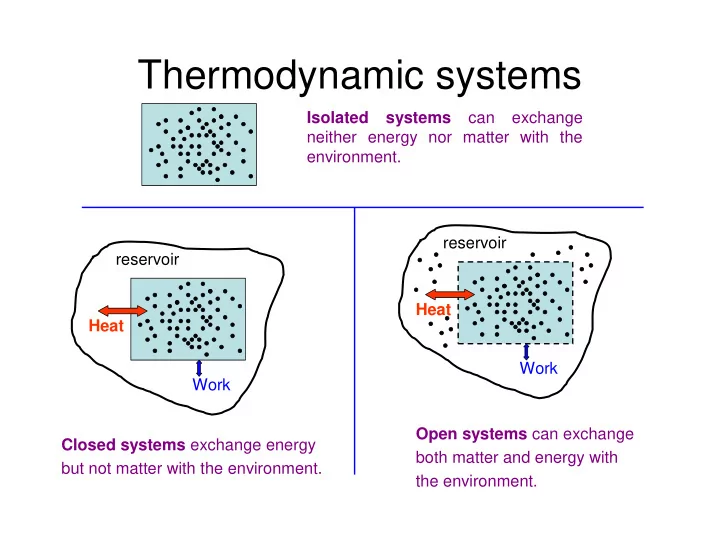
Thermodynamic systems Isolated systems can exchange neither energy nor matter with the environment. reservoir reservoir Heat Heat Work Work Open systems can exchange Closed systems exchange energy both matter and energy with but not


slide-1
SLIDE 1

Isolated systems can exchange neither energy nor matter with the environment. Closed systems exchange energy but not matter with the environment. Heat Work reservoir Open systems can exchange both matter and energy with the environment. Heat Work reservoir

Thermodynamic systems

slide-2
SLIDE 2

Quasi-static processes: near equilibrium Initial state, final state, intermediate state: p, V & T well defined Sufficiently slow processes = any intermediate state can considered as at thermal equilibrium. Thermal equilibrium means that It makes sense to define a temperature. Examples of quasi-static processes:

  • isothermal:

T = constant

  • isochoric:

V = constant

  • isobaric:

P = constant

  • adiabatic:

Q = 0

Quasi-static processes

slide-3
SLIDE 3

Work in thermodynamics

Expansion: work on piston positive, work on gas negative Compression: work on piston negative, work on gas positive

slide-4
SLIDE 4

Work during a volume change

= ⇒ = = =

2 1

. .

V V

pdV W pdV Adx p dx F dW

slide-5
SLIDE 5

Work in pV diagrams

Work done equals area under curve in pV diagram

Careful with the signs…

slide-6
SLIDE 6

1st Law of Thermodynamics

W Q U − = ∆

Conservation of energy

Heat is positive when it enters the system Work is positive when it is done by the system Heat is negative when it leaves the system Work is negative when it is done on the system

slide-7
SLIDE 7

1st Law of Thermodynamics

pdV dQ dU − =

Conservation of energy

Heat is positive when it enters the system Work is positive when it is done by the system Heat is negative when it leaves the system Work is negative when it is done on the system

slide-8
SLIDE 8

) (

1 2 2

V V p W − =

  • a. isochoric
  • b. isobaric
  • a. isobaric
  • b. isochoric

) (

1 2 1

V V p W − =

=

f i

V V pdV

W

isothermal

  • The work done by a system depends on the initial and final states and
  • n the path it is not a state function.
  • Amount of heat transferred also depends on the initial, final, and intermediate

states it is not a state function either. (a) (b) (c)

State Functions

slide-9
SLIDE 9

State Functions

1 2

U U W Q U − = − = ∆

The internal energy U is a state function: the energy gain (loss) only depends on the initial and final states, and not

  • n the path.

Even though Q and W depend on the path, ∆U does not!

slide-10
SLIDE 10

This pV–diagram shows two ways to take a system from state a (at lower left) to state c (at upper right):

  • via state b (at upper left), or
  • via state d (at lower right)

For which path is W > 0?

  • A. path abc only
  • B. path adc only
  • C. both path abc and path adc
  • D. neither path abc nor path adc
  • E. The answer depends on what the system is made of.

CPS question

slide-11
SLIDE 11

A system can be taken from state a to state b along any of the three paths shown in the pV– diagram. If state b has greater internal energy than state a, along which path is the absolute value |Q| of the heat transfer the greatest?

  • A. path 1
  • B. path 2
  • C. path 3
  • D. |Q| is the same for all three paths.
  • E. not enough information given to decide

CPS question

slide-12
SLIDE 12

Thermodynamic Processes:

  • Adiabatic: no heat transfer (by insulation or by very fast process)

Q=0 → → → → U2 – U1 = -W

  • Isochoric: constant volume process (no work done)

W=0 → → → → U2 – U1 = Q

  • Isobaric: constant pressure process

p=const. →

→ → → W = p (V2 – V1)

  • Isothermal: constant temperature process (heat may flow but very

slowly so that thermal equilibrium is not disturbed) ∆ ∆ ∆ ∆U=0,Q =-W only for ideal gas. Generally ∆

∆ ∆ ∆U,Q, W not zero

any energy entering as heat must leave as work

slide-13
SLIDE 13

Thermodynamic processes

slide-14
SLIDE 14

Isolated systems:

f i

U U U W Q = → = ∆ → = =

Cyclic processes P

i, f

V initial state = final state

W Q U = → = ∆

The internal energy

  • f an isolated systems

remains constant

Adiabatic processes

W U Q − = ∆ → = 0

Expansion: U decreases Compression: U increases Energy exchange between “heat” and “work”

First Law for Several Types of Processes

slide-15
SLIDE 15

More about cyclic processes

P

i, f

V

Work equals the area enclosed by the curves (careful with the sign!!!)

slide-16
SLIDE 16
  • A. Q > 0, W > 0, and ∆U = 0.
  • B. Q > 0, W > 0, and ∆U > 0.
  • C. Q = 0, W > 0, and ∆U < 0.
  • D. Q = 0, W < 0, and ∆U > 0.
  • E. Q > 0, W = 0, and ∆U > 0.

CPS question An ideal gas is taken around the cycle shown in this pV–diagram, from a to b to c and back to a. Process b → c is isothermal. For this complete cycle,

slide-17
SLIDE 17

Important formulas

∆U=Q-W (1st law) (work during a volume change) pV=nRT (Ideal gas law) CV=f/2nR (Equipartition theorem)

=

2 1

V V

pdV W

slide-18
SLIDE 18

Isochoric process: V = constant

V P V1,2 1 2

2 2

nRT V p =

1 1

nRT V p =

2 1

= = →

V V pdV

W

T C T T C Q

V V

∆ = − = ) (

1 2

Heat

reservoir During an isochoric process, heat enters (leaves) the system and increases (decreases) the internal energy.

(CV: heat capacity at constant volume)

T C Q U W Q U

V∆

= = ∆ → − = ∆

Ideal gas: isochoric process

slide-19
SLIDE 19

Isobaric process: p = constant

V P V1 1 2

2 2

nRT pV =

1 1

T Nk pV

B

=

V p V V p pdV W

V V

∆ = − = = →

) (

1 2

2 1

V2

T C T T C Q

p p

∆ = − = ) (

1 2

(CP: heat capacity at constant pressure)

V p T C W Q U

P

∆ − ∆ = − = ∆

During an isobaric expansion process, heat enters the system. Part of the heat is used by the system to do work on the environment; the rest of the heat is used to increase the internal energy. Heat Work reservoir

Ideal gas: isobaric process

slide-20
SLIDE 20

Isothermal process: T = constant

V P V1 1 2

nRT pV =

1 2

ln

2 1 2 1 2 1

V V nRT V dV nRT dV V nRT pdV W

V V V V V V

= = = =

∫ ∫ ∫

V2

= ∆ ⇒ = ∆ U T

1 2

ln V V nRT W Q = = →

Expansion: heat enters the system all of the heat is used by the system to do work on the environment. Compression: the work done on the system increases its internal energy, all of the energy leaves the system at the same time as the heat is removed.

Ideal gas: isothermal process

slide-21
SLIDE 21

Heat capacities of an Ideal gas

Consider an isobaric process p=constant

T C Q

p p

∆ =

From the 1st Law of Thermodynamics:

pdV dU dT C dQ

p p

+ = =

but

dT C dU

V

= pdV dT C dT C

V p

+ = ⇒ nRdT pdV Vdp pdV nRT pV = = + ⇒ =

From the Ideal gas law:

nR C C nRdT dT C dT C

V p V p

+ = ⇒ + = ⇒

slide-22
SLIDE 22

Heat capacities of an Ideal gas

nR f C nR C C

V V p

2 = + = nR f Cp 2 2 + = ⇒ f f nR f nR f C C

V p

2 2 / 2 2 + = + = ⇒

f = #degrees

  • f freedom

For a monoatomic gas f=3

67 . 1 3 / 5 ; 2 5 = = = ⇒

V p p

C C nR C

slide-23
SLIDE 23

Molar heat capacities of various gases at (25 C)

1.05 8.76 3.29 27.36 36.12 H2S 1.02 8.51 3.41 28.39 36.90 N2O 1.02 8.45 3.39 28.17 36.62 CO2 Polyatomic 1.00 8.40 2.49 20.74 29.04 CO 1.01 8.39 2.52 20.98 29.37 O2 1.01 8.38 2.46 20.44 28.82 H2 1.00 8.32 2.50 20.80 29.12 N2 Diatomic 0.99 8.27 1.51 12.52 20.79 Xe 1.00 8.34 1.50 12.45 20.79 Kr 1.00 8.34 1.50 12.45 20.79 Ar 0.98 8.11 1.52 12.68 20.79 Ne 0.99 8.27 1.51 12.52 20.79 He Monoatomic (Cp-Cv)/R Cp-Cv Cv/R Cv Cp Gas

slide-24
SLIDE 24

V P V1 1 2 V2

Adiabatic process: Q = 0

) , ( T V p p =

∫ ∫

= =

2 1 2 1

) , (

V V V V

dV T V p pdV W

T Nk pV

B

=

nRdT Vdp pdV nRT d pV d = + → = → ) ( ) (

pdV RdT f n pdV dT C pdV dW dU

V

− = → − = → − = − = 2

pdV f Vdp pdV 2 − = + f is the # of degrees of freedom

Ideal gas: adiabatic process

slide-25
SLIDE 25

V P V1 1 2 V2

) , ( T V p p =

) 2 1 ( 2 = + + → − = + pdV f Vdp pdV f Vdp pdV

= + V dV p dp γ

constant ln ln ln

1 1 1 1 1 1

1 1

= = → = → = + → = + ∫

γ γ γ γ

γ γ V p pV V p pV V V p p V dV p dp

V V p p

let , and dividing by pV ) 2 1 ( f + = γ

Ideal gas: adiabatic process (contd)

slide-26
SLIDE 26

V P V1 1 2 V2

constant =

γ

pV

) ( 1 1 ) ( ) (

2 2 1 1 2 2 1 1 2 1

V p V p V p V p R C T T nC T nC U W

V V V

− − = − = − = ∆ − = ∆ − = γ

        − − = →

− − 1 2 1 1 1 1

1 1 ) 1 ( 1

γ γ γ

γ V V V p W

constant

1 1

= =

γ γ

V p pV

Ideal gas: adiabatic process (contd)

Using:

slide-27
SLIDE 27

V P V1 1 2 V2

constant =

γ

pV

γ γ 2 2 1 1

V p V p =

2 2 2 1 1 1

nRT V p nRT V p = =

2 1 2 1 2 1

T T V V p p = →

γ γ 1 2 2 1

V V p p = →

2 1 1 1 1 2

T T V V = →

− − γ γ

  • r

constant

1 1

= =

γ γ

V p pV

constant

1 2 2 1 1 1

= =

− − γ γ

V T V T

Ideal gas: adiabatic process (contd)

slide-28
SLIDE 28

V P V1 1 2 V2

constant =

γ

pV

constant

1 1

= =

γ γ

V p pV

constant

1 2 2 1 1 1

= =

− − γ γ

V T V T

nRT pV =

During an adiabatic expansion process, the reduction of the internal energy is used by the system to do work on the environment. During an adiabatic compression process, the environment does work on the system and increases the internal energy.

Ideal gas: adiabatic process (contd)

        − − =

− − 1 2 1 1 1 1

1 1 ) 1 (

γ γ γ

γ V V V p W

slide-29
SLIDE 29

When an ideal gas is allowed to expand isothermally from volume V1 to a larger volume V2, the gas does an amount of work equal to W12. If the same ideal gas is allowed to expand adiabatically from volume V1 to a larger volume V2, the gas does an amount of work that is

  • A. equal to W12.
  • B. less than W12.
  • C. greater than W12.
  • D. either A., B., or C., depending on the ratio of V2 to V1.

CPS question

slide-30
SLIDE 30

Quasi-static process Character

U ∆

W

Q

adiabatic

= Q

W U − = ∆

isothermal T = constant

= ∆U

isochoric isobaric V = constant p = constant

Q U = ∆

T C Q

V∆

=

= W

V p W ∆ =

W Q U − = ∆

T C Q

P∆

=

1 2

ln V V nRT W =

W Q =

) 1 1 ( ) 1 ( 1

1 1 1 2 1 1 − − −

− =

γ γ γ

γ V V V p W

= Q

Summary