Thermal-Hydraulic Uncertainty Factors for Prediction of Fuel Rod - - PDF document

thermal hydraulic uncertainty factors for prediction of
SMART_READER_LITE
LIVE PREVIEW

Thermal-Hydraulic Uncertainty Factors for Prediction of Fuel Rod - - PDF document

Transactions of the Korean Nuclear Society Virtual Spring Meeting July 9-10, 2020 Thermal-Hydraulic Uncertainty Factors for Prediction of Fuel Rod Burst in LBLOCA Safety Analysis Joosuk Lee, Deog-Yeon Oh, Young-Seok Bang Korea Institute of


slide-1
SLIDE 1

Thermal-Hydraulic Uncertainty Factors for Prediction of Fuel Rod Burst in LBLOCA Safety Analysis

Joosuk Lee, Deog-Yeon Oh, Young-Seok Bang Korea Institute of Nuclear Safety 62 Gwahak-ro, Yusong-gu, Daejeon, 305-338, Republic of Korea Tel: +82-42-868-0784, Fax: +82-42-868-0045 Email: jslee2@kins.re.kr

  • 1. Introduction

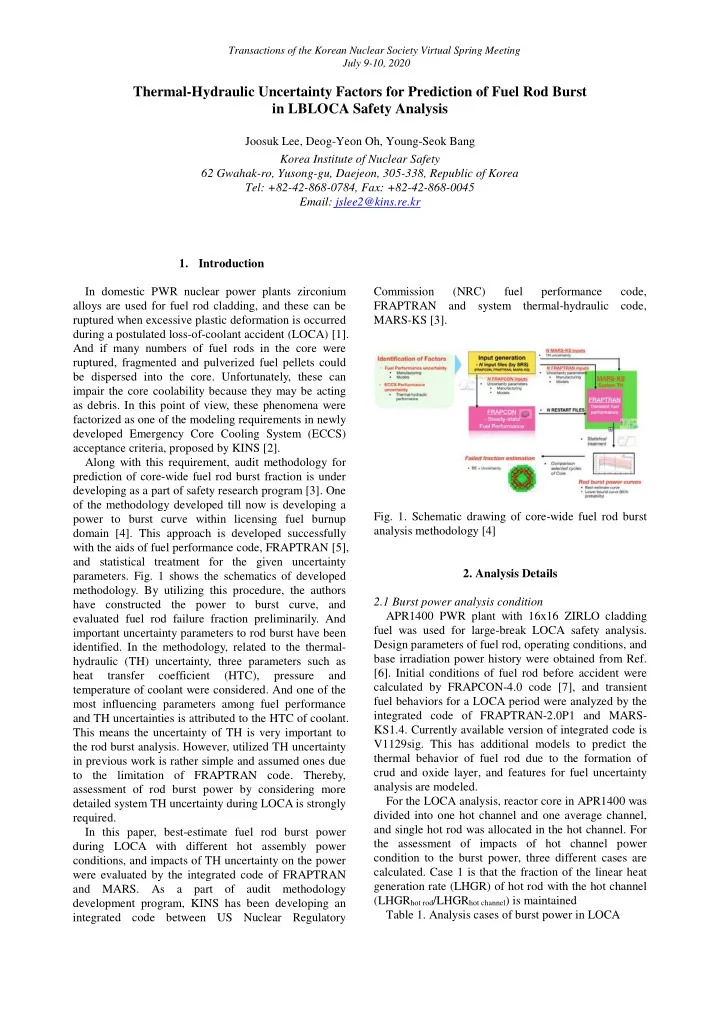
In domestic PWR nuclear power plants zirconium alloys are used for fuel rod cladding, and these can be ruptured when excessive plastic deformation is occurred during a postulated loss-of-coolant accident (LOCA) [1]. And if many numbers of fuel rods in the core were ruptured, fragmented and pulverized fuel pellets could be dispersed into the core. Unfortunately, these can impair the core coolability because they may be acting as debris. In this point of view, these phenomena were factorized as one of the modeling requirements in newly developed Emergency Core Cooling System (ECCS) acceptance criteria, proposed by KINS [2]. Along with this requirement, audit methodology for prediction of core-wide fuel rod burst fraction is under developing as a part of safety research program [3]. One

  • f the methodology developed till now is developing a

power to burst curve within licensing fuel burnup domain [4]. This approach is developed successfully with the aids of fuel performance code, FRAPTRAN [5], and statistical treatment for the given uncertainty

  • parameters. Fig. 1 shows the schematics of developed
  • methodology. By utilizing this procedure, the authors

have constructed the power to burst curve, and evaluated fuel rod failure fraction preliminarily. And important uncertainty parameters to rod burst have been

  • identified. In the methodology, related to the thermal-

hydraulic (TH) uncertainty, three parameters such as heat transfer coefficient (HTC), pressure and temperature of coolant were considered. And one of the most influencing parameters among fuel performance and TH uncertainties is attributed to the HTC of coolant. This means the uncertainty of TH is very important to the rod burst analysis. However, utilized TH uncertainty in previous work is rather simple and assumed ones due to the limitation of FRAPTRAN code. Thereby, assessment of rod burst power by considering more detailed system TH uncertainty during LOCA is strongly required. In this paper, best-estimate fuel rod burst power during LOCA with different hot assembly power conditions, and impacts of TH uncertainty on the power were evaluated by the integrated code of FRAPTRAN and MARS. As a part of audit methodology development program, KINS has been developing an integrated code between US Nuclear Regulatory Commission (NRC) fuel performance code, FRAPTRAN and system thermal-hydraulic code, MARS-KS [3].

  • Fig. 1. Schematic drawing of core-wide fuel rod burst

analysis methodology [4]

  • 2. Analysis Details

2.1 Burst power analysis condition APR1400 PWR plant with 16x16 ZIRLO cladding fuel was used for large-break LOCA safety analysis. Design parameters of fuel rod, operating conditions, and base irradiation power history were obtained from Ref. [6]. Initial conditions of fuel rod before accident were calculated by FRAPCON-4.0 code [7], and transient fuel behaviors for a LOCA period were analyzed by the integrated code of FRAPTRAN-2.0P1 and MARS- KS1.4. Currently available version of integrated code is

  • V1129sig. This has additional models to predict the

thermal behavior of fuel rod due to the formation of crud and oxide layer, and features for fuel uncertainty analysis are modeled. For the LOCA analysis, reactor core in APR1400 was divided into one hot channel and one average channel, and single hot rod was allocated in the hot channel. For the assessment of impacts of hot channel power condition to the burst power, three different cases are

  • calculated. Case 1 is that the fraction of the linear heat

generation rate (LHGR) of hot rod with the hot channel (LHGRhot rod/LHGRhot channel) is maintained Table 1. Analysis cases of burst power in LOCA

Transactions of the Korean Nuclear Society Virtual Spring Meeting July 9-10, 2020

slide-2
SLIDE 2

Case # LHGRhot rod / LHGRhot channel Burst criterion Computer Code 1 1.135 NUREG-0630 fast ramp FRAP/MARS 2 1 3 Fixed hot assembly LHGR (12.74kW/ft)

  • Ref. [4]

FRAPTRAN

as 1.135 while the Case 2 is that the fraction is given as 1.0. This means that each rod in the hot channel has the same LHGR as the hot rod. Case 3 is that the LHGR of hot channel does not changed even if the LHGR of hot rod is varied. Maximum LHGR of hot channel in this case is given as 12.74 kW/ft. Meanwhile total reactor power was maintained by adjusting the average channel

  • power. Top-skewed cosine axial power profile in fuel

rod was used in the analysis, because top-skewed profile is identified as conservative one [4]. Analyzed cases with given condition are listed in Table 1. Burst power analysis was carried out from 0 to 70 MWd/kgU fuel burnup. 2.2 Considered uncertainty parameters and assessment In this study, 21 TH uncertainty parameters were

  • evaluated. These are chosen based on the recent KINS-

REM study [8], as listed in Table 2. Impacts of those parameters to the rod burst power change were assessed at fuel burnup of 0 to 60 MWd/kgU. For the cladding burst assessment, a well-known strain-based NUREG- 0630 fast ramp burst criterion was used. And the BALON2 cladding deformation model was activated. Root sum squared (RSS) tolerance analysis method was used for the assessment of combined uncertainty. Combined uncertainty = Root {Σi (Pi - PBE) 2}

Where, PBE and Pi is a best-estimate and assessed burst power with the given bias/tolerance, respectively.

  • 3. Results

3.1 Required fuel power for rod burst

  • Fig. 1 shows analyzed best-estimated fuel power

curves for rod burst with the given analysis condition, listed in Table 1. Generally, behaviors of power to burst with burnup change are very similar in all cases, but quantitative values are somewhat different. As the fraction of LHGR of hot rod to hot assembly is given as 1.135 (case 1), the required power at zero burnup is 13.0 kW/ft, and burnup increased to 10 MWd/kgU, it increased also to 14.5 kw/ft. However, fuel burnup moved further from 10 to 70 MWd/kgU, it reduced slowly and continuously until reached to 11.8 kW/ft. As the LHGR fraction is imposed as 1.0 (case 2), about 0.3~1.1 kW/ft lower burst powers are obtained as compared to the case 1. At 0 burnup, the required power to burst was 12.2 kW/ft, but burnup increased to 10 MWd/kgU, the power reached to 13.4 kW/ft. But, this is about 1.1 kW/ft lower than the case 1. And fuel burnup moved further from 10 to 70 MWd/kgU, burst power was continuously reduced until reaching 11.5 kW/ft. However, differences of burst power between two cases are reduced, from 1.1 to 0.3 kW/ft. The lower burst power of case 2 is clearly attributed to the increased hot assembly power. As the hot assembly LHGR was fixed as 12.74 kW/ft (case 3), the power at 0 burnup was 12.0 kW/ft. and burnup moved to 10 MWd/kgU, it increased to 14.6 kW/ft, then continuously reduced to 10.6 kW/ft at 70 MWd/kgU. Previous work [4], depicted as reference case in Fig. 1, shows very similar trends with the current analysis results. It showed 12.1 kW/ft burst power at fresh fuel and increased to 15.1 kW/ft at 10 MWd/kgU. Then it reduced until reaching 10.9 kW/ft at 60 MWd/kgU.

  • Fig. 1. Best-estimate required peak fuel power for rod burst as a function of fuel burnup with given hot assembly

LHGR conditions

Transactions of the Korean Nuclear Society Virtual Spring Meeting July 9-10, 2020

slide-3
SLIDE 3

Table 2. Considered uncertainty parameters and changes of local peak power for rod burst (∆P_burst) at the fuel burnup

  • f 0 and 60 MWd/kgU

Parameters Tolerance or Bias ∆P_burst (kW/ft) Case 1 Ref.[4] 60 60

  • 1. Dittus-Boelter HTC (liquid)

0.606-1.39 0.3 0.2 HTC of coolant = 4.0 Coolant

  • temp. =

1.4 Coolant pressure = 0.0 HTC of coolant = 2.6 Coolant

  • temp. =

1.3 Coolant pressure = 0.0

  • 2. Chen-nucleate boiling HTC

0.53-1.46 0.3 0.1

  • 3. Groeneveld-CHF

0.17-1.8 2.7 2.7

  • 4. Chen Transition Boiling Correlation

0.54-1.46 2.5 2.0

  • 5. Bromley film boiling heat transfer

0.428-1.58 0.0 0.4

  • 6. Dittus-Boelter HTC (vapor)

0.606-1.39 1.2 1.3

  • 7. Zuber CHF correlation

0.38-1.62 0.6 0.7

  • 8. Wesimann TB correlation

EF 1.51 0.2 0.4

  • 9. QF Bromley correlation

0.75-1.25 0.1 0.1

  • 10. Forslund-Rohsenoow FB correlation

(reflood)

0.5-1.5 0.1 0.0

  • 11. Vapor correlation(reflood)

0.5-1.5 0.1 0.6

  • 13. Pump 2-phase head multiplier

0.0-1.0 0.9 1.2

  • 14. Pump 2-phase torque multiplier

0.0-1.0 0.4 0.1

  • 15. SIT actuation pressure (MPa)

4.03-4.46 0.2 0.1

  • 16. SIT water inventory (m3)

45.34-54.57 0.3 0.1

  • 17. SIT water temp. (K)

294.1-321.9 0.4 0.5

  • 18. IRWST water temp. (K)

283-321.89 0.3 0.1

  • 12. Break CD

0.729-1.165 1.4 0.9

  • 19. Dry/wet wall criteria

0.568-1.269 0.2 0.2

  • 20. Weber number

0-1.402 0.2 0.0

  • 21. Droplet interfacial heat transfer

0.348-2.212 0.6 0.2 Combined uncertainty (lower bound) 4.40 (2.69) 4.10 (2.98) 4.23 (2.03) 2.91 (1.54)

This study clearly shows the importance of hot assembly power condition to the rod burst power

  • assessment. Thereby, the condition has to be carefully

chosen based on the actual nuclear core design. 3.2 Influencing TH factors to rod burst Table 2 shows the changes of burst power (∆P_burst) by the given TH parameters. These changes are assessed for the Case 2 hot assembly condition, listed in Table 1. Among the 21 parameters, Groeneveld-CHF and Chen Transition Boiling Criteria showed a strong influence. Groeneveld-CHF criteria has induced 2.7 kW/ft power change at both 0 and 60 MWd/kgU burnup. And Chen Transition Boiling Criteria shows 2.5 and 2.0 kW/ft at 0 and 60 MWd/kgU, respectively. Dittus-Boelter HTC (vapor), Pump 2-phase head multiplier and Break CD showed a moderate impact, such as ranging 0.9~1.3 kW/ft. Others revealed small effect to the burst power, such as less than 0.7 kW/ft. The degree of burst power change of each parameter with burnup change is not

  • significant. This may be caused by the similar levels of

burst power between two burnup conditions, as shown in Fig. 1. 3.3 Combined uncertainty and further work Table 2 also shows the results of the combined uncertainty to the burst power evaluated by the RSS

  • technique. At 0 and 60 MWd/kgU conditions, the

combined uncertainty (upper + lower bound) was 4.40 and 4.10 kW/ft, respectively. And if considered the lower bound uncertainty only, it was 2.69 and 2.98 kW/ft at 0 and 60 MWd/kgU, respectively. These showed the burst power uncertainty has no clear dependency between two burnups. In the previous work, the authors’ have assessed the influence of HTC, temperature and pressure of coolant

  • n the burst power, as listed in Table 2. If combining

them, the uncertainty was 4.23 and 2.91 kW/ft at 0 and 60 MWd/kgU, respectively. And lower bound uncertainty was 2.03 and 1.54 kW/ft, respectively. This result shows that combined uncertainty between two studies is very similar at 0 MWd/kgU condition. But at the burnup of 60 MWd/kgU, smaller uncertainty was

  • bserved in previous work. This may be due to the

difference of best-estimate burst power. Therefore, the intensity may be reduced. By utilizing the integrated code of FRAPTRAN and MARS, best-estimated, sensitivity and combined uncertainty to the rod burst power were successfully

  • analyzed. And similarities and differences were

identified compared to the previous work. In this study, the importance of LHGR relationship between hot rod and hot assembly is also identified. Therefore, reasonable and/or conservative approach based on the actual nuclear design in the core is required to construct a robust power to burst curve. And combining the fuel performance and TH uncertainty is required for prediction of lower bound burst curve. In this analysis, statistical treatment based on the Monte-Carlo approach can be used as a one of the statistical tools.

Transactions of the Korean Nuclear Society Virtual Spring Meeting July 9-10, 2020

slide-4
SLIDE 4
  • 4. Summary

Thermal-hydraulic factors to the rod burst power in LBLOCA safety analysis were assessed in this study. Best-estimated burst power and effect of thermal- hydraulic uncertainty to the burst power were evaluated with the integrated code of FRAPTRAN and MARS-

  • KS. Following results can be drawn.

Modeling of LHGR between hot rod and hot channel shows significant effect on the burst

  • power. Thereby, LHGR relation has to be

determined carefully based on the actual nuclear design in the core.

Among 21 uncertainty parameters that can affect the thermal-hydraulics of the core, Groeneveld- CHF and Chen Transition Boiling Criteria showed a strong influence on the burst power. Dittus- Boelter HTC (vapor), Pump 2-phase head multiplier and Break CD showed a moderate impact.

Combined uncertainty of thermal-hydraulic to the burst power showed similar levels at the fuel burnup of 0 and 60 MWd/kgU. Similarities and differences are discovered compared to the previous work. But the results obtained in this study seem to be more reliable because in the assessment thermal-hydraulic conditions were reflected properly using the integrated code. ACKNOWLEGEMENT The preparation of this paper was supported by the Nuclear Safety Research Program through the Korea Foundation Of Nuclear Safety (KOFONS), granted financial resource from the Nuclear Safety and Security Commission (NSSC), Republic of Korea (No. 1805004- 0118-SB110). REFERENCES [1] OECD/NEA/CSNI/R(2016)16, “Report on Fuel Fragmentation, Relocation and Dispersal”, July 2016. [2] Joosuk Lee et.al., “Research on the ECCS Acceptance Criteria Revision for Domestic PWR Plants”, KINS/RR-1848, 2018.11 [3] Joosuk Lee at.al., “Validation of Fuel/Thermal- Hydraulics Coupled Computer Code and Development

  • f Fuel Models”, KINS/RR-1849 Vol.2, 2019.11

[4] Joosk Lee and Young-Seok Bang, “Development of Evaluation Methodology of Core=Wide Fuel Rod Burst in LOCA Safety Analysis”, TopFuel 2019, Sep.22-26, Seattle Washington USA [5] K.J. Geelhood et. al., “FRAPTRAN-2.0: A Computer Code for the Transient Analysis of Oxide Fuel Rods”, May 2016, PNNL-19400, Vol.1. Rev2. [6] KEPCO-NF, “PLUS7 Fuel Design and Safety Evaluation for Korean Standard Nuclear Power Plants”, Propriety, KNF-TR-DMR-04001/N/A Rev.0, 2006. [7] K.J. Geelhood et. al., “FRAPCON-4.0: A Computer Code for the Calculation of Steady-State, Thermal- Mechanical Behavior of Oxide Fuel Rods for High Burnup”, PNNL-19418, Vol.1. Rev.2, September 2015. [8] Young-Seok Bang et.al., “Development of Safety Evaluation Technology for New Design Features and New Safety Criteria”, KINS/GR-627, 2018.9.

Transactions of the Korean Nuclear Society Virtual Spring Meeting July 9-10, 2020