There are 184 Talukas with on average more than 20% drop in the - - PDF document

there are 184 talukas with on average more than 20 drop
SMART_READER_LITE
LIVE PREVIEW

There are 184 Talukas with on average more than 20% drop in the - - PDF document

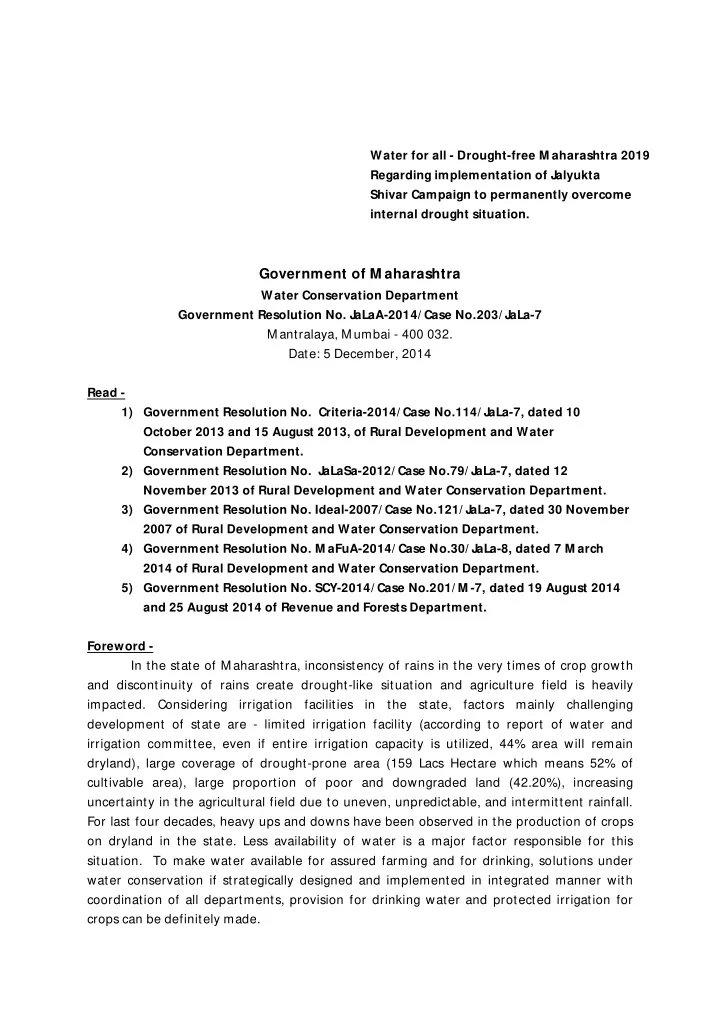
Water for all - Drought-free M aharashtra 2019 Regarding implementation of J alyukta Shivar Campaign to permanently overcome internal drought situation. Government of M aharashtra Water Conservation Department aLa-7 Government Resolution No. J


slide-1
SLIDE 1

Water for all - Drought-free M aharashtra 2019 Regarding implementation of J alyukta Shivar Campaign to permanently overcome internal drought situation.

Government of M aharashtra

Water Conservation Department Government Resolution No. J aLaA-2014/ Case No.203/ J aLa-7 M antralaya, M umbai - 400 032. Date: 5 December, 2014 Read - 1) Government Resolution No. Criteria-2014/ Case No.114/ J aLa-7, dated 10 October 2013 and 15 August 2013, of Rural Development and Water Conservation Department. 2) Government Resolution No. J aLaSa-2012/ Case No.79/ J aLa-7, dated 12 November 2013 of Rural Development and Water Conservation Department. 3) Government Resolution No. Ideal-2007/ Case No.121/ J aLa-7, dated 30 November 2007 of Rural Development and Water Conservation Department. 4) Government Resolution No. M aFuA-2014/ Case No.30/ J aLa-8, dated 7 M arch 2014 of Rural Development and Water Conservation Department. 5) Government Resolution No. SCY-2014/ Case No.201/ M -7, dated 19 August 2014 and 25 August 2014 of Revenue and Forests Department. Foreword - In the state of M aharashtra, inconsistency of rains in the very times of crop growth and discontinuity of rains create drought-like situation and agriculture field is heavily

  • impacted. Considering irrigation facilities in the state, factors mainly challenging

development of state are - limited irrigation facility (according to report of water and irrigation committee, even if entire irrigation capacity is utilized, 44% area will remain dryland), large coverage of drought-prone area (159 Lacs Hectare which means 52% of cultivable area), large proportion of poor and downgraded land (42.20%), increasing uncertainty in the agricultural field due to uneven, unpredictable, and intermittent rainfall. For last four decades, heavy ups and downs have been observed in the production of crops

  • n dryland in the state. Less availability of water is a major factor responsible for this
  • situation. To make water available for assured farming and for drinking, solutions under

water conservation if strategically designed and implemented in integrated manner with coordination of all departments, provision for drinking water and protected irrigation for crops can be definitely made.

slide-2
SLIDE 2

Government Resolution No. JaLaA-2014/ case no. 203/ JaLa-7

There are 184 Talukas with on average more than 20% drop in the rainfall in the year 2014, while there are 72 Talukas with more than 3 M etre drop in groundwater level, 116 Talukas with more than 2 to 3 M etre drop, and 190 Talukas with more than 1 to 2 M etre

  • drop. This means there are 188 Talukas (2234 villages) where level of groundwater has

dropped for more than 2 M etre. High scarcity of drinking water might be faced in these

  • villages. Through the GR dated 25 November 2014, government has declared drought-like

situation in 19059 villages from 22 districts. Also, water storage in the state is 81% on average in big projects, 67% on average in medium projects, and 60% on average in small

  • projects. Looking at this fact, drought-like situation is created in some Talukas of 22 districts.

In 2011-12, heavy drought situation was created in Western M aharashtra and M arathwada. It is observed that after every 2 years, drought situation is created in some areas. Since last two years, chain cement concrete canal construction programme, M ahatma Phule water and land conservation campaign have been implemented in the

  • state. Similarly, water harvesting activities like sludge extraction in Latur district and well

refilling in Nanded district have been successfully conducted. To permanently overcome drought situation, Jalyukta Gaav (waterful village) campaign was implemented in 5 districts from Pune division in the year 2012-13. Under this, action plan was prepared for water harvesting and increasing groundwater level by implementing various schemes collectively through coordination of all departments. Activities taken up under this campaign were - watershed projects in the division through water conservation, cement chain canal constructions, repair and renovation of old existing cement canal dams / K.T.Wear, sludge extraction from water source, water source empowerment, well refilling, efficient utilization

  • f available water and canal joining works. Through all these projects, decentralized water

storage of 8.40 TM C capacity has been created. Because of this, groundwater level is increased by 1 to 3 M etre and provision for drinking water and protected irrigation for farming is made. This has helped to permanently overcome drought situation. Considering results of all these projects, the government was thinking of preparing

  • rganised action plan to make ‘water for all - drought-free M aharashtra and to permanently
  • vercome drought situation and implementing ‘Jalyukta Shivar’ (waterful surrounding)

campaign to increase water availability. Page 2 of 41

slide-3
SLIDE 3

Government Resolution No. JaLaA-2014/ case no. 203/ JaLa-7

Government Resolution - Almost 82% area in the state is dryland while 52% area is drought-prone. There are 188 Talukas (2234 villages) where groundwater level dropped for more than 2 M etre and drought situation were declared in 19059 villages from 22 districts in the year 2014-15. This ‘Jalyukta Shivar’ campaign needs to be implemented in these locations on priority. Also, provisions should be made to ensure water scarcity situation is not created in future in the remaining part of the state. Therefore, government is authorizing implementation of Jalyukta Shivar campaign in all districts of the state, in order to permanently overcome drought situation by convergence of funds approved for schemes under various departments and through M REGS/ M LA/ M P Fund/ District-level Fund/ Non-governmental Organisations/ CSR and public participation. 1) Objective of the campaign:- Considering drought-like situation occurring frequently in the state, Jalyukta Shivar campaign is being taken up under ‘water for all - drought-free M aharashtra 2019’:-

  • 1. Harvesting maximum rainwater in the surrounding of village itself.
  • 2. Increasing level of groundwater.
  • 3. Increasing area under irrigation in the state - Increasing assured water for farming

and efficiency of water usage.

  • 4. Guaranteeing availability of sufficient water for all in the state - Increasing water

supply by resurrecting dead water supply schemes in the rural area.

  • 5. Implementing groundwater act.
  • 6. Creating decentralized water storages.
  • 7. Initiating new projects to create water storage capacity.
  • 8. Reinstating / increasing water storage capacity of existing and dysfunctional water

sources (small dams / village tanks / percolation tanks / cement dams).

  • 9. Extracting sludge from existing water sources through public participation and

increasing water storage of water sources.

  • 10. Encouraging tree plantation and planting trees.
  • 11. Creating public concern / awareness about balanced use of water.
  • 12. Encouraging / creating awareness about efficient utilization of water for farming.
  • 13. Sensitising people about water harvesting / increasing public participation.

Page 3 of 41

slide-4
SLIDE 4

Government Resolution No. JaLaA-2014/ case no. 203/ JaLa-7

2. Scope of the campaign:- This programme should be implemented as a campaign through government departments, voluntary organisations, public participation and funds available with private businessmen (CSR), to ensure drought does not occur in future in drought-like Talukas and remaining area. 3. Divisional Coordination Committee: To effectively coordinate systems concerned with this campaign, to approve the plan, to monitor and to report to the government, a committee under chairmanship of Divisional Commissioner is being formed as follows:- Divisional Commissioner : Chairman Divisional Assistant Director of Agriculture : M ember Superintending Engineer, M icro Irrigation : M ember (Water Conservation) Circle Superintending Engineer, Water Resources : M ember Deputy Director, Groundwater Survey Development : M ember System Deputy Commissioner (Development) : M ember Deputy Commissioner (EGS) : M ember Secretary 4. District-level Committee:- To take decisions of implementation regarding this campaign, to select villages / activities, to approve them, to prepare action plan, to implement / monitor and coordinate the programme, a committee under chairmanship of District Collector is being formed as follows:- District Collector : Chairman Chief Executive Officer : Co-chairman Additional Chief Executive Officer : M ember Deputy Chief Executive Officer (Gram Panchayat) : M ember Zilla Parishad Deputy Chief Executive Officer (M NREGA) : M ember Deputy District Collector (EGS) : M ember Executive Engineer (Rural Water Supply) : M ember Zilla Parishad Senior Geologist, Groundwater : M ember Survey and Development System Executive Engineer, Water Resources Department : M ember Executive Engineer, M icro Irrigation Department : M ember Page 4 of 41

slide-5
SLIDE 5

Government Resolution No. JaLaA-2014/ case no. 203/ JaLa-7

Zilla Parishad Executive Engineer, M icro Irrigation : M ember Water Conservation Department Sub-divisional : M ember Officer (Region) Expert (Water Conservation) - (1) : M ember Representatives of Non Governmental Organisations - (2) : M ember District Superintendant Agricultural Officer Agricultural Officer : M ember Secretary 5. Taluka-level Committee:- Will prepare Taluka-level plan regarding this campaign through co-ordination of entire system and will present to the District-level committee. For this, Taluka-level committee is being formed as follows. Sub-divisional Officer (Region) : Chairman Group Development Officer : Co-member Sub-divisional Agricultural Officer : M ember Tehsildar : M ember Deputy Engineer (Water Supply) : M ember Group Development Officer : M ember Deputy Engineer Water Resource : M ember Deputy Engineer M icro Irrigation (Water Conservation) Circle : M ember Deputy Engineer (Irrigation) Zilla Parishad : M ember Expert (Water Conservation) : M ember Representatives of Non-Governmental Organisations : M ember Taluka Agricultural Officer : M ember Secretary 6. Activities to be conducted under the campaign:- Following activities should be taken up under ‘Jalyukta Shivar’ campaign, details of which are as per annexure B. 1) Watershed development activities. 2) Chain cement concrete canal dam work to be conducted including canal deepening / widening. 3) To reinstate old water structures. 4) To repair existing micro irrigation structures (K.T. ware/ storage dam). 5) To repair, renovate, and reinstate capacity of percolation tank, micro irrigation tank (RRR). 6) To extract sludge from percolation tank/ village tank / storage tank / Shivakalin Tank / Britishkalin tank/ Nijamkalin tank / soil canal dam. 7) To make provision for actual utilization of medium and large projects according to irrigation capacity. Page 5 of 41

slide-6
SLIDE 6

Government Resolution No. JaLaA-2014/ case no. 203/ JaLa-7

8) To implement small canal joining projects. 9) To refill well/ bore well. 10) Efficient utilization of available water. 11) To empower drinking water sources. 12) To empower water usage organisation. 13) To repair the canal. To implement solutions under ‘Water For All - Drought-free M aharashtra 2019’ project, priorities and criteria developed through participation and approval by all elements in ‘Water For All - Water Lab’ organised during 19 to 27 June 2014 by Delivering Change Foundation (DCF) and Pemandu. 7. Duration of Campaign:- Since it is necessary to complete activities planned under campaign before rains, action plan should be prepared by December end. This should be approved by divisional committee and at least 5 activities should be started in each Taluka by first week of

  • January. Actual implementation of this project should be done between January 2015

and January 2016 and after that, evaluation work should be conducted between January 2016 and M arch 2016. This campaign should be implemented till year 2019 in above manner. 8. In villages with high scarcity of water, the programme should be implemented considering balance sheet of water and necessity of water. This campaign should be implemented as a village and Taluka element. 9. Criteria for village selection for chain cement concrete canal dam (Government Resolution No. J aLaSa2012/ Case No.79/ J aLa-7, dated 12/ 11/ 2013) Village for chain cement dam should be selected according to the guidelines for chain cement concrete canal dam programme under Jalyukta Shivar Campaign. Water balance sheet should be determined under Integrated Watershed Programme and chain cement canal dam programme should also be taken up on priority as required. Opinions of Ground Water Survey and Development Agency should be considered in this regard without fail.

  • 10. Availability of Funds:-

To implement Jalyukta Shivar campaign in the state, funds available under various schemes should be. Activities planned under campaign should be carried out through convergence of funds available on district level under accounts heads of various

  • schemes. Similarly public participation should be taken to complete activities planned

under campaign. Page 6 of 41

slide-7
SLIDE 7

Government Resolution No. JaLaA-2014/ case no. 203/ JaLa-7

Funds potentially available through various sources Sr. No. Activity Description Schemes for potential funds availability Implementing Agency

1 Watershed Development Works - compartment bunding / flux maintenance, agriculture tank, Soil canal dam, straight leveled groove etc. IWMP, MNREGA, National Fruits Production Campaign, State level funds, Tribal sub- schemes / Non-tribal sun- schemes, Vidarbha Saghan Irrigation Development Programme, special elements scheme Agriculture, forest and social forestation 2 Chain cement concrete canal dam/ canal deepening / straightening / widening

  • Hon. Chief minister relief fund,

state level funds, District planning committee funds, hon. MLA/ MP funds, Vidharbha Saghan Irrigation Development Programme, Zilla Parishad funds, Non- governmental

  • rganisation

funds, Co-operative Sugar Factories CSR and

  • ther
  • rganisations funds

Agriculture, micro irrigation (Water Conservation), Water Resource Zilla Parishad. 3 To reinstate old water structures Hon. Chief Minister Relief Fund, State-level Fund, District Planning Committee Fund, Zilla Parishad Fund, Non- governmental Organisation Fund, Co-operative Sugar Factories, CSR, Public Participation, Machinery available with mechanical department, Mahatma Phule Water Land Campaign Fund, MNREGA, IWMP - Inspiring Entry Initiative Fund Agriculture, Micro Irrigation (Water Conservation), Water Resource Zilla Parishad 4 To increase utilisation and make repair of existing soil and water conservation kind

  • f structures, K.T. Ware

storage dam State-level Fund, District Planning Committee Fund, Zilla Parishad Fund, Non- governmental Organisations Fund, Co-operative Sugar Factories, Public Participation Agriculture, Micro Irrigation (Water Conservation), Zilla Parishad and Water Resource Department

Page 7 of 41

slide-8
SLIDE 8

Government Resolution No. JaLaA-2014/ case no. 203/ JaLa-7

Sr. No. Activity Description Schemes for potential funds availability Implementing Agency

5 To increase utility of large and medium projects State-level Fund, District Planning Committee Fund, Non-governmental Organisation Fund, Co-

  • perative

Sugar Factories, Public Participation Water Resource 6 Small river/ canal joining project State Fund Water Resource 7 To extract sludge from L.P. Tank / M.M. Tank / Percolation Tank / Village Tank / Storage Tank / Shivkalin Tank / Britishkalin Tank / Nizamkalin Tank / Soil Canal Dam. MNREGA, Public Participation, Co-operative Sugar Factories, Non-governmental Organisations, Mahatma Phule Water and Land Campaign, Vidarbh Saghan Irrigation Development Programme Agriculture, Micro Irrigation (Water Conservation), Zilla Parishad and Water Resource 8 To empower drinking water sources Zilla Parishad Fund, District Planning Committee Fund, Water Supply, Survey and Development Agency, Zilla Parishad 9 Well / Bore well refilling works MNREGA, Mahatma Phule Water Land Campaign Fund Agriculture, Groundwater Survey and Development Agency, Water Supply and Sanitation Department, Zilla Parishad 10 Efficient utilisation of available water, change in crop pattern National Micro Irrigation Campaign, State Fund Agriculture and Water Resource 11 Implementation of Dryland Farming Campaign (Detailed comments Annexure F) State Fund Agriculture 12 Water Usage Organisation Empowerment State Fund, Public Participation Water Resource and Water Conservation 13 Canal Cleaning MNREGA Water Resource and Water Conservation 14 Public Awareness IWMP Mahatma Phule Water Land Campaign Agriculture 15 Publicity IWMP Mahatma Phule Water Land Campaign Agriculture

Page 8 of 41

slide-9
SLIDE 9

Government Resolution No. JaLaA-2014/ case no. 203/ JaLa-7

  • 11. M ahatma Phule Water and Land Campaign:-

This year, the government has made funds of Rs.25.00 Crores available for this

  • campaign. This fund should be utilised for the work of empowering water sources.

Additional funds will be made available for works in villages where drought is declared / which are included in the tribal and hill development, upon receiving demand from concerned District Collector and Divisional Commissioner.

  • 12. To prepare water balance sheet for village:-

For systematic implementation of Jalyukta Shivar campaign, it is necessary to prepare water balance sheet of concerned village. This balance sheet should be prepared by agriculture / water conservation / water resource / groundwater survey development agency. M ethodology for this should be followed as per Annexure D.

  • 13. To prepare plan of the campaign:-

To implement Jalyukta Shivar campaign, it is necessary to prepare district-wise plan. Funds available under various government schemes, M NREGA funds, participation of voluntary organisations, CSR, co-operative organisations, and public participation should be considered while preparing this plan. While preparing plan for activities to be taken up under the campaign, objectives and required funds should be determined for 1) completing existing water conservation works in district on priority, 2) activities to be taken up as new, 3) repairing of existing works and extracting sludge from water

  • sources. Format for preparing village / Taluka / district level plan is provided in

Annexure C. Plans should be prepared accordingly. For preparing village-level plan, officers of concerned department, for example, Gram Sevak / Talathi / Agriculture Supervisor / Agriculture Assistant / Branch Engineer / Junior Engineer should visit the surrounding and should help in preparing center-

  • riented plan. For preparing this plan, District Collector should appoint Expansion

Officer (Agriculture) / Circle Agriculture Officer / Circle Officer (Revenue) and they should visit the surroundings along with Sarpanch, Gram Panchayat members, progressive farmers, and should prepare a village plan by considering needs of the

  • village. This village plan should be approved in the Gram Sabha. Taluka and district plan

should be prepared by collecting plans of villages in Taluka and district. While preparing Jalyukta Shivar campaign plan, participation of all district-level agencies will be mandatory.

  • 14. It is being approved to utilise 3.5% funds available with district planning development

committee for innovative schemes, and relief and rehabilitation funds available at state and district level, for J alyukta Shivar campaign on priority. From this, the district collector is being authorized to undertake works like extracting sludge from canal by using JCB machine, deepening / widening of canal, etc. and the district level committee Page 9 of 41

slide-10
SLIDE 10

Government Resolution No. JaLaA-2014/ case no. 203/ JaLa-7

will be capable of providing administrative approval to the activities conducted under this fund. The rights of approving funds with local government body will lie with concerned authorities in those bodies.

  • 15. CSR / Non-governmental Organisations / Public Participation Room

For this, the District Collector should appoint a committee of concerned officers at Zilla / Taluka level. Projects should be prepared to conduct water conservation works through CSR. Also, a committee of officers related to water field, representatives of Delivering Change Foundation, representatives of the office of the Chief M inister should be appointed at ministerial level. Also for strategic matters, a committee of representatives of the office of the Chief M inister, Secretaries of concerned departments, representatives of Delivering Change Foundation, subject matter experts should be appointed. Guidelines for this will be separately issued.

  • 16. Technical and Administrative Approval:-

After the village plan is approved by Gram Sabha, technical and administrative approval according to guidelines of concerned schemes included in this programme, should be taken from concerned competent authorities.

  • 17. Royalty:-

Sludge in the existing water source will be tax-free. (Revenue and Forest Department Government Resolution No. Gau.Kha.Ni.-1092/ Case No.52/ Kha, dated 19 M arch 1999 and GauKhaNi-10/ 0510/ Case No.215/ Kha, dated 03 November 2010)

  • 18. Nodal Officer for Implementation of the Campaign:-

For preparing plan for Jalyukta Shivar campaign, effective implementation, coordination and monitoring, Sub-divisional Officer (Region) and District Collector will work as Nodal Officers at Taluka and district levels respectively.

  • 19. Award for Excellent Work:-

Under this campaign, Talukas doing excellent work are going to be honoured by giving awards. For this, two Talukas doing excellent work under this campaign should be selected from each district. Similarly, two Talukas should be selected for awards at divisional level and three Talukas should be selected for awards at state level. Criteria for awards will be determined separately.

  • 20. Public Awareness about the Campaign:-

For effective implementation of Jalyukta Shivar campaign in the state, public awareness programme should be undertaken. Following activities will be mainly expected under public awareness programme about the campaign. For this, some proportion of funds (about Rs.10 Lacs per district) should be made available under Page 10 of 41

slide-11
SLIDE 11

Government Resolution No. JaLaA-2014/ case no. 203/ JaLa-7

M ahatma Phule Water Land campaign which is available for public awareness / publicity of various scheme, and all concerned should prepare a campaign publicity plan for this.

  • Gram Sabha should be organised to give information about campaign to

people in villages, and to finalize the village plan.

  • To write slogans in the village regarding activities to be taken up under the

campaign.

  • A study tour of ideal villages should be organised for Sarpanch, Deputy

Sarpanch, Gram Panchayat members, representatives of women’s groups, representatives of youth groups and self help groups in the village.

  • Kirtankar, Bhajan Groups should be involved to conduct street-play / Bhajan /

Kirtan about campaign.

  • To organise morning march / campaign run / essay competition / drawing

competition / elocution competition regarding waterful village, for students.

  • To create public awareness through radio / television / private channels.
  • To prepare and distribute printed flyers / folded brochures / booklets.
  • To use social networking such as Facebook / Whatsapp.
  • To publicise through jingles / spots on Radio / F.M . Radio.0
  • To conduct workshops with public representatives at Taluka and district

levels.

  • To effectively utilise media (press, television)
  • 21. Award for J
  • urnalists doing excellent work:-

A scheme should be implemented to award journalists doing excellent work in creating public awareness about said Jalyukta Shivar campaign / encouraging maximum number of people to increase public participation in the campaign / spreading information about this campaign among public / reviewing the implementation, etc. Under this, three awards each should be given at district level / divisional level and state level. Guidelines / orders regarding this award will be released separately.

  • 22. Outcomes of the campaign:-

While determining outcomes of the Jalyukta Shivar campaign, information like situation before and after work, water storage and GIS based photographs of the work (with latitude and longitude), etc. should be collected and this information should be uploaded on the website. A separate link for information about this campaign will be provided on the village development and water conservation website and facility will be Page 11 of 41

slide-12
SLIDE 12

Government Resolution No. JaLaA-2014/ case no. 203/ JaLa-7

provided to make campaign information available online on the website. Also, documentation should be done considering following factors.

  • Increase in availability of drinking water in the village. (T.M .C. increase in

water capacity)

  • Increase in level of ground water.
  • Increase in area under irrigation.
  • Increase in crop density.
  • Reduction in area under dry land crops and increase in area under irrigated

crops.

  • Increase in area under fruit production crops
  • Increase in agricultural productivity / product quality.
  • Value added growth
  • Increase in area under fodder crops.
  • Increase in moisture protection of land.
  • Environmental improvement (tree conservation / plantation)
  • Raised social and economic standard of living.
  • Public participation
  • 23. M onitoring and Progress Report:-

A) District level committee

  • District Collector will be the Nodal Officer for implementation of solutions

under drought-free M aharashtra project. Working scope of this committee will be as follows

  • To collect all information, statistics regarding implementation of the project

in prescribed criteria.

  • To periodically review implementation of solutions on district level.
  • To periodically submit report of implementation in district to the Divisional
  • Commissioner. Also, to submit report about obstacles, challenges in

implementation to divisional committee.

  • To create public awareness at district level, to increase public participation,

to encourage best performers by awarding them, also to take administrative action against those not implementing as per plan.

  • To periodically monitor Jalyukta Shivar campaign at every step. Under

Jalyukta Shivar campaign, District Collector and Chief Executive Officer should jointly review works completed by concerned agencies at district level every Page 12 of 41

slide-13
SLIDE 13

Government Resolution No. JaLaA-2014/ case no. 203/ JaLa-7

month and should guide concerned agencies as required. Factor-wise report

  • f works completed under campaign should be sent online to Divisional

Commissioner by 5

th of every month.

B) Divisional committee

  • For implementation of solutions under drought-free M aharashtra project,

Divisional Commissioner will be the Nodal Officer at division level. This committee will collect and review all reports regarding implementation of this plan from district committee.

  • Committee will submit this report to counter at water conservation

department along with their opinion and obstacles, challenges in the implementation, as required. C) Coordination / M onitoring Counter

  • An interactive website will be developed by the department for online

monitoring of this campaign in next five years. Coordination and monitoring counter will be established in water conservation department at M antralaya. Through this counter, report received from Divisional Commissioner will be scrutinized and will be sent to other concerned departments for their

  • pinions on points related to them and report along with opinions of all

concerned departments will be submitted to counter at the office of Hon. Chief M inister. D) Chief M inister Transformation Office (CM TO)

  • Chief M inister Transformation Office (CM TO) will work under the office of the

Chief M inister for boosting time-bound and all-inclusive development of areas prioritised by the Chief M inister.

  • Proceedings of this office will be run by office of the Chief M inister with help
  • f water conservation department and Delivering Change Foundation (DCF)

and through coordination of PEM ANDU (Performance Enhancement And M anagement Delivery Unit, separate department under office of the Prime M inister of M alaysia).

  • This office will be responsible for determining key performance indicators for

implementation of development plan for selected area at state, division, district,Taluka, and village level, and for developing monitoring and tracking tool for evaluation of implementation at each step, with reference to these

  • indicators. Also, this office will be responsible for checking whether the

Page 13 of 41

slide-14
SLIDE 14

Government Resolution No. JaLaA-2014/ case no. 203/ JaLa-7

implementation process is evaluated at each level according to each indicator and tracking tool or not.

  • To inspect, review, and analyse periodic reports of measures, campaign,

project implementation. To submit the report to the DM O (Delivery M anagement Office) of various departments and to the office of the Chief M inister.

  • To take strategic decisions regarding obstacles in implementation and to

consult regarding these obstacles.

  • To periodically publish report about campaign, implementation of measures.

E) Delivery M anagement Office

  • Delivery M anagement Office will be established in water conservation and
  • ther departments under J

alyukta Shivar campaign. A nodal officer appointed by order of secretary of concerned department will be working in this office.

  • This office will be responsible for studying the report received from Chief

M inister Transformation Office and for sending it to concerned ministers for review and submitting modified report along with remarks of the minister to Chief M inister Transformation Office.

  • This office will carry out responsibility of taking measures concerned with the

department or removing obstacles in the implementation of project, under guidance of the minister and Chief M inister Transformation Office. F) Transformation Committee

  • Hon. Chief M inister will be ex-officio chairman of this committee. This

committee will consist of ministers of concerned departments and secretaries of concerned departments and office of the Chief M inister.

  • Among other members, office of the Chief M inister, ministers and secretaries
  • f important portfolio related to prioritised area will be included.
  • This committee will be responsible for drawing rules and manuals

complementing to implementation of campaign, projects, measures. This committee will inspect reports received from Chief M inister Transformation Office and will review trailing, stuck projects and will take decision on further measures.

  • 24. Evaluation of the programme:-

Concurrent evaluation will be carried out for schemes under this campaign. For this, a team should be formed within the district and other districts should be Page 14 of 41

slide-15
SLIDE 15

Government Resolution No. JaLaA-2014/ case no. 203/ JaLa-7

  • evaluated. Also, works taken up under this programme should be evaluated from third

party agencies after completion.

  • 25. Activities completed under J

alyukta Shivar campaign should be noted in the confidential report of concerned. This Government Resolution is being released in accordance with water supply and sanitation department, village development department, water resource department, agriculture department, planning department and finance department. This Government Resolution has been made available on the website of Government

  • f

M aharashtra

  • www.maharashtra.gov.in

and its code number is

  • 201412061015068426. This order is being attested with digital signature.

By the order of and in the name of Governor of M aharashtra. (Prabhakar Deshmukh) Secretary, Government of M aharashtra Copy, 1. Secretary of Hon. Governor. 2. Secretary of Hon. Chief M inister. 3. Secretary of Hon. Deputy Chief M inister. 4. Hon. Leader

  • f

Opposition, Legislative Assembly/ Legislative Council, M aharashtra Legislature Secretariat, M umbai. 5. All Honourable M embers of Legislative Assembly/ Legislative Council and M embers of Parliament. 6. Secretary of Hon. M inister (Water Conservation). 7. Secretary of Hon. M inister of State (Water Conservation). 8. Secretaries of all Hon. M inisters/ Hon. M inisters of State. 9. Additional Chief Secretary (Agriculture), Agriculture and Animal Husbandry, Dairy Development, Fisheries Department, M antralaya, M umbai.

  • 10. All Additional Chief Secretaries/ Secretary General, M antralaya, M umbai.
  • 11. Additional Chief Secretary, Revenue and Forests Department (Relief and

Rehabilitation), M antralaya, M umbai.

  • 12. Commissioner (Agriculture), Agriculture Commissionerate, Pune - 411 001.

Page 15 of 41

slide-16
SLIDE 16

Government Resolution No. JaLaA-2014/ case no. 203/ JaLa-7

  • 13. All Divisional Commissioners.
  • 14. Director (Soil Conservation), Agriculture Commissionerate, Pune - 411 001.
  • 15. Chief Ranger General and Director General, Social Forestation, M aharashtra

State, Pune.

  • 16. Chief Engineer, M icro Irrigation (Water Conservation), Pune
  • 17. Chief Engineer, Vidarbh Saghan Irrigation Development Programme, Nagpur.
  • 18. Director, M aharashtra Distant Survey and Development Agency, Pune.
  • 19. Director, Groundwater Survey and Development Agency, Pune.
  • 20. Chief Executive Officer/ Additional Chief Executive Officer, Vasundhara

Watershed Development Agency, Pune.

  • 21. Director General, Information and Public Relations, M umbai (for publicity).
  • 22. All District Collectors.
  • 23. All Chief Executive Officers / Additional Chief Executive Officers, Zilla Parishad
  • 24. Accountant General One and Two, M aharashtra State, M umbai / Nagpur (Audit

and Accounts and Entitlement).

  • 25. Payments and Accounts Officer, M umbai.
  • 26. Residential Auditing Officer, M umbai.
  • 27. All Deputy Commissioners (Development), Divisional Commissioner Office,
  • 28. All Divisional Agriculture Joint Directors,
  • 29. All Superintending Engineers, M icro Irrigation (Water Conservation) Circle,
  • 30. All District Superintending Agriculture Officers.
  • 31. All Executive Engineers, M icro Irrigation (Water Conservation).
  • 32. All District Treasury Officers.
  • 33. All M inisterial Departments
  • 34. All Joint Secretaries / Deputy Secretaries / Under Secretaries / Officers in Charge,

Village Development and Water Conservation Department, M antralaya, M umbai.

  • 35. Planning Department / Finance Department, M antralaya, M umbai.
  • 36. JaL-7, Selection Records.

Page 16 of 41

slide-17
SLIDE 17

Government Resolution No. JaLaA-2014/ case no. 203/ JaLa-7

Annexure - A Government Resolution Number: J aLaA-2014/ Case No.203/ J aLa-7, dated 5 December, 2014 List of drought-hit villages where improved seasonal paisewari (crop value) in Kharip season

  • f 2014-15 has come up to 50 paisa or less than that:-

Sr. No. Divisio n District Villages with paisewari declared Villages with paisewari less than 50 paisa Villages with paisewari more than 50 paisa 1 Konkan Thane 907 907 Palghar 980 980 Raigad 1888 1888 Ratnagiri 1511 1511 Total… 6023 6023 2 Nashik Nashik 1960 1166 794 Dhule 676 108 568 Nandurbar 883 883 Jalgaon 1501 203 1298 Ahmednagar 581 305 276 Total… 5601 1782 3819 3 Pune Pune 1302 1302 Satara 1489 3 1486 Sangli 631 631 Solapur Since Kharif crops are not planted over more than 80% of area, improved hungama cultivation is nil. Kolhapur 1212 1212 Total… 4634 3 4631 4 Aurangabad Aurangabad 1353 1307 46 Jalna 929 929 Parbhani 848 848 Hingoli 707 707 Nanded 1575 1575 Beed 1403 1377 26 Latur 943 943 Usmanabad 381 318 63 Total… 8139 8004 135 Page 17 of 41

slide-18
SLIDE 18

Government Resolution No. JaLaA-2014/ case no. 203/ JaLa-7

5 Amaravati Amaravati 1981 1981 Akola 997 997 Yavatmal 2050 2050 Buldana 1420 1420 Vashim 793 793 Total… 7241 7241 6 Nagpur Nagpur 1795 525 1270 Vardha 1341 1049 292 Bhandara 847 7 840 Gondiya 921 921 Chandrapur 1396 448 948 Gadchiroli 1496 1496 Total… 7796 2029 5767 Total for the State… 39434 19059 20375 Page 18 of 41

slide-19
SLIDE 19

Government Resolution No. JaLaA-2014/ case no. 203/ JaLa-7

Annexure – B Government Resolution Number: J aLaA-2014/ Case No.203/ J al-7, dated 5 December 2014 Detailed description of activities to be taken up under the campaign 1) Watershed development works:- Works of compartment bunding / flux maintenance, farm ponds, soil canal dam and consistent even groove sanctioned under integrated watershed management programme moving watershed development programme and Vidarbh saghan irrigation development programme should be carried out on priority. 2) To conduct chain cement concrete canal dam works along with canal deepening / widening. 3) Resurrection of old water structures:- Water structures like cement canal dam, Kolhapur Type weir / storage dam, village pond and bodi etc. have been constructed in the state through funds from various

  • schemes. Due to sludge deposit, dam breakage, damaged gate, wear of shaft and water

leakage from storage, water falling from rains is flowing away instead of depositing in these water sources. Hence the objective with which these works were undertaken is not achieved. Therefore, under Jalyukta Shivar campaign, following works of repair / resurrection of all above-mentioned water storage structures in the village should be taken up.

  • M inor repairing of existing structures
  • To conduct canal deepening and widening from main dam excluding berm.
  • To conduct consistent even groove, tree plantation and flow control works in

the watershed area.

  • To make large medium project irrigation facility and water usage
  • rganisations capable and functional.

4) To repair existing micro irrigation structures (K.T.Weir / Storage Dam). Several schemes of micro irrigation have been completed in the state and their irrigation capacity is not fully utilised, rather these structures are not functional, hence their irrigation capacity has reduced. Reasons for reduced irrigation capacity of existing micro irrigation structures are commonly seen as below. 1) Theft or damage of iron gate. 2) Due to stone construction, percolation of water through main wall and slot. 3) Works of percolation tank / L.P. tank / storage tank not done in technically correct manner. 4) Damages to the canal. Page 19 of 41

slide-20
SLIDE 20

Government Resolution No. JaLaA-2014/ case no. 203/ JaLa-7

5) M aji maal gujri tanks have been built in east Vidarbha 300 to 350 years ago, storage capacity of which has been reduced due to natural reasons and they have become

  • utdated. To increase utility of all structures, their repair work should be taken up

under Jalyukta Shivar campaign. Actions to be taken to increase utility of micro irrigation works:-

  • 1. To mark all micro irrigation works on the map.
  • 2. To get all micro irrigation works inspected by an officer of Deputy Engineer level.
  • 3. To take photographs / video shooting of works to be repaired.
  • 4. To determine factors of works to be repaired.
  • 5. To prepare budgets of works to be taken up for repairing.
  • 6. To classify micro irrigation works according to order of priority.

A Class - M ore than 100 Hectares B Class - 25 to 100 Hectare C Class - Up to 25 Hectare

  • 7. To conduct repair works under supervision of non-governmental organisations

concerned beneficiary group, and technical employees of the agency.

  • 8. To ensure proper utilisation of repaired micro irrigation schemes, non-governmental
  • rganisations and farmers’ group from village should be involved.

5) To repair, renovate and reinstate percolation tank, micro irrigation tank (RRR) 6) To extract sludge from percolation tank / village tank / storage tank / Shivkalin tank / Britishkalin tank / Nizamkalin tank / soil canal dam. These works of sludge extraction should be carried out according to guidelines of M ahatma Phule water and land campaign. 7) To make provisions for actual utilisation of medium and large projects as per irrigation capacity. 8) Canal joining project 9) Well / bore-well refilling works 10) Efficient usage of available water:- M anagement of irrigated water is very important for farming. There is no alternative to micro irrigation for increasing productivity of crops in drought-prone area / dryland area, by using available water sources and improved technology, without spoiling grade of the land. Drip irrigation has been used on 11.77 Lacs Hectare area out of total area in the state. Out of this, 1.86 Lacs Hectare area of sugarcane is under drip irrigation. Looking at these statistics, there seems to be huge scope for utilizing available water for bagayati crops like sugarcane, banana, Page 20 of 41

slide-21
SLIDE 21

Government Resolution No. JaLaA-2014/ case no. 203/ JaLa-7

through drip irrigation. To ensure efficient utilisation of available water under Jalyukta Shivar campaign, following measures should be implemented.

  • To use spray and drip irrigation for all crops in the village.
  • To determine crop structure in the village according to availability of water.
  • To make drip irrigation compulsory for sugarcane, grapes, banana and all

year-round crops.

  • To define scope of water usage organisation/ group within limits of 40 to 50

Hectare.

  • Care and repair of the scheme should be done up to head by government

agency and below head by beneficiary / water usage group.

  • To appoint at least 1 water protector on group level for every 50 Hectare

irrigation area.

  • To organise demonstrations regarding efficient water usage.

11) To strengthen sources of drinking water. 12) To strengthen water usage organisations. Page 21 of 41

slide-22
SLIDE 22

Government Resolution No. JaLaA-2014/ case no. 203/ JaLa-7

Annexure- C Government Resolution No.: J aLaA-2014/ Case No.203/ J aLa-7, dated 5 December, 2014 To prepare village / Taluka / district-wise plan of J alyukta Shivar campaigns 1) To complete the water conservation work on priority under the existing/ sanctioned schemes Sr. No. Type of work

  • No. of works/

hectare Available funds (Rs. Lakh) 1 Watershed development works 2 To conduct works of chain cement concrete canal dam along with canal deepening / widening. 3 To resurrect old water structures. 4 To repair existing micro irrigation structures (K.T. weir / storage dam) 5 To repair, renovate and reinstate percolation tanks, micro irrigation tanks (RRR) 6 To extract sludge from percolation tank / village tank/ storage tank/ shivkalin tank/ britishkalin tank/ nizamkalin tank/ soil canal dam. 7 To implement canal joining project 8 Well / bore well refilling work 9 Effective use of available water 10 To strengthen sources of drinking water 2) Activities to be taken up as new:- Sr. No. Type of work

  • No. of works/

hectare Required funds (Rs. Lakh) 1 Watershed development works 2 To conduct works of chain cement concrete canal dam along with canal deepening / widening. 3 To resurrect old water structures. 4 To repair existing micro irrigation structures (K.T. weir / storage dam) 5 To repair, renovate and reinstate Page 22 of 41

slide-23
SLIDE 23

Government Resolution No. JaLaA-2014/ case no. 203/ JaLa-7

Sr. No. Type of work

  • No. of works/

hectare Required funds (Rs. Lakh) percolation tanks, micro irrigation tanks (RRR) 6 To extract sludge from percolation tank / village tank / storage tank / shivkalin tank / britishkalin tank / nizamkalin tank / soil canal dam. 7 To implement canal joining project 8 Well / bore well refilling work 9 Effective use of available water 10 To strengthen sources of drinking water 3) To repair and strengthen existing water sources, to extract sludge:- Sr. No. Type of work

  • No. of

works/ hectare Available Funds / Required funds (Rs. Lakh) 1 To repair existing micro irrigation structures (K.T. weir / storage dam) 2 To repair, renovate and reinstate percolation tanks, micro irrigation tanks (RRR) 3 To extract sludge from percolation tank / village tank / storage tank / shivkalin tank / britishkalin tank / nizamkalin tank / soil canal dam. 4 To implement canal joining project 5 Well / bore well refilling work 6 Effective use of available water 7 To strengthen sources of drinking water Page 23 of 41

slide-24
SLIDE 24

Government Resolution No. JaLaA-2014/ case no. 203/ JaLa-7

Annexure – D Government Resolution No.: J aLaA-2014/ Case No.203/ J aLa-7, dated 5 December, 2014 Following important factors should be considered while preparing water balance sheet:-

  • Actual rainfall in watershed area.
  • Section of the rains just flowing away.
  • Total availability of water in watershed.
  • Specific requirement of water for village.

a) For drinking and b) For irrigation

  • It should be determined how much of flowing water we have harvested and how

much water we can harvest more, also this water is harvested by which methods and how much and potentially how much water is required to be harvested.

  • Order of priority for measures to be taken up as new - To fulfill the need of water in

village apart from existing measures if any measures are required to be taken up as new, those should be completed with following order of priority. 1) Consistent even groove / deep consistent even groove, 2) Farm ponds, 3) Gabion dams, 4) Cement dams, 5) New K.T. Weir / percolation tank / L.P. tank / village tank, 6) canal joining work, 7) forestation / meadow development, 8) well refilling. Page 24 of 41

slide-25
SLIDE 25

Field visit report - Parbhani April 2015

Hemant Belsare

  • Prof. Milind Sohoni

Centre for Technology Alternatives for Rural Areas (CTARA), Indian Institute of Technology, Bombay

May 2015

slide-26
SLIDE 26

CTARA, IIT Bombay (May 2015) Page 2

Executive Summary

Maharashtra, especially Marathwada, has been witnessing increasing agricultural and drinking water stress in recent years. As a possible solution to this, Government of Maharashtra (GoM) has rolled out a new programme, Jal Yukta Shivar (JYS), as a means to combat this stress. The JYS is a successor of many earlier watershed programs which have already been implemented, and some of which are ongoing, such as the Integrated Watershed Management Programme (IWMP). The JYS proposes a framework for village level water balance calculation which includes estimation of crop-water requirements, drinking water stress etc. The interventions to be proposed under this programme and the funds required will be used from already existing programmes like IWMP, Mahatma Gandhi National Rural Guarantee Scheme (MGNREGS), Mahatma Phule Jal Bhoomi Abhiyan, National Horticulture Mission and so on. JYS promotes an integration and coordination between various government agencies and programmes during planning and implementation levels and stresses on people's participation as one of the key objectives. In order to understand and assess the roll-out of the JYS, a team of researchers undertook a visit of six villages (Pedgaon, Bhogaon, Takli Kumbhakarna, Singnapur, Narsapur and Nagapur) of Parbhani block in Parbhani district. Out of these, all except Takli Kumbhakarna were JYS villages. Following are some of the key observations noted during the visit to above villages –

  • 1. Non-uniform progress. Work had commenced in three villages and not at all in two
  • villages. The non-JYS village was found to have a severe drinking water problem but was not

in JYS.

  • 2. Ambiguous cropping pattern. A cropping pattern for the village is an important

calculation done within the JYS plan for the village. However, there is no specified methodology for its computation, nor is there a commitment by the village to stick by this. In the villages studied, this was presumably done by taking an average of previous years

  • patterns. This is inappropriate on two counts. Firstly, it consolidates cropping patterns which

may be unsustainable. Secondly, if the JYS interventions actually succeed and lead to more water, this cropping pattern may change, and a vicious loop may be entered.

  • 3. Differing crop water demands. The net crop water demand calculation uses

multiplication factors in terms of TCM (thousand cubic metres) water per hectare. These factors were found to be inconsistent across villages. Thus the net water balance number (in TCM) is prone to error. These numbers need to be recomputed and verified with actual farming practices. Field level irrigation data, by source (groundwater, canal, lift etc.) and by application (drip, flood etc.) should also be considered while calculating water demand.

  • 4. No Irrigation field data. Field data of existing irrigation wells and their use is absent.

Considering growing exploitation of groundwater, this data would help in better understanding the groundwater scenario of the region and would be an important input in designing crop plans. In all villages, groundwater was seen to be in a precarious position.

slide-27
SLIDE 27

CTARA, IIT Bombay (May 2015) Page 3

  • 5. Possible Spatial Imbalance. The interventions are planned around a residual numerical

water budget, where each intervention is to account for a certain addition to groundwater. There is no spatial or hydro-geological basis for the assumptions that (i) all the impounded water is directly available for use, and (ii) the spatial reach of the added groundwater is available to needy farms. Such a spatial mismatch was seen in the villages. Thus, a CNB in the north of a village impounding 100 TMC would be of little use in the south but this spatial element of planning is absent.

  • 6. Missing Drinking Water Plan. The only focus on the program seems to be on water for
  • agriculture. Drinking water stress in most villages is severe. However here is no reporting on

this stress and no measures in the JYS plan. Water quality is a creeping menace and at least three villages reported some issue, while one village reported kidney failures. Most traditional sources of drinking water within the gavthan are dry and private PWS schemes are present in most villages. Landless and poor households seem to be hard-pressed to meet their daily drinking water needs. The women, the landless and the poor should be met separately and their issues documented and designed for.

  • 7. No Maps or other legacy data. Use of maps and GIS data is absent in preparing JYS
  • plans. This data is available with different departments like Agriculture (IWMP), GSDA

(Groundwater Surveys and Development Agency), MRSAC (Maharashtra Remote Sensing Application Centre) and so on. Use of GIS will help in problem identification and formulation of problems. At the same time, secondary data such as from NRDWP (National Rural Drinking Water Programme) or Census will substantially improve the targeting of issues.

  • 8. Policy issues. There were some policy implementation issues as well. In at least two

villages, residents did not know of the JYS plan or consultation. A women's meeting held before the gram sabha would have pointed out drinking water as an important issue. In at least two locations, there was a dispute about parcel boundaries. This was obstructing the implementation of recharge structures for two drinking water wells. Following is the summary table of the villages visited –

Name Populati

  • n

Is SC dom inate d? Area (ha) Is JYS villa ge? Total water demand (TCM) Runoff impounded by existing + proposed structures (TCM) Water balance (TCM) Dist to dr. water source more than 500m (% population ) Pvt dr. water schem es presen t Quality

  • prob. as

per NRDW P

(1) (2) (3) (4) (5) (6) (7) (8) (9) (10) (11)

Pedgaon

11757 N 3226.5 Y 1997.49 2057.72 60.23 37% Y Y

Bhogaon

2350 N 1103.6 Y 784.25 955.7 171.45 52.3% N Y

Takli Kumbhakarna

7045 N

  • N
  • 53.9%

Y Y

Singnapur

5016 N 1640 Y 1343.75 975.33

  • 368.42

41.9%

  • Y

Narsapur

1343 N 397 Y 250.9 74.06

  • 176.84

56.4% Y N

Nagapur

613 Y 394 Y 257.19 35.05

  • 222.14

93.4% N Y Data for columns 2, 4, 5, 6, 7 and 8 is taken from the baseline report for all JYS villages in Parbhani block. Columns 2 and 9 data is taken from Census 2011 village-wise data of assets and amenities. Column 10 data is as per the preliminary discussions with people in the village, and needs to be further verified in detail. Column 11 is taken from NRDWP reports of habitation-wise chemical-contamination testing of drinking water sources.

slide-28
SLIDE 28

CTARA, IIT Bombay (May 2015) Page 4

Table of Contents

Executive Summary ............................................................................................................... 2

  • 1. Introduction

........................................................................................................................ 5

  • 2. Summary ............................................................................................................................

7 2.1 Village-wise water budget calculation – ...................................................................... 7 2.1.1 Findings................................................................................................................. 8 2.1.2 Recommendations ............................................................................................... 12 2.2 Drinking water ........................................................................................................... 15 2.2.1 Findings............................................................................................................... 15 2.2.2 Recommendations ............................................................................................... 16 2.3 Drinking water quality ............................................................................................... 19 2.3.1 Findings............................................................................................................... 19 2.3.2 Recommendations ............................................................................................... 20 2.4 Policy and implementation ........................................................................................ 21 2.5 Village-wise summary table ...................................................................................... 22

  • 3. Broader suggestions .........................................................................................................

23 3.1 Representation on GIS platform ................................................................................ 23 3.2 Interaction and coordination between departments ................................................... 23 3.3 Groundwater modelling and simulations ................................................................... 23

  • 4. About CTARA – past and ongoing work ........................................................................

24 APPENDIX - JYS Village Plan format ............................................................................... 25

slide-29
SLIDE 29

CTARA, IIT Bombay (May 2015) Page 5

  • 1. Introduction

An exploratory visit was arranged on 11th April to three villages, Pedgaon, Bhogaon and Takli Kumbhakarna and then again on 21st April to another three villages, Singnapur, Narsapur tarf Parbhani and Nagapur. All these villages are in Parbhani block of the Parbhani district, all these villages except Takli Kumbhakarna are selected under Jalyukta Shivar Abhiyan (JYS) programme. Figure 1 shows the villages visited on the map.

Figure 1 Villages visited

JYS is the Government of Maharashtra’s programme to provide water for all and make villages scarcity-free. The Government Resolution (GR) for this programme was released on 5th Dec 2014. The GR is available at following link

  • https://www.maharashtra.gov.in/site/Upload/Government%20Resolutions/English/20141206

1015068426.pdf. The primary motive of the visit was to understand the design and implementation of JYS programme and to check for the possibilities of collaboration between IIT Bombay, CTARA (Centre for Technology Alternatives for Rural Areas) and Collector, Parbhani district, to supplement the JYS planning and design framework in order to make the programme more robust and sound. The team visiting these villages included Prof. Milind Sohoni (Head, CTARA, IIT Bombay), Hemant Belsare (PhD student, CTARA, IIT Bombay), Pankaj Kela (independent researcher working with International Water Management Insitute IWMI), Gopal Chavan (Faculty at Shri Guru Gobind Singhji Institute of Engineering, Nanded SGGS) and Pooja Prasad (Phd student, CTARA, IIT Bombay).

slide-30
SLIDE 30

CTARA, IIT Bombay (May 2015) Page 6 The visit was arranged by the Resident Deputy Collector, Parbhani, Shri. Subhash Shinde.

  • Shri. Shinde was personally present for the visits to Pedgaon and Singnapur and introduced

us to the local representatives, villagers as well as Taluka Krushi Adhikari, Shri Giri, and Krushi Sahayyaks and Talathis in all the villages. All were helpful and provided us with relevant information about local conditions, some of the maps like revenue maps and JYS village plans. During the visit, meetings and discussions were held in each village with the Sarpanch, Gram Sevak, Krushi Sahayyak, Gram Sadasya (if present), ZP elected representatives (if present), talathi (if present) and some residents. Issues related to water scarcity, works done under IWMP, works proposed under JYS, awareness about JYS etc. were discussed, which was followed by small investigatory survey of the village where some key streams, traditional drinking water wells, percolation tanks, CNBs etc. were visited along with the villagers. This gave us some idea about the local conditions viz. terrain, drinking and livelihood water availability, farming practices, groundwater scenario. A compendium of JYS plans for the 34 selected villages of Parbhani block, prepared by the Agriculture department, was also studied to understand the planning process and water balance calculation. Agriculture Supervisor for Parbhani block, Shri. Bhise helped in explaining the details of the process. Along with the village visits and interviews with different government officials, some basic secondary information regarding drinking water schemes and water quality data from National Rural Drinking Water Programme (NRDWP) reports and drinking water access data

Figure 2 – Meeting at Pedgaon (top), Farm pond inauguration at Nagapur (bottom) Figure 3- Krushi Sahayyak showing revenue map (Nagapur)

slide-31
SLIDE 31

CTARA, IIT Bombay (May 2015) Page 7 from Census 2011 Amenities and Assets reports was also studied for the villages in Parbhani block. A small presentation was made to the Collector and Shri. Subhash Shinde at the end of the two visits. Following is a more detailed summary report of the two visits which contains notings about JYS planning and design framework and some preliminary recommendations.

  • 2. Summary

2.1 Village-wise water budget calculation –

In the report for JYS for Parbhani block, water balance for each JYS village is calculated. The process for calculating this water balance was partially explained by the Krushi Supervisor Shri. Bhise and other Krushi Sahayyaks. The JYS village plan format is attached as appendix to this report. The process of calculating water balance is as follows – 1) Estimation of runoff – The estimation of surface runoff is done as per the Strange’s rainfall-runoff relationship. Rainfall is multiplied by a multiplier which is given for area with particular slope-range. The slopes in Parbhani are too small and hence most of the rainfall is infiltrated below surface and

  • nly 15-20% is available as surface runoff. This surface runoff is treated as inflow

component in the water balance calculations. 2) Runoff impounded – This is the amount of water stored / impounded by existing / proposed conservation structures like Cement Nala Bunds, Percolation Tanks, Farm Ponds, Graded Bunding, Well recharge structures and so on. The exact figures are arrived at based

  • n the thumb rules provided in the Paanlot Maargadarshika handbook. This water is available

for use directly and serves as storage in the water balance calculations. 3) Water demand calculations –

  • Drinking water – based on population and number of cattle, other livestock
  • Agricultural water – calculated using crop-water requirement and area under crop for

all crops grown in the village (the crop-water requirement numbers for all crops (in TCM/ha) are taken form ICAR’s handbook for agricultural practices for different crops). This is treated as the outflow component in the water balance calculations. The water balance calculations can be explained in following steps–

slide-32
SLIDE 32

CTARA, IIT Bombay (May 2015) Page 8 Thus, the water balance is basically a surface runoff budget. The primary motive is to make as much use of runoff generated within the village boundary as possible without depending

  • n external sources like canals and rivers outside village boundary. More the runoff

impounded through conservation structures, more positive will be the balance. 2.1.1 Findings 1) Crop water requirement The crop-water requirement figures used in the water-balance calculations correspond to the extra water (besides rainfall and soil moisture available due to rainfall), i.e. the irrigations which farmer must give to the crops. e.g. for Moong, Corn and Udid, the crop-water requirement is zero because these are kharif crops which require no extra rotations, while Rabi crops like Sorghum or Wheat are shown to need 0.24 and 0.70 TCM/ha water, which are the rotations (extra water) to be given besides water available from soil moisture. According to Shri. Bhise, these figures are directly taken as per the norms for different crops in different geographical regions from the ICAR handbook However in the whole report identical crops have different crop-water requirement numbers entered by different Krushi Sahayyaks in different villages. For example, Soyabean crop water requirement for village Singnapur is 0.4 TCM/ha while in Pedgaon it is 0.15 TCM/ha. Similarly, for Wheat it is 0.6 TCM/ha in Singnapur while 0.7 TCM/ha in Pedgaon. Also, sugarcane figures in Pedgaon are 2 TCM/ha while in Singnapur they are 0.8 TCM/ha. It is not clear whether this is due to use of Drip irrigation in Singnapur or different thumb rules. For village Hingla, the crop water requirement numbers are very different from above numbers in Pedgaon and Singnapur. Here, there is one more column in the crop water requirement table, called ‘Net Water (TCM)’ which is obtained by multiplying ‘Total water requirement’ by some factor. According to this table, water requirement for Wheat comes out to be 5.5 TCM/ha while for Soyabean it is 0 TCM/ha.

Figure 4 - Crop water requirement - Singnapur Figure 5 - Crop water requirement - Pedgaon

slide-33
SLIDE 33

CTARA, IIT Bombay (May 2015) Page 9

Figure 6 - Crop water requirement - Hingla

It is not clear whether this mismatch is due to changes in local farming practices or due to different methods of calculations used by different Krushi Sahayyaks. Few Krushi Sahayyaks reported that they entered the numbers as per thumb rules and not by consulting farmers. Thus, it is also important to consult the Krushi Sahayyaks and understand how they have arrived at these numbers. Moreover, the crop-water requirement calculations need to be revisited and some common framework needs to be developed. These numbers should also be verified against farmers’ irrigation practices to get more realistic crop-water demand. This will also give us more information about how farmers provide the extra water and how they adjust to uncertainties in rainfall. 2) Baseline survey Based on the format provided in the JYS GR, each village in the report has the baseline survey table consisting of fields like Drinking water availability, number of months drinking water is available, Irrigated area (ha), Crop density, Groundwater level before the project (i.e. in March 2015) etc. The groundwater level in metres is a single number (for e.g. 14m for Pedgaon) observed in March 2015. But it is not mentioned whether it is the reading in a single (observation) well or average of water table depth in the whole village. If it is a single representative well, the selection of this well and its exact location should be included in the report. The irrigated area (in hectares) mentioned in the baseline survey tables takes into account

  • nly the area under sugarcane and horticulture. For e.g. in Pedgaon the irrigated area as

mentioned in the baseline table is 49.1 ha while there is large area under cotton (1500 ha) and Jowar (244 ha) and vegetables (25 ha) and other crops which require irrigation. It is not clear why only sugarcane, horticulture and flowers are treated as irrigated crops.

slide-34
SLIDE 34

CTARA, IIT Bombay (May 2015) Page 10

Figure 7- Baseline survey - Pedgaon

3) Sources and methods of irrigation The extra water (crop water requirement) which farmer has to manage comes from one of the three sources, i) groundwater, ii) surface water – canals (command area) or iii) surface water – lifts (outside command area). Similarly farmer may adopt different methods of irrigation like i) drip, ii) sprinkler or iii) conventional (flow). The current water balance calculations do not inform the sources and methods of irrigation. The crop table does not have columns for the type like i) command area / non-command area ii) surface water / groundwater irrigation and iii) lift schemes / canal irrigation nor does it have separate columns for different methods of irrigation. The regions under these different areas, if marked on the revenue map of the village will provide useful information about the needs and types interventions to be designed in different areas. 4) Spatial / Groundwater component in water balance It is well known that almost 75-80% of the farmers depend on groundwater for irrigating

  • crops. But the water balance takes into account only rainfall runoff as the input to the system

while ignoring the rainfall infiltrating below the surface. Thus, the increase in the groundwater table which is available to farmers through open / bore wells is considered as extra water (or irrigation water) to be managed by farmer and not included in water balance. The water levels in the wells depend not only on rainfall, but also on pre-monsoon water levels, hydrogeology of the region and groundwater extraction in the current season. These water levels indicate the water availability to the farmer for that season depending on which farmer decides the cropping pattern. But sometimes cropping pattern may also force the farmer to sink deeper wells in the conditions

  • f poor water availability. Thus, there is a two-way relationship between groundwater

availability and cropping pattern which needs to be understood in order to have proper

Figure 8 - Farm well - Singnapur

slide-35
SLIDE 35

CTARA, IIT Bombay (May 2015) Page 11 demand-side management of water, which is an important objective as per the JYS GR. Hence, groundwater use and budgeting needs to be included along with the runoff budgeting in the water balance exercise in JYS. The main argument of the JYS is that, the storage and impoundment structures created or proposed increase the chances of increasing groundwater storage and make it available for the irrigation. Thus, this impounded water is available to farmers through groundwater recharge which depends on the topography of the village, soil characteristics, aquifer characteristics, current groundwater table depth and so on. Hence the spatial and geological component is very important in estimating the effects of water impoundments. The spatial component is missing in the current water budgeting. The surface water impounded is directly added numerically to the water balance and thus assumes equal distribution of benefits to all the farms spatially. But a farm adjoining to the structure would be more benefited than a farm far away from it. To visualize this, the locations of the structures and the location of the wells adjoining to the structures should be marked on the revenue maps and displayed in the Gram Panchayat office. 5) Cropping pattern The agricultural water balance is calculated with the assumption that the existing cropping pattern is the cropping pattern which will remain constant for all years. But crop patterns change due to many reasons like increase in water availability, low rainfall, farmer’s affordability etc. For example, there can be a change in cropping pattern due to increase in water availability due to impoundment structures. The farmers having fields and wells adjoining to these structures (like CNBs and earthern bunds) would get the immediate benefit, and hence can switch to water intensive crops. So the current calculations of crop demand would change and distort the water balance in the future. The change in cropping pattern due to increased availability of water is not incorporated in the current JYS framework. It does not mention whether an optimal or optimistic or pessimistic crop plan needs to be followed. JYS GR mentions about crop plans and regulations in water use. But there is no provision for agreements or regulations to be done at the village level to bring these things into the plan. 6) GSDA’s groundwater assessment and regulations Groundwater Surveys and Development Agency (GSDA), Maharashtra, performs groundwater budgeting of all the 1500+ watersheds every alternate year. It uses village level data like cropping patterns, extraction of groundwater for irrigation, number of irrigation wells, pumping hours, public drinking water requirements, canal length, command area, conservation structures and so on. The output of the groundwater budgeting is to notify watersheds into Safe, Critical, Exploited and Over-exploited categories. These categories indicate the amount of groundwater extracted in the watershed against the net groundwater availability.

slide-36
SLIDE 36

CTARA, IIT Bombay (May 2015) Page 12 Maharashtra Groundwater (Development and Management) Act, 2009 which was passed in 2013, uses this output of groundwater assessment for regulating the use of groundwater. It mentions some important points like protection of public drinking water sources by delineating area of influence (i.e. the area within which if groundwater is extracted for irrigation purposes, will severely affect the availability of drinking water), designing crop water plans as per the groundwater extraction and availability in the area, banning sinking of wells beyond particular limit in areas where groundwater is depleting rapidly and so on. JYS GR highlights ‘implementation of groundwater act’ as an important objective. Current JYS plans neither have the mechanisms to accommodate the outputs of groundwater assessment at village level nor have any interaction with GSDA or the Watershed Water Resources Committee (set up in critical, exploited and over-exploited watersheds under the Act which has powers to regulate groundwater use and design crop plans). Proper interaction and communication with GSDA will give a bigger picture about water balance in the village and will also help in regulating the use in critical, exploited and over-exploited watersheds and protecting the status of safe watersheds. 2.1.2 Recommendations 1) Sample survey of farmers and their irrigation practices at taluka level The crop water requirement figures are very important in the process of calculating water budget and deficit water for the village. Although there are established norms for crop water requirements developed by ICAR, there seems to be some inconsistency and ambiguity in the current figures for different crops in different villages. There is a need to come up with a consistent framework for the crop-water requirement figures. This framework would be more robust if it reflects actual farming practices in the given region. A sample survey of local farmers could be conducted for data like timings and number of irrigations applied for different crops, the source of irrigation for different crops in different seasons (i.e. groundwater / surface water through lifts, canal etc.), method of irrigation (drip / sprinkler / flow), cropping decisions in bad and good monsoons, historical cropping data etc.

Table 1 - Crop water sample survey format

Village and farmer name Crop name Type Duration (months) Acreage (acres) Source of irrigation Method

  • f

irrigation No.

  • f

irrigatio ns per season Pumping hours per irrigation Pump HP Muug, Udid, Maka, Cotton, Banana and so

  • n

Kharif/ rabi/ summer/ horticult ure/ Cash crop Canal / lift / groundwa ter Drip / Sprinkler / Flow In case

  • f canal

irrigatio n, this will indicate no.

  • f

rotation . .

slide-37
SLIDE 37

CTARA, IIT Bombay (May 2015) Page 13 The farmers should be selected so as to cover all the cropping patterns at taluka level. This survey would help in verifying the crop-water figures with the local practices of the farmers and would improve water balance calculations. A sample format for the survey is as shown in Table 1. 2) Marking of all irrigation sources on revenue map Talathi of the village has information about all the borewells / open wells dug by the farmers. These are linked to the farmers’ saat-baaraa forms. This data can be supplemented and used to create farm well inventory of the village. It will have information like location of the well, type, year of construction, its depth, depth to water level at the start of every cropping season

  • etc. Sample format for the same could be as follows –

Table 2 Farm well survey format

Farm well location Type Year

  • f

constructi

  • n

Depth (m) Diameter (m) Aquifer description Status Depth to water level (m) Latitude, Longitude, Elevation (m) Borewell / Open dug well Soil layer (m), murum (m), geru (m) hard rock (m) In use / abandone d / seasonal – month in which goes dry This is monitoring data. Readings to be taken at start of every cropping season

Last two columns would be monitored at regular intervals while the first six columns would serve as master data. Also, new row would be added to the table by the talathi as and when new wells are dug by farmers. Such data would surely improve the well-census data which is currently handled by the Minor Irrigation department. Data regarding other irrigation sources like canals and lifts should also be maintained. Following formats can be used to maintain the data.

  • Canal name –
  • Canal length passing through village (m) –
  • Command area within the village (ha) –
  • Number of rotations (number of times water was released) in last three years –
  • Lift irrigation scheme name –
  • Source location (latitude, longitude, elevation (m) –
  • Source type (river / pond / MI structure etc.) –
  • Area covered by the scheme (ha)
slide-38
SLIDE 38

CTARA, IIT Bombay (May 2015) Page 14 Along with these formats, all the farm wells, the canal, command area under canal irrigation, area under lift irrigation and lift irrigation sources should be marked and mapped on the village map. This data will help in knowing the extra water (groundwater / canal / lift) availability during the whole year. This would improve the budget calculations and would help in designing and administering crop water plans. 3) Marking zones of influence of conservation structures The JYS plan assumes that the runoff obstructed by the conservation structures (existing and proposed) would be directly and completely available to farmers as extra water. In reality this water would be available to farmers as increased water levels in their wells. Hence it is important to mark the wells which are expected to benefit by a particular structure. This would create a zone of influence for each structure. For different structures, the zones of influence would be different (e.g. for farm pond it would be one or two farms while a percolation (MI) tank it could be half of the village area). The zone of influence would depend on many factors –

  • Type of the structure (percolation tank / CNB / deepened CNB / graded bunding etc.)
  • Dimensions of the structure
  • Typical rainfall in the region (mm)
  • Terrain (slope, soil characteristics, aquifer depth etc.)

Thus, depending on the above factors, the zones of influence would have different area covered as well as age (i.e. month till which the impounded water lasts). If such zones of influence for the proposed and existing conservation structures are marked on the map, it will be very useful to find regions which are excluded by the interventions. Such regions would then require special treatments. Similarly, zoning of influence in the design stage would help in finding appropriate location for the structures. This could benefit more area of the village with given funds and interventions.

Figure 9 - Bund at Pedgaon Figure 10 - Nala deepening at Bhogaon

slide-39
SLIDE 39

CTARA, IIT Bombay (May 2015) Page 15 Such zones of influence should be marked on the revenue map of the village. This would require transferring all the required data to a GIS platform. This would include slope layers, soil depth and type layers, geological layers, groundwater level data, locations and types of structures etc. much of which is available in Integrated Watershed Management Programme (IWMP) plans. Such data and its representation on GIS platform will enable use of groundwater flow simulations in future and will lead to more robustness and better outcomes.

2.2 Drinking water

2.2.1 Findings In most villages, there was overall scarcity of drinking water. Different sections and parts of the village faced very different drinking water situations, and there coping mechanisms were also very different. The JYS GR (dated 5-12-2014) recognizes drinking water stress in the villages along with the crop water scarcity and also mentions tackling drinking water stress as an important objective in JYS. The current planning framework does not parameterize the problem adequately nor does it plan for its solution. The planning format in JYS baseline survey includes column ‘Availability of drinking water in the village in LPCD and number of months it is available’. The JYS Parbhani (block) report for 34 villages does not mention the LPCD, but mentions the seasonality aspect. As per this data, no village in the list of 34 villages has year round availability of drinking water. This shows the seriousness of drinking water problem, but the JYS plan does not elaborate on its nature / causes of the problem or its solution. Also, it is not clear how the data about the seasonality is obtained. The figures also do not tell whether the availability is for the whole village or for certain sections. In villages like Takli and Pedgaon, poorer sections of the village either have to pay more or have to fetch water from long distances. Such data cannot be accommodated in the current JYS plan and hence, is not reflected in the report. The public drinking water sources (the traditional wells which are around 30-40 feet deep) in all the villages visited have gone dry. The primary reason seems to be proliferation of private bore wells within the gavthan which are deeper (around 70 feet) than traditional wells, rather than poor monsoons. In some villages, some of these private bore wells have also gone dry due to depletion. In many villages, drinking water schemes are incomplete or have

  • failed. Failure of drinking water schemes and public (traditional)

wells has resulted into a dependence on private bore wells or farm

  • wells. This forces the landless and poorer sections of the village

to depend on others’ private sources for drinking water. In some

Figure 11 - Queue for drinking water - Takli K.

slide-40
SLIDE 40

CTARA, IIT Bombay (May 2015) Page 16 cases private drinking water schemes have come up which can be costlier than public schemes. Groundwater is the common resource for both, irrigation and for domestic use and hence the linkage between groundwater depletion due to more water intensive crops and drinking water stress needs to be understood better. It is not clear how the JYS interventions will address this problem. JYS planning framework does not contain listing and status of drinking water sources nor does it include data on access and affordability drinking water for all villagers. 2.2.2 Recommendations Drinking water problem needs to be well formulated to tackle it systematically. This would require describing the problem in detail. Following are various dimensions needed to formulate it –

  • Marking of all drinking water sources along with seasonality on the map
  • Listing of all drinking water schemes and their status and updating it to NRDWP
  • Sruveying and tabulating household-level access and affordability

1) Marking of all drinking water sources (public as well as private) on village gavthan map It is very essential to know the current status of drinking water availability and access in the

  • village. All the traditional wells should be marked with information about their location

(latitude, longitude, elevation), age, depth, diameter, in use or abandoned, if in use - month in which it dries, quality problem if any, number of households depending on this source. Sample format is as follows, and it matches the format used by NRDWP -

Table 3 - Drinking water sources survey format

Location Type Depth (m) Diameter (m) No.

  • f

households depending

  • n

this source If in use – when does it go dry? Status Latitude, Longitude, Elevation (m) Open dug well, shallow tube well (handpump), deep borewell Month in which well goes dry In use / abandoned / quality affected

Last two columns are monitoring columns to be filled at regular intervals while first four columns serve as master data. For other sources like private borewells and farm wells, information like location (latitude, longitude, elevation), year of construction, depth, in use or abandoned, if in use - month in

slide-41
SLIDE 41

CTARA, IIT Bombay (May 2015) Page 17 which it goes dry, quality problem if any, use (private or public without fees or public with fees) can be marked. Sample format is as follows –

Table 4 - Other / private drinking water sources survey format

Source of drinking water If farm well – dist from hh (m) Location Year

  • f

construc- tion Depth (m) Status If in use - When does it go dry? Use Private bore well / Farm well Latitude, Longitude, Elevation (m) In use / abandoned due to quantity / abandoned due to quality Month

  • f

year when it goes dry Private / public with fees / public without fees

Other data like locations and status of handpumps with their depths and months in which they go dry should also be marked and mapped. 2) List of drinking water schemes (public as well as private) The current status of all the drinking water schemes in the village should also be included in the JYS planning framework. This would include information like year of construction, functional / failed / seasonal, type (piped water supply with house connections / standposts or handpumps or open wells), surface water based / groundwater based, with treatment or not, number of households covered, planned quantity in LPCD, tariff etc.

Table 5 - Public drinking water schemes survey format

Schem e start year Status Type Source Treatment No.

  • f

households covered Quantity (LPCD) Tariff (Rs. / month) Functional / Failed / Seasonal / Quality affected PWS with house taps / PWS without house taps / handpump /well Groundwa ter / surface water Non treated / treated with WTP / WTP dysfunctional Litres per capita per day

Figure 12 - Private connections in Takli K. Figure 13 - Private connections in Narsapur

slide-42
SLIDE 42

CTARA, IIT Bombay (May 2015) Page 18 All such formats and data are similar to those used by Water Supply and Sanitation department, Maharashtra and are available on the website of National Rural Development Programme (NRDWP) www.indiawater.gov.in. Figure 14 shows drinking water sources data for the village Singnapur. Similarly, drinking water scheme data is also available with NRDWP.

Figure 14 - NRDWP Drinking water data for Singnapur

3) Sample survey of households regarding access and affordability of drinking water Sample survey of households can be done to get information like distance to drinking water source in different seasons, fees paid etc. Sampling should be done on the basis of community, geography and land holding. Mini- wards of 30-50 households should be created having a representative (preferably woman) whose contact number and address should be available in the Gram Panchayat office. Women groups like SHGs and landless should be consulted. Sample format is as follows –

Table 6 - Sample household survey for drinking water access and affordability

Household name and Vasti name Class Primary source Distance to primary drinking water source (m) Month till which primary source lasts Alternate sources Distance to alternate sources (m) Tariff paid (Rs. / year) main gavthan, dhangar vasti dalit vasti and so

  • n

Big farmer / marginal farmer / landless /

  • ther

labour PWS / Handpump / Standpost / well Private borewell / farm well / tanker

As per the secondary data obtained from the Census 2011 reports on assets and amenities, there are many villages in Parbhani where the location drinking water source as reported by the villagers is ‘away’, i.e. more than 500m away from the house. Also lot of population

slide-43
SLIDE 43

CTARA, IIT Bombay (May 2015) Page 19 seems to depend on handpumps and uncovered wells for drinking water. Such data needs to be incorporated while selecting JYS villages and while planning for the interventions in the JYS selected villages.

Figure 15- Fraction of population using different souces of drinking water and different locations

4) Interventions for strengthening drinking water sources NRDWP keeps 20% funds for source sustainability i.e. strengthening of drinking water sources which go dry, or are seasonal. These works are implemented by GSDA. Works like well recharge, recharge shafts, subsurface bunds, fracture cementation etc. are included under this component. In Parbhani, GSDA is currently has planned to implement recharge shafts in 87 villages. The impact of such interventions varies with terrain and geology and they must be carefully monitored and documented through measuring of increased water levels in the wells, rainfall in that season along with intensity, interviews with people, their perception about the impact etc. Proper documentation and description of these interventions and their impacts along with marking of these structures on the GIS platform, along with other layers like groundwater potential layers, soil depth layers, slope layers etc. would lead to more knowledge about the working and impact of these structures.

2.3 Drinking water quality

2.3.1 Findings Water quality although not mentioned directly in JYS, is a critical element in access to drinking water. In most of the villages visited, villagers reported the problem of water

  • quality. In all these villages, according to villagers, one part of the village (generally the

downstream part) was affected by salinity while groundwater in the other part is fresh. This problem needs to be understood properly and the reason for the salinity needs to be tracked. This may be natural (as predicted by villagers), or it may be contaminated due to poor

slide-44
SLIDE 44

CTARA, IIT Bombay (May 2015) Page 20 sanitation practices and lack of sewage infrastructure in the villages or due to leaching of fertilizers from farms. One village reported the kidney-related problems.

Figure 16 – Red dots are Nitrate affected villages in Parbhani block (NRDWP data)

According to National Rural Drinking Water Programme (NRDWP) data on water quality (collected at regular intervals by Jalsurakshaks in the villages and tested at Public Health Department Labs), many villages in Parbhani block are affected by Nitrates. Figure 16 shows the nitrate affected villages in Parbhani block. Figure 17 shows the detailed Nitrate report of Singnapur village.

Figure 17 - Nitrate contamination report - Singnapur

2.3.2 Recommendations 1) Testing of water samples from drinking water sources NRDWP maintains and updates this water quality data for all villages in Maharashtra. They have habitation-wise and contamination-wise water quality data of all drinking water sources.

slide-45
SLIDE 45

CTARA, IIT Bombay (May 2015) Page 21 The data can be accessed at http://indiawater.gov.in/imisreports/Reports/WaterQuality/rpt_WQM_ContaminationWiseLa bTesting_S.aspx?Rep=0&RP=Y. Water quality of all drinking water sources in a village for all biological as well as mineral parameters at regular intervals (different testing intervals for biological and mineral parameters are followed) is maintained and updated. These data formats and the actual data needs to be incorporated in the JYS framework to parameterize the water quality problem in better way. NRDWP quality data is only for the drinking water sources in gavthan area of the village. It does not cover the farm wells which are used for drinking water. It also does not cover the private bore wells. Thus, there should be some sample survey done to delineate the regions with different quality problems. 2) Investigation of the source of contamination Although people in almost all the villages report the problem of salinity in some drinking water wells in the gavthan area, the source of this problem is not clear. This needs further investigation, because some people claim this to be natural problem while prima-facie it seems to be problem caused by lack of sanitation infrastructure and open gutters. Proper description of the problem (exact location, elevation and depth of wells / private bore wells having salinity, locations of areas used for defecation, locations of water logged areas during monsoons etc.) will be necessary in order to find out the root source of contamination. If the water quality data (available with NRDWP) for a particular region is mapped and put

  • n a GIS platform along with other layers like slope maps, land use maps, drainage maps etc.,

it would help in tracking the reasons and sources of contamination.

2.4 Policy and implementation

1) Awareness about JYS In 2 villages (Nagapur and Narsapur), people were not aware of the JYS and did not know about the Gram Sabha held for the same. Wherever people knew about the JYS, they did not know about its objectives. They did not know about their village’s water balance though some of them knew about the interventions proposed. It is important that along with the JYS promotion-vehicle travelling to villages, village maps showing all the proposed and existing interventions should be displayed in the Gram Panchayat office and schools. Along with this, the deficit water calculated from water balance exercise should also be displayed. This would force discussions and analysis among people and would bring more robustness in the design and planning framework. 2) Some implementation issues In Nagapur, a farmer who had his field adjoining to a Cement Nala Bund had removed the gate, because of which the bund is rendered useless and stream remains dry. The stream is now used as the road by other farmers to go to their fields. The reason which farmer reported

slide-46
SLIDE 46

CTARA, IIT Bombay (May 2015) Page 22 for removing the gates is that if the bund is filled with water, farmers would walk through his

  • field. The farmer also feared that due to impoundment his field will be encroached. There is a

drinking water well close to this bund and downstream. This well would surely be benefited if the bund holds water. In the same village, inspite of having good locations for building bunds on the stream, the Krushi Sahayyak reported that intervention cannot be done because, as per the norms the width of the stream is too small to have such intervention. But by looking closely and by talking to local farmers it is clear that the stream has been encroached over the years by the adjoining fields. Hence, if the stream and fields are demarcated accurately, according to 7-12 land records and revenue maps, the true width of the stream would be revealed. Similar instance was also reported in Bhogaon. Maps showing exact boundaries available with talathi and land records department should be used to settle such disputes.

2.5 Village-wise summary table

Following is a summary table showing some important figures for each of the villages visited.

Table 7 - Village-wise Summary table Name Populati

  • n

Is SC dom inate d? Area (ha) Is JYS villa ge? Total water demand (TCM) Runoff impounded by existing + proposed structures (TCM) Water balance (TCM) Dist to dr. water source more than 500m (% population ) Pvt dr. water schem es presen t Quality

  • prob. as

per NRDW P

(1) (2) (3) (4) (5) (6) (7) (8) (9) (10) (11)

Pedgaon

11757 N 3226.5 Y 1997.49 2057.72 60.23 37% Y Y

Bhogaon

2350 N 1103.6 Y 784.25 955.7 171.45 52.3% N Y

Takli Kumbhakarna

7045 N

  • N
  • 53.9%

Y Y

Singnapur

5016 N 1640 Y 1343.75 975.33

  • 368.42

41.9%

  • Y

Narsapur

1343 N 397 Y 250.9 74.06

  • 176.84

56.4% Y N

Nagapur

613 Y 394 Y 257.19 35.05

  • 222.14

93.4% N Y

Data for columns 2, 4, 5, 6, 7 and 8 is taken from the baseline report for all JYS villages in Parbhani block. Columns 2 and 9 data is taken from Census 2011 village-wise data of assets and amenities. Column 10 data is as per the preliminary discussions with people in the village, and needs to be further verified in detail. Column 11 is taken from NRDWP reports

  • f habitation-wise chemical-contamination testing of drinking water sources.
slide-47
SLIDE 47

CTARA, IIT Bombay (May 2015) Page 23

  • 3. Broader suggestions

3.1 Representation on GIS platform

Proper description of the situation is one of the most important first steps for any programme to succeed. This requires representation and proper analysis of all the relevant data. This demands for proper data collection of various parameters like terrain, soil, geology, rainfall, wells, crops, quality and so on, in order to tackle the problem of water security. In order to have proper representation and analysis, this data needs to be transported to GIS

  • platform. JYS GR (dated 5-12-2014) mentions the importance and use of GIS in planning and

representation. Currently most of the data like soil, geology, land use etc. is available with MRSAC as GIS shape files at village level. MRSAC shares this data with the concerned departments like agriculture, GSDA etc. But this data is not easily available in the public / academic domain. These GIS layers can be very useful in understanding the nature and causes of drinking water scarcity, quality problems, impact of conservation structures etc. Use of GIS also makes available different maps like drinking water stress maps, quality affected areas maps, sugarcane belts, poor groundwater belts etc. Such maps would serve two purposes; i) maps convey more information than tables and reports, hence villagers will become more aware and ii) these maps give further direction in understanding the problem better.

3.2 Interaction and coordination between departments

Proper representation of data on GIS platform requires integration of data from different

  • departments. Different datasets like revenue and land use data from Revenue department,

crop data from Agriculture department, canal and command area data from Water Resources department, groundwater assessment data from GSDA, conservation structures data from Soil conservation department, watershed data from IWMP (Agriculture department), drinking water data from Water Supply and Sanitation department etc. has to be brought to one place for correct analysis and formulation of the problem. This requires proper integration and communication between all these departments. JYS GR mentions this as a requirement while preparing all the village plans. But there is no clear provision and room to make such interaction and communication in the village planning framework. Village plans talk about financial convergence between various departments and programmes, but this needs to be extended to convergence of data, capacities and so on.

3.3 Groundwater modelling and simulations

Some complex problems might require more research and analysis and use of tools such as groundwater modelling for greater understanding of the problem. For example, finding suitable areas for interventions like nala-deepening would include understanding of the geology, aquifer characteristics and groundwater flows. Similarly, impact of recharge shafts

  • r identification of source of contamination of drinking water in villages etc. can be carried
  • ut by using groundwater modelling and simulations. Proper representation of the required
slide-48
SLIDE 48

CTARA, IIT Bombay (May 2015) Page 24 data on GIS platform would make use of such tools easier and more reliable. A suite of such simulations will help in designing JYS better.

  • 4. About CTARA – past and ongoing work

CTARA has been working on the problems of drinking water security and livelihood water security for last several years. The work includes failure analyses of drinking water schemes, design of multi-village drinking water schemes, analysis and design of monitoring and evaluation framework for drinking water schemes, livelihood water security and watershed planning in hilly watersheds, analysis of watershed programmes like IWMP, impact analyses

  • f watershed interventions using groundwater modelling and simulations, analysis of GSDA
  • bservation well data of last 30 years, analyses of various policy documents and institutions,

study of district planning processes and so on. Although most of the work has been concentrated in the adjoining districts of Thane and Raigad, CTARA is looking forward to work on water security problems in the Marathwada region. One such project is the analysis

  • f Water supply scheme of Parbhani town.

The work has always involved interactions with people, government officials and departments, non-governmental organizations and various practitioners working in water

  • sector. This has created a large body of understanding in the field of water security in rural
  • areas. For detailed reports on above topics, please refer to following links –

www.cse.iitb.ac.in/sohoni~/water www.ctara.iitb.ac.in/water www.ctara.iitb.ac.in/tdsc

slide-49
SLIDE 49

CTARA, IIT Bombay (May 2015) Page 25

APPENDIX - JYS Village Plan format

slide-50
SLIDE 50

CTARA, IIT Bombay (May 2015) Page 26

slide-51
SLIDE 51

CTARA, IIT Bombay (May 2015) Page 27

slide-52
SLIDE 52

CTARA, IIT Bombay (May 2015) Page 28

slide-53
SLIDE 53

CTARA, IIT Bombay (May 2015) Page 29

slide-54
SLIDE 54

CTARA, IIT Bombay (May 2015) Page 30

slide-55
SLIDE 55

CTARA, IIT Bombay (May 2015) Page 31

slide-56
SLIDE 56

CTARA, IIT Bombay (May 2015) Page 32

slide-57
SLIDE 57

CTARA, IIT Bombay (May 2015) Page 33