Therapeutic and Research Potential of Human Stem Cells Prospects - - PowerPoint PPT Presentation

therapeutic and research potential of human stem cells
SMART_READER_LITE
LIVE PREVIEW

Therapeutic and Research Potential of Human Stem Cells Prospects - - PowerPoint PPT Presentation

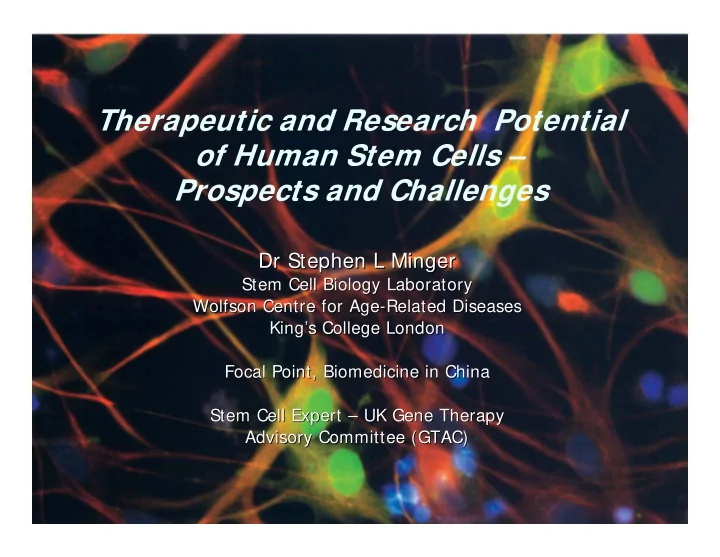
Therapeutic and Research Potential of Human Stem Cells Prospects and Challenges Dr Stephen L Minger Dr Stephen L Minger Stem Cell Biology Laboratory Stem Cell Biology Laboratory Wolfson Centre for Age- -Related Diseases Related


slide-1
SLIDE 1

Therapeutic and Research Potential

  • f Human Stem Cells –

Prospects and Challenges

Dr Stephen L Minger Dr Stephen L Minger

Stem Cell Biology Laboratory Stem Cell Biology Laboratory Wolfson Centre for Age Wolfson Centre for Age-

  • Related Diseases

Related Diseases King King’ ’s College London s College London Focal Point, Biomedicine in China Focal Point, Biomedicine in China Stem Cell Expert Stem Cell Expert – – UK Gene Therapy UK Gene Therapy Advisory Committee (GTAC) Advisory Committee (GTAC)

slide-2
SLIDE 2

Manipulation of Stem Cells for Manipulation of Stem Cells for Research &/or Therapeutic Use Research &/or Therapeutic Use

  • Expansion & Differentiation of Pluripotent

Expansion & Differentiation of Pluripotent Cells for Transplantation Cells for Transplantation

  • Stimulation of Endogenous Tissue

Stimulation of Endogenous Tissue-

  • Specific

Specific Stem/Progenitor Cells for Tissue Repair Stem/Progenitor Cells for Tissue Repair

  • Expansion & Differentiation of Pluripotent

Expansion & Differentiation of Pluripotent Cells for Drug Discovery/Toxicology Cells for Drug Discovery/Toxicology

  • Generation of Disease

Generation of Disease-

  • Specific Pluripotent

Specific Pluripotent Cell Line for Cell Line for “ “Disease in a dish Disease in a dish” ” Modelling Modelling

slide-3
SLIDE 3

Parkinson Parkinson’ ’s Disease and the Brain s Disease and the Brain

slide-4
SLIDE 4

Progressive and sustained improvement in transplant function over ten years in human graft recipient

Piccini et al, 1999, Nature Neurosci, 2

slide-5
SLIDE 5

Stem Cells – Types, Flavours and Sources

Pluripotent Multipotent Multipotent Multipotent

slide-6
SLIDE 6

Cell transplantation Cell transplantation and stem cells: and stem cells: minimal requirements for success minimal requirements for success

  • Stem/progenitor cells must proliferate for extended

Stem/progenitor cells must proliferate for extended periods and generate 100,000,000,000+ s of cells periods and generate 100,000,000,000+ s of cells

  • Stem/progenitor cell phenotype must be stable over time

Stem/progenitor cell phenotype must be stable over time with no loss of cellular potency with no loss of cellular potency

  • Stem/progenitor cells must be capable of generating

Stem/progenitor cells must be capable of generating required cell types upon differentiation required cell types upon differentiation

  • Stem/progenitor cells or their differentiated progeny

Stem/progenitor cells or their differentiated progeny must survive implantation, functionally integrate into must survive implantation, functionally integrate into host adult tissue, evade immune rejection, and provide host adult tissue, evade immune rejection, and provide long long-

  • term therapeutic benefit.

term therapeutic benefit.

slide-7
SLIDE 7

Austin Smith, 2003

slide-8
SLIDE 8

With Good Karma, Embryos, and Culture Conditions, Human ES Cells Can Be Established At Frequency of ~ 10% A, B, Cystic Fibrosis Line (CF-1) C HES Cell Line (WT-4) A B C

C

slide-9
SLIDE 9

Oct-4

β-Tubulin(ectoderm)

Smooth Muscle Actin (mesoderm) Albumin (endoderm)

slide-10
SLIDE 10

ES cells Pluripotent Multipotent Tissue-specific stem cells Neural Stem Cells Pancreatic Stem Cells Bi or Tri- potential Progenitor cells Other Stem Cells

Neurones Oligos Astrocytes

Tissue-specific cell types Insulin Glucagon

Generation of multipotent somatic stem cells from pluripotent embryonic stem cells

slide-11
SLIDE 11

Generation of Differentiated Somatic Cell Generation of Differentiated Somatic Cell Populations from Human ES Cells Populations from Human ES Cells

  • Embryoid Body (EB) Formation

Embryoid Body (EB) Formation

  • Efficient process

Efficient process – – gives rise to many diff cell types gives rise to many diff cell types

  • Very mixed populations (

Very mixed populations ( endo endo-

  • ,

, meso meso-

  • ectoderm)

ectoderm)

  • EB Formation with Defined

EB Formation with Defined Mitogenic Mitogenic Factors Factors

  • Uncertainty as to which factors support cell types of interest

Uncertainty as to which factors support cell types of interest

  • Direct Selection by

Direct Selection by Mitogenic Mitogenic Selection Selection

  • Only cells capable of responding to individual factors should pr

Only cells capable of responding to individual factors should proliferate

  • liferate
  • Co

Co-

  • Culture of

Culture of EBs EBs/ES cells with Somatic Cell Lines /ES cells with Somatic Cell Lines

  • Often requires physical contact/close proximity to target cells

Often requires physical contact/close proximity to target cells

  • Cells often of animal origin and require serum for growth

Cells often of animal origin and require serum for growth

  • Lineage Specification and Selection

Lineage Specification and Selection

  • Requires cell surface antigen unique to cell population of inter

Requires cell surface antigen unique to cell population of interest est

  • Requires knowledge of transcription factors expressed early in d

Requires knowledge of transcription factors expressed early in development of evelopment of target tissue target tissue – – genetic modification and selection genetic modification and selection

  • Requires Selection of Target Population

Requires Selection of Target Population -

  • > Gene Transfer,

> Gene Transfer, FACs FACs, , Immunoselection Immunoselection

slide-12
SLIDE 12

Human Embryoid Bodies – 6 days post-differentiation

slide-13
SLIDE 13

In vitro expression of germ layer markers during differentiation.

0 5 10 15 20 400 250 100 100 75 50 25

WT4

0 5 10 15 20 25 50 75 100 125 150 CF1

WT3

  • 0 5 10 15 20

40 20 50 100 150 200

  • NCAM-1

AFP VEGFR2

Mean fold change in target gene expression (Transcript copy number) Differentiation time (Days) All data are expressed relative to an undifferentiated hES cell and normalised for the GAPDH house-keeping gene. n=5. Bars represent S.E.M.

slide-14
SLIDE 14

Human Neural Stem/Progenitor Cells Derived from Human Embryonic Stem Cells

Taylor and Minger, unpublished

20 40 60 80 100 120 PSA-NCAM Nucleostemin Sox-2 Musashi-1 Neural stem cell marker Mean percentage of immuno- reactive cells (%)

slide-15
SLIDE 15

Generation of Differentiated Somatic Cell Generation of Differentiated Somatic Cell Populations from Human ES Cells Populations from Human ES Cells

  • Embryoid Body (EB) Formation

Embryoid Body (EB) Formation

  • Efficient process

Efficient process – – gives rise to many diff cell types gives rise to many diff cell types

  • Very mixed populations (

Very mixed populations (endo endo-

  • ,

, meso meso-

  • ectoderm)

ectoderm)

  • EB Formation with Defined

EB Formation with Defined Mitogenic Mitogenic Factors Factors

  • Uncertainty as to which factors support cell types of interest

Uncertainty as to which factors support cell types of interest

  • Direct Selection by

Direct Selection by Mitogenic Mitogenic Selection Selection

  • Only cells capable of responding to individual factors should pr

Only cells capable of responding to individual factors should proliferate

  • liferate
  • Co

Co-

  • Culture of

Culture of EBs EBs/ES cells with Somatic Cell Lines /ES cells with Somatic Cell Lines

  • Often requires physical contact/close proximity to target cells

Often requires physical contact/close proximity to target cells

  • Cells often of animal origin and require serum for growth

Cells often of animal origin and require serum for growth

  • Lineage Specification and Selection

Lineage Specification and Selection

  • Requires cell surface antigen unique to cell population of inter

Requires cell surface antigen unique to cell population of interest est

  • Requires knowledge of transcription factors expressed early in

Requires knowledge of transcription factors expressed early in development of target tissue development of target tissue – – genetic modification and selection genetic modification and selection

  • Requires Selection of Target Population

Requires Selection of Target Population -

  • > Gene Transfer,

> Gene Transfer, FACs FACs, , I mmunoselection I mmunoselection

slide-16
SLIDE 16

Neuroepithelial stem cell Dopaminergic Progenitor Cell Post-mitotic differentiating DA neuron Differentiated neuron

Lmx1a Msx1 Aldh1, Lmx1b Ngn2 Nurr-1

En1, En2, Wnt1, Pax2, Pax5 Ptx3 TH, RET Nurr-1, Ptx3, Lmx1b, En1, En2, Aldh1, TH

Gestational week 4 6.5 5

Proposed induction and development of mesencephalic dopaminergic neurons in the human midbrain.

Onset Of DA Neuron Markers During Embryonic Onset Of DA Neuron Markers During Embryonic Development Of Human Midbrain Development Of Human Midbrain

Taylor and Minger, 2005

Sox1

slide-17
SLIDE 17

Timeline for Clinical Translation of PD Cell Therapy

slide-18
SLIDE 18

Human Lineage Human Lineage-

  • Specific

Specific Transcription Factors Transcription Factors

  • Cloned

Cloned

  • Sox 1

Sox 1 neuroectoderm neuroectoderm

  • Olig

Olig 2 2

  • ligodendroglial
  • ligodendroglial
  • Pax

Pax 6 6 retinal & S cord retinal & S cord

  • Nkx

Nkx 2.5 2.5 cardiac cardiac

  • GATA

GATA-

  • 4

4 cardiac cardiac

  • Tbx5

Tbx5 cardiac cardiac

  • Pdx

Pdx-

  • 1

1 pancreatic pancreatic

  • Lmx1b

Lmx1b dopaminergic dopaminergic

  • Lmx1a

Lmx1a dopaminergic dopaminergic

  • Msx1

Msx1 dopaminergic dopaminergic

  • Ptx3

Ptx3 dopaminergic dopaminergic

  • Ngn2

Ngn2 dopaminergic dopaminergic

  • Nurr1

Nurr1 dopaminergic dopaminergic

  • In progress

In progress

  • Hb9

Hb9 motor neuron motor neuron

  • Sox 9

Sox 9 chondrocytes chondrocytes

  • Runx2

Runx2

  • steoblasts
  • steoblasts
  • Pax

Pax 4 4 pancreatic pancreatic

  • Sox 10

Sox 10

  • ligodendroglial
  • ligodendroglial
  • Sox17

Sox17 pancreatic pancreatic

  • FoxJ1

FoxJ1 lung lung

  • GATA6

GATA6 lung lung

  • TITF1

TITF1 lung lung

  • Gsh2

Gsh2 ventral forebrain ventral forebrain

  • Nkx2.1

Nkx2.1 ventral forebrain ventral forebrain

  • ChAT

ChAT cholinergic cholinergic

slide-19
SLIDE 19

Results for undifferentiated cells Results for undifferentiated cells

C-peptide Hoechst Merged image Insulin Hoechst Merged image

Luo, Wu, Jones and Minger, in preparation

slide-20
SLIDE 20

Results for differentiated cells Results for differentiated cells

Glucagon Hoechst Merged image

Luo, Wu, Jones and Minger, in preparation

slide-21
SLIDE 21

Pure Clonal Populations of Highly Expandable Mesoendodermal Progenitor Cells Generated from GATA-4-transduced mES cells

Shatapathy & Minger, unpublished data

slide-22
SLIDE 22

Stem Cell Biology Laboratory Cellular Targets Stem Cell Biology Laboratory Cellular Targets – – Therapy and Drug Discovery Therapy and Drug Discovery

  • CNS Disorders

CNS Disorders

  • Spinal Cord Cell types (McMahon, Bradbury)

Spinal Cord Cell types (McMahon, Bradbury) -

  • traumatic injury, Multiple

traumatic injury, Multiple Sclerosis Sclerosis

  • Dopaminergic Progenitor Cells

Dopaminergic Progenitor Cells -

  • Parkinson

Parkinson’ ’s disease (Duty, Jenner) s disease (Duty, Jenner)

  • Cardiac Regeneration

Cardiac Regeneration

  • Cardiac Progenitor Cells/Endothelial Cells for Heart Failure/Hea

Cardiac Progenitor Cells/Endothelial Cells for Heart Failure/Heart Attack rt Attack (Mathur/Martin & British Collective on Cell Therapy in the Heart (Mathur/Martin & British Collective on Cell Therapy in the Heart) )

  • Retinal Regeneration

Retinal Regeneration

  • Retinal Stem Cells for Macular Degeneration, Retinitis

Retinal Stem Cells for Macular Degeneration, Retinitis Pigmentosa Pigmentosa (Ali, Institute of Ophthalmology) (Ali, Institute of Ophthalmology)

  • Endocrine Disorders

Endocrine Disorders

  • Insulin

Insulin-

  • Producing Islet Cells for Type I Diabetes (Jones,

Producing Islet Cells for Type I Diabetes (Jones, Persaud Persaud & King & King’ ’s s Islet Transplant Programme) Islet Transplant Programme)

  • Hepatic Regeneration

Hepatic Regeneration

  • Hepatic Stem Cells for Hepatic Insufficiency (King

Hepatic Stem Cells for Hepatic Insufficiency (King’ ’s Liver Transplant s Liver Transplant Programme) Programme)

  • Joint and Bone Destruction

Joint and Bone Destruction

  • Chondrocytes for Cartilage Repair (Hollander, Oreffo)

Chondrocytes for Cartilage Repair (Hollander, Oreffo)

  • Osteoblasts

Osteoblasts for Bone Replacement (Grigoriadis) for Bone Replacement (Grigoriadis)

  • Epithelial Cells

Epithelial Cells

  • Lung Differentiation (Novartis)

Lung Differentiation (Novartis)

  • Epithelial Cells for Genetic Skin Disorders (McGrath)

Epithelial Cells for Genetic Skin Disorders (McGrath)

slide-23
SLIDE 23

Developments Required for Therapeutic Developments Required for Therapeutic Application of Human ES Cells Application of Human ES Cells

  • Generation of Animal

Generation of Animal-

  • Free, Chemically Defined

Free, Chemically Defined Culture Conditions Culture Conditions

  • Identification of hES Growth Factors/Small

Identification of hES Growth Factors/Small Molecules Molecules

  • Controlled Differentiation

Controlled Differentiation – –> Generation of > Generation of Specific Cell Populations Specific Cell Populations

  • Testing of Therapeutically Important Cell

Testing of Therapeutically Important Cell Populations in Animal Models Populations in Animal Models – – Relevance to Relevance to Human Clinical Conditions? Human Clinical Conditions?

  • Species Requirements for Safety/Efficacy?

Species Requirements for Safety/Efficacy?

slide-24
SLIDE 24

Developments Required for Therapeutic Developments Required for Therapeutic Application of Human ES Cells Application of Human ES Cells

  • Delivery/Design of Cells for Therapeutic

Delivery/Design of Cells for Therapeutic Applications Applications – – suspension, aggregates, scaffolds suspension, aggregates, scaffolds

  • Immune Response

Immune Response – – Immunosuppression, Immunosuppression, SCNT, hES Cell Banks, Encapsulation, Induction SCNT, hES Cell Banks, Encapsulation, Induction

  • f Tolerance?
  • f Tolerance?
  • Generation of Therapeutic

Generation of Therapeutic-

  • Grade hES

Grade hES Celll Celll Lines Lines – – Will Require Specialised GMP Will Require Specialised GMP-

  • Level Facilities &

Level Facilities & Expertise (King Expertise (King’ ’s s £ £4M 4M – – opening now)

  • pening now)
slide-25
SLIDE 25

Stimulation of Adult Neurogenesis Stimulation of Adult Neurogenesis

  • Goal

Goal

  • Elucidate Mechanisms underlying Ischaemia

Elucidate Mechanisms underlying Ischaemia-

  • Induced

Induced Enhancement of Neurogenesis Enhancement of Neurogenesis

  • Funding

Funding

  • Research into Aging

Research into Aging

  • Alzheimer

Alzheimer’ ’s Research Trust s Research Trust

  • People

People

  • Dr Antigoni Ekonomou

Dr Antigoni Ekonomou

Prof Robert Perry (Newcastle) Prof Robert Perry (Newcastle)

  • Prof Clive Ballard

Prof Clive Ballard Prof Raj Prof Raj Kalaria Kalaria (Newcastle) (Newcastle)

  • Prof Elaine Perry

Prof Elaine Perry Dr Omar Pathmanaban ( Dr Omar Pathmanaban (Manc Manc) )

  • Mr Christos Tolias

Mr Christos Tolias

  • Dr Mike Modo

Dr Mike Modo

  • Dr Manuel Mayr

Dr Manuel Mayr

slide-26
SLIDE 26

Adult Neurogenesis

Human adult brain contains proliferative neural stem cells in dentate gyrus and lateral ventricle wall (SVZ) that generate new neurons throughout life

Eriksson et al, 1998, Nature Med, 4, 1313

slide-27
SLIDE 27

Regulators of Adult Neurogenesis Regulators of Adult Neurogenesis

  • Positive

Positive

  • Enriched Environment

Enriched Environment

  • Physical Activity (e.g. Running)

Physical Activity (e.g. Running)

  • Antidepressants

Antidepressants

  • Caloric Restriction

Caloric Restriction

  • Learning

Learning

  • Stroke (experimental)

Stroke (experimental)

  • Pregnancy (

Pregnancy (Prolactin Prolactin) )

  • Inflammatory Blockade (NSAIDS)

Inflammatory Blockade (NSAIDS)

  • VEGF, G

VEGF, G-

  • CSF, NO, SCF

CSF, NO, SCF

  • Statins (Anti

Statins (Anti-

  • lipids)

lipids)

  • Lithium

Lithium

  • Negative

Negative

  • Opiates

Opiates

  • Methamphetamine

Methamphetamine

  • Seizures

Seizures

  • Aging

Aging

  • Stress (

Stress (Glucocorticoids Glucocorticoids) )

  • Serotonin Depletion

Serotonin Depletion

  • Nitric Oxide

Nitric Oxide

  • Inflammation

Inflammation

  • Interleukin

Interleukin-

  • 6 (from activated

6 (from activated microglia) microglia)

  • Irradiation

Irradiation

  • Nicotine

Nicotine

slide-28
SLIDE 28

Minger et al, 2007

slide-29
SLIDE 29

Ekonomou et al, submitted

Ischaemia-induced Proliferation and Migration of Neural Stem/Progenitor Cells into Region of Vascular Damage

slide-30
SLIDE 30

Adult Human SVZ Neural Progenitor Cells

slide-31
SLIDE 31

Generation of Disease Generation of Disease-

  • Specific

Specific Human ES Cell Lines Human ES Cell Lines

  • Use of PGD Embryos with Genetic Lesions (CF, HD)

Use of PGD Embryos with Genetic Lesions (CF, HD)

  • Prof Peter Braude

Prof Peter Braude

  • Emma Stephenson

Emma Stephenson

  • Sara Hall

Sara Hall

  • Glenda Cornwall

Glenda Cornwall

  • Funded by Medical Research Council

Funded by Medical Research Council

  • Knock

Knock-

  • in of Disease Genes using Homologous

in of Disease Genes using Homologous Recombination (HD) Recombination (HD)

  • Prof Gillian Bates

Prof Gillian Bates

  • Dr Liza Sutton

Dr Liza Sutton

  • Eva Sirinathsinghji

Eva Sirinathsinghji

  • Dr Stefanie Gogel

Dr Stefanie Gogel

  • Funded by the High Q Foundation and Huntington

Funded by the High Q Foundation and Huntington’ ’s Disease s Disease Association Association

slide-32
SLIDE 32

Eggs from cow

  • varies

Nucleus removed Human skin cell Enucleated egg Nuclear transfer Stimulus for egg to divide Cell division Day 3 Day 6 Embryonic stem cell culture Colony of embryonic stem cells

Schematic representation of procedure for deriving stem cells from human “admixed” embryos

Inner cell mass (source of stem cells)

slide-33
SLIDE 33

Induction of induced Pluripotent Stem (iPS) Cells from Adult Human Dermal Fibroblasts Requires Retroviral-Mediated Gene Transfer of: n-Myc Oct-4 Sox2 Klf4

Takahashi et al., (2007) Cell 131, 861-872

slide-34
SLIDE 34

SCNT/iPS hES Cell Lines SCNT/iPS hES Cell Lines

  • Use fibroblasts from patients with FAD, SMA,

Use fibroblasts from patients with FAD, SMA, ApoE ApoE ε

ε4+ /

4+ / ε

ε4+ and genetic forms of PD, MND,

4+ and genetic forms of PD, MND, FTD FTD

  • Clone cells into non

Clone cells into non-

  • human oocytes & iPS

human oocytes & iPS

  • Generate cloned hES cell lines

Generate cloned hES cell lines

  • Differentiate hES cells

Differentiate hES cells -

  • > disease

> disease-

  • specific

specific selectively vulnerable neural populations selectively vulnerable neural populations

  • Establish

Establish “ “disease in a dish disease in a dish” ” cellular models cellular models

slide-35
SLIDE 35

Strengths of UK Stem Cell Research Strengths of UK Stem Cell Research

  • World

World-

  • class academic research centres

class academic research centres

  • Tight regulation on Assisted Reproduction & Human

Tight regulation on Assisted Reproduction & Human Embryo Research by HFEA Embryo Research by HFEA

  • Government Commitment to Stem Cell Research (~

Government Commitment to Stem Cell Research (~ £ £45 45 million million – – 2003 2003-

  • 2004);

2004); £ £350 350-

  • 800 million 10

800 million 10-

  • year strategy

year strategy from Chancellor from Chancellor’ ’s Office announced Dec 2005 s Office announced Dec 2005

  • Government Funded UK Stem Cell Bank for foetal, adult

Government Funded UK Stem Cell Bank for foetal, adult & embryonic human stem cell lines & embryonic human stem cell lines

  • London Regenerative Medicine Network

London Regenerative Medicine Network – – drive towards drive towards clinical applications clinical applications

  • UK Stem Cell Network

UK Stem Cell Network – – integration of all UK regional integration of all UK regional network network

slide-36
SLIDE 36

Stem Cell Biology Lab Stem Cell Biology Lab

  • Antigoni Ekonomou

Antigoni Ekonomou

  • Yue Wu

Yue Wu

  • Sarah Pringle

Sarah Pringle

  • Miriam Gubernator

Miriam Gubernator

  • Chetan Shatapathy

Chetan Shatapathy

  • Noor Almaani

Noor Almaani

  • Liza Sutton

Liza Sutton

  • SH Cedar

SH Cedar

  • Katerina Varanou

Katerina Varanou

  • Alyma Somani

Alyma Somani

  • Sarah Hardwick

Sarah Hardwick

  • Stephanie Gogel

Stephanie Gogel

  • Omar Pathmanaban

Omar Pathmanaban

  • Sara Hall

Sara Hall

  • Hannah Taylor

Hannah Taylor

  • Daniel Webber

Daniel Webber

  • Zhenling

Zhenling Luo Luo

  • Minal

Minal Patel Patel

  • Jessica Cooke

Jessica Cooke

  • Julie Ghosh

Julie Ghosh

  • Niloufar Safinia

Niloufar Safinia

slide-37
SLIDE 37

Stem Cell Biology Laboratory Collaborators Stem Cell Biology Laboratory Collaborators

Human ES Cells Human ES Cells

Peter Braude Peter Braude Sara Hall Sara Hall Glenda Cornwall Glenda Cornwall Emma Stephenson Emma Stephenson

Spinal Cord Repair Spinal Cord Repair

Steve McMahon Steve McMahon Liz Bradbury Liz Bradbury Paul Felts Paul Felts Merion Davies Merion Davies

Retinal Regeneration Retinal Regeneration

Robin Ali (UCL/ Robin Ali (UCL/ Moorfields Moorfields) )

Pancreatic I slet Cells Pancreatic I slet Cells

Peter Jones Peter Jones Shanta Shanta Persaud Persaud

Parkinson Parkinson’ ’s Disease s Disease

Peter Jenner Peter Jenner Susan Duty Susan Duty

Tooth Replacement Tooth Replacement

Paul Sharpe Paul Sharpe

Neural Differentiation Neural Differentiation

Jonathan Corcoran Jonathan Corcoran Bia Bia Gonclaves Gonclaves

iNANO (Aarhus) iNANO (Aarhus)

Morten Foss Morten Foss Mogens Duch Mogens Duch

Medical Research Council, Mrs Lily Safra, BBSRC, ESRC, EPSRC, Medical Research Council, Mrs Lily Safra, BBSRC, ESRC, EPSRC, European Commission, Oliver Bird Foundation, UK DTI , European Commission, Oliver Bird Foundation, UK DTI , Francesca Patrizi, Francesca Patrizi, High Q Foundation, Wellcome Trust, Huntington High Q Foundation, Wellcome Trust, Huntington’ ’s Disease Society s Disease Society, John & , John & Helen Robertson, Helen Robertson, Alzheimer Alzheimer’ ’s Research Trust, Liz & John Hancock, Guy s Research Trust, Liz & John Hancock, Guy’ ’s & St Thomas s & St Thomas’ ’ Charitable Trust Charitable Trust Adult Neurogenesis Adult Neurogenesis

Clive Ballard Clive Ballard Omar Pathmanaban Omar Pathmanaban Manuel Mayr Manuel Mayr Christos Tolias Christos Tolias Elaine Perry (Newcastle) Elaine Perry (Newcastle) Robert Perry (Newcastle) Robert Perry (Newcastle)

Vascular Development Vascular Development

Karen Hirschi (Baylor) Karen Hirschi (Baylor) Qingbo Xu Qingbo Xu

Blood Stem Cells Blood Stem Cells

Paul Fairchild (Oxford) Paul Fairchild (Oxford) Karl Karlsson (Oxford) Karl Karlsson (Oxford)

Lung Differentiation Lung Differentiation

Carol Jones (Novartis) Carol Jones (Novartis) Phil Kemp (Novartis) Phil Kemp (Novartis)

Bioethics & Politics Bioethics & Politics

Claire Williams Claire Williams Steve Steve Wainright Wainright Sarah Franklin (LSE) Sarah Franklin (LSE) Brian Salter (Norwich) Brian Salter (Norwich) Herbert Gottweis (Vienna) Herbert Gottweis (Vienna)

Electrophysiology Electrophysiology

Reginald Docherty Reginald Docherty

Cardiac Repair Cardiac Repair

Anthony Mathur ( Anthony Mathur (Barts Barts) ) Ken Suzuki ( Ken Suzuki (Barts Barts) )

Proteomics Proteomics

Tony Ng Tony Ng Simon Simon Ameer Ameer-

  • Beg

Beg Manuel Mayr Manuel Mayr

Huntington Huntington’ ’s Disease s Disease

Gillian Bates Gillian Bates Eva Sirinathsinghji Eva Sirinathsinghji Liza Sutton Liza Sutton

Hepatic Stem Cells Hepatic Stem Cells

Anill Anill Dhawan Dhawan Robin Hughes Robin Hughes Ragai Mitry Ragai Mitry

Joint and Bone Joint and Bone Development Development

Agi Grigoriadis Agi Grigoriadis

Skin Differentiation Skin Differentiation

John McGrath Noor Almaani

Lentivirus Lentivirus Production Production

Adrian Thrasher (GOSH) Adrian Thrasher (GOSH)