What are Stem Cells? How can they be used in medicine? What is a - - PowerPoint PPT Presentation

what are stem cells how can they be used in
SMART_READER_LITE
LIVE PREVIEW

What are Stem Cells? How can they be used in medicine? What is a - - PowerPoint PPT Presentation

What are Stem Cells? How can they be used in medicine? What is a stem cell????........ What is a stem cell????........ .....a cell with the ability to differentiate into specialized cells and renew to become more stem cells THE BUILDING BLOCKS


slide-1
SLIDE 1

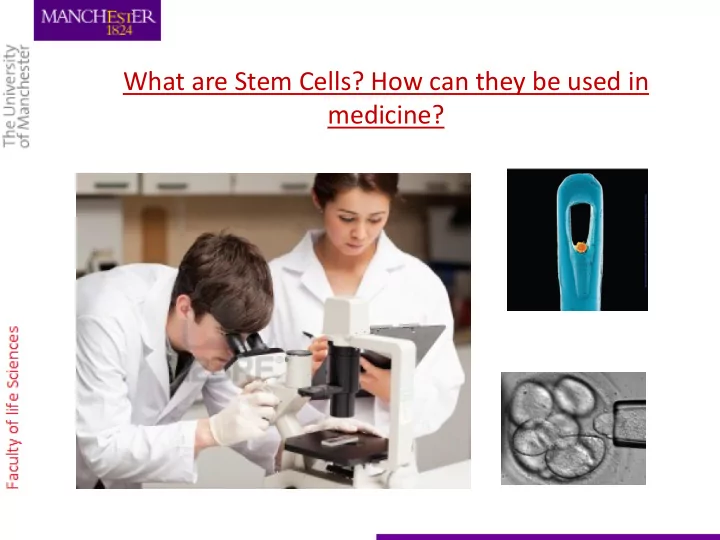
What are Stem Cells? How can they be used in medicine?

slide-2
SLIDE 2

What is a stem cell????........

slide-3
SLIDE 3

What is a stem cell????........

.....a cell with the ability to differentiate into specialized cells and renew to become more stem cells THE BUILDING BLOCKS OF LIFE

slide-4
SLIDE 4

What is a stem cell????........

  • what are the two major different

types of stem cells and how are they different?

ADULT STEM CELLS

  • multipotent= ability to produce a few types of

specialized cells EMBRYONIC STEM CELLS

  • pluripotent= ability to produce all cell types of the

human body (but not a whole new organism)

slide-5
SLIDE 5

Can you think of any places in the body where we might have stem cells?

How about.....

  • in the skin?
  • hair follicles?
  • bone marrow?
  • ...and many many more!
slide-6
SLIDE 6

TASK ONE: LISTEN TO THE FOLLOWING CLIP AND SEE IF YOU CAN COMPLETE THE EXERCISE ON YOUR WORKSHEET What are stem cells and how can stem cells be

used in medicine?

0:19-3:30

slide-7
SLIDE 7

TASK ONE: Fill in the blanks, using the audio clip:

WORDS TO CHOOSE FROM- use these to help you fill

in the blanks on your worksheet

  • 2
  • 200
  • ADULT
  • ADULT
  • BLOOD
  • BONE MARROW
  • CANCERS
  • CANCERS
  • DEVELOPMENT
  • DIFFERENT
  • DISEASE
  • DRUGS
  • EMBRYONIC
  • EMBRYONIC
  • IVF
  • SOME
  • STEM CELLS
  • STEM CELLS
slide-8
SLIDE 8

TASK ONE-ANSWERS

WHAT IS A STEM CELL?

  • The human body is composed of over 200 cell types such as skin cells, heart cells etc.

It also houses cells called STEM CELLS. These cells are special because they can do two things: make more STEM CELLS and make DIFFERENT cell types. ARE THERE MANY KINDS OF STEM CELLS?

  • There are 2 main different types of stem cells. These are ADULT and EMBRYONIC

stem cells. EMBRYONIC stem cells can produce all cell types, whereas ADULT stem cells can only produce SOME cell types and are therefore more limited. Embryonic stem cells are sourced from left over embryos from IVF treatments. These can be used to evaluate DISEASE and DEVELOPMENT in the laboratory. HOW DO DOCTORS USE STEM CELLS?

  • ADULT stem cells have been used for years to treat cancers and rare blood diseases.

Stem cells can be taken from the BONE MARROW to treat CANCERS. As well as being used to treat patients directly, stem cells can be used by doctors to understand disease and used to discover and test new DRUGS.

DID YOU GET THE ANSWERS RIGHT?

slide-9
SLIDE 9

TASK TWO:

WATCH THE FOLLOWING VIDEO AND DECIDE WHICH ARE THE CORRECT ANSWERS TO THE QUESTIONS ON YOUR WORKSHEET

http://www.youtube.com/watch?v=2-3J6JGN-_Y&feature=g- list&list=PLMaNlhHedsI-NJwiWO1bKA5e7xiF5aimI

slide-10
SLIDE 10

TASK TWO- ANSWERS

PAGE 1

  • 1. Why are stem cells called a ‘reservoir’?
  • A. Because they can replace the specialized cells that die/get

used up in our body

  • 2. Why are stem cells important in the blood system?
  • A. Because we need to produce millions of blood cells every day
  • 3. Where can blood stem cells be found in the body?
  • A. In the bone marrow
  • 4. Can stem cells be found in the brain?
  • A. Yes
  • 5. What is the decision a stem cell must make every time it divides?
  • A. All of the above
  • 6. What specialized cells can a skin stem cell make?
  • A. Skin cells
slide-11
SLIDE 11

TASK TWO- ANSWERS

PAGE 2

  • 7. When using stem cells to treat burns, what do the stem cells actually

produce?

  • A. The outermost layer of the skin (epidermis layer)
  • 8. How can stem cells treat leukemia?
  • A. Transplant of blood stem cells into patient
  • 9. What makes embryonic stem cells different to adult stem cells?
  • A. They can give rise to all cells of the body
  • 10. What can neural stem cells make?
  • A. Cells of the brain
  • 11. How could stem cells be used to treat diabetes?
  • A. Produce insulin making cells that can be transplanted into patient
  • 12. What is the role of stem cells in our bodies?
  • A. Produce specialized cells to replace cells that are used up or

damaged due to disease/injury

slide-12
SLIDE 12

TASK THREE: can you match the following stem cell related words with their definitions?

BONE MARROW TRANSPLANT IN-VITRO FERTILISATION(IVF) DIFFERENTIATION DIABETES CANCER SELF-RENEWAL ADULT STEM CELLS EMBRYONIC STEM CELLS REGENERATIVE MEDICINE DRUG TESTING PARKINSON’S DISEASE

slide-13
SLIDE 13

TASK THREE- ANSWERS

BONE MARROW TRANSPLANT:

  • A. A procedure where stem cells are taken from the bone marrow (either of the

patient themselves or a donor) and transplanted into the patient to replace faulty blood cells. This is a very successful procedure to treat diseases such as leukaemia. CANCER:

  • A. A disease characterised as unregulated cell growth in the body. Stem cell

therapies are a method used to overcome this disease. EMBRYONIC STEM CELLS:

  • A. Undifferentiated cells that have the potential to differentiate into any cell of

the body. This is very useful in regenerative medicine because they provide a source of cells that can become the cell type required on demand. DIFFERENTIATION:

  • A. The process by which an unspecialized stem cell acquires the features of a

specialized cell; such as a skin cell, muscle cell etc.

slide-14
SLIDE 14

TASK THREE- ANSWERS

DIABETES:

  • A. Disease caused by the destruction of specialized cells of the pancreas that

produce insulin (beta cells). Characterised by a lack of insulin leading to abnormally high levels of glucose in the blood. Methods using stem cells could

  • ne day be used to treat the disease by producing these beta cells.

IN-VITRO FERTILISATION (IVF):

  • A. A process where an egg is fertilised outside the body. Embryos that are

produced by this process and that are not used can be donated to stem cell

  • research. This presents an extremely valuable source of embryonic stem cells

for research into drug testing, development and tissue regeneration. SELF-RENEWAL:

  • A. The ability of a stem cell to divide to produce more undifferentiated stem cells.

This ensures that a stem cell population is maintained within the body. ADULT STEM CELLS:

  • A. Undifferentiated cells that have the potential to differentiate into a number of

cell types of the body. Their main use in the body is to regenerate damaged cells

  • r tissues in times of disease/injury.
slide-15
SLIDE 15

TASK THREE- ANSWERS

REGENERATIVE MEDICINE:

  • A. The process of replacing cells or tissues in order to restore normal function

to the body. This process usually makes use of stem cells. DRUG TESTING:

  • A. The use of stem cells for toxicity screening of medicines in early

development stages. This allows scientists to determine whether medicines have any harmful side-effects before they are produced for mass use. This method could reduce the need for animal testing. PARKINSON’S DISEASE:

  • A. A disorder that occurs because of damage to dopamine producing nerve

cells in the brain, causing the individual to twitch uncontrollably. Stem cell research may provide the answer towards treating the disorder by replacing these cells.

DID YOU GET THE ANSWERS RIGHT?

slide-16
SLIDE 16

All that’s left for me to say is a big....

....for all your hard work and attention today!!!! Hope you found it interesting 