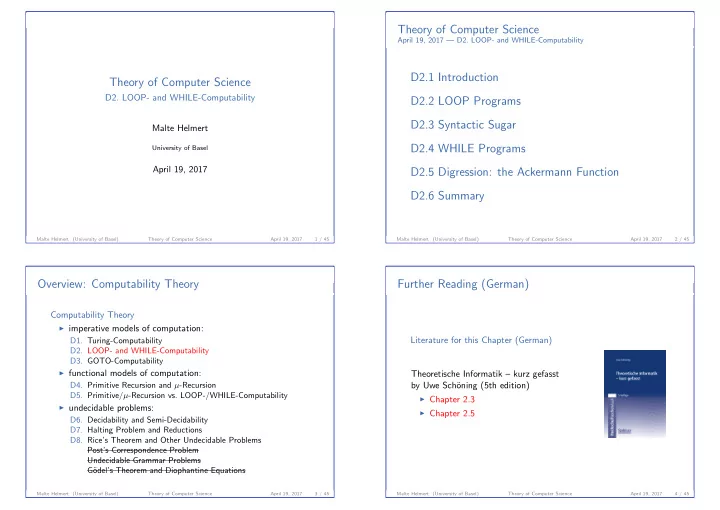
Theory of Computer Science April 19, 2017 D2. LOOP- and - - PowerPoint PPT Presentation

theory of computer science
SMART_READER_LITE
LIVE PREVIEW

Theory of Computer Science April 19, 2017 D2. LOOP- and - - PowerPoint PPT Presentation

Theory of Computer Science April 19, 2017 D2. LOOP- and WHILE-Computability D2.1 Introduction Theory of Computer Science D2. LOOP- and WHILE-Computability D2.2 LOOP Programs D2.3 Syntactic Sugar Malte Helmert D2.4 WHILE Programs


slide-1
SLIDE 1

Theory of Computer Science

  • D2. LOOP- and WHILE-Computability

Malte Helmert

University of Basel

April 19, 2017

Malte Helmert (University of Basel) Theory of Computer Science April 19, 2017 1 / 45

Theory of Computer Science

April 19, 2017 — D2. LOOP- and WHILE-Computability

D2.1 Introduction D2.2 LOOP Programs D2.3 Syntactic Sugar D2.4 WHILE Programs D2.5 Digression: the Ackermann Function D2.6 Summary

Malte Helmert (University of Basel) Theory of Computer Science April 19, 2017 2 / 45

Overview: Computability Theory

Computability Theory

◮ imperative models of computation:

  • D1. Turing-Computability
  • D2. LOOP- and WHILE-Computability
  • D3. GOTO-Computability

◮ functional models of computation:

  • D4. Primitive Recursion and µ-Recursion
  • D5. Primitive/µ-Recursion vs. LOOP-/WHILE-Computability

◮ undecidable problems:

  • D6. Decidability and Semi-Decidability
  • D7. Halting Problem and Reductions
  • D8. Rice’s Theorem and Other Undecidable Problems

Post’s Correspondence Problem Undecidable Grammar Problems G¨

  • del’s Theorem and Diophantine Equations

Malte Helmert (University of Basel) Theory of Computer Science April 19, 2017 3 / 45

Further Reading (German)

Literature for this Chapter (German) Theoretische Informatik – kurz gefasst by Uwe Sch¨

  • ning (5th edition)

◮ Chapter 2.3 ◮ Chapter 2.5

Malte Helmert (University of Basel) Theory of Computer Science April 19, 2017 4 / 45

slide-2
SLIDE 2

Further Reading (English)

Literature for this Chapter (English) Introduction to the Theory of Computation by Michael Sipser (3rd edition)

◮ This topic is not discussed by Sipser!

Malte Helmert (University of Basel) Theory of Computer Science April 19, 2017 5 / 45

  • D2. LOOP- and WHILE-Computability

Introduction

D2.1 Introduction

Malte Helmert (University of Basel) Theory of Computer Science April 19, 2017 6 / 45

  • D2. LOOP- and WHILE-Computability

Introduction

Formal Models of Computation: LOOP/WHILE/GOTO

Formal Models of Computation

◮ Turing machines ◮ LOOP, WHILE and GOTO programs ◮ primitive recursive and µ-recursive functions

In this and the following chapter we get to know three simple models of computation (programming languages) and compare their power to Turing machines:

◮ LOOP programs today ◮ WHILE programs today ◮ GOTO programs next chapter

Malte Helmert (University of Basel) Theory of Computer Science April 19, 2017 7 / 45

  • D2. LOOP- and WHILE-Computability

Introduction

LOOP, WHILE and GOTO Programs: Basic Concepts

◮ LOOP, WHILE and GOTO programs are structured like

programs in (simple) “traditional” programming languages

◮ use finitely many variables from the set {x0, x1, x2, . . . }

that can take on values in N0

◮ differ from each other in the allowed “statements”

Malte Helmert (University of Basel) Theory of Computer Science April 19, 2017 8 / 45

slide-3
SLIDE 3
  • D2. LOOP- and WHILE-Computability

LOOP Programs

D2.2 LOOP Programs

Malte Helmert (University of Basel) Theory of Computer Science April 19, 2017 9 / 45

  • D2. LOOP- and WHILE-Computability

LOOP Programs

LOOP Programs: Syntax

Definition (LOOP Program) LOOP programs are inductively defined as follows:

◮ xi := xj + c is a LOOP program

for every i, j, c ∈ N0 (addition)

◮ xi := xj − c is a LOOP program

for every i, j, c ∈ N0 (modified subtraction)

◮ If P1 and P2 are LOOP programs,

then so is P1;P2 (composition)

◮ If P is a LOOP program, then so is

LOOP xi DO P END for every i ∈ N0 (LOOP loop) German: LOOP-Programm, Addition, modifizierte Subtraktion, Komposition, LOOP-Schleife

Malte Helmert (University of Basel) Theory of Computer Science April 19, 2017 10 / 45

  • D2. LOOP- and WHILE-Computability

LOOP Programs

LOOP Programs: Semantics

Definition (Semantics of LOOP Programs) A LOOP program computes a k-ary function f : Nk

0 → N0. The computation of f (n1, . . . , nk) works as follows:

1 Initially, the variables x1, . . . , xk hold the values n1, . . . , nk.

All other variables hold the value 0.

2 During computation, the program modifies the variables

as described on the following slides.

3 The result of the computation (f (n1, . . . , nk)) is

the value of x0 after the execution of the program. German: P berechnet f

Malte Helmert (University of Basel) Theory of Computer Science April 19, 2017 11 / 45

  • D2. LOOP- and WHILE-Computability

LOOP Programs

LOOP Programs: Semantics

Definition (Semantics of LOOP Programs) effect of xi := xj + c:

◮ The variable xi is assigned the current value of xj plus c. ◮ All other variables retain their value.

German: P berechnet f

Malte Helmert (University of Basel) Theory of Computer Science April 19, 2017 12 / 45

slide-4
SLIDE 4
  • D2. LOOP- and WHILE-Computability

LOOP Programs

LOOP Programs: Semantics

Definition (Semantics of LOOP Programs) effect of xi := xj − c:

◮ The variable xi is assigned the current value of xj minus c

if this value is non-negative.

◮ Otherwise xi is assigned the value 0. ◮ All other variables retain their value.

German: P berechnet f

Malte Helmert (University of Basel) Theory of Computer Science April 19, 2017 13 / 45

  • D2. LOOP- and WHILE-Computability

LOOP Programs

LOOP Programs: Semantics

Definition (Semantics of LOOP Programs) effect of P1; P2:

◮ First, execute P1.

Then, execute P2 (on the modified variable values). German: P berechnet f

Malte Helmert (University of Basel) Theory of Computer Science April 19, 2017 14 / 45

  • D2. LOOP- and WHILE-Computability

LOOP Programs

LOOP Programs: Semantics

Definition (Semantics of LOOP Programs) effect of LOOP xi DO P END:

◮ Let m be the value of variable xi at the start of execution. ◮ The program P is executed m times in sequence.

German: P berechnet f

Malte Helmert (University of Basel) Theory of Computer Science April 19, 2017 15 / 45

  • D2. LOOP- and WHILE-Computability

LOOP Programs

LOOP-Computable Functions

Definition (LOOP-Computable) A function f : Nk

0 →p N0 is called LOOP-computable

if a LOOP program that computes f exists. German: f ist LOOP-berechenbar Note: non-total functions are never LOOP-computable. (Why not?)

Malte Helmert (University of Basel) Theory of Computer Science April 19, 2017 16 / 45

slide-5
SLIDE 5
  • D2. LOOP- and WHILE-Computability

LOOP Programs

LOOP Programs: Example

Example (LOOP program for f (x1, x2)) LOOP x1 DO LOOP x2 DO x0 := x0 + 1 END END Which (binary) function does this program compute?

Malte Helmert (University of Basel) Theory of Computer Science April 19, 2017 17 / 45

  • D2. LOOP- and WHILE-Computability

Syntactic Sugar

D2.3 Syntactic Sugar

Malte Helmert (University of Basel) Theory of Computer Science April 19, 2017 18 / 45

  • D2. LOOP- and WHILE-Computability

Syntactic Sugar

Syntactic Sugar or Essential Feature?

◮ We investigate the power of programming languages

and other computation formalisms.

◮ Rich language features help when writing complex programs. ◮ Minimalistic formalisms are useful for proving statements

  • ver all programs.

conflict of interest! Idea:

◮ Use minimalistic core for proofs. ◮ Use syntactic sugar when writing programs.

German: syntaktischer Zucker

Malte Helmert (University of Basel) Theory of Computer Science April 19, 2017 19 / 45

  • D2. LOOP- and WHILE-Computability

Syntactic Sugar

Example: Syntactic Sugar

Example (syntactic sugar) We propose five new syntax constructs (with the obvious semantics):

◮ xi := xj for i, j ∈ N0 ◮ xi := c for i, c ∈ N0 ◮ xi := xj + xk for i, j, k ∈ N0 ◮ IF xi = 0 THEN P END for i ∈ N0 ◮ IF xi = c THEN P END for i, c ∈ N0

Can we simulate these with the existing constructs?

Malte Helmert (University of Basel) Theory of Computer Science April 19, 2017 20 / 45

slide-6
SLIDE 6
  • D2. LOOP- and WHILE-Computability

Syntactic Sugar

Example: Syntactic Sugar

Example (syntactic sugar) xi := xj for i, j ∈ N0 Simple abbreviation for xi := xj + 0.

Malte Helmert (University of Basel) Theory of Computer Science April 19, 2017 21 / 45

  • D2. LOOP- and WHILE-Computability

Syntactic Sugar

Example: Syntactic Sugar

Example (syntactic sugar) xi := c for i, c ∈ N0 Simple abbreviation for xi := xj + c, where xj is a fresh variable, i.e., an otherwise unused variable that is not an input variable. (Thus xj must always have the value 0 in all executions.)

Malte Helmert (University of Basel) Theory of Computer Science April 19, 2017 22 / 45

  • D2. LOOP- and WHILE-Computability

Syntactic Sugar

Example: Syntactic Sugar

Example (syntactic sugar) xi := xj + xk for i, j, k ∈ N0 Abbreviation for: xi := xj; LOOP xk DO xi := xi + 1 END Analogously we will also use the following:

◮ xi := xj − xk ◮ xi := xj + xk − c − xm + d ◮ etc.

Malte Helmert (University of Basel) Theory of Computer Science April 19, 2017 23 / 45

  • D2. LOOP- and WHILE-Computability

Syntactic Sugar

Example: Syntactic Sugar

Example (syntactic sugar) IF xi = 0 THEN P END for i ∈ N0 Abbreviation for: xj := 0; LOOP xi DO xj := 1 END; LOOP xj DO P END where xj is a fresh variable.

Malte Helmert (University of Basel) Theory of Computer Science April 19, 2017 24 / 45

slide-7
SLIDE 7
  • D2. LOOP- and WHILE-Computability

Syntactic Sugar

Example: Syntactic Sugar

Example (syntactic sugar) IF xi = c THEN P END for i, c ∈ N0 Abbreviation for: xj := 1; xk := xi − c; IF xk = 0 THEN xj := 0 END; xk := c − xi; IF xk = 0 THEN xj := 0 END; IF xj = 0 THEN P END where xj and xk are fresh variables.

Malte Helmert (University of Basel) Theory of Computer Science April 19, 2017 25 / 45

  • D2. LOOP- and WHILE-Computability

Syntactic Sugar

Can We Be More Minimalistic?

◮ We see that some common structural elements such as IF

statements are unnecessary because they are syntactic sugar.

◮ Can we make LOOP programs even more minimalistic

than in our definition? Simplification 1 Instead of xi := xj + c and xi := xj − c it suffices to only allow the constructs

◮ xi := xj, ◮ xi := xi + 1 and ◮ xi := xi − 1.

Why?

Malte Helmert (University of Basel) Theory of Computer Science April 19, 2017 26 / 45

  • D2. LOOP- and WHILE-Computability

Syntactic Sugar

Can We Be More Minimalistic?

◮ We see that some common structural elements such as IF

statements are unnecessary because they are syntactic sugar.

◮ Can we make LOOP programs even more minimalistic

than in our definition? Simplification 2 The construct xi := xj can be omitted because it can be simulated with other constructs: LOOP xi DO xi := xi − 1 END; LOOP xj DO xi := xi + 1 END

Malte Helmert (University of Basel) Theory of Computer Science April 19, 2017 27 / 45

  • D2. LOOP- and WHILE-Computability

WHILE Programs

D2.4 WHILE Programs

Malte Helmert (University of Basel) Theory of Computer Science April 19, 2017 28 / 45

slide-8
SLIDE 8
  • D2. LOOP- and WHILE-Computability

WHILE Programs

WHILE Programs: Syntax

Definition (WHILE Program) WHILE programs are inductively defined as follows:

◮ xi := xj + c is a WHILE program

for every i, j, c ∈ N0 (addition)

◮ xi := xj − c is a WHILE program

for every i, j, c ∈ N0 (modified subtraction)

◮ If P1 and P2 are WHILE programs,

then so is P1;P2 (composition)

◮ If P is a WHILE program, then so is

WHILE xi = 0 DO P END for every i ∈ N0 (WHILE loop) German: WHILE-Programm, WHILE-Schleife

Malte Helmert (University of Basel) Theory of Computer Science April 19, 2017 29 / 45

  • D2. LOOP- and WHILE-Computability

WHILE Programs

WHILE Programs: Semantics

Definition (Semantics of WHILE Programs) The semantics of WHILE programs is defined exactly as for LOOP programs. effect of WHILE xi = 0 DO P END:

◮ If xi holds the value 0, program execution finishes. ◮ Otherwise execute P. ◮ Repeat these steps until execution finishes

(potentially infinitely often).

Malte Helmert (University of Basel) Theory of Computer Science April 19, 2017 30 / 45

  • D2. LOOP- and WHILE-Computability

WHILE Programs

WHILE-Computable Functions

Definition (WHILE-Computable) A function f : Nk

0 →p N0 is called WHILE-computable

if a WHILE program that computes f exists. German: f ist WHILE-berechenbar

Malte Helmert (University of Basel) Theory of Computer Science April 19, 2017 31 / 45

  • D2. LOOP- and WHILE-Computability

WHILE Programs

WHILE-Computability vs. LOOP-Computability

Theorem Every LOOP-computable function is WHILE-computable. The converse is not true. WHILE programs are therefore strictly more powerful than LOOP programs. German: echt m¨ achtiger

Malte Helmert (University of Basel) Theory of Computer Science April 19, 2017 32 / 45

slide-9
SLIDE 9
  • D2. LOOP- and WHILE-Computability

WHILE Programs

WHILE-Computability vs. LOOP-Computability

Proof. Part 1: Every LOOP-computable function is WHILE-computable. Given any LOOP program, we construct an equivalent WHILE program, i. e., one computing the same function. To do so, replace each occurrence of LOOP xi DO P END with xj := xi; WHILE xj = 0 DO xj := xj − 1; P END where xj is a fresh variable. . . .

Malte Helmert (University of Basel) Theory of Computer Science April 19, 2017 33 / 45

  • D2. LOOP- and WHILE-Computability

WHILE Programs

WHILE-Computability vs. LOOP-Computability

Proof (continued). Part 2: Not all WHILE-computable functions are LOOP-computable. The WHILE program x1 := 1; WHILE x1 = 0 DO x1 := 1 END computes the function Ω : N0 →p N0 that is undefined everywhere. Ω is hence WHILE-computable, but not LOOP-computable (because LOOP-computable functions are always total).

Malte Helmert (University of Basel) Theory of Computer Science April 19, 2017 34 / 45

  • D2. LOOP- and WHILE-Computability

Digression: the Ackermann Function

D2.5 Digression: the Ackermann Function

Malte Helmert (University of Basel) Theory of Computer Science April 19, 2017 35 / 45

  • D2. LOOP- and WHILE-Computability

Digression: the Ackermann Function

LOOP vs. WHILE: Is There a Practical Difference?

◮ We have shown that WHILE programs

are strictly more powerful than LOOP programs.

◮ The example we used is not very relevant in practice

because our argument only relied on the fact that LOOP-computable functions are always total.

◮ To terminate for every input is not much of a problem

in practice. (Quite the opposite.)

◮ Are there any total functions that are WHILE-computable,

but not LOOP-computable?

Malte Helmert (University of Basel) Theory of Computer Science April 19, 2017 36 / 45

slide-10
SLIDE 10
  • D2. LOOP- and WHILE-Computability

Digression: the Ackermann Function

Ackermann Function: History

◮ David Hilbert conjectured that all computable

total functions are primitive recursive (1926).

We will see what this means in Chapter D4.

◮ Wilhelm Ackermann refuted the conjecture

by supplying a counterexample (1928).

◮ The counterexample was simplified by R´

  • zsa P´

eter (1935). here: simplified version

Malte Helmert (University of Basel) Theory of Computer Science April 19, 2017 37 / 45

  • D2. LOOP- and WHILE-Computability

Digression: the Ackermann Function

Ackermann Function

Definition (Ackermann function) The Ackermann function a : N2

0 → N0 is defined as follows:

a(0, y) = y + 1 for all y ≥ 0 a(x, 0) = a(x − 1, 1) for all x > 0 a(x, y) = a(x − 1, a(x, y − 1)) for all x, y > 0 German: Ackermannfunktion Note: the recursion in the definition is bounded, so this defines a total function. (Why?)

Malte Helmert (University of Basel) Theory of Computer Science April 19, 2017 38 / 45

  • D2. LOOP- and WHILE-Computability

Digression: the Ackermann Function

Table of Values

y = 0 y = 1 y = 2 y = 3 y = k a(0, y) 1 2 3 4 k + 1 a(1, y) 2 3 4 5 k + 2 a(2, y) 3 5 7 9 2k + 3 a(3, y) 5 13 29 61 2k+3 − 3 a(4, y) 13 65533 265536−3 2265536 −3 22···2

  • k+3

−3

Malte Helmert (University of Basel) Theory of Computer Science April 19, 2017 39 / 45

  • D2. LOOP- and WHILE-Computability

Digression: the Ackermann Function

Computability of the Ackermann Function

Theorem The Ackermann function is WHILE-computable, but not LOOP-computable. (Without proof.)

Malte Helmert (University of Basel) Theory of Computer Science April 19, 2017 40 / 45

slide-11
SLIDE 11
  • D2. LOOP- and WHILE-Computability

Digression: the Ackermann Function

Computability of the Ackermann Function: Proof Idea

proof idea:

◮ WHILE-computability:

◮ show how WHILE programs can simulate a stack

(essentially: push/pop with encode/decode from Chapter D4)

◮ dual recursion by using a stack

WHILE program is easy to specify

◮ no LOOP-computability:

◮ show that there is a number k for every LOOP program

such that the computed function value is smaller than a(k, n), if n is the largest input value

◮ proof by structural induction; use k = “program length”

Ackermann function grows faster than every LOOP-computable function

Malte Helmert (University of Basel) Theory of Computer Science April 19, 2017 41 / 45

  • D2. LOOP- and WHILE-Computability

Summary

D2.6 Summary

Malte Helmert (University of Basel) Theory of Computer Science April 19, 2017 42 / 45

  • D2. LOOP- and WHILE-Computability

Summary

Summary: LOOP and WHILE Programs

two new models of computation for numerical functions:

◮ LOOP programs and WHILE programs ◮ closer to typical programming languages than Turing machines

Malte Helmert (University of Basel) Theory of Computer Science April 19, 2017 43 / 45

  • D2. LOOP- and WHILE-Computability

Summary

Summary: Comparing Models of Computation

general approach to compare power of formalisms:

◮ How can features be used to simulate other features

(cf. syntactic sugar, minimalistic formalisms)?

◮ How can one formalism simulate the other formalism?

Malte Helmert (University of Basel) Theory of Computer Science April 19, 2017 44 / 45

slide-12
SLIDE 12
  • D2. LOOP- and WHILE-Computability

Summary

Power of LOOP vs. WHILE

We now know:

◮ WHILE programs are strictly more powerful

than LOOP programs.

◮ WHILE-, but not LOOP-computable functions:

◮ simple example: function that is undefined everywhere ◮ more interesting example (total function):

Ackermann function, which grows too fast to be LOOP-computable

How do LOOP and WHILE programs relate to Turing machines? next chapter

Malte Helmert (University of Basel) Theory of Computer Science April 19, 2017 45 / 45