THE WATER CITY PROJECT PREPARED FOR PREPARED FOR In the Context of - - PowerPoint PPT Presentation

the water city project
SMART_READER_LITE
LIVE PREVIEW

THE WATER CITY PROJECT PREPARED FOR PREPARED FOR In the Context of - - PowerPoint PPT Presentation

THE WATER CITY PROJECT PREPARED FOR PREPARED FOR In the Context of Lisbon as a Tourism Destination March 2015 CONTENTS Introduction 3 Project Background 4 Location and Surroundings Urban Plan Strengths & Opportunities Potential for


slide-1
SLIDE 1

PREPARED FOR PREPARED FOR
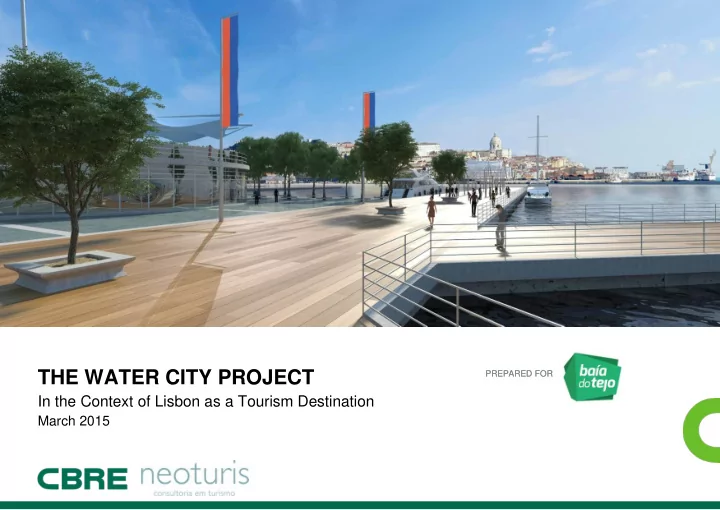
THE WATER CITY PROJECT

In the Context of Lisbon as a Tourism Destination

March 2015

slide-2
SLIDE 2

2 CBRE | BAÍA DO TEJO | WATER CITY PROJECT

CONTENTS

Introduction 3 Project Background 4 Location and Surroundings Urban Plan Strengths & Opportunities Potential for a Mixed-use Tourism Project 10 Portugal as a Tourism Destination Lisbon Tourism Hotel Market Residential Market Marinas Entertainment Examples Institutional Support 26

slide-3
SLIDE 3

3 CBRE | BAÍA DO TEJO | WATER CITY PROJECT

INTRODUCTION

Located in the Lisbon Region, on the south bank of Tejo River, and facing downtown Lisbon, the Water City Project site has an area of 60 ha and a 2 km waterfront. The site was formerly occupied by the major private naval dockyard in Portugal (known as “Lisnave”) and one of the largest in Europe, which was deactivated in 2000. The site is currently vacant, and is managed by Baía do Tejo on behalf of the government. Having obtained planning consent, Baía do Tejo is looking to attract investors to undertake the foreseen urban regeneration of this area. Water City is planned to be a new mixed-use project based on sustainability, environment and accessibility. Main highlights of the project are:  One of the largest sites for development in the Lisbon Region;  Possibility to develop a “new city inside the city”;  One of the few projects with river front in the Lisbon Region;  Unique connexion between the river and the urban fabric.

The Opportunity

slide-4
SLIDE 4

4 CBRE | BAÍA DO TEJO | WATER CITY PROJECT

PROJECT BACKGROUND

The site benefits from excellent connectivity and is at a short distance to major tourism destinations. Excellent Transport Network  Road network  Ferryboat (passenger and car)  Train (through the 25 de Abril bridge)  Bus  Overland metro The project foresees ferryboat, bus and an overland metro station inside the site. Short Distance to major Tourism Destinations

Location and Surroundings

Source: CBRE/ neoturis

Destination Distance

Downtown Lisbon 10 min by ferry boat Downtown Lisbon 13 km; 25 min by car Lisbon International Airport 18 km; 20 min by car Costa da Caparica Beaches 9 km; 10 min by car Sintra 35 km; 30 min by car Cascais/ Estoril 30 km; 25 min by car Arrábida 30 km; 30 min by car

Source: CBRE/ neoturis

Almada Beaches Lisbon Lisbon International Airport Arrábida Natural reserve Sintra Cascais/ Estoril Tagus River “25 de Abril” Bridge

Water City

slide-5
SLIDE 5

5 CBRE | BAÍA DO TEJO | WATER CITY PROJECT

PROJECT BACKGROUND

Sights The privileged position of Water City along the river front allows for great views over Lisbon and the Tejo River.

Location and Surroundings

Almada “25 de Abril” Bridge Seixal Barreiro Tagus River Cruise Terminal Downtown Lisbon View Points

Water City Source: CBRE/ neoturis

slide-6
SLIDE 6

6 CBRE | BAÍA DO TEJO | WATER CITY PROJECT

PROJECT BACKGROUND

The Masterplan

The Water City project is integrated in a general Urban Plan designed by a state of the art team of international architects, led by Richard Rogers in partnership with WS Atkins and Santa-Rita Arquitectos. The general Plan approved in 2009, covers an area of around 115 ha and has a total proposed gross construction area of 867,675 sq m. It defines four different areas of which “Margueira” is the largest, and corresponds to the development of the Water City project. The Water City project covers an area of 60 ha, including 54 ha on land and 6 ha

  • n-water, and allows the development of 630 246 sq m of gross construction area

above ground. This is currently the largest urban regeneration project in the Lisbon Region and includes, housing, hotel, office, retail, cultural and leisure areas. The Strategic Vision of the Plan foresees for the site:  “A Place to Work”,  “A Place Connected to Water”,  “A Place to Live”  “A Place of Culture”, and  “A Place of Knowledge” OVERVIEW OF THE GENERAL PLAN

slide-7
SLIDE 7

7 CBRE | BAÍA DO TEJO | WATER CITY PROJECT

PROJECT BACKGROUND

The Urban Plan

WATER CITY URBAN PLAN

Source: Water City Urban Plan (“Plano de Urbanização de Almada Nascente Cidade da Água”) 1 2 3 4 1 Legend (not exhaustive): Limit of Site Areas Margueira 2 Mutela 3 4 Cova da Piedade Cacilhas Mixed-Use Areas Buildings of Collective Equipment’s Residential Use Areas Tertiary Use Areas Cultural Use Areas River Use Areas Ecological Structure Primary Green Areas Secondary Green Areas Tertiary Green Areas Water Levels Urban Development Schedule New Pier For Cruise Terminal Other Areas/ Infrastructures Environmental Infrastructures Areas Road Network Plazas Railroad Network Road Tunnel

slide-8
SLIDE 8

8 CBRE | BAÍA DO TEJO | WATER CITY PROJECT

PROJECT BACKGROUND

The Urban Plan

PROPERTY USES AREA (sq m) % Mixed-use Areas 381 865 60.6 Residential 177 871 4.9 Tertiary 31 140 28.2 Cultural 29 350 4.7 River Side Activities 10 020 1.6 Total Construction Area 630 246 100.0 Total Land Area 540 000 Total On-Water Area 66 000 MIXED-USE RESIDENTIAL TERTIARY CULTURAL RIVER SIDE ACTIVITIES COMPATIBLE USES COMPATIBLE USES COMPATIBLE USES EXCLUSIVE USES COMPATIBLE USES

  • Housing (max. 70%

area)

  • Public Facilities
  • Tourism
  • Retail
  • Offices
  • Housing (min. 70%

area)

  • Public Facilities
  • Tourism
  • Retail
  • Offices
  • Offices
  • Restaurants / Bars
  • Tourism
  • Retail
  • General Services
  • Museums
  • Exhibition Centres
  • Art Galleries
  • Concert Halls
  • Art Centres
  • Complementary Uses:

Retail and Restaurants

  • Ferryboat building
  • Cruise terminal

building

  • Marina buildings
  • Complementary Uses:

Retail, Restaurants and Support Services COMPATIBLE AND EXCLUSIVE USES

Uses related to tourism are present in all the areas of the Water City Urban Plan

DISTRIBUTION OF USES

Source: Water City Urban Plan (“Plano de Urbanização de Almada Nascente Cidade da Água”)

slide-9
SLIDE 9

9 CBRE | BAÍA DO TEJO | WATER CITY PROJECT

PROJECT BACKGROUND

Strengths & Opportunities The prime location, views and specific features of the project, such as size and natural conditions, are key factors for the success of Water City Project

 Beautiful views overlooking the Tagus River and Lisbon City  Proximity and excellent transport connections to the Portuguese Capital  Large site area to develop a mixed-use scheme  Capability to attract different inspirations  Exclusive waterfront connection that provides an unique setting to users and occupiers and leverages leisure activities  Awareness and visibility of Lisbon as a Tourism Destination  Increasing tourism demand in Lisbon and consequent need to develop new attraction poles and functional areas

slide-10
SLIDE 10

10 CBRE | BAÍA DO TEJO | WATER CITY PROJECT

POTENTIAL FOR A MIXED-USE TOURISM PROJECT

ENTERTAINMENT MARINA

MIXED USE PROJECT ECT

HOTEL RESIDENTIAL TOURISM

The Water City has all the conditions to position itself as a distinguished tourism project in the Lisbon Region. The project has potential for the development of different tourism products leveraging the attractiveness of Lisbon as a tourism destination.

slide-11
SLIDE 11

11 CBRE | BAÍA DO TEJO | WATER CITY PROJECT

PORTUGAL AS A TOURISM DESTINATION

Portugal is one of the world’s most competitive tourism destinations, according to the World Economic Forum, which criteria include:  Government prioritisation of the Travel and Tourism Industry;  Ease in setting up companies;  Portuguese hospitality; and  Large number of monuments and World Heritage sites. We highlight some key findings of the competitiveness of Portugal’s tourism resources:  Proximity and accessibility from main European outbound markets (494 million inhabitants in the EU);  Warm climate without sub-zero temperatures, no snow and maximum summer temperatures between 30º and 35º C;  Safe and stable country – standing as one of Europe’s safest destinations;  Value for money, with marked improvement in the quality of tourism services and product offer;  High quality of urban, environmental and scenic resources and increasingly qualified human resources;  Organisation, communication and hosting

  • f

events with international projection, which are strongly supported by the public authorities; and  Modernisation and enhanced efficiency of the public and private sector’s agents, namely in the tourism cluster.

According to the World Economic Forum, Portugal ranks 14th in Europe and 20th in World in the Tourism and Travel Competitive Index 2013

slide-12
SLIDE 12

12 CBRE | BAÍA DO TEJO | WATER CITY PROJECT

LISBON TOURISM

What does Lisbon has to offer?

Lisbon is Europe's second-oldest capital (after Athens), once home to the world's greatest navigators, becoming the first “truly global city”, with cultural connections over all continents. With a strategic location in the centre of Portugal and mild weather, pleasant for most of European countries, Lisbon combines a huge range of cultural and natural resources. Lisbon offers a mix of cultural destinations: capital city, coastal resort and wide golf offer – which greatly influences the type of hotel demand, leading to a preponderance of leisure based clientele for the market. According to the “Motivational Survey of Tourists in Lisbon City”, leisure demand is an important market segment for all the hotels, whether urban or resort located, although the leisure purpose varies per location. The most important motivational segments of “Vacations, Leisure and Recreation” are 1) City Breaks, 2) Touring Portugal and 3) Sun and Sea. The second most representative motivation of tourists in Lisbon city is “Business”, where Meeting Industry and Private Business are the main segments.

Vacations, Leisure and Recreation are the main reasons to visit Lisbon

TOURIST DEMAND PROFILE IN LISBON CITY (2013)

VACATIONS, LEISURE AND RECREATION City Breaks 45.2% Touring Portugal 7.2% Sun and Sea 3.1% Sporting Events 2.8% Cultural Events 1.9% Golf 0.7% Cruise Industry 0.2% Nature 0.1% BUSINESS Meeting Industry 13.0% Private Business 9.0% Fairs 0.6% Training 0.5% Incentives 0.4%

Source: Lisbon’s Tourism Association (ATL) – “Motivational Survey of Tourists in Lisbon City, 2013”

Vacations, leisure and recreation 61% Business 23% Visiting family and friends 10% Religion 2% Health 2% Other 2%

slide-13
SLIDE 13

13 CBRE | BAÍA DO TEJO | WATER CITY PROJECT

Almada

LISBON TOURISM

Main Tourist Areas in the Lisbon Region

The Cultural Landscape of Sintra is classified as World Heritage by

  • UNESCO. Its monuments are linked to

key milestones and dates of the History of Portugal. Its palaces, beaches and gastronomy, are attractive resources of major differentiation

Sintra

The region of Estoril / Cascais, has been considered, for many years, an elite zone of rest and tranquility. It combines a very rich architectural heritage with the scenic beauty of the Atlantic coast

Cascais

Oeiras is currently one of the most developed districts of the country, and

  • ne of the main business centers
  • f R&D in Portugal.

It is possible to find the headquarters of several multinational companies such as Samsung and Nestlé

Oeiras

Lisbon’s International Airport

  • More than 16 million passengers
  • Annual growth rate of 4.3%

Lisbon is Portugal's capital and centre

  • f a region with a rich cultural diversity.

Belém with its monuments, along with the streets and alleys of the historic districts, are unique and attractive, and representative of the Portuguese culture Water City

Lisboa

Costa da Caparica has 22 beaches along 15 km, and it s recognized in Portugal as one of the best spots to learn Surf and other water sports. It has more than 15 licensed water sports schools

Costa da Caparica

The municipality of Almada stands out for its 35 continuous km of ocean and river front. Being essentially a satellite city of Lisbon, it still offers an interesting range of cultural, and particularly, natural resources

slide-14
SLIDE 14

14 CBRE | BAÍA DO TEJO | WATER CITY PROJECT

LISBON TOURISM

 Expressive growth in the number of tourists;  Growth of high yield customers from Brazil, Angola, Russia, China and USA as well as other markets leveraged by new air connections (e.g. Russia or Middle East, through Emirates);  Diversity of areas with touristic attractions in the city and surroundings;  Airport within the city and important hub between Brazil, Africa and Europe;  Growing importance of Lisbon in the Mediterranean cruising scene.

Competitiveness Factors

PASSENGERS IN LISBON’S AIRPORT

[million of boarding and landing passengers]

11,2 14,1 16,8 20,0 2005 2010 2015 2020

AAGR = 3.9%

PROJECTIONS Source: ANA – Aeroportos de Portugal

PASSENGERS ON CRUISES IN LISBON

[number of passengers] 100,000 200,000 300,000 400,000 500,000 600,000 2009 2010 2011 2012 2013 2014

AAGR = 3.8%

Source: Lisbon’s Cruise Port

slide-15
SLIDE 15

15 CBRE | BAÍA DO TEJO | WATER CITY PROJECT

LISBON TOURISM

Over the last few years, Lisbon has established itself as one of the most attractive European cities for international tourists. As a consequence, the city has received countless distinctions and awards in the last 2 years, namely:  “5 Remarkably Affordable Travel Destinations”, according to Forbes;  “Best-value destinations in Europe”, according to Lonely Planet;  “2nd Best European destination” by European Best Destinations;  “4th Most beautiful city in the world” by CityGuides;  “Europe's Leading City Break Destination” by the World Travel Awards.  “Europe’s Leading Cruise Destination” and “Europe’s Leading Cruise Port 2014” by World Travel Awards;  The 25th of April Bridge as one of “The Most Beautiful Bridges in Europe”, according to European Best Destinations.

Prizes and Titles Recently Awarded Lisbon is currently a trendy destination

Lisbon is also a reference in the international press, having been the cover of National Geographic Traveller Magazine in the August/ September 2014 edition and, with an article in CNN under the title “7 reasons why Lisbon could be Europe’s coolest city”.

slide-16
SLIDE 16

16 CBRE | BAÍA DO TEJO | WATER CITY PROJECT

LISBON TOURISM

National Strategic Plan for Tourism

Source: National Strategic Plan for Tourism (2013-2015); Analysis: Tourism of Portugal

The Tourism of Portugal has defined the new strategic guidelines for tourism development in the National Strategic Plan for Tourism (2013-2015). Lisbon Region’s strategy focuses on the following markets:  Growing markets, for e.g., Brazil, France and Russia;  Revitalize the mature markets, like Spain;  Create a new impulse for the most dynamic sectors of Germany, Italy, United Kingdom and USA;  Aggregated approach from the city to the Portugal destination brand in markets like Asia and The Middle East.

Water City addresses the principal tourism products defined in the National Strategic Plan for Tourism: Nautical as well as City Breaks, Touring and Business

PRODUCTS FOR LISBON REGION

Product’s Strategy Consolidated Developing Complementary Emergent Sun and Sea

Health Tourism

 

City Breaks

Touring

Gastronomy and Wines

Nature Tourism

Golf

Nautical Tourism

Business Tourism

Integrated Resorts

slide-17
SLIDE 17

17 CBRE | BAÍA DO TEJO | WATER CITY PROJECT

LISBON TOURISM

The Strategic Plan for Tourism in the Lisbon Region (2015-2019) includes 5 centralities – Lisbon, Cascais, Sintra, Arrábida and Arco do Tejo – all contributing for the development of the major region of Lisbon.

Strategic Plan for Tourism in the Lisbon Region

The strategy for the development of tourism in the Lisbon Region, sets the city of Lisbon as the anchor, as it is already an international reference brand with a very strong and consolidated tourist offer. To undertake this strategy, several policies should be followed:

  • Preserve and increase the existing centralities, already considered

tourism areas of excellence;

  • Develop tourism products such as Meetings and Incentives and

Cruises;

  • Improve existent products such as Nautical, Health Tourism,

Gastronomy, Shopping and Surf;

  • Include in the offer of Lisbon Region, other tourism inputs that

belong to neighbouring cities - Mafra, Oeiras, Almada, Loures, Odivelas and Amadora - that may contribute to the improvement and complementarity of the tourism product of Lisbon. As for Almada, this benefits from the view over the river and the city

  • f Lisbon, as well as from the surf product which has a very strong

potential. The development of the Arco do Tejo Centrality and its contribution for the region should focus on nautical, nature and equestrian tourism.

Water City project is located in Lisbon Centrality but is also strongly influenced by Arco do Tejo Centrality.

TOURISM CENTRALITIES IN THE LISBON REGION

Lisbon Sintra Cascais Arco do Tejo Arrábida

slide-18
SLIDE 18

18 CBRE | BAÍA DO TEJO | WATER CITY PROJECT

Hotel Demand

TOURISM DEMAND IN THE LISBON REGION BY NATIONALITY (2014)

Source: National Statistical Institute (INE) and Tourism of Portugal

TOURISM DEMAND IN THE LISBON REGION

[million of overnight stays] 2 4 6 8 10 12 2009 2010 2011 2012 2013 2014 Portugal 24% Spain 10% France 9% Brazil 7% Germany 7% U.K. 6% Scandinavia 4% U.S.A. 4% Others 29%

LISBON HOTEL MARKET

The tourism demand in the Region of Lisbon is increasing expressively, achieving record highs every year. There were 10.8 million of overnight stays in the region in 2014, outstanding with a 15% year-on-year increase and an annual average growth rate of 6.6% in the last 5 years. Although Spain remains the main source market, there is a trend for diversification of traditional markets. Spain, France, Brazil and Germany are currently the main foreign nationalities. Markets like France, Brazil, China, Russia or Angola are increasing with consequent less dependence on Iberian market.

Hotels in the Lisbon Region are achieving annual record highs in overnight stays and there is a trend for diversification in the source markets

Source: National Statistical Institute (INE) and Tourism of Portugal

slide-19
SLIDE 19

19 CBRE | BAÍA DO TEJO | WATER CITY PROJECT

LISBON HOTEL MARKET

Occupancy Rate Occupancy rate of 3, 4 and 5 star hotels, in the Lisbon Region, has remained relatively stable between 2009 to 2013. However there was an interesting growth in 2014, with occupancies of 71.5%, 72.0% and 60.7% for 3, 4 and 5 star hotels, respectively. Average Daily Rate The Average Daily Rate in Lisbon’s region has been quite stable in 3 star hotels. However 4 and 5 star hotel categories showed, in recent years, a negative average annual growth rate, reaching of € 63.8 and € 130.9 respectively. 2014 has shown a slight improvement at general hotel categories with higher average daily rates in comparison with previously years.

Hotel Performance

OCCUPANCY RATE IN THE LISBON REGION AVERAGE DAILY RATE IN THE LISBON REGION

0 € 20 € 40 € 60 € 80 € 100 € 120 € 140 € 160 € 2009 2010 2011 2012 2013 2014 3-star 4-star 5-star 0% 10% 20% 30% 40% 50% 60% 70% 80% 2009 2010 2011 2012 2013 2014 3-star 4-star 5-star AAGR = 0.5% AAGR = -0.8% AAGR = -0.9%

Source: Lisbon’s Tourism Association

Lisbon hotels performed strongly in 2014 achieving records Occupancy Rates

slide-20
SLIDE 20

20 CBRE | BAÍA DO TEJO | WATER CITY PROJECT

RESIDENTIAL MARKET

After a period of economic and financial crisis, the Portuguese residential market began to recover at the end of 2013, with a more expressive growth in the Lisbon

  • Region. The third quarter of 2014 recorded a 6% year on year increase in the

number of houses sold in Portugal, and approximately 5% year on year rise in the housing prices. Prices of high-end developments, achieve up to 8,000€/ sq m in the Lisbon centre. The current activity in the residential market is highly driven by the demand from foreign investors, due to the legislation relating to tax incentives for non-habitual residents and the Golden Visa program. According to data from APEMIP, 22% of real estate properties sold in Portugal in 2014 were purchased by foreign investors, mainly from United Kingdom (23%), China (18%) and France (16%). Emerging Trends in Real Estate Europe 2015 ranks Lisbon in the “Top 10 European Cities for Existing Property Investments, 2015”, climbing 17 positions from the previous year.

International buyers are driving the recovery of the residential market

slide-21
SLIDE 21

21 CBRE | BAÍA DO TEJO | WATER CITY PROJECT

RESIDENTIAL MARKET

Golden Visa Program

It doesn’t exempt the reading of the respective legal document.

Temporary Residence Permit In 2012 Portugal implemented a new legal regime that allows the granting of a temporary residence permit for third-country nationals that intend to invest in Portugal (“Golden Visa”). The granting of this permit allows for free travelling within Schengen Space and for family reunification. The Golden Visa regime provides for three alternatives of investment: capital transfer of a minimum of €1,000,000, creation of at least 10 jobs and acquisition of real estate assets with a minimum price of €500,000. This last alternative is by far the choice of the majority of the Golden Visa applicants (more than 80%). The real estate asset acquired for Golden Visa purposes can be leased for commercial, agricultural or tourism purposes.

Incentives for Home Acquisition by Foreigners

The Golden Visa is valid for 1 year and renewable for 2 year periods. According to the Golden Visa Regime, the investor shall maintain the investment for 5 years and, during such period, shall comply with the minimum mandatory periods of stay (7 days in the 1st year and 14 days in the following 2 years periods).

More than 2,000 Golden Visas were already conceded up to the end of 2014

NUMBER OF GOLDEN VISAS ISSUED

Source: SEF

200 400 600 800 1,000 1,200 1,400 1,600 1,800 2012 2013 2014

slide-22
SLIDE 22

22 CBRE | BAÍA DO TEJO | WATER CITY PROJECT

RESIDENTIAL MARKET

Incentives for Home Acquisition by Foreigners

Golden Visa Program (cont.) Permanent Residence Permit Any third-country nationals holding a temporary residence permit in Portugal for at least 5 years (including Golden Visa) may apply for a permanent residence permit. The granting of the permanent residence permit is subject to certain requirements. Portuguese Citizenship Any third-country nationals legally resident in Portugal for at least 6 years (including Golden Visa) may apply for Portuguese citizenship/ passport. Non-Habitual Residents Tax Regime

Not exempted from reading the respective legal document.

The Portuguese Non-Habitual Residents (“NHR”) tax regime was introduced in 2009 and provides certain special tax rates and rules applicable to individuals that qualify as NHR. This regime is applicable for a period of consecutive 10 years. In order to qualify for the regime, the individual only has to meet two requirements: (1) Qualify as a Portuguese resident taxpayer under the Portuguese domestic rules; (2) Not having been taxed as a Portuguese resident taxpayer in the five years prior to taking up residence in Portugal. If qualifying and duly registered as a NHR, the following benefits would be available for the said individuals:

  • Portuguese-sourced income: employment (category A) and self-

employment (category B) income derived from specific high value added activities is subject to tax at a 20% flat rate. The extraordinary surtax of 3.5% will also apply for 2015 on this income.

  • Foreign-sourced income may be exempt of taxation under certain

circumstances and the rules provide for differences depending on the type of income. Besides lower final taxation for the individual, this regime also provides lower costs for the employer in expatriation, when the expatriation agreement establishes a tax equalisation mechanism.

slide-23
SLIDE 23

23 CBRE | BAÍA DO TEJO | WATER CITY PROJECT

MARINA’S LISBON MARKET

Regarding nautical facilities for sailors, Lisbon region has 10 main venues: 3 marinas, 2 harbours and 5 recreational docks. There is a reasonable supply in terms of moorings, around 3,245, but a poor supply in terms of service and support infrastructures. The average

  • ccupancy is about 65%, considering visitors and residents but with a

much higher proportion of residents (70% of total). There is a growth trend in the larger vessels while in the smaller vessels there has been a decrease in demand in Marinas and Harbours – in fact there is a slow shift from smaller to larger vessels. This trend implies a potential need for more berths able to receive vessels with larger lengths (ultimately mega yachts). The Lisbon Region has very good features to attract international demand, such as:  Strategic location between Northern Europe, the Caribbean Sea and the Mediterranean;  Beautiful sites for sailing (oceanic coast as well as several rivers such as the Tagus and Sado);  Favourable natural sailing conditions.

There is a growth trend in demand from smaller to larger vessels, that implies a potential need for more berths able to receive larger lengths vessels

1 2 4 3 6 5 7 8 9 10

Water City Cascais Marina Oeiras Harbor Bom Sucesso Dock Belém Dock Alcântara Dock Santo Amaro Dock Tróia Marina Sesimbra Harbor Fontainhas Dock Parque das Nações Marina

1 2 3 4 6 5 7 8 9 10

slide-24
SLIDE 24

24 CBRE | BAÍA DO TEJO | WATER CITY PROJECT

ENTERTAINMENT

Natural Resources, Shopping, Cultural and Sports Events, and other attractions

Lisbon Region offers a wide range of leisure and entertainment resources, facilities and events. Besides its natural resources, namely beaches and river, the region offers golf courses, shopping areas, sports and cultural events that attract both residents and visitors to the region. Lisbon is currently a tourism shopping destination. The top luxury brands are located at Avenida da Liberdade and Chiado and include Prada, Louis Vuitton, Cartier, Gucci and Hermés, amongst others. Furthermore, there are also high quality recognised shopping centres like Colombo, Almada Forúm and Freeport Outlet, etc. Lisbon tourism destination has increased its visibility and media coverage, thanks to the many events which have taken place enriching the product

  • ffer, in terms of culture and sport.: Euro 2004, Tennis Masters and

Portugal Rally. Major international sports events that take place in the Lisbon Region include Estoril Moto GP, Volvo Ocean Race and Various official surfing championships (at several beaches, including Costa da Caparica). There are also several outdoor musical festival during summertime like Rock in Rio, NOS Alive and Super Bock Super Rock.

slide-25
SLIDE 25

25 CBRE | BAÍA DO TEJO | WATER CITY PROJECT

EXAMPLES OF WATERFRONT REGENERATION PROJECTS

PORTO MARAVILHA, RIO DE JANEIRO PORT VELL, BARCELONA PARQUE DAS NAÇÕES, LISBON BALTIMORE INNER HARBOR, BALTIMORE HAFENCITY, HAMBURG

Water City is one of the next big urban developments in waterfront in the World

slide-26
SLIDE 26

26 CBRE | BAÍA DO TEJO | WATER CITY PROJECT

INSTITUCIONAL SUPPORT

“Turismo de Portugal (the Portuguese national tourism authority) embraces the Water City project with interest and believe there is potential for the diversification of the tourism

  • ffer in the Lisbon region, namely in the promotion of nautical

activities and business tourism. Furthermore, the important urban and landscape requalification of the Tejo Southbank would benefit the entire region” João Cotrim Figueiredo, President of Turismo de Portugal “The Almada Nascente Urban Plan – Water City, sponsored by the Almada Municipality, is a project of great economic, social and territorial importance for the Lisbon Metropolitan Area. in addition to its core importance for the development of a region that is increasingly affirming itself as a worldwide tourism destination, the Plan boosts development capacities in multiple investment areas, of great relevance and

  • importance. These are likely to generate high returns, namely

in the fronts related to the sea industry, where Portugal is well positioned, as one of the world’s major exclusive economic zones.” Joaquim Miguel Judas, President of Almada Municipality

slide-27
SLIDE 27

For additional information please visit: www.baiadotejo.pt