The Warriors Burden Disclaimer This presentation does not represent - - PowerPoint PPT Presentation

the warrior s burden disclaimer
SMART_READER_LITE
LIVE PREVIEW

The Warriors Burden Disclaimer This presentation does not represent - - PowerPoint PPT Presentation

The Warriors Burden Disclaimer This presentation does not represent the views of the US Department of Defense nor the US Department of Health and Human Services. It is an individual exploration of personal and professional experience


slide-1
SLIDE 1

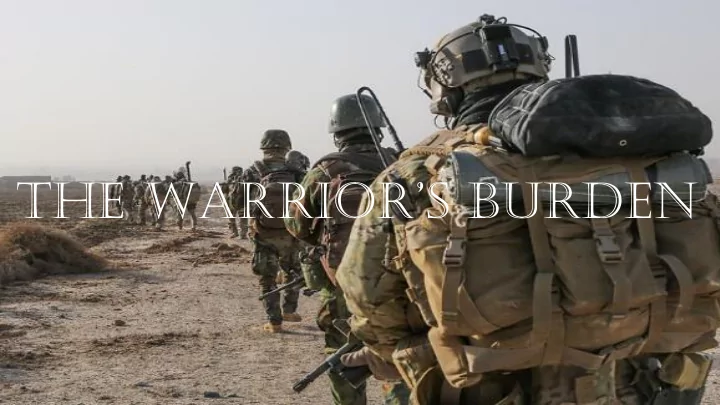
The Warrior’s Burden

slide-2
SLIDE 2

Disclaimer

This presentation does not represent the views of the US Department of Defense nor the US Department of Health and Human Services. It is an individual exploration of personal and professional experience related to uniformed service and its effects on the

  • individual. It is shared in the spirit of furthering

discussion, research, clinical understanding, and healing.

slide-3
SLIDE 3
slide-4
SLIDE 4
slide-5
SLIDE 5

Weapons, however beautiful, are instruments of ill omen…

Lao Tzu, circa 500 BCE

slide-6
SLIDE 6
slide-7
SLIDE 7

Moral Injury

slide-8
SLIDE 8

Like psychological trauma, moral injury is a construct that describes extreme and unprecedented life experience including the harmful aftermath

  • f exposure to such events. Events are considered morally injurious if they

“transgress deeply held moral beliefs and expectations”. Thus, the key precondition for moral injury is an act of transgression, which shatters moral and ethical expectations that are rooted in religious or spiritual beliefs, or culture based, organizational, and group related rules about fairness, the value of life and so forth.(Source: Department of Veterans Affairs – National Center for PTSD https://www.ptsd.va.gov/professional/co-

  • ccurring/moral_injury_at_war.asp )

Moral Injury Defined: VA

slide-9
SLIDE 9

Moral Injury Defined: ACMF Moral Injury Development Team

Moral injury results from committing, witnessing, imagining, or failing to prevent acts or events that can be judged as evil or harmful, and that violate foundational social and ethical taboos: in short, the experience of combat itself. Central to this definition is the belief moral injury is not pathology, but experience.

  • Rev. Rita Nakashima Brock, Ph.D. and

Jon Perez, Ph.D.

slide-10
SLIDE 10

Although moral injury has some of the same symptoms as Post Traumatic Stress Disorder (PTSD), it is fundamentally different.

  • Where PTSD originates from having or seeing experiences that are life

threatening, resulting in feelings of intense fear, moral injury is a “soul wound” resulting from the dissonance experienced between deeply held cultural and personal requirements to live in peaceful society, versus the equally deep, and often more intense and opposite requirements to survive, let alone prevail in combat.

  • This often deeply experienced dissonance results in feelings of guilt, shame,

and personal culpability. The symptoms of moral injury include: sorrow, grief, regret, shame, alienation, betrayal, and loss of purpose.

slide-11
SLIDE 11

https://www.rand.org/pubs/resea rch_reports/RR1542.html

slide-12
SLIDE 12

Cabrini.edu

slide-13
SLIDE 13

Iliad: Priam and Achilles

But great Achilles different passions rend, And now his sire he mourns, and now his friend. The infectious softness through the heroes ran; One universal solemn shower began; They bore as heroes, but they felt as men.

Homer circa 800 BCE

slide-14
SLIDE 14

THE ARTILLERYMAN'S VISION

WHILE my wife at my side lies slumbering, and the wars are over long, And my head on the pillow rests at home, and the vacant mid- night passes, And through the stillness, through the dark, I hear, just hear, the breath of my infant, There in the room as I wake from sleep this vision presses upon me; The engagement opens there and then in fantasy unreal, The skirmishers begin, they crawl cautiously ahead… Drum-Taps 1865

slide-15
SLIDE 15

Someday this war’s gonna end…

slide-16
SLIDE 16

“Someday, this war's gonna end. That'd be just fine with the boys on the boat. They weren't looking for anything more than a way

  • home. Trouble is, I'd been back there and I

knew that it just didn't exist anymore."

Willard Apocalypse Now 1979

slide-17
SLIDE 17

Saint Francis of Assissi: Wisdom is not Weakness

slide-18
SLIDE 18

“I have been all things unholy. If God can work through me, He can work through anyone.” ― St Francis

slide-19
SLIDE 19

Wisdom is not Weakness: Clinical Considerations (and Questions)

  • How do we best understand Moral Injury?
  • Is Moral Injury pathology?
  • Differential Diagnosis
  • Fear/Shame Differentials
  • Based on these understandings, how do we best intervene?
  • Clinical
  • Spiritual
  • Holistic Integrations?
  • Future Directions
  • Research
  • Clinical/Healing Practice(s)
slide-20
SLIDE 20

The Wolf of Gubbio

slide-21
SLIDE 21

Jon Perez, Ph.D. jon.perez@samhsa.hhs.gov