
SLIDE 1
THE WAR HORSE PROJECT
Hope And Healing After Trauma
www.hopereinstherapy.com
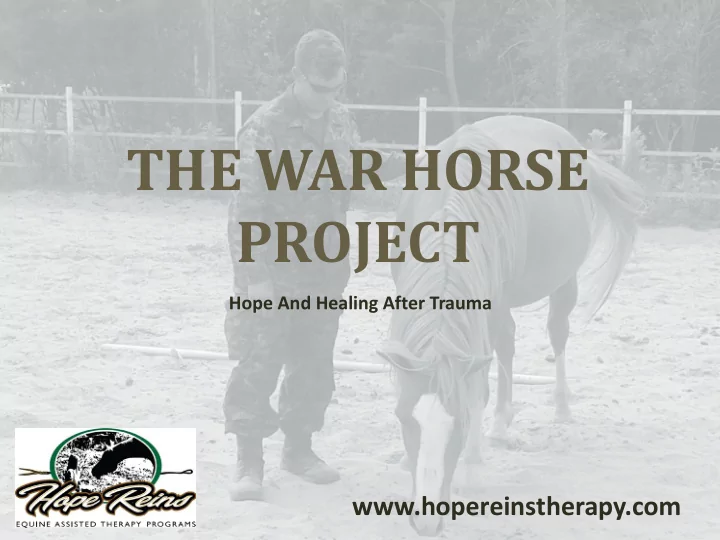
THE WAR HORSE PROJECT Hope And Healing After Trauma - - PowerPoint PPT Presentation
THE WAR HORSE PROJECT Hope And Healing After Trauma www.hopereinstherapy.com About: THE WAR HORSE PROJECT Supports CF Members & First Responders affected by trauma Is a journey of self discovery where participants are challenged to
Hope And Healing After Trauma
www.hopereinstherapy.com
Responders affected by trauma
participants are challenged to explore who they are
family, community, and a unit relies on
healthy relationships
the skills needed to overcome challenges
rebuild the capacity to regulate internal states
the brain, rather a matter of the heart
environment
what is now called post traumatic stress disorder by the medical community.
used during the American Civil War to explain some of the symptoms common to many soldiers who suffer following often heart- wrenching situations.
goal is to invite people to a more complete understanding of who they are – Soldier’s Heart being but one part of that story.
Many families in the military community face great pain as they watch their loved
experiences.
Bonding with a horse and experiencing full acceptance without judgment creates a powerful catalyst to once again re-connect with other people
The horse, being a prey animal by nature, assesses its environment and provides immediate feedback to what is happening.
Horses response to stressors…….Fight, Flight, or Freeze
Soldier’s response to stressors…….Fight, Flight, or Freeze
Carefully planned activities give participants the opportunity to explore what’s happening within themselves and receive feedback immediately.
Horses do not offer unconditional anything until a balanced relationship is built.
Relationships Communication
Boundaries Response to stress
Leading & Following Grief & Loss
Guilt & Shame Forgiveness
component is added to the program.
Rhythmic, patterned, repetitive movement to help clients learn to self- regulate, and to allow them to further recognize relationship patterns.
therapy to the more traditional methods of treating Soldier’s Heart.
treatment does not typically address the "who you are", or find meaning in the things they have experienced.
symptoms of Soldier’s Heart
rending situations
meaningful relationships
meaningful in their lives
struggles, and maintain the much needed comradery so vital to a soldier
“who am I”?
Actual outcomes from WHP 1 -from a medical model approach.
“I found that the War Horse Project was able to break through the stigma (whether real, perceived or imagined) associated with PTSD” “The War Horse Project was able to overcome some of the limitations that, in my experience, traditional therapies such as group discussion, EMDR, or one-
“I was able to draw parallels to my own reactions under stressful or traumatic conditions, and found a much more complete understanding of my own stress responses”
“I learned to be much more open to verbal and non-verbal methods of communicating intent to the horses. This once again had a direct and positive impact on my own communication skills with my children and family.”
“I believe that this program has the ability to change, & more importantly save the lives of soldiers. Keep up the fight & carry on! Chimo!” GR
“I cannot say enough positive things of this program. It was incredible!” L.S.
This project will become a regular, ongoing program. Presently we serve the Petawawa area. As this program becomes well established, we would like to extend
communities that would benefit from this approach.
The War Horse Project
challenges soldiers to explore and make sense
in new ways –to bring purpose to the events they cannot change, and perhaps redefine normal .