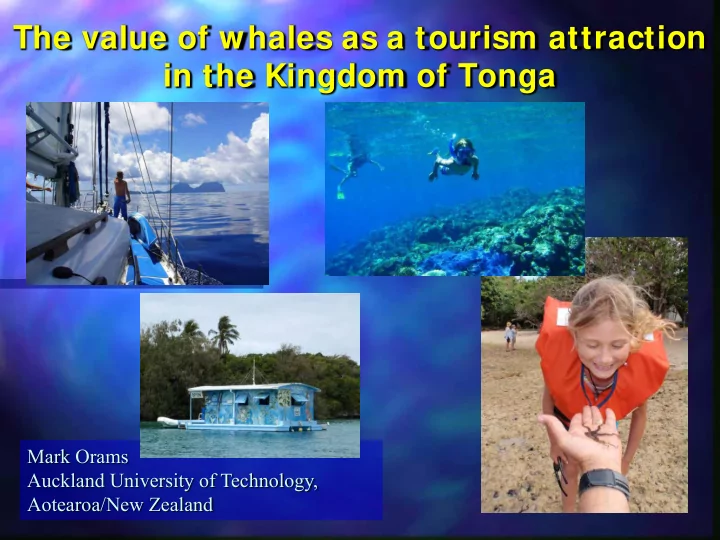
The value of whales as a tourism attraction in the Kingdom of Tonga - - PowerPoint PPT Presentation
The value of whales as a tourism attraction in the Kingdom of Tonga Mark Orams Auckland University of Technology, Aotearoa/New Zealand Characteristics of Whale Tourism in Tonga Seasonal (July to September). Humpback whale focused.
Characteristics of Whale Tourism in Tonga
- Seasonal (July to September).
- Humpback whale focused.
- Swim (snorkel) with opportunities major
draw-card.
- Clear, warm water – but wind and sea state can be
challenging.
- Mother – calf pair focus.
- Has expanded from Vava’u to Ha’apai, Eua and Tongatapu
Economic Valuation of Natural Resources
- Valuation: Benefits and costs, tangible and intangible.
- Expenditure (revenue), leakage, existence, option and
bequest values.
- Direct, indirect and induced expenditure.
- Other challenges in valuing natural resources.
Studies completed into value of whale- based tourism in Vava’u: 1999 and 2009
Data collection methods
- 1. Self-reply questionnaire of holiday-makers travelling
via aircraft.
- 2. Self-reply questionnaire of holiday-makers
travelling via boat.
- 3. Face to face interviews with licensed whale-watching
business operators.
Economic benefits of whale-watching model used in this study
Self reply questionnaire for tourists Direct (Step 1) Visitor spend Expenditure
- n whale-
watching Business spend Indirect (Step 2) Interviews of tourism businesses Employee spend Induced (Step 3) Estimation of multiplier Estimation of "leakage"
Estimation of total economic benefit
Study Findings
Comparison of economic benefit of whale-watching estimates for Vava’u in 1999 and 2009 (all figures in United States dollars per season).
Direct Expenditure
- f Visitors on
Whale- watching Other Expenditure
- f Whale
Tourists Whale- watch Operators Expenditure in Vava'u Whale- watch Business Employees Expenditure in Vava'u TOTAL Estimated totals for all permitted whale-watch
- perators in
1999 $50,000 to $74,240 $364,800 $30,080 $28,160 $473,030 to $497,280 Estimated totals for all permitted whale-watch
- perators in
2009 $600,000 $4,069,169 $300,629 $209,671 $5,170,469 Notes: Totals are rounded to nearest dollar.
Other I mportant Findings
- Whales have become the predominant tourism attraction in Vava’u.
1999: 22% of aircraft-based visitors & 8% of yacht-based visitors. 2009: 42% of aircraft-based visitors & 25% of yacht-based visitors.
- Predominance of swim-with-whales.
- Compressed the peak tourism season.
- Increasing misunderstanding and conflict.
- Increasing concern regarding the potential negative impacts on
whales.
- Tension regarding licenses and management.
- Disagreement on commercial whale-watching activities on Sundays.
- Low numbers of local Tongan owners and low level of involvement
from locals.
Implications
- 1. There is increasing evidence from elsewhere that whale-watching
can tip into a decline after a strong period of growth (eg. Hervey Bay, Queensland, Australia).
- 2. Competition exists from not only other whale-watching
destinations but also from other marine wildlife interaction
- pportunities.
- 3. The growth in ethical influences on travel and activity choices
continues, especially with mature western source countries (eg. Australia, USA, Canada, New Zealand, UK, Western European and Scandinavian countries).
Strengths, Weaknesses, Opportunities, Threats (SWOT)
Strengths
- Established whale-watching industry and good “visibility” in
some source markets (eg. New Zealand).
- Climate (air and water temperature).
- Water clarity and quality (open water areas).
- Humpback whales (numbers, ‘charisma”, breeding season).
- Swim-with opportunities (and photography/videography).
- Strong growth in outbound tourism from countries in Asia-
Pacific region (eg. China, India)
- Close proximity to strong growing inbound tourism markets
(New Zealand and east coast Australia).
- Experience and support for whale conservation.
Strengths, Weaknesses, Opportunities, Threats (SWOT)
Weaknesses
- High seasonality = very compressed season (July-Sept).
- Remoteness and access (cost, time, reliability).
- Inflated cost of participation (including high exchange rate).
- Continued questions/concerns about ethics of operations,
management regime and negative effects on whales.
- Quality, reliability and safety of infrastructure supporting
tourism (eg. aircraft, vessels, accommodation).
- High turn-over of operators, staff.
- Variable quality of experience offered.
- Operators dominated by Palangis.
- Leakage of economic benefits.
Strengths, Weaknesses, Opportunities, Threats (SWOT)
Opportunities
- Transition to world-leading ecotourism destination with ethical
whale-watching practices.
- Growth in whale numbers.
- Build pride, social and economic benefits from industry.
- Quality of experience over quantity of customers.
- Leadership in whale and marine conservation.
- Value add to whale-tourism “product” (eg. Souvenirs,
photography/videography, festival/s, event/s, citizen science, voluntourism, museum/visitor centre, education tourism …).
- Extend season through attraction switching (eg. Sea-turtles, sea-
birds, rays/sharks, coral reef attractions …)
Strengths, Weaknesses, Opportunities, Threats (SWOT)
Threats
- Whale population decline (and/or destination switching).
- Reputation.
- Infrastructure failure.
- Cyclone/s and related damage, costs and image.
- Competition.
- Exchange rate and economic competitiveness.
- Accidents (especially fatalities).
- World economy, security.
- Climate change and related issues.
- Environmental degradation and decreased quality of experience.
- Corruption, greed and lack of integrity.
- 1. Evidence from elsewhere shows that whale-based tourism will
not grow indefinitely.
- 2. Remote locations are vulnerable to alternate destinations that are
more easily accessible and more affordable.
- 3. Impacts and a destination’s reputation regarding careful
management of impacts is an important influence on patronage.
- 4. Financial viability, conflict and tension is often a challenge for
the industry.
- 5. Management regimes can be effective if carefully designed,
developed in partnership with industry and effectively implemented (including policing).
- 6. Tonga as a whale watching destination is at an important
transition point.
The Future?
“He waka eke noa”
(We are all paddling in the same canoe)