Rationality and Traffic Attraction Rationality and Traffic - - PowerPoint PPT Presentation

rationality and traffic attraction rationality and
SMART_READER_LITE
LIVE PREVIEW

Rationality and Traffic Attraction Rationality and Traffic - - PowerPoint PPT Presentation

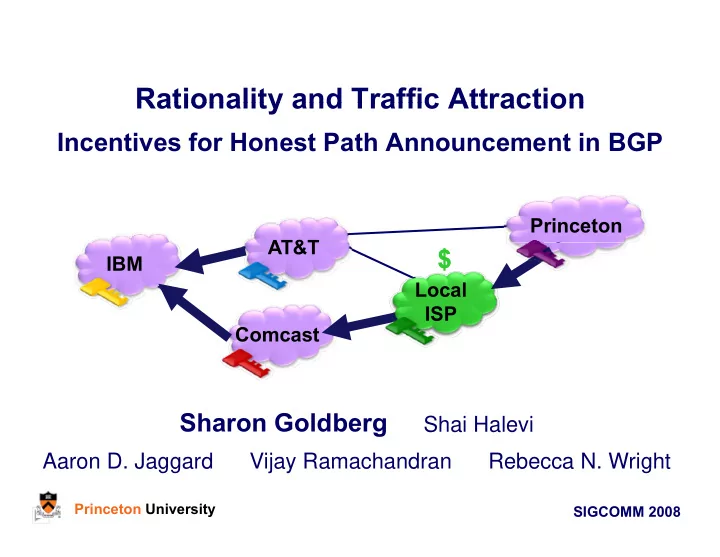
Rationality and Traffic Attraction Rationality and Traffic Attraction Incentives for Honest Path Announcement in BGP Princeton AT&T AT&T $ IBM Local Local ISP ISP ISP ISP Comcast Sharon Goldberg Shai Halevi Aaron D. Jaggard


slide-1
SLIDE 1

Rationality and Traffic Attraction Rationality and Traffic Attraction

Incentives for Honest Path Announcement in BGP

AT&T Princeton IBM AT&T Local ISP Local ISP

$

Comcast ISP ISP

Sharon Goldberg

Shai Halevi A D J d Vij R h d R b N W i h

Princeton University SIGCOMM 2008 Princeton University

Aaron D. Jaggard Vijay Ramachandran Rebecca N. Wright

slide-2
SLIDE 2

Incentives and Security

We use game theory to understand the which secure protocols should be deployed in the Internet.

$

We ask: Does traffic on the Internet actually follow the paths announced in BGP? Approach: Assume that nodes are economic entities

  • They are rational -- try to maximize utility.

AS

$

Our Results: Mostly bad news.

  • We find that cryptographically authenticating
  • We find that cryptographically authenticating

routing messages is not sufficient.

  • … unless we also make unrealistic

Polic

2/24

assumptions about routing policies.

  • Results are mostly descriptive, not prescriptive

cy

slide-3
SLIDE 3

BGP: The Interdomain Routing Protocol (1)

Th B d G t P t l (BGP) i th ti t l The Border Gateway Protocol (BGP) is the routing protocol that sets up paths between Autonomous Systems (ASes). AT&T Princeton

IBM AT&T, IBM

IBM AT&T Local ISP

Local Ranking

Comcast ISP

IBM Local Ranking: Comcast, IBM AT&T, IBM

Forwarding: Node use single outgoing link for all traffic to destination.

Comcast, IBM IBM

Rankings: Static and local; usually based on economic relationships.

3/24

slide-4
SLIDE 4

BGP: The Interdomain Routing Protocol (2)

Th B d G t P t l (BGP) i th ti t l

AT&T, IBM

The Border Gateway Protocol (BGP) is the routing protocol that sets up paths between Autonomous Systems (ASes). AT&T Princeton

AT&T, IBM

IBM AT&T Local ISP

Princeton Ranking: Local AT&T IBM

Comcast ISP

Local, AT&T, IBM AT&T, IBM Local, Comcast, IBM Local, Comcast, IBM

Forwarding: Node use single outgoing link for all traffic to destination. Rankings: Static and local; usually based on economic relationships.

4/24

slide-5
SLIDE 5

Today’s Security Goal: Matching the Data Plane

Goal: Goal: BGP announcements match AS-paths packets take in data plane.

AT&T Princeton

Local, AT&T, IBM

IBM AT&T Local ISP Local ISP

$

Princeton Ranking: Local AT&T IBM

Comcast ISP ISP

Local, AT&T, IBM AT&T, IBM Local, Comcast, IBM

This way, ASes can use BGP messages: 1. To avoid ASes perceived as adversarial / unreliable 2. To choose high performance paths g p p 3. As part of an accountability framework

5/24

slide-6
SLIDE 6

Data Plane Approaches

S D t Pl P t l Secure Data-Plane Protocols:

  • Packet Passports

[LYWA-06] Packet Obituaries [AMISS-07] Truth in advertising [WBAGS-07] Failure Localization [BGX-08] Truth in advertising [WBAGS-07] Failure Localization [BGX-08] Secure Secure AS-path tracing protocols incur overheads proportional to the amount of traffic sent in the data plane.

X

What path are my packets actually taking to IBM?

AT&T Princeton

taking to IBM?

$

IBM AT&T Local ISP Local ISP

$

Probe! Comcast

Local, AT&T, IBM

6/23

slide-7
SLIDE 7

R ti P t l G Th

Routing Protocol Approaches to Match Data Plane

Routing Protocols + Game Theory:

  • [NR-01] [FPS-01] [FPSS-05] [PS-04] [FKMS-05]

Shortest path policy / Next hop policy [FRS 06] [FSS 07] Shortest-path policy / Next-hop policy [FRS-06] [FSS-07] Secure BGP [LSZ-08] Corollary: If ______, rational rational ASes have no incentive to unilaterally deviate from announcing paths that match data plane.

  • IBM

AT&T Princeton p

$

IBM Comcast Local ISP Local ISP

$

Local Ranking: Comcast IBM

7/24

Comcast

Comcast, IBM AT&T, IBM

slide-8
SLIDE 8

Quick background: Public-key Signatures

Anyone who knows Alice’s public key can verify that yreceived the correct message from Alice. Alice Bob

Msg, tag Alice’s Secret Key Alice s Secret Key Alice’s Public Key

Eve Bob

Mssg, faketag Alice’s P blic Alice’s Public Key

ALARM!

This looks great, what’s the catch? We need an infrastructure to certify the public keys.

slide-9
SLIDE 9

Secure BGP (1)

If AS a announced path abP then b announced bP to a

Assumes a public-key infrastructure that, today, we don’t have.

AT&T: (IBM) AT&T: (IBM) Local: (AT&T, IBM)

IBM AT&T Princeton Comcast Local ISP

Local Ranking: Comcast, IBM AT&T, IBM Comcast: (IBM) Comcast: (IBM) Local: (Comcast, IBM)

slide-10
SLIDE 10

Secure BGP (2)

If AS a announced path abP then b announced bP to a

AT&T: (IBM) Princeton: (AT&T, IBM)

IBM AT&T Princeton Comcast Local ISP

Pton Ranking: Local, AT&T, IBM AT&T, IBM Comcast: (IBM) Local, Comcast, IBM Local: (Comcast, IBM) Princeton: (Local, Comcast, IBM)

slide-11
SLIDE 11

Secure BGP : Matching the Data Plane ???

AT&T: (IBM)

If AS a announced path abP then b announced bP to a

AT&T: (IBM) Local: (AT&T, IBM)

Why does Local ISP do this? Let’s look at utility models. IBM AT&T Princeton

$

Comcast Local ISP Local ISP

Pton Ranking: Local, AT&T, IBM AT&T, IBM Comcast: (IBM) AT&T: (IBM) Local, Comcast, IBM Local: (Comcast, IBM) Princeton: (Local, Comcast, IBM) Local: (AT&T, IBM) Princeton: (Local, AT&T, IBM)

slide-12
SLIDE 12

Model of utility in prior work:

Modeling Utility

Our model of utility:

. Utility of outgoing (data-plane) path Utility of attracted incoming traffic Utility of AS =

+

Model of utility in prior work:

. Utility of outgoing (data-plane) path Utility of attracted incoming traffic Utility of AS =

+

Our model of utility:

( p ) p g

In all prior work: Utility is determined by the ranking function

( p ) p g IBM AT&T Princeton

$

Comcast Local ISP Local ISP

Local Ranking: Comcast, IBM AT&T, IBM

Local ISP has no incentive to announce mismatched paths

12/24

announce mismatched paths.

slide-13
SLIDE 13

Model of utility in prior work:

Modeling Utility with Traffic Attraction

Our model of utility:

. Utility of outgoing (data-plane) path Utility of attracted incoming traffic Utility of n

= +

Model of utility in prior work:

. Utility of outgoing (data-plane) path Utility of attracted incoming traffic Utility of AS =

+

Our model of utility:

( p ) p g ( p ) p g

Traffic-volume attractions:

  • AS only cares who originates traffic
  • Models incentive to snoop / tamper
  • … or increase incoming traffic volumes

… or increase incoming traffic volumes

Customer attractions:

AS wants to attract traffic from customers via direct link

  • AS wants to attract traffic from customers via direct link.
  • Models bilateral economic relationships.

Generic attractions:

  • AS wants to attract traffic from specific ASes via a specific path

13/23

slide-14
SLIDE 14

Result: Secure BGP is not Sufficient!

With t ffi l OR t tt ti th b With traffic-volume OR customer attractions, there can be an incentive to announce mismatched paths, even with Secure BGP. Observation: Princeton does not use a shortest-path policy.

Attracted customer

AT&T: (IBM) Local: (AT&T, IBM) Princeton (Local AT&T IBM)

IBM AT&T Princeton

$

Princeton: (Local, AT&T, IBM)

IBM C t Local ISP Local ISP

$

Pton Ranking: Local, AT&T, IBM AT&T IBM

Comcast

AT&T, IBM Local, Comcast, IBM Local Ranking: Comcast, IBM AT&T IBM

Favorite

  • utgoing path

AT&T, IBM

  • utgoing path

14/23

slide-15
SLIDE 15

Result: Shortest-Path Policy is not Sufficient! (0)

With t ffi l OR t tt ti th b With traffic-volume OR customer attractions, there can be an incentive to mismatch paths, even with shortest-path policies. IBM AT&T Princeton IBM C t Local ISP

Princeton Ranking: Local, AT&T, IBM AT&T IBM Ranking: Local, IBM AT&T, IBM

Comcast

AT&T, IBM Local, Comcast, IBM Local Ranking: Comcast, IBM AT&T IBM Ranking: IBM Comcast, IBM Local, Comcast, IBM AT&T, IBM

15/23

slide-16
SLIDE 16

Result: Shortest-Path Policy is not Sufficient! (1)

With t ffi l OR t tt ti th b With traffic-volume OR customer attractions, there can be an incentive to mismatch paths, even with shortest-path policies.

No export to Local Ranking: Local, IBM AT&T, IBM Local, Comcast, IBM

IBM AT&T Princeton

No export to Local

C t Local ISP

Ranking: Local, IBM AT&T, IBM

X

Ranking: IBM Comcast, IBM

Comcast

Attract: Princeton Ranking: IBM Local, Comcast, IBM g Comcast, IBM

16/23

slide-17
SLIDE 17

Result: Shortest-Path Policy is not Sufficient! (2)

With t ffi l OR t tt ti th b With traffic-volume OR customer attractions, there can be an incentive to mismatch paths, even with shortest-path policies.

No export to Local Ranking: Local, IBM AT&T, IBM Local, Comcast, IBM AT&T, IBM

IBM AT&T Princeton

No export to Local

C t Local ISP

X

  • Local ISP fails

to attract traffic from Princeton Comcast

Attract: Princeton Ranking: IBM Local, Comcast, IBM

  • from Princeton.

g Comcast, IBM

17/23

slide-18
SLIDE 18

Result: Shortest-Path Policy is not Sufficient! (3)

With t ffi l OR t tt ti th b With traffic-volume OR customer attractions, there can be an incentive to mismatch paths, even with shortest-path policies.

No export to Local Ranking: Local, IBM AT&T, IBM Local, Comcast, IBM Ranking: Local, *, IBM AT&T, *, IBM

IBM AT&T Princeton

No export to Local

C t Local ISP

X

Local ISP

Rankings based Comcast

Attract: Princeton Ranking: IBM Local, IBM

g

  • nly
  • nly on the
  • utgoing link

link Observation: Manipulation not possible with Secure BGP.

g Comcast, IBM

Observation: Princeton does not use a next-hop policy.

18/23

slide-19
SLIDE 19

Secure BGP (1a)

If a announced path abP then b announced bP to a

Assumes a public-key infrastructure that, today, we don’t have.

AT&T: (IBM)

IBM AT&T Princeton Comcast Local ISP

Comcast: (IBM)

slide-20
SLIDE 20

Secure BGP (1b)

If a announced path abP then b announced bP to a

AT&T: (IBM) Local: (AT&T, IBM)

IBM AT&T Princeton Comcast Local ISP

Local Ranking: Comcast, IBM AT&T, IBM Comcast: (IBM) Local: (Comcast, IBM)

slide-21
SLIDE 21

Secure BGP (2)

If a announced path abP then b announced bP to a

AT&T: (IBM) Princeton: (AT&T, IBM)

IBM AT&T Princeton Comcast Local ISP

Pton Ranking: Local, AT&T, IBM AT&T, IBM Comcast: (IBM) Local, Comcast, IBM Local: (Comcast, IBM) Princeton: (Local, Comcast, IBM)

slide-22
SLIDE 22

Secure BGP : Matching the Data Plane ???

AT&T: (IBM)

If a announced path abP then b announced bP to a

AT&T: (IBM) Local: (AT&T, IBM)

Again the example where announcements

IBM AT&T Princeton

$

don’t match data-plane paths….

Comcast Local ISP Local ISP

Pton Ranking: Local, AT&T, IBM AT&T, IBM Comcast: (IBM) AT&T: (IBM)

Wh d L l ISP d thi ?

Local, Comcast, IBM Local: (Comcast, IBM) Princeton: (Local, Comcast, IBM) Local: (AT&T, IBM) Princeton: (Local, AT&T, IBM)

Why does Local ISP do this? Let’s look at utility models.

slide-23
SLIDE 23

Model of utility in prior work:

Modeling Utility (1)

Our model of utility:

. Utility of outgoing (data-plane) path Utility of attracted incoming traffic Utility of AS =

+

Model of utility in prior work:

. Utility of outgoing (data-plane) path Utility of attracted incoming traffic Utility of AS =

+

Our model of utility:

( p ) p g

In all prior work: Utility is determined by the ranking function

( p ) p g IBM AT&T Princeton Comcast Local ISP

Local Ranking: Comcast, IBM AT&T, IBM

23/24

slide-24
SLIDE 24

Model of utility in prior work:

Modeling Utility (2)

Our model of utility:

. Utility of outgoing (data-plane) path Utility of attracted incoming traffic Utility of AS =

+

Model of utility in prior work:

. Utility of outgoing (data-plane) path Utility of attracted incoming traffic Utility of AS =

+

Our model of utility:

( p ) p g

In all prior work: Utility is determined by the ranking function

( p ) p g IBM AT&T Princeton

$

Comcast Local ISP Local ISP

Local Ranking: Comcast, IBM AT&T, IBM

Local ISP has no incentive to announce mismatched paths

24/24

announce mismatched paths.

slide-25
SLIDE 25

Model of utility in prior work:

Modeling Utility with Traffic Attraction (1)

Our model of utility:

. Utility of outgoing (data-plane) path Utility of attracted incoming traffic Utility of n

= +

Model of utility in prior work:

. Utility of outgoing (data-plane) path Utility of attracted incoming traffic Utility of AS =

+

Our model of utility:

( p ) p g ( p ) p g

Traffic-volume attractions: c

  • AS only cares who originates traffic
  • Models incentive to snoop / tamper
  • … or increase incoming traffic volumes

d n

… or increase incoming traffic volumes

d

25/23

slide-26
SLIDE 26

Model of utility in prior work:

Modeling Utility with Traffic Attraction (2)

Our model of utility:

. Utility of outgoing (data-plane) path Utility of attracted incoming traffic Utility of n

= +

Model of utility in prior work:

. Utility of outgoing (data-plane) path Utility of attracted incoming traffic Utility of AS =

+

Our model of utility:

( p ) p g ( p ) p g

Traffic-volume attractions: c

  • AS only cares who originates traffic
  • Models incentive to snoop / tamper
  • … or increase incoming traffic volumes

d n

… or increase incoming traffic volumes

Customer attractions:

AS wants to attract traffic from customers via direct link

  • d
  • AS wants to attract traffic from customers via direct link.
  • Models bilateral economic relationships.

26/23

slide-27
SLIDE 27

Model of utility in prior work:

Modeling Utility with Traffic Attraction (3)

Our model of utility:

. Utility of outgoing (data-plane) path Utility of attracted incoming traffic Utility of n

= +

Model of utility in prior work:

. Utility of outgoing (data-plane) path Utility of attracted incoming traffic Utility of AS =

+

Our model of utility:

( p ) p g ( p ) p g

Traffic-volume attractions: c

  • AS only cares who originates traffic
  • Models incentive to snoop / tamper
  • … or increase incoming traffic volumes

d n

… or increase incoming traffic volumes

Customer attractions:

AS wants to attract traffic from customers via direct link

d

  • AS wants to attract traffic from customers via direct link.
  • Models bilateral economic relationships.

Generic attractions:

  • AS wants to attract traffic from specific ASes via a specific path

27/23

slide-28
SLIDE 28

Result: Secure BGP is not Sufficient! (1)

With t ffi l OR t tt ti th b With traffic-volume OR customer attractions, there can be an incentive to announce mismatched paths, even with Secure BGP.

Attracted customer

AT&T: (IBM) Local: (AT&T, IBM) Princeton (Local AT&T IBM)

IBM AT&T Princeton

$

Princeton: (Local, AT&T, IBM)

IBM C t Local ISP Local ISP

$

Pton Ranking: Local, AT&T, IBM AT&T IBM

Comcast

AT&T, IBM Local, Comcast, IBM Local Ranking: Comcast, IBM AT&T IBM

Favorite

  • utgoing path

AT&T, IBM

  • utgoing path

28/23

slide-29
SLIDE 29

Result: Secure BGP is not Sufficient! (2)

With t ffi l OR t tt ti th b With traffic-volume OR customer attractions, there can be an incentive to announce mismatched paths, even with Secure BGP. IBM AT&T Princeton

$

IBM C t Local ISP Local ISP

$

Pton Ranking: Local, AT&T, IBM AT&T IBM

Comcast

AT&T, IBM Local, Comcast, IBM Local Ranking: Comcast, IBM AT&T IBM

Observation: Princeton does not use a shortest-path policy.

AT&T, IBM

29/23

slide-30
SLIDE 30

Result: Shortest-Path Policy is not Sufficient! (1)

With t ffi l OR t tt ti th b With traffic-volume OR customer attractions, there can be an incentive to mismatch paths, even with shortest-path policies.

No export to Local Ranking: Local, IBM AT&T, IBM Local, Comcast, IBM

IBM AT&T Princeton

No export to Local

C t Local ISP

X

Comcast

Attract: Princeton Ranking: IBM g Comcast, IBM

30/23

slide-31
SLIDE 31

Result: Shortest-Path Policy is not Sufficient! (2)

With t ffi l OR t tt ti th b With traffic-volume OR customer attractions, there can be an incentive to mismatch paths, even with shortest-path policies.

No export to Local Ranking: Local, IBM AT&T, IBM Local, Comcast, IBM AT&T, IBM

IBM AT&T Princeton

No export to Local

C t Local ISP

X

  • Local ISP fails

to attract traffic from Princeton Comcast

Attract: Princeton Ranking: IBM Local, Comcast, IBM

  • from Princeton.

g Comcast, IBM

31/23

slide-32
SLIDE 32

Result: Shortest-Path Policy is not Sufficient! (3)

With t ffi l OR t tt ti th b With traffic-volume OR customer attractions, there can be an incentive to mismatch paths, even with shortest-path policies.

No export to Local Ranking: Local, IBM AT&T, IBM Local, Comcast, IBM

IBM AT&T Princeton

No export to Local

C t Local ISP

X

Local ISP

Comcast

Attract: Princeton Ranking: IBM Local, IBM

g Comcast, IBM

32/23

slide-33
SLIDE 33

Result: Shortest-Path Policy is not Sufficient! (4)

With t ffi l OR t tt ti th b With traffic-volume OR customer attractions, there can be an incentive to mismatch paths, even with shortest-path policies.

No export to Local Ranking: Local, IBM AT&T, IBM Local, Comcast, IBM

IBM AT&T Princeton

No export to Local

C t Local ISP

X

Local ISP

Rankings based

  • nly
  • nly on the

Observation: Manipulation not possible with Secure BGP. Comcast

Local, IBM

y

  • utgoing link

link Observation: Manipulation not possible with Secure BGP. Observation: Princeton does not use a next-hop policy.

33/23

slide-34
SLIDE 34

Theorem: Traffic Volume Attractions

When all attractions are traffic volume, nodes have no incentive to unilaterally announce mismatched paths if all nodes in the network use either: nodes in the network use either:

1. Secure BGP, and 2 P li i t c 2. Policy consistency; OR n

1. Next-hop policies;

and there is no dispute wheel in the network

d

and there is no dispute wheel in the network and there is consistent export (in the first case) or all-or- nothing export (in the second case).

The exact statement of this result is in the paper

34/23

slide-35
SLIDE 35

What about Customer Attractions? (1)

When all attractions are traffic volume, there is no incentive to unilaterally announce mismatched paths if there is either:

Are these sufficient if we have customer attractions?

is either:

1. Secure BGP, and 2 P li i t Are these sufficient if we have customer attractions? 2. Policy consistency; c

  • 1.

Next-hop policies;

and there is no dispute wheel in the network and there is

d n

  • and there is no dispute wheel in the network and there is

consistent export (in the first case) or all-or-nothing export (in the second case).

d

Customer attractions: Attract customers via Attract customers via direct link.

35/23

slide-36
SLIDE 36

Customer Traffic Attraction (1a)

With t tt ti th b i ti t With customer attractions, there can be an incentive to announce false paths, even if all nodes use next-hop policy.

cn*d cm*d

c

This was sufficient for traffic volume! nm*d Attract c (on direct link)

m n c

X

nd md

d m n

X

Observation: All nodes use next-hop policy.

slide-37
SLIDE 37

Customer Traffic Attraction (1b)

With t tt ti th b i ti t With customer attractions, there can be an incentive to announce false paths, even if all nodes use next-hop policy.

cn*d cm*d

c

This was sufficient for traffic volume! nm*d Attract c (on direct link)

m n c

nd md

d m n

Observation: All nodes use next-hop policy.

slide-38
SLIDE 38

Customer Traffic Attraction (2)

With t tt ti th b i ti t With customer attractions, there can be an incentive to announce false paths, even if all nodes use next-hop policy.

cn*d cm*d

c

m,d

nm*d Attract c (on direct link)

m n c

Transmitter Driven Loop m

$

nd md

d m n

p Detection m m c d

If I announce n,m,c,d

m,c,d

, , , to c, we will have a loop!

Observation: All nodes use next-hop policy.

slide-39
SLIDE 39

Customer Attractions: Introducing Loop Verification

With t tt ti th b i ti t With customer attractions, there can be an incentive to announce false paths, even if all nodes use next-hop policy.

What? cn*d cm*d

c

m,d

What? I never announced “c,d”! nm*d Attract c (on direct link)

m n c

Receiver Driven Loop Detection m

$

n,m,c,d

nd md

d m n

m m,c,d Observation: All nodes use next-hop policy.

slide-40
SLIDE 40

Customer Attractions: Introducing Loop Verification

With t tt ti th b i ti t With customer attractions, there can be an incentive to announce false paths, even if all nodes use next-hop policy.

What? cn*d cm*d

c

m,d

What? I never announced “c,d”! nm*d Attract c (on direct link)

m n c

Receiver Driven Loop Detection m

$

n,m,c,d

nd md

d m n

m m,c,d

Loop Verification:

If c receives announcement QcR but c did not announce path R then Observation: All nodes use next-hop policy. Q p the lying node on path Q is punished with zero utility. Models “fear of getting caught’. Also implied by Secure BGP.

slide-41
SLIDE 41

Somewhat More Formally …

With generic traffic attraction, there exists an honest strategy that obtains the best possible stable outcome for each node (i e that each node has no incentive to unilaterally node (i.e. that each node has no incentive to unilaterally mismatch paths), if every node uses

1. Loop verification, and 1. Loop verification, and 2. Next-hop policies, and 3. All or nothing export. g

and there is no dispute wheel in the network

Removing any condition gives a counterexample

The exact statement of this result is in the paper

41/23

slide-42
SLIDE 42

All-or-Nothing Export

For each neighbor, either export all paths or export none. Path-based egress filtering is not allowed! (Incompatible with practice ) (Incompatible with practice.)

AT&T Princeton

AT&T Sprint UUNet

IF

AT&T, Princeton

THEN

AT&T Sprint UUNet

AT&T S i t P i t

Princeton

AT&T, Sprint, Princeton

AT&T makes money because it delivers traffic to a customer. AT&T loses money because it transits traffic between its peers.

slide-43
SLIDE 43

Conclusions

What conditions ensure BGP messages match data-plane What conditions ensure BGP messages match data plane paths?

  • Secure BGP is not sufficient
  • …if it is rational for ASes to want to attract traffic.
  • Generally, we need next-hop policy as well as
  • … other conditions (no dispute wheel, no egress filtering).

Also notice how strongly results depend on utility model Also, notice how strongly results depend on utility model. What should we do?

AS

  • Use expensive data-plane protocols?
  • Forget about matching BGP messages to data plane?
  • Allow ASes to send traffic on more than one outgoing link?

43/23

slide-44
SLIDE 44

Thanks! Thanks!

IBM AT&T Local Princeton Local

$

Comcast Local ISP Local ISP

Full version with all proofs and counterexamples available: www.princeton.edu/~goldbe/

Princeton University

44/23

slide-45
SLIDE 45

Formalizing the Model

Utilit R ki

Acts on data plane Acts on control plane

Utility

Satisfaction of node n with a data-plane routing outcome T

Ranking

Ranking of outgoing paths Used by n in BGP decision process p g

un(T) = v n(T)

y p

rn(T) un(T) = v n(T) + αn(T) compile

compile

Export

vn(T) is the valuation function Satisfaction of n is with his The set of neighbours to which n is willing to announce path P

en(T)

  • utgoing path in T

α n(T) is the attraction function

en( )

Satisfaction of n with incoming traffic in T

Formal model

slide-46
SLIDE 46

Stability: No Dispute Wheel

A dispute wheel is a cycle of nodes with rankings that prefer paths

2 3

d spute ee s a cyc e o

  • des

t a gs t at p e e pat s through neighbours over direct paths

1

12d 1d

2

21d 2d 21d 2d

d

32d 3d

d

13d 1d

1

Disagree: 2 stable outcomes Bad Gadget: no stable outcomes Without traffic attraction [GSW01]: The network has a unique stable

  • utcome when there is no dispute wheel in the rankings

Disagree: 2 stable outcomes Bad Gadget: no stable outcomes

  • utcome when there is no dispute wheel in the rankings.

46/12

slide-47
SLIDE 47

The Gao-Rexford Conditions

Adjacent nodes have a customer-provider relationship:

  • r a peer-peer relationship:

c p a b

Customer pays provider for service Transit each other’s traffic for free.

Topology: No customer-provider cycles in the network. T it T it t ffi l f t

a c b

Transit: Transit traffic only for your customers.

2 3 1 2 3 1

4* 3*

2 3 1 2 3 1

Traffic Traffic

4

47/12

Preferences: Prefer customer routes to peers & providers. Attractions: Only want to attract traffic from your customers.