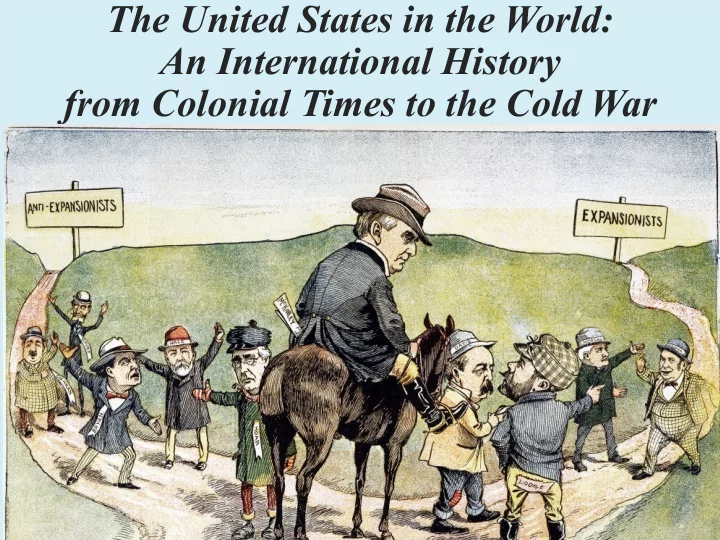
SLIDE 1
The United States in the World: An International History from Colonial Times to the Cold War
SLIDE 2
Rough Course Schedule
v Week 1: Colonial Possessions in a World at War v Week 2: New Republic, Perilous World, 1787-44 v Week 3: Manifest Destiny, 1844-1898 v Week 4: Emerging Great Power, 1898-1914 v Week 5: United States in the Great War, 1914-18 v Week 6: Interwar Interregnum, 1919-1941 v Week 7: United States in World War II, 1941-45 v Week 8: From World War to Cold War, 1945-
SLIDE 3 Polk: Partisan War President
v Excessive partisanship
political martyrs
v Undermined Gen. Taylor
(1848 nominee) and Gen. Scott (1852 nominee)
v Broke with Benton over
Fremont (1856 GOP nominee)
SLIDE 4
Lincoln, Seward & Foreign Affairs
v William H. Seward: “One
war at a time, William”
v Foreign intervention v Britain: Charles Francis
Adams
v France: William Dayton v Preservation of the Union vs.
ending slavery, 1861-62
SLIDE 5
Lincoln’s Shrewd Diplomatic Strategy
v Essential to keep
Britain & France out
v Given the border states,
he emphasized preservation of the Union
v But he risked British or
French intervention
SLIDE 6
Lincoln’s Diplomatic Challenges
v Keep Britain & France from
aiding or recognizing Confederacy (remember 1778)
v Avoid any incident that might
give cause to Britain, France
v Balance preservation of the
Union vs. emancipation
SLIDE 7
Stormy Anglo-American Relations
v Britain issued 1861 neutrality
proclamation recognizing Confederate belligerency
v France & other Europeans
acted with more caution
v British official circles:
sympathy for Confederacy; it had achieved independence
SLIDE 8
Charles Francis Adams Minister to Britain
v Yet another difficult Adams
(low opinion of Lincoln)
v Like father, JQA, a shrewd
diplomat (grasped British class differences over war)
v Instrumental in maintaining
British neutrality & preventing recognition
SLIDE 9 Prime Minster Palmerston
v British believed Lincoln
sought to preserve the Union, not abolish slavery
v Illegal US seizure of
Confederate diplomats James Mason & John Slidell from Trent, Nov. 1861
v British demanded release &
SLIDE 10
Adam’s Measured Diplomacy
v Fearful that Anglo-
American war would result, Adams counseled restraint to Seward & Lincoln
v US released the diplomats;
Seward & Adams appeased Britain to avoid war (“One war at a time, William”)
SLIDE 11
SLIDE 12
(Red: Where the proclamation would apply Blue: Where it would not apply) A War Measure: Seizure of Property. Recruitment of Black Troops. Reverberations Abroad.
SLIDE 13
William Dayton at the Court of Emperor Napoleon III
v Like Franklin before him,
Dayton shrewdly achieved amicable relations
v A less genial diplomat
might have triggered transatlantic war (& Confederate victory)
SLIDE 14
Pictured: Emperor Napoleon III
v Dayton served shrewdly v This despite his inability
to speak French
v Exploited French
suspicions of the British
v Napoleon’s support of
Maximilian in Mexico
SLIDE 15 Dayton’s Challenges in Paris
v Confederate attempts to
build warships in French shipyards
v Cotton shortage (pretext
for Anglo-French intervention?)
v 1864 death in apartment
delicate situation”
SLIDE 16
SLIDE 17
SLIDE 18
“Seward’s Folly” 1867: Alaska Purchased for $7.2 million
SLIDE 19 “Our New Senators”
v Purchase provoked
resistance
v The “Color Line”:
complained about the prospect of “Exquimaux fellow citizens.”
SLIDE 20
One historian quipped that the deal went through because, in the end, there weren’t that many ‘Exquimaux,’ & there was quite a lot of Alaska!
SLIDE 21
Cleveland’s Counterintuitive Foreign Policy
v Opposed territorial
expansion
v Withdrew treaty to
construct canal through Nicaragua
v Reversal on Hawaii v Venezuela Dispute