The Threat Driving while distracted increases crash risk 4.3 times - - PDF document

the threat
SMART_READER_LITE
LIVE PREVIEW

The Threat Driving while distracted increases crash risk 4.3 times - - PDF document

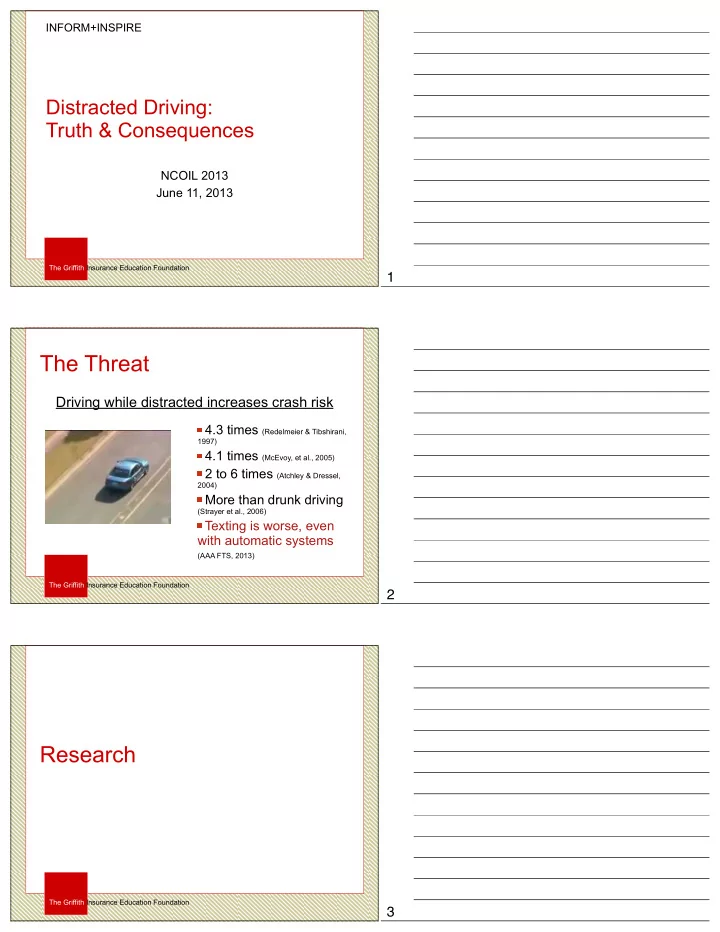
INFORM+INSPIRE Distracted Driving: Truth & Consequences NCOIL 2013 June 11, 2013 The Griffith Insurance Education Foundation 1 The Threat Driving while distracted increases crash risk 4.3 times (Redelmeier & Tibshirani, 1997) 4.1


slide-1
SLIDE 1

The Griffith Insurance Education Foundation

INFORM+INSPIRE

Distracted Driving: Truth & Consequences

NCOIL 2013 June 11, 2013

The Griffith Insurance Education Foundation

4.3 times (Redelmeier & Tibshirani,

1997)

4.1 times (McEvoy, et al., 2005) 2 to 6 times (Atchley & Dressel,

2004)

More than drunk driving

(Strayer et al., 2006)

Texting is worse, even with automatic systems

(AAA FTS, 2013)

Driving while distracted increases crash risk

The Threat

The Griffith Insurance Education Foundation

Research

1 2 3

slide-2
SLIDE 2

The Griffith Insurance Education Foundation

McEvoy, Stevenson, McCartt, & Woodward. (2005). Role of mobile phones in motor vehicle crashes resulting in hospital attendance: a case- crossover study. British Medical Journal, 331, 428-432.

Phone records of 456 drivers involved in injury

crashes over 27 months.

Talking on a phone increased risk 4.1 times Hand-held and hands free produced same risk

Phone records after a crash

The Griffith Insurance Education Foundation

Redelmeier, & Tibshirani. (1997). Association between cellular-telephone calls and motor vehicle collisions. New England Journal of Medicine, 336, 453-458.

Phone records of 699 drivers involved in non-

injury crashes over 14 months.

Talking on a phone increased risk 4.3 times Hand-held and hands free produced same risk

Phone records after a crash

The Griffith Insurance Education Foundation

These designs compared drivers to themselves to assign odds ratios

What is the chance a driver has an accident when they are on the phone or not?

All other distractions are equal in both cases Increase in risk accounts for other distractions

Case Crossover Designs

4 5 6

slide-3
SLIDE 3

The Griffith Insurance Education Foundation

Atchley, & Dressel. (2004). Conversation Limits the Functional Field of View. Human Factors, 46, 664-673. Used an attention assessment tool utilized to screen

  • lder drivers.

Conversation reduced attention, leading to an increase in accident risk of 2 to 6 fold 20 year-olds performed like older adults with the

  • nset of dementia

Attentional screening

The Griffith Insurance Education Foundation

Strayer, Drews, & Crouch (2006). A comparison of the cell phone driver and the drunk driver. Human Factors, 48, 381-391. Drivers with cell phones:

Drove more slowly 9%slower to hit the brakes 24% percent more variation in following distance More likely to crash

Driving simulation

The Griffith Insurance Education Foundation

Strayer and colleagues (2013). Measuring Cognitive Distraction in the Automobile. AAA Foundation for Traffic Safety. Drivers drove an instrumented vehicle, in a simulator and both behavior and their brain activity was measured:

Cell phones more than doubled distraction Text to speech technology tripled distraction Passive sources (radio) were not distracting

On-road + sim + neuroscience

7 8 9

slide-4
SLIDE 4

The Griffith Insurance Education Foundation

The other side

The Griffith Insurance Education Foundation

Where are the crashes?

The National Safety Council reviewed 180 fatal crashes from 2009 to 2011, where evidence indicated the drivers were using cell phones.

The Griffith Insurance Education Foundation

What about “naturalistic” data?

  • Very few crashes
  • 2 in this study
  • Data analyzed only

if “triggers” occur

  • Triggers flawed
  • Drivers know they

are being recorded

  • Miscoding
  • Fail to see phone

10 11 12

slide-5
SLIDE 5

The Griffith Insurance Education Foundation

The Bottom-Line

DISTRACTED DRIVING POSES THE SAME RISK AS DRUNK DRIVING

  • Crash studies with phone records
  • Simulator studies
  • Behavioral and neuroscience studies
  • Meta-analyses of scores of studies

ONE-QUARTER OF ALL CRASHES ARE DUE TO CELL PHONE DISTRACTIONS

  • National Safety Council (2008)

The Griffith Insurance Education Foundation

The digital natives are here

The Griffith Insurance Education Foundation

Digital natives

Cell technology use is

  • !More frequent
  • Earlier
  • Reinforced by
  • peer networks
  • the brain

13 14 15

slide-6
SLIDE 6

The Griffith Insurance Education Foundation

Heavier use (teens)

  • Text a peer every day (63%)
  • Calling (39%)
  • Face-to-face (35%)
  • Social network messaging (29%)
  • Instant messaging (22%)
  • Email (6%)

The Griffith Insurance Education Foundation

Earlier and deeper adoption

  • First cell phone:

8 years old .

  • Exclusion from

texting lowers self-esteem

  • Inclusion

increases peer connectedness

The Griffith Insurance Education Foundation

The brain is wired for smart phones

Tamir & Mitchell, 2012

16 17 18

slide-7
SLIDE 7

The Griffith Insurance Education Foundation

“While!these!aren’t!the!craziest!fines!in! the!world,!the!fact!that!the! government!is!so!strictly!regula9ng! what!we!do!in!our!cars!frustrates!me.! I’m!not!going!to!pretend!like!this!is!the! worst!thing!to!happen!to!me,!but$I’m$ bothered$that$now$not$only$do$I$need$ to$interrupt$my$phone$call$when$I$see$ an$officer,$I$also$need$to$make$sure$it$ doesn’t$look$like$I’m$punching$the$ bu:ons.”

“RESTRICTION!ON!TEXTING!WHILE!DRIVING! TARGETS!THE!WRONG!DISTRACTIONS”

ScoN!Pearring,!January!9,!2009 The Griffith Insurance Education Foundation

It will get worse

The Griffith Insurance Education Foundation

Helmet: It’s the law Texting: Because he can

19 20 21

slide-8
SLIDE 8

The Griffith Insurance Education Foundation

Why do we do it?

The Griffith Insurance Education Foundation

Why do we do it?

Safety!requires!understanding!people

The Griffith Insurance Education Foundation

The brain deceives us

We!think!we!understand!risk

22 23 24

slide-9
SLIDE 9

The Griffith Insurance Education Foundation

April 26th, 2012

Crashes Claim Teen Lives

USA - In another day of tragedy, eight young Americans between the ages of 16 and 19 were killed in motor vehicles. Another 960 were taken to emergency rooms with injuries ranging from life- threatening to less severe. The Center for Disease Control reported that though this demographic only accounts for 14% of the U.S. population, they account for about 30% of the cost of crashes.

Eight dead and 960 taken to emergency room

The Griffith Insurance Education Foundation

April 27th, 2012 USA - In another day of tragedy, eight young Americans between the ages of 16 and 19 were killed in motor vehicles. Another 960 were taken to emergency rooms with injuries ranging from life- threatening to less severe. The Center for Disease Control reported that though this demographic only accounts for 14% of the U.S. population, they account for about 30% of the cost of crashes.

Crashes Claim Teen Lives Eight dead and 960 taken to emergency room

The Griffith Insurance Education Foundation

April 28th, 2012 USA - In another day of tragedy, eight young Americans between the ages of 16 and 19 were killed in motor vehicles. Another 960 were taken to emergency rooms with injuries ranging from life- threatening to less severe. The Center for Disease Control reported that though this demographic only accounts for 14% of the U.S. population, they account for about 30% of the cost of crashes.

Crashes Claim Teen Lives Eight dead and 960 taken to emergency room

25 26 27
slide-10
SLIDE 10

The Griffith Insurance Education Foundation

April 29th, 2012

Eight dead and 960 taken to emergency room

USA - In another day of tragedy, eight young Americans between the ages of 16 and 19 were killed in motor vehicles. Another 960 were taken to emergency rooms with injuries ranging from life- threatening to less severe. The Center for Disease Control reported that though this demographic only accounts for 14% of the U.S. population, they account for about 30% of the cost of crashes.

Crashes Claim Teen Lives

The Griffith Insurance Education Foundation

The brain deceives us

We!think!we!see!more!than!we!do

The Griffith Insurance Education Foundation

Simons & Levine, 1998

28 29 30

slide-11
SLIDE 11

The Griffith Insurance Education Foundation

FOR POSITION ONLY

Our view: A complex computer

The Griffith Insurance Education Foundation

FOR POSITION ONLY

Reality: A limited processor

The Griffith Insurance Education Foundation

31 32 33

slide-12
SLIDE 12

The Griffith Insurance Education Foundation The Griffith Insurance Education Foundation

Attention demo

(not included in handout)

The Griffith Insurance Education Foundation

Multitasking is a myth

34 35 36

slide-13
SLIDE 13

The Griffith Insurance Education Foundation

Transport Canada

The Griffith Insurance Education Foundation

The brain deceives us

AUtudes!are!disconnected!from!ac9ons

The Griffith Insurance Education Foundation

0% 25% 50% 75% 100%

Read Replied Initiated

% Reporting Activity No Only while stopped Yes Atchley, Atwood & Boulton, 2011

Reports about 15 texts while driving per week

“Everybody is doing it”

37 38 39

slide-14
SLIDE 14

The Griffith Insurance Education Foundation

Nelson, Atchley & Little, 2009 Atchley, Atwood & Boulton, 2011

  • Drivers rate

distracted driving as very risky

  • They do it anyway
  • Importance of the

call/text outweighs risk

Knowing risk does not change behavior

The Griffith Insurance Education Foundation

Attitudes versus actions

Drunk!driving!versus!tex9ng!and!driving

The Griffith Insurance Education Foundation

“By this time David had had quite a lot of alcohol to drink, and he drank the remaining contents of his drink and said good-bye to the other party guests. He drove for a few

  • blocks. He came to a stoplight controlling

traffic at a broad intersection.”

Atchley, Hadlock & Lane, 2012

Drunk driving narrative

40 41 42

slide-15
SLIDE 15

The Griffith Insurance Education Foundation

“As he was driving he picked up his cell phone and started to compose a text message to girlfriend telling her he was on his way home from the party. Still text messaging, he came to a stoplight controlling traffic at a broad intersection.”

Texting and driving narrative

The Griffith Insurance Education Foundation

Preventability

Attentive Drinking Texting

Not preventable Very preventable

How preventable was the crash?

The Griffith Insurance Education Foundation

$0 $500 $1000 $5000 $10,000 $100,000

  • Exp. 1 (No law)
  • Exp. 2 (Distraction law)

Drinking Texting

What fine should be assigned?

43 44 45

slide-16
SLIDE 16

The Griffith Insurance Education Foundation

  • Exp. 1 (No law)
  • Exp. 2 (Distraction law)

Drinking Texting

None 1 Year 24 hours 48 hours 7 days 30 days 6 months

What jail time should be assigned?

The Griffith Insurance Education Foundation

Solving the problem

The Griffith Insurance Education Foundation

Solving the problem

Myth!#1:!Drivers!are!not!ready!for!this

46 47 48

slide-17
SLIDE 17

The Griffith Insurance Education Foundation

Public opinion

Quinnipiac University

  • 2424 US Voters
  • November 2010, +/- .02
  • By a 63% – 34% margin, American voters support a federal ban on cell

phone use while driving, even while using a "hands-free" device

Nationwide Insurance “On Your Side Survey”

  • 1008 US drivers
  • August 2009, +/- .03
  • 80% support ban on texting or emailing
  • 57% support a ban on all cell phone use while driving

The Griffith Insurance Education Foundation

Corporate bans

  • Exxon/Mobil
  • DuPont
  • Halliburton
  • Shell
  • BP
  • Chevron
  • Abbott
  • Cargill
  • CSX Intermodal
  • Schneider National
  • UPS
  • Sysco Corporation
  • Time Warner Cable
  • Owens Corning
  • AstraZeneca
  • Spectra Energy

Fortune 500 companies w/ total bans: 20%

The Griffith Insurance Education Foundation

Victim impact

49 50 51

slide-18
SLIDE 18

The Griffith Insurance Education Foundation

Solving the problem

Myth!#2:!Laws!have!no!effect

The Griffith Insurance Education Foundation

Laws can be effective

  • Fatalities decline in

states with texting bans

  • Primary bans 7x

more effective

  • Secondary bans are

ineffective

  • Enforcement

matters

The Griffith Insurance Education Foundation

Solving the problem

Myth!#3:!We!can’t!enforce!the!laws

52 53 54

slide-19
SLIDE 19

The Griffith Insurance Education Foundation

NHTSA enforcement study

  • Syracuse: 32%

decrease in handheld phone use and texting.

  • Hartford: 57% drop

in handheld phone use and a 72% decrease in texting.

The Griffith Insurance Education Foundation

Solving the problem

Myth!#4:!Technology!will!save!us

The Griffith Insurance Education Foundation

Even the best technology requires attention

AAAFTS, 2013

55 56 57

slide-20
SLIDE 20

The Griffith Insurance Education Foundation

Potential technological solutions

  • In-car driver jamming
  • Non-optional interlocks for phones

paired with cars

  • Parental enforcement of voluntary

systems

  • Employer phone tracking

The Griffith Insurance Education Foundation

Solving the problem

Myth!#5:!Produc9vity!will!decline

The Griffith Insurance Education Foundation

Productivity may go up!

  • Fortune 500’s with bans
  • 7% said productivity decreased
  • 19% said productivity increased
  • 22% said productivity the same
  • 52% don’t yet know
  • NSC members with bans
  • 1.5% reported productivity decreased
  • 10% report productivity increased

58 59 60

slide-21
SLIDE 21

The Griffith Insurance Education Foundation

Potential technological solutions

  • In-car driver jamming
  • Non-optional interlocks for phones

paired with cars

  • Parental enforcement of volutary

systems

  • Employer phone tracking

The Griffith Insurance Education Foundation

Summary

  • People are dying and distraction is a

major cause

  • Our brain disguises how risky

distracted driving is

  • Technology is a part of the solution but

“hands-free” isn’t one of them

  • There are a lot of myths, but enforced

laws will make a difference

The Griffith Insurance Education Foundation

Paul Atchley, Ph.D. Department of Psychology University of Kansas patchley@ku.edu

INFORM+INSPIRE

Thank you for your attention!

61 62 63