The thermodynamics of cellular computation Sourjik and Wingreen - - PowerPoint PPT Presentation

the thermodynamics of cellular computation
SMART_READER_LITE
LIVE PREVIEW

The thermodynamics of cellular computation Sourjik and Wingreen - - PowerPoint PPT Presentation

The thermodynamics of cellular computation Sourjik and Wingreen (2012) Cur. Opinions in Cell Bio. Pankaj Mehta Collaborators: David Schwab, Charles Fisher, Mo Khalil Cells perform complex computations Compute gradients of external


slide-1
SLIDE 1

Pankaj Mehta

The thermodynamics of cellular computation

Collaborators: David Schwab, Charles Fisher, Mo Khalil

Sourjik and Wingreen (2012) Cur. Opinions in Cell Bio.
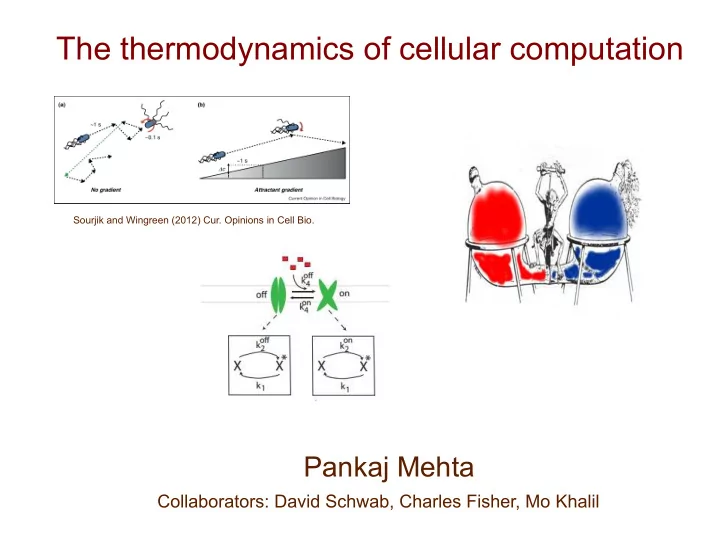
slide-2
SLIDE 2

Cells perform complex computations

Compute gradients of external concentrations Howard Berg

Sourjik and Wingreen (2012) Cur. Opinions in Cell Bio. IGEM website

slide-3
SLIDE 3

Cells perform complex computations

Quorum Sensing Quorum Sensing + Synthetic Biology= Stripes

Science 334 (6053): 238-241

slide-4
SLIDE 4

Cells perform complex computations

Tero et al Science 327 (5964): 439-442 (2010)

Slime mold (Physarum polycephalum) can design transportation networks!

slide-5
SLIDE 5

Thermodynamics of Computation

Information is physical! (Maxwell, Landauer, Charles Bennett, many others)

slide-6
SLIDE 6

Outline

  • Part I: Crash Course in Thermodynamics of Computation
  • Part II: Energetics of the simplest cellular computation (Berg-Purcell)
  • Part III: Landauer’s principle and the design of synthetic biological memory

Haynes K A , Silver P A J Cell Biol 2009;187:589-596

slide-7
SLIDE 7

Part I: Thermodynamics of computation

slide-8
SLIDE 8

Information is physical

1 1 1 Basic Atomic Message Left side of box: 1 Right side of box: 0

slide-9
SLIDE 9

Entropy of a compressed gas

  • Compress ideal gas isothermally

V1 V2

  • Now consider single particle

V2 The less information we have about state, the higher the entropy!

slide-10
SLIDE 10

Thermodynamic definitions of information

1 1 1

  • Define information theoretic (Shannon) entropy H to be proportional to

amount of free energy required to reset the tape to zero!

  • If we know position of particle we can reset to zero with no energy costs!

(two pistons push to the left to reset 1 state)

slide-11
SLIDE 11

Thermodynamic definitions of information

  • Define information theoretic (Shannon) entropy H to be proportional to

amount of free energy required to reset the tape to zero!

  • Example: Uniform message

00000000000 1111111111111 100100110101

  • Random message

(Compress N squares- each one half configuration space) Erasing/resetting memory if we don’t know state requires energy!

slide-12
SLIDE 12

Information as fuel

Use knowledge of message to power engine 0 position to right and let gas do work 1 position to left and let gas do work

slide-13
SLIDE 13

What causes energy dissipation?

Reversible computation- computation in principle can be done without energy dissipation at expense of speed/efficiency/resources Resetting always requires dissipation! (own Wikipedia entry!) Crab computing

Gunji et al Complex Systems 2010

slide-14
SLIDE 14

Landauer’s Principle

Erasing memory cost energy (1bit = 1KbT of entropy)

Berut et al Nature 483, 187–189 (2012)

Experimental verification! Current devices 1000 times limit Validity in quantum regime active area of research! (many papers in last 3 years)

slide-15
SLIDE 15

Part I: Conclusions

  • Information is physical!
  • Direct relationship between information and dissipation
  • Erasing memory causes dissipation and entropy production in environment
  • More info: see many reviews by Bennett, Landauer, and Feynman’s

book

slide-16
SLIDE 16

Part II: Thermodynamics of the simplest cellular computation

Compute (sense) concentration of external chemical or ligand

slide-17
SLIDE 17

Sensing external concentrations

Classic paper: Berg and Purcell, Biophysics Journal (1977)

Recent work: Setayeshagar and Bialek PNAS (2005), Endres and Wingreen (2009), Mora Wingreen (2011)

Use receptor time series to estimate concentration of external ligand Stochasticity leads to uncertainty! What computation should cell do? How much does it learn?

Endres and Wingreen PRL (2009)

slide-18
SLIDE 18

Cellular information is physical

See: Mehta Schwab (2012)

  • To relate to thermodynamics must think about physical/biological

implementation of calculation

  • Can show Berg-Purcell calculation can be carried out by simple network

shown below

slide-19
SLIDE 19

Cellular information is physical

  • Receptor exists in two states: an unbound “off” state and bound “on” state.
  • X* is read out of average receptor occupancy
  • Receptor modifies (i.e. phosphorylates) downstream protein from inactive

form X to anactive form X* in a state-dependent manner

  • Process depends on kinetic parameters shown above

See: Mehta Schwab (2012)

slide-20
SLIDE 20

From information to thermodynamics

  • Need to relate this circuits computation to thermodynamics
  • Thermodynamics hidden in the relationship of the kinetic parameters
  • Key insight: can think of circuit dynamics as non-equilibrium Markov

process

slide-21
SLIDE 21

Energy consumption versus uncertainty

  • Can show that detailed balanced implies infinite uncertainty
  • Learning requires consumption of energy!!
  • Biological manifestation of Landauer’s principle!
slide-22
SLIDE 22

“Erasing Memory” costs energy

  • Notice power consumption tends to zero as k1 tends to zero
  • This is the rate at which we erase memory stored in X* (reversible

computing limit)

  • Total energy per measurement still goes up
slide-23
SLIDE 23

Is this biologically important?

  • This energy is a miniscule part of total energy consumed by cells.
  • Still can imagine scenario where this is important: bacterial spore germination
  • Proc. Natl. Acad. Sci. 104: 9644-9649 (2007)
  • Spores can be dormant for thousands of years- germinate in response

to improved environment

  • Experiments suggest work in “reversible” limit where a store of chemical

be degraded

slide-24
SLIDE 24

Part II: Conclusions

  • Biological information is also physical!
  • Showed Berg-Purcell task of computing external concentration could

be implemented by a simple network

  • Learning about the environment required consuming energy
  • Energy consumption is small but may be relevant to extreme

environments such as spore germination.

slide-25
SLIDE 25

Part III: Landauer in the age of synthetic biology

Khalil and Collins, Nat Rev Genet. 2010 May; 11(5): 367–379.

  • Concerned with thermodynamic
  • and kinetic constraints on memory

devices

  • Trade offs between energy

consumption, reliability, and speed

slide-26
SLIDE 26

Landauer’s memory classification

  • Distinguished two kinds of memory in physical computers:

Barrier-based memories Kinetic memories

slide-27
SLIDE 27

Landauer memory- synthetic biology version

Barrier-based memories Kinetic memories

Burill et al Cell 140 113 (2010) Mehta et al Physical Biology 2007

Memory stored in # of proteins Memory stored in orientation

  • f DNA strand

Endy Group

Proc Natl Acad Sci U S A. 2012 June 5; 109(23): 8884-8889.

slide-28
SLIDE 28

Proc Natl Acad Sci U S A. 2012 June 5; 109(23): 8884-8889.

Resetting memory

Want to make memory that can be reset -> Landauer’s principle says must break detailed balance and consume energy

slide-29
SLIDE 29

Proc Natl Acad Sci U S A. 2012 June 5; 109(23): 8884-8889.

Resetting memory

  • Want to make memory that can be reset -> Landauer’s principle says

must break detailed balance and consume energy

  • Landauer outlines general thermodynamic

tradeoffs between energy consumption, stability, and ability to reset!

  • Can interpret the circuit it terms of

these basic principles Landauer

  • utlined
slide-30
SLIDE 30

Conclusions

  • Part I: Thinking about information physically highlights relationship between

information and thermodynamics

  • Part II: The simplest cellular computation
  • Part III: Landauer’s analysis also applicable to memory in synthetic biology
slide-31
SLIDE 31

Acknowledgements

Charles Fisher THE GROUP: Alex Lang JavadNoorbakhsh