Mobility and cellular networks Mobility and cellular networks - - PowerPoint PPT Presentation

mobility and cellular networks mobility and cellular
SMART_READER_LITE
LIVE PREVIEW

Mobility and cellular networks Mobility and cellular networks - - PowerPoint PPT Presentation

Wireless WANs Mobility and cellular networks Mobility and cellular networks Cellular radio and PCS networks Wireless data networks Satellite links and networks Mobility, etc.- 2 Basic concepts and directions in telecommunications


slide-1
SLIDE 1

Mobility and cellular networks Mobility and cellular networks

Mobility, etc.- 2

Basic concepts and directions in telecommunications C. Courcoubetis

Wireless WANs

Cellular radio and PCS networks Wireless data networks Satellite links and networks

Mobility, etc.- 3

Basic concepts and directions in telecommunications C. Courcoubetis

Cellular networks

First generation: initially debuted in Japan in 1979, analog transmission system Second generation (2G): introduced digital transmission, operational in 1992 2.5G: offers enhancements to the data services

  • n existing second-generation digital platforms

Third generation (3G): digital, permit per-user and terminal mobility, broadband applications (voice, data, and multimedia streams) at higher data speeds 144Kbps to 384Kbps, up to 2Mbps

Mobility, etc.- 4

Basic concepts and directions in telecommunications C. Courcoubetis

Cellular networks

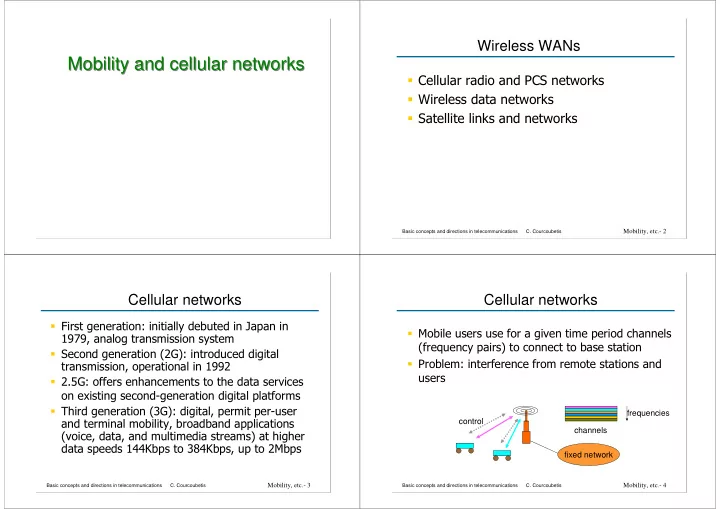
Mobile users use for a given time period channels (frequency pairs) to connect to base station Problem: interference from remote stations and users

channels fixed network control frequencies

slide-2
SLIDE 2

Mobility, etc.- 5

Basic concepts and directions in telecommunications C. Courcoubetis

The concept of a cell

Interference: reduced when cells are small ( ) Possibility of frequency reuse Size of cell: function of density of users and of demand, possibility of breaking large cells into smaller ones Need for hand-off

2

/ 1 r

Mobility, etc.- 6

Basic concepts and directions in telecommunications C. Courcoubetis

The digital cellular architecture

Cell 1 Cell 4 Cell 5 Cell 6 Cell 3 Cell 2 Cell 7

A seven-cell cluster

Cell 1 Cell 4 Cell 5 Cell 6 Cell 3 Cell 2 Cell 7 Cell 1 Cell 4 Cell 5 Cell 6 Cell 3 Cell 2 Cell 7 Cell 1 Cell 4 Cell 5 Cell 6 Cell 3 Cell 2 Cell 7

Cell 1 Cell 2

channels frequency ruse variable size cells TDMA: time slots /frequency channel

Mobility, etc.- 7

Basic concepts and directions in telecommunications C. Courcoubetis

The digital cellular architecture (2)

Mobility, etc.- 8

Basic concepts and directions in telecommunications C. Courcoubetis

GSM (2G)

GSM supports 124 channel pairs with a 200KHz spacing to prevent channel interference TDM with 8 slots: eight callers per channel Basic GSM: data rates 9.6Kbps International roaming with a single invoice, SIM card security, SMS

slide-3
SLIDE 3

Mobility, etc.- 9

Basic concepts and directions in telecommunications C. Courcoubetis

GPRS (2G+)

Always-on data service, <115Kbps Packets sent over the 8 time slots of GSM More architectural components added to GSM

– the Gateway GPRS Service Node (GGSN)

gateway between the GPRS network and IP networks, connect to other GPRS networks to facilitate GPRS roaming

– the Serving GPRS Service Node (SGSN)

The SGSN provides packet routing to and from the SGSN service area for all users in that service area, performs mobility management functions

Mobility, etc.- 10

Basic concepts and directions in telecommunications C. Courcoubetis

GSM evolution

GSM

– new services, improved quality & performance, lower cost – backward compatibility – independent of UMTS standards

GSM phase 2+

– new services (ΙΝ services+) – quality equal to fixed network – circuit switched data < 76.8 kbps – efficient administration (routing, packet data) – location services – GSM/DECT interworking

– GPRS: wireless extension of Internet over GSM network

WWW, ftp,…, low QoS, combines 1-8 14kbps voice ch.

Mobility, etc.- 11

Basic concepts and directions in telecommunications C. Courcoubetis

3G

3G is designed for high-speed multimedia data and voice Its goals include high-quality audio and video and advanced global roaming, which means being able to go anywhere and be automatically handed off to whatever wireless system is available (4G?)

Mobility, etc.- 12

Basic concepts and directions in telecommunications C. Courcoubetis

3G (2)

Objectives:

– improve throughput and QoS, voice quality, battery life, position- location services – Coexistence with current infrastructures, including backward compatibility, ease of migration or overlay, interoperability and handoffs, the need for bandwidth on demand, improving authentication and encryption methodologies to support mobile commerce (m-commerce) – Supporting higher bandwidths over greater allocations (that is, 5MHz to 20MHz)

UMTS is considered the proposed 3G standard towards the IMT2000

slide-4
SLIDE 4

Mobility, etc.- 13

Basic concepts and directions in telecommunications C. Courcoubetis

Universal Mobile Telecommunications Systems

Goal: remove any distinctions between mobile and fixed networking

– supports the ITU's UPT concept: personal mobility across many different networks, each user is issued a unique UPT number

UMTS Forum: speedup processes, evolution

– regulatory framework, spectrum, standards – the example of GSM

UMTS: a whole system, not just technologies

– integrates existing technologies (GSM 2…) – proposes new ones – global technology concept – IP is pushed further into the network

Mobility, etc.- 14

Basic concepts and directions in telecommunications C. Courcoubetis

The UMTS vision

Personal communications in the 21st century Universality

– low cost of new technologies – open architectures

Mobility

– personal mobility, smart cards, Virtual Home Environment, service mobility, personal service profile

  • Telecommunications

– transparency of service access, seamless provisioning, satellite+terrestrial,…

Basic services

– interconnection, charging, security, management, performance

Content and value-added services

– public, business to business, financial, ...

Mobility, etc.- 15

Basic concepts and directions in telecommunications C. Courcoubetis

Code Division Multiple Access

  • Can we transmit on the same frequency and the same time? Yes,

using CDMA:

– Frequency hopping: 802.11b, Bluetooth – Direct Sequence CDMA: 3G

user signals are spread up to a wideband by multiplication by a code power of user wideband signal must be above the rest of the signals in

  • rder to be successfully received at the receiver.

freq power

  • 1 1 -1 -1 1 -1 1 1 -1 1 -1 -1 1 -1 1 1
  • 1 1 -1 -1 1 -1 1 1 1 -1 1 1 -1 1 -1 -1
  • 1

1

DS-CDMA

narrowband signal (i.e. voice call) power of one wideband signal

Mobility, etc.- 16

Basic concepts and directions in telecommunications C. Courcoubetis

UMTS architecture

New elements

– UMTS 99: RNC, Node B (WBTS) – UMTS R4:MSC Server, Media Gateway (MGW) – UMTS R5: all IP network

slide-5
SLIDE 5

Mobility, etc.- 17

Basic concepts and directions in telecommunications C. Courcoubetis

UMTS architecture

SGSN GGSN

Circuit core

PSTN IP BS

Packet core

SGSN GGSN

PSTN IP BS

Packet core

IP IMS (IP) IMS Initial implementation R5 and beyond

Mobility, etc.- 18

Basic concepts and directions in telecommunications C. Courcoubetis

Convergence of technologies

Combine elements from 2G: GSM, IP, ATM

– GPRS (GSM phase 2+, point-to-point-multi-point connectionless, connection-oriented, IP service, tunneling), WAP – ATM – TCP (wireless case, new proposals: link-layer forward error corrections, end-to-end Selective ACKs, split- connection, Snoop protocol), QoS enhancements – mobility management (MIPv6++) – addressing issues

The purpose is service continuation regardless of user’s place and client capabilities.

Mobility, etc.- 19

Basic concepts and directions in telecommunications C. Courcoubetis

Next Generation Networks

  • Transition from single-service

networks to multi-service networks

  • In NGN service intelligence is

decoupled from network transmission

  • Offers converged services: fixed

telephony, mobile telephony, broadband Internet, leased lines, …

  • Traffic from various access

networks types is aggregated: fixed (ISDN, FTTx), mobile (PLMN), wireless (802.1x), …

  • Core network is IP-based
  • Supports QoS (G/MPLS)

IP Core Network Access Access Access Clients Access Access Access Servers

Communcation Control

Content Content Mobility, etc.- 20

Basic concepts and directions in telecommunications C. Courcoubetis

IMS - IP Multimedia Subsystem

3GPP (3rd Generation Partnership Project) is working on IMS

– 3G Release 5 – A commercial step towards NGN – Enables services that are independent from access network technologies – Based on Internet protocols – 4G?

3 layer architecture

– Transport (networking fabric & gateways) – Control (signaling elements) – Services (back end systems & content)

slide-6
SLIDE 6

Mobility, etc.- 21

Basic concepts and directions in telecommunications C. Courcoubetis

IMS and mobility

SIP is the protocol used for session management Users have a public SIP address (identifier) user@sip- provider.com Mobility is enabled through proxy servers and registrars

– Proxy servers process/forward requests from users and other proxies – A registrar stores information about users (IP address of user’s terminal or current proxy server)

“Home provider” has control on services received from roaming user, as he participates in authentication and performs authorization, accounting in order to bill A 4G-provider is expected to be a 3G provider that can interoperate with other 3G providers during the provision

  • f a single service

Mobility, etc.- 22

Basic concepts and directions in telecommunications C. Courcoubetis

IMS Main Components

  • Call Session Control Function

(CSCF): Set of entities for managing user sessions

– Proxy CSCF: UE’s first point of contact (can be either on the visited or home network) – Interrogating CSCF: a type of “proxy” for incoming SIP requests from other networks – Serving CSCF: session controller assigned to subscriber (always on the home network)

  • Home Subscriber Server

(HSS): a database with subscriber information

P-CSCF I-CSCF S-CSCF

Visited network Home network

REG REG REG 200 OK 200 OK 200 OK

Registration example

Mobility, etc.- 23

Basic concepts and directions in telecommunications C. Courcoubetis

Example of a session between 2 roaming users in IMS

P-CSCF I-CSCF A’s visited network User A User B B’s visited network A’s home network S-CSCF I-CSCF I-CSCF S-CSCF I-CSCF P-CSCF B’s home network Optional Required on registration,

  • ptional on

session establish Required on registration,

  • ptional on

session establish GPRS GPRS

SIP

voice packets

Mobility, etc.- 24

Basic concepts and directions in telecommunications C. Courcoubetis

BT Fusion

The first commercially available service bringing Fixed-Mobile Convergence (since fall 2005) BT decides the most appropriate access network for delivering services, based on subscriber’s location

– 3 choices in case of telephony services: POTS, VoIP, Mobile – Combines functionality of a mobile phone with reliability of fixed telephony and/or lower charges (especially for VoIP)

Vodafone is the associated mobile operator

slide-7
SLIDE 7

Mobility, etc.- 25

Basic concepts and directions in telecommunications C. Courcoubetis

BT Fusion

  • User owns a special access point and a dual-mode handset
  • User is assigned only one identifying number (from BT)
  • Calls routed to fixed-line network within range of Bluetooth access

point (WiFi in future)

– VoIP if quality is acceptable, POTS otherwise

  • Out of range calls routed to cellular network
  • BT has full control (not the user)!

Convergent Handset Cell site VoIP Gateway PSTN

Cellular network Bluetooth

  • r WiFi

Broadband Link PSTN Link

NTE ADSL NTE

OR

Fusion Access Point Mobility, etc.- 26

Basic concepts and directions in telecommunications C. Courcoubetis

Content strategies

A walled garden is a mechanism for a provider to restrict the user experience by confining the user to a specific region/space as defined by the provider

– more profit for the provider – traditional strategy of cable operators & cellular providers

An open access portal model allows the user unrestricted access to whatever content is available.

– based on the “End-to-end” principle of Internet – network operators charge purely on traffic (bit pushers)