The synergistic relationship of institutionalization and expansion: - - PowerPoint PPT Presentation

the synergistic relationship of institutionalization and
SMART_READER_LITE
LIVE PREVIEW

The synergistic relationship of institutionalization and expansion: - - PowerPoint PPT Presentation

The synergistic relationship of institutionalization and expansion: Lessons from scale-up of youth-friendly services in five countries Gwyn Hainsworth, Deputy Director of Technical Services, Pathfinder International/E2A BACKGROUND Large

slide-1
SLIDE 1

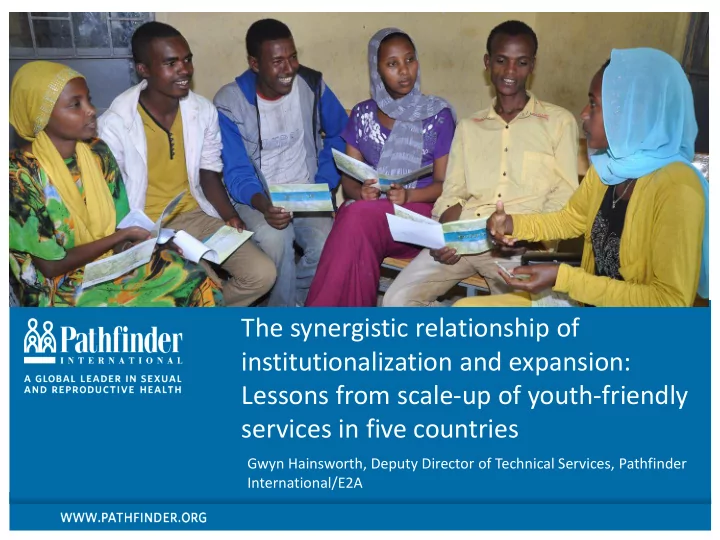
The synergistic relationship of institutionalization and expansion: Lessons from scale-up of youth-friendly services in five countries

Gwyn Hainsworth, Deputy Director of Technical Services, Pathfinder International/E2A

slide-2
SLIDE 2

BACKGROUND

  • Large adolescent and youth population with disproportionate

burden of poor SRH outcomes

  • Youth-friendly services (YFS) that are equitable, accessible,

acceptable, appropriate, and effective can address access barriers

  • Many countries have YFS
  • n a limited scale
  • How to scale up YFS to

achieve adequate coverage?

slide-3
SLIDE 3

METHODOLOGY: THE EXPANDNET FRAMEWORK

The innovation: Youth-friendly SRH services Resource team: Pathfinder, UNFPA and partners, including experts from user orgs User organization: Ministry of Health and NGOs/FBOs Scaling-up Strategy Type of scaling up: Expansion and institutionalization Dissemination and advocacy Organizational process Costs/resource mobilization Monitoring and evaluation

The elements of scaling up Strategic choice areas

Environment

slide-4
SLIDE 4

INNOVATION: YOUTH-FRIENDLY SERVICES

Characteristics of the innovation – Package of SRH services offered by trained providers at public-sector facilities and (depending on country) through private facilities, workplace programs, and CBD. – Emphasis on privacy, confidentiality, respectful treatment, free or subsidized services – Accompanied by demand generation and enabling environment activities – Emphasized youth participation and leadership in program design and implementation

slide-5
SLIDE 5

SCALE UP APPROACH

Institutionalization (Vertical scale up) Expansion (Horizontal scale up)

BOTH institutionalization and expansion were pursued contributing to the sustainable scale-up of YFS

slide-6
SLIDE 6

INSTITUTIONALIZATION

Mozambique Ghana Tanzania Vietnam Ethiopia Policies & guidelines supporting YFS

  • • • • •

National YFS curricula & training network

  • • • • •

Incorporation of YFS in national preservice training

  • National YFS tools
  • • • • •

YFS integrated in NGO/FBO service delivery system

  • HMIS age disaggregation
  • YFS in national/regional/district budgets & workplans
  • • •
slide-7
SLIDE 7

Mozambique (Geração Biz)

Phase 1 1999-2000 Consensus building; pilot introduced to 12 sites in 2 provinces Phase 2 2000-2005 Expansion to 83 sites in 8 provinces Phase 3 2005-2008 Expansion to 244 YFS sites in 11 provinces (nat’l scale) Phase 4 2008-2012 System strengthening & capacity building; transition to government Ethiopia (RH/FP Project and Integrated Family Health Program ) Phase 1 2005-2007 Consensus building; study tour to Mozambique; pilot in 20 YFS sites in 4 regions Phase 2 2008-2009 Expansion to 64 YFS sites in 4 regions Phase 3 2010-2011 Expansion to 115 YFS sites in 4 regions Phase 4 2012-2014 Expansion to 163 YFS sites in 6 regions; transition to government

EXPANSION

slide-8
SLIDE 8

Vietnam (Reproductive Health Projects) Phase 1 2004-2006 Consensus building; study tour to Thailand; pilot of 5 YFS sites in 3 provinces Phase 2 2007-2008 Expansion to 19 YFS sites in 7 provinces Phase 3 2009-2011 Expansion to 28 YFS sites in 17 provinces

Ghana (African Youth Alliance) Phase 1 2000-2001 Consensus building Phase 2 2002 YFS introduced in 19 sites in 3 regions Phase 3 2003-2004 Expansion to 65 YFS sites in 5 regions

Tanzania (African Youth Alliance) Phase 1 2001 Consensus building Phase 2 2002 11 YFS sites introduced in 4 regions Phase 3 2003-2004 Expansion to 58 YFS sites in 8 regions

slide-9
SLIDE 9

SYNERGIES BETWEEN VERTICAL AND HORIZONTAL SCALE

  • Supportive policy environment (under

institutionalization) provided needed mandate for expansion of YFS

  • YFS expansion led to greater service use and

generated momentum—holding gov’ts accountable for fully operationalizing adolescent health policies

  • Timing was key!
  • First expansion occurred soon after creation of

supportive policy environment

  • Investment in development and dissemination of tools

and technical resources (e.g., network of YFS trainers) allowed for efficient scale-up, achievement of economies of scale and sustainability

  • As YFS was expanded, needed system changes or tool

development identified to ensure fidelity to the innovation during scale up

slide-10
SLIDE 10

PURSUING VERTICAL AND HORIZONTAL SCALE SIMULTANEOUSLY INCREASES SUSTAINABILITY

  • Factors influencing sustainability:

– Degree of expansion (horizontal scale): National or close to national scale can help mitigate staff turnover and create high visibility of YFS making it harder to dismantle – Extent of institutionalization (establishment of systems to support YFS delivery, incorporation of YFS into relevant budget lines, and integration of YFS within preservice education)

  • Capacity building of MOH and NGO staff critical for supporting expansion

and institutionalization of YFS and incorporation of YFS within national, regional and district budgets and workplans

  • Internal funding for YFS and less reliance on external funding is a crucial

factor to long term sustainability

slide-11
SLIDE 11

CONSIDERATIONS WHEN SCALING-UP A YOUTH- FOCUSED INTERVENTION

  • Young people’s lack of political voice requires greater advocacy to ensure

expansion and institutionalization of youth-focused interventions

  • Partner with health systems strengthening efforts to ensure age-

disaggregated HMIS and that youth-focused interventions are included in national supervision and quality improvement systems

  • Adult bias requires additional efforts to shift attitudes and commitment to

addressing young people’s health needs

  • Lack of donor commitment may require innovative funding strategies and

capacity building from of gov’t counterparts to include youth-focused interventions within budgets and workplans from the onset

slide-12
SLIDE 12

twitter.com/PathfinderInt facebook.com/PathfinderInternational Youtube/user/PathfinderInt

Thank you