The Sustainable University Prof Stephen Sterling Centre for - - PowerPoint PPT Presentation

the sustainable university
SMART_READER_LITE
LIVE PREVIEW

The Sustainable University Prof Stephen Sterling Centre for - - PowerPoint PPT Presentation

The Sustainable University Prof Stephen Sterling Centre for Sustainable Futures/PedRIO Plymouth University 5 June 2013 EAUC Webinar Context! Context! A complete overhaul of the way the planet is managed is urgently needed if the


slide-1
SLIDE 1

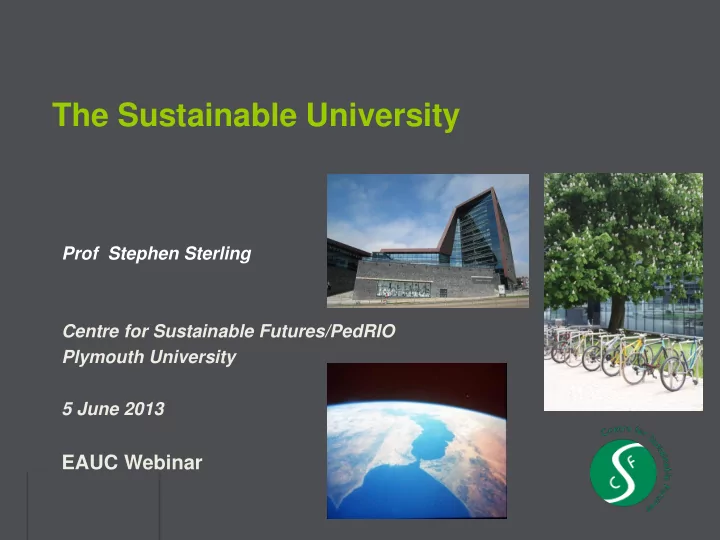
The Sustainable University

Prof Stephen Sterling Centre for Sustainable Futures/PedRIO Plymouth University 5 June 2013

EAUC Webinar

slide-2
SLIDE 2
slide-3
SLIDE 3

Context!

slide-4
SLIDE 4

Context!

‘A complete overhaul of the way the planet is managed is

urgently needed if the challenges of global sustainability are to be met for seven billion people.’

‘The second most pressing emerging issue is Transforming

Human Capabilities for the 21stCentury: Meeting Global Environmental Challenges and Moving towards a Green Economy.’

The Foresight Report: Global Environment Outlook-5 http://www.unep.org/publications/ebooks/foresightreport/

slide-5
SLIDE 5

Launch of the international Platform for Sustainability Performance in Education

“It’s encouraging that around the world there is a fast growing realisation that universities and colleges urgently need to find new models to help them evolve their leadership and operation to ensure success in a very different and disrupted further and higher education and global climate. In the face of a multitude of economic, social and environmental crises, the old models and systems are being found wanting and we cling onto them at our peril. Education is being reinvented and we desperately need ‘turn-around’ leadership which is up to the challenge of delivering institutions and graduates which are fit for the economic, environmental and social complexity and challenges we now face.”

  • Iain Patton, CEO, EAUC
slide-6
SLIDE 6

The double learning - challenge/opportunity

  • Structured learning:
  • designed formal

learning amongst students arising from educational policies, programmes and policies

  • Organisational

learning:

  • the social learning

response to sustainability in

  • rganisations,

institutions and their actors

slide-7
SLIDE 7

Sustainability goals

  • a) Integrating actions of

conservation and human development.

  • b) Satisfying basic

human needs.

  • c) Achieving equality

and social justice for all.

  • d) Facilitating social

self-determination and cultural diversity.

  • e) Managing our legacy

for future generations.

  • f) Maintaining

ecological integrity.

  • g) Developing new

technologies and product manufacturing processes

  • The Sustainability Professional: 2010 Competency Survey Report

A research study conducted by the International Society of Sustainability Professionals

http://www.sustainabilityprofessionals.org/system/files/ISSP%20Special%20Report_3.10_final_0.pdf

slide-8
SLIDE 8

The student voice

  • Over two thirds of 2011 first and second-year

respondents (66.6% and 70.3% respectively), as in 2010 (70%), believe that sustainability should be covered by their university;

  • There is a continued preference among students for a

reframing of curriculum content rather than additional content or courses

  • Student attitudes towards and skills for sustainable

development A report for the Higher Education Academy Rachel Drayson, Elizabeth Bone & Jamie Agombar (2012), NUS/HEAhttp://www.heacademy.ac.uk/assets/documents/esd/Student_attit

udes_towards_and_skills_for_sustainable_development.pdf

slide-9
SLIDE 9

What’s it got to do with HE?

‘HE institutions bear a profound moral responsibility to increase the awareness, knowledge, skills and values needed to create a just and sustainable future.... ...why is HE so averse to risk and difficult to change? Because the change sought is a deep cultural shift....

  • - Anthony Cortese 2003

(Founder of Second Nature) http://www.secondnature.org/about/

slide-10
SLIDE 10

Tensions: add-on or transformation?

  • Defined issue relating

mainly to estates and resource use

  • Principally an

environmental issue

  • Requires add-on, or

reformative approach

  • Involves a few key

disciplines

  • Is an additional agenda,

easily accommodated

  • Has clear goals,

measurable

  • Broad relevance to all aspects
  • f HE operation and provision
  • Also encompasses social

relations, justice, ethics, economic viability etc

  • Requires holistic and

transformative approach

  • Implications for most

disciplinary areas and requires interdisciplinarity

  • Is an overarching agenda and

challenges existing policy and practice, involving

  • rganisational change
  • Emerging and contested

arearea

slide-11
SLIDE 11

Sustainability at Plymouth

  • Sustainability in new corporate strategy
  • Sustainability Strategy – under revision 2013
  • Sustainability Executive; and Sustainability Advisory Groups
  • Sustainability Research Institute (ISSR)
  • Office of Procurement and Sustainability
  • ESD research key part of Pedagogic Research Institute (PedRIO)
  • Sustainability key area in Research and Innovation strategy
  • Sustainability education(ESD) in Teaching and Learning Strategy
  • ISO 140001 and Fair Trade Status
  • Commitment to Carbon Neutrality 2030
  • New Green Travel Plan and Sustainable Food Policy
  • Green Gowns Award winner in 2011
  • Second in Green League 2011 and 2012
  • 2010 and 2012 curriculum reviews indicate strong sustainability orientation in some

subjects and good coverage in other subjects

  • Pool of committed and enthusiastic staff across academics, professionals,

administrators and service providers in relation to sustainability

  • Centre for Sustainable Futures supporting the sustainability curriculum
slide-12
SLIDE 12

Sustainability has implications for...

  • Curriculum
  • Hidden curriculum and

learning environments

  • Most (all) disciplines
  • Interdisciplinarity
  • Pedagogy
  • Research
  • Research-teaching

linkages

  • Student engagement
  • Campus operation and

management

  • Procurement
  • Community and

business links

  • Institutional governance
  • Corporate policy and

plans

slide-13
SLIDE 13

Contents: LiFE Framework

slide-14
SLIDE 14

Self-imposed criteria re whole institutional change (2008)

  • Sustainability vision – policy

statement

  • Whole institution strategy and

action plan

  • Senior manager with known

responsibility for implementation

  • Senior executive committee
  • Regular sustainability and

environmental auditing

  • Sustainability applied to all

aspects of campus operation

  • Ethical investment policy
  • Excellent internal communication
  • Excellent external communication
  • f sustainability message
  • Holistic perception and

management of 4 Cs (Curriculum, Campus, Community, Culture)

  • Embedding sustainability in formal

and informal learning of students

  • Sustainability principles and

pedagogy in L&T policy

  • University sustainability research

centre and research strategy

  • Culture of organisational learning

and improvement

  • Concern for wellbeing of whole

community as well as achievement

slide-15
SLIDE 15

‘A sustainable university is an open space which is not known by its 'ivory towers'; its rigid traditions, or its allegiance to power, but rather by its creativity, and energy for change; a 'hub' of social transformation and social learning for a more sustainable, just and equitable future.’

  • Heila Lotz-Sistika, Chair of Environmental Education and Sustainability

at Rhodes University, South Africa

slide-16
SLIDE 16

16

Some challenges for the ‘sustainable university’, how to...

  • bring together and reconcile agendas coherently: eg.employment,

internationalisation, enterprise and sustainability

  • spearhead sustainable development regionally with stakeholders,

and support healthy and sustainable economies and communities

  • model sustainability on campus, procurement, food and resource use etc
  • anticipate social, economic and ecological change, particularly related to

climate change

  • ensure ‘sustainability literacy’ of staff and students
  • Work to make all this a central part of the institution’s culture

(based on Regional Centre of Expertise network slide)

slide-17
SLIDE 17
slide-18
SLIDE 18

Objectives of book

  • To relate, contextualise and appraise institutional stories of change

in HE in relation to the sustainability agenda in recent years and interest in whole institutional responses

  • To examine and draw out tactics and strategies for change towards

sustainability in HE in the light of common drivers and barriers

  • To help identify the meaning and role of ‘the sustainable university’
  • To reflect on the prospects of sustainability as a key driver of the

culture of the university and outline future challenges and possibilities

slide-19
SLIDE 19

Part I - Context

  • 1 The sustainable university: challenge and response

Stephen Sterling

  • 2 EfS: contesting the market model of higher education

John Blewitt

  • 3 Another world is desirable: a global rebooting of higher education

for sustainable development Daniella Tilbury

Part II- Aspects

  • 4 Promoting sustainable communities locally and globally: the role
  • f Regional Centres of Expertise (RCEs) 89

Ros Wade

  • 5 Leadership

Chris Shiel

  • 6 The journey towards sustainability via community: lessons from

two UK universities Rehema M White and Marie K Harder

  • 7 Times of change: shifting pedagogy and curricula for future

sustainability Alex Ryan and Debby Cotton

slide-20
SLIDE 20
  • 8 Sustainability research: a novel mode of knowledge generation

to explore alternative ways for people and planet Rehema M White

  • 9 The student experience: campus, curriculum, communities and

transition at the University of Edinburgh Peter Higgins , Robbie Nicol , David Somervell and Mary Bownes

  • 10 Well-being: what does it mean for the sustainable university?

Sarah Sayce , Judi Farren Bradley , James Ritson and Fiona Quinn

Part III -Institutional change

  • 11 Whole institutional change towards sustainable universities:

Bradford’s Ecoversity initiative Peter Hopkinson and Peter James

  • 12 Bottoms up for sustainability: the Kingston experience

Ros Taylor

  • 13 Towards a Green Academy

Heather Luna and Larch Maxey

  • 14 The sustainable university: taking it forward

Stephen Sterling and Larch Maxey

slide-21
SLIDE 21

The Sustainable University

‘This is a must-read for every Vice- Chancellor, President and University Trustee of the world's 17,000 Higher Education Institutions(HEIs). While less than 2% of the world's population will graduate from an HEI, these graduates will form the vast majority of the future decision makers in the private and public sectors and civil society at large. As such, our HEIs are crucial entry points in the global attempt to create a more sustainable future.’

  • Professor Charles Hopkins, UNESCO

Chair in Education for Sustainable Development, York University, Toronto, Canada

slide-22
SLIDE 22

Responding to sustainability: 4 R’s

Regarding what we do now:

  • What is of value that we need to keep?
  • Retain
  • What might need modification?
  • Revise
  • What, if anything, might we need to abandon?
  • Reject
  • What new ideas, concepts, principles, methodologies,

working methods, pedagogies etc are needed?

  • Renew
slide-23
SLIDE 23

The Sustainable University

Questions: 1 How big is the gap?

2 What constitutes the 'really' sustainable university? 3 How far should or can this agenda go? 4 How can it be advanced (individually, institutionally, nationally)? 5 What are the main barriers and opportunities?

slide-24
SLIDE 24

References

Assadourian, E and Prugh, T et al (2013) Is Sustainability Still Possible? Worldwatch Institute, Island Press, Washington Drayson, R, Bone, Agombar, J (2012), Student attitudes towards and skills for sustainable development, A report for the Higher Education Academy, NUS/HEAhttp://www.heacademy.ac.uk/assets/documents/esd/Student_attitudes_towards_and_skills_for_sustain able_development.pdf Gore, (2013) A The Future, WH Allen, New York Sterling, S, Maxey, L and Luna, H (2013) The Sustainable University – progress and prospects, Abingdon: Routledge/Earthscan. http://www.routledge.com/books/details/9780415627740/#description Sterling, S (2012) The Future Fit Framework – An introductory guide to teaching and learning for sustainability in HE, The Higher Education Academy. http://www.heacademy.ac.uk/assets/documents/esd/The_Future_Fit_Framework.pdf Sterling, S, Jones, P and Selby, D (eds) (2010) Sustainability Education: perspectives and practice across higher education, Earthscan, London. http://www.routledge.com/books/details/9781844078783/ UNEP (2012) The Foresight Report: Global Environment Outlook-5 http://www.unep.org/publications/ebooks/foresightreport/