
SLIDE 1
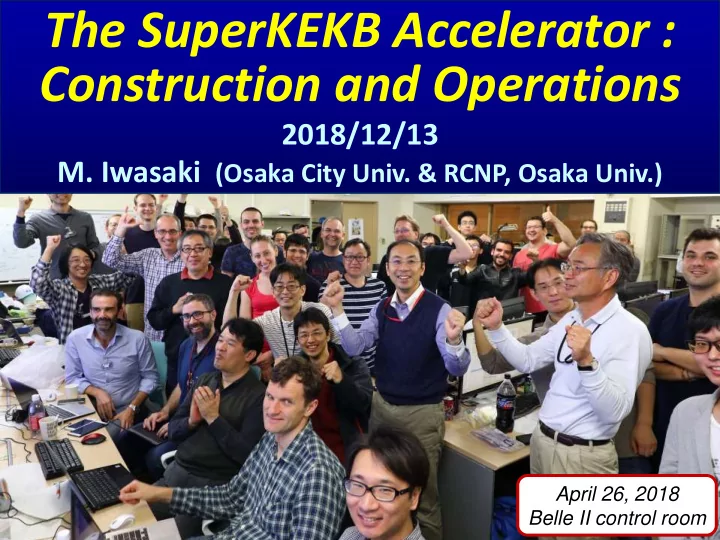
April 26, 2018 Belle II control room
The SuperKEKB Accelerator : Construction and Operations
2018/12/13
- M. Iwasaki (Osaka City Univ. & RCNP, Osaka Univ.)
The SuperKEKB Accelerator : Construction and Operations 2018/12/13 - - PowerPoint PPT Presentation
The SuperKEKB Accelerator : Construction and Operations 2018/12/13 M. Iwasaki (Osaka City Univ. & RCNP, Osaka Univ.) April 26, 2018 Belle II control room First collisions on April 26, 2018 First hadronic event First collisions on April
April 26, 2018 Belle II control room
2018/12/13
First hadronic event
SuperKEKB First Collisions Ceremony
(June 26, 2018 @ KEK)
OCU Advisor to the President (H. Suzuki)
Today I’ll talk
5
“Luminosity frontier experiment”
Low energy experiment indirectly probing high energy using high statistics data
x40 of the KEKB’s world record to accumulate high statistics of 50ab-1 data →Probe > O(TeV) energy scale
6
KEKB at KEK
8GeV (e-) 3.5GeV (e+)
Belle KEKB / Belle has upgraded to SuperKEKB / Belle II
1km diameter Belle detector
Asymmetric Energy e+ e- collider
KEKB Linac
KEK
7 2012.11.8 B workshop @ Hanamaki
1km
Belle
Next generation B-factories
40 times higher luminosity
1036 KEKB SuperKEKB
(1) Smaller by
*
(2) Increase beam currents (3) Increase xy
“Nano-Beam” scheme
Collision with very small spot-size beams Three Key factors for a factor of ~40 gain
Beam current Beam-beam parameter Vertical beta function @ IP
First proposed by P.Raimondi for SuperB
Vertical beam size (relative value)
βy* = 1/20 σz Too small βy* = 2σz Too large βy* = σz The best size IP
If we squeezing the beams at IP, particles in the bunch-tails experience a much higher b*
y and loss L
→ b*
y should be around the size of
the beam overlap (~bunch length)
Hourglass effect
To increase L, we want to squeeze beams (=small b*
y )
However β*
y cannot be much smaller than the bunch length
to avoid the “hourglass” effect
To overcome the “hourglass” effect, Enlarge crossing angle & Make horizontal beam size small Two colliding beams overlap region becomes much smaller than the bunch length Intersect bunches only at highly focused region
ss
Hourglass condition: βy*> ~L Hourglass condition: βy*> ~σs
L
Head-on collision Nano-beam scheme
In the nano-beam scheme, we 1) Enlarge the crossing angle, and 2) Make the horizontal beam size small Make b*
y small to increase the luminosity
Small size horizontal beam → Small b*
x and small ex
ss
Hourglass condition: βy*> ~L Hourglass condition: βy*> ~σs
L
Head-on collision Nano-beam scheme
parameters
KEKB SuperKEKB
units
LER HER LER HER
Beam energy
Eb 3.5 8 4 7
GeV Half crossing angle
φ 11 41.5
mrad Horizontal emittance
εx 18 24 3.2 4.6
nm Emittance ratio
κ
0.88 0.66
0.27 0.25
% Beta functions at IP
βx*/βy* 1200/5.9 32/0.27 25/0.30
mm Beam currents
Ib 1.64 1.19 3.6 2.6
A beam-beam parameter
ξy
0.129 0.090
0.088 0.081
Luminosity
L 2.1 x 1034 8 x 1035
cm-2s-1
To get x40 higher luminosity
Colliding bunches
TiN-coated beam pipe with antechambers Redesign the lattices of HER & LER to squeeze the emittance Replace short dipoles with longer ones (LER)
New Positron Damping Ring New positron source Add / modify the RF system New beam pipe & bellows New Low emittance gun New IR
4 GeV Positron Beam 7 GeV Positron Beam
Belle2
SuperKEKB Master Schedule
JFY2010 Dismantle KEKB KEKB Operation
SuperKEKB Operation
JFY2011 JFY2012 JFY2013 JFY2014 JFY2015 JFY2016 JFY2017
For about 10 years
QCS install Belle2 roll in
Phase 1 Phase 2 ・・・ ・・・
SuperKEKB construction
Startup,
Conditioning,
etc
JFY2018
Phase 3
BelleII Upgrade
3 step operations Phase-1 For machine studies (w/o Belle, w/o QCS) Phase-2 Experiments w/o Vertex Detector Phase-3 Experiments with full detector
9 months/year 20 days/month
Calendar Year
We are here
Milestone of SuperKEKB
17
(BCS)
1.1 GeV
±2%
±2.7mm
DR → Linac → SuperKEKB
Z (m) Δp/p
±5%
20% is cut at tail Collimators in the arc
(ECS)
Positron Target
Linac → DR
Energy Compression System Bunch Comp. System
Design
DR Injection Extraction
gex(mm) 2800 89.3 64.6 (estimated) gey(mm) 2600 4.5 < 2.0±0.36 (measured)
DR RTL Line
2018/05/01 IPAC'18 19
New SC magnets around IP (QCS)
Assembly of the QC1LP, QC2LP, QC1LE, correctors and QC1LP leak field cancel magnets (Front cold mass of QCSL)
QC1LP leak field cancel magnets
QC1LP a1, b1, a2 correctors
QC1LE a1, b1, a2, b4 correctors QC2LP a1, b1, a2, b4 correctors b4 corrector Magnetic shield Magnetic shield
2018/05/01 IPAC'18 20
ESL compensation solenoid ESR1 compensation solenoid ESR2-3 compensation solenoid
Magnet length= 914 mm Maximum field at 404 A= 3.53 T Stored Energy= 118 kJ Magnet length= 1575 mm Maximum field at 450 A=3.19 T Stored Energy= 244 kJ Cold diode quench protection system
New SC magnets around IP (QCS)
2018/03/22
物理学会シンポジューム(東京理科大学野田)
21
QCSR was installed in 2017. QCSL was installed in 2016
Belle II detector before Roll-in.
From the presentation by Prof. K. AKAI @KEKB review at Mar. 14, 2018
20170321
22
History of Commissioning
23
Beam dose: 120 Ah in LER / 114 Ah in HER
March 19 Phase 2 commissioning started. April 25 First Beam-Beam deflection was observed. April 26. First Collision (Physics event) was observed.
History of Commissioning
24
Lpeak = 5.55 x 1033 cm-2s-1
Integrated Luminosity (delivered from SuperKEKB) = 1853 pb-1
βy* Evolution over 50 Years
25
Year
SuperKEKB Phase 3
CEPC FCC-ee KEKB DAFNE PEP-II CESR-C BEPC-II VEPP-2000 SPEAR CESR PEP PETRA LEP, BEPC TRISTAN SuperKEKB will try to make the smallest βy* in the world !
Final design
Phase 2 mm-world μm-world
Phase 2.0 (LER)
Beta Squeezing at IP
26
β*y = 2mm trial (single beam)
Verification of Nano-Beam Scheme
2 7
βy* > σz βy* = σz βy* < σz
Emittance is improved XY coupling at IP is corrected by QCS
Luminosity
28
by
*= 80mm
by
*= 8mm
6mm by
*= 4mm
by
*= 3mm
4/1/2018 5/1 6/1 7/1
5.55 x 1033/cm2/s (by*3mm, LER: 800mA, HER: 780mA)
QCS Quench
29
Stable Operation
Damage of Movable Collimator Head
30
HER
D01V1
LER
D02V1
D01V1 D02V1
Damaged during collisions Damaged during current storage (w/o collisions)
31
32
1km diameter BelleII
Injector Linac To achieve the high luminosity, precise operation tuning to get the higher injection efficiency is very important Currently R&D of operation tuning for the injector Linac using Machine Learning (ML) is ongoing
KEK, Osaka-City U., IDS Osaka U.
In Osaka, we form a group working on
“Application of Deep Learning for Accelerator Experiments”
→ Approved as a RCNP project
Particle Physics Data Science
The group is formed with particle physicists and data scientists
34
(Osaka-City U., IDS, RCNP)
(Osaka-City U., U. Oregon, PNNL, SLAC)
(KEK, Osaka-City U., IDS)
35
Injector Linac is for SuperKEKB, PF and PF-AR We can accumulate online data even SuperKEKB is not running
First collisions in April 2018 Peak luminosity 5.5x1033/cm2 /sec
for the injector Linac using ML is on going Collaboration : KEK, OCU, and IDS Osaka U.
New physics commissioning (phase-3) will start from 2019!