The Sunrise Integral and Elliptic Polylogarithms Luise Adams , - - PowerPoint PPT Presentation

the sunrise integral and elliptic polylogarithms
SMART_READER_LITE
LIVE PREVIEW

The Sunrise Integral and Elliptic Polylogarithms Luise Adams , - - PowerPoint PPT Presentation

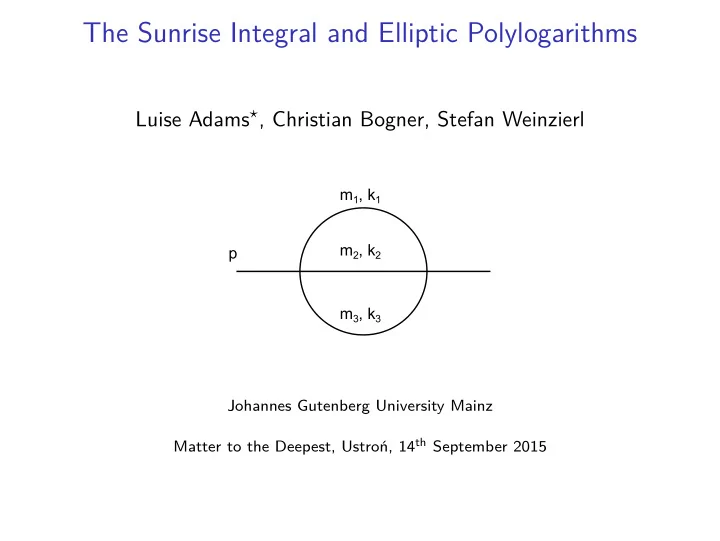
The Sunrise Integral and Elliptic Polylogarithms Luise Adams , Christian Bogner, Stefan Weinzierl m 1 , k 1 m 2 , k 2 p m 3 , k 3 Johannes Gutenberg University Mainz n, 14 th September 2015 Matter to the Deepest, Ustro Short Introduction


slide-1
SLIDE 1

The Sunrise Integral and Elliptic Polylogarithms

Luise Adams⋆, Christian Bogner, Stefan Weinzierl

p m1, k1 m2, k2 m3, k3 Johannes Gutenberg University Mainz Matter to the Deepest, Ustro´ n, 14th September 2015

slide-2
SLIDE 2

Short Introduction The Sunrise Integral in D = 2 The Sunrise Integral in D = 4

Elliptic Curves and Elliptic Integrals

An elliptic curve can be written with the help of the Weierstrass equation: Y 2Z + a1XYZ + a3YZ 2 = X 3 + a2X 2Z + a4XZ 2 + a6Z 3 and is topologically equivalent to a torus; two integrals along the paths α, β are in the first homology group of the torus ⇒ periods ω1, ω2

1

λ β α

elliptic integral = path integral along elliptic curve E;

  • nly well-defined mod Λ = {n1ω1 + n2ω2 : n1, n2 ∈ Z}

which defines a lattice

ω1 ω2

E(C)

elliptic integrals

− − − − − − − − → torus C\Λ:

elliptic integral gives an isomorphism from E(C) to C\Λ 2 / 21

slide-3
SLIDE 3

Short Introduction The Sunrise Integral in D = 2 The Sunrise Integral in D = 4

modified lattice Λτ generated by 1 and τ = ω2/ω1: Λτ = Zτ + Z and it is Λτ = Λτ+k, k ∈ Z with q = e2πiτ Under the exponential map J : C → C∗, z → e2πiz = w the lattice Λτ in C is mapped to qZ in C∗ → analytic isomorphism Eτ = C/Λτ → C∗/qZ The representation of the elliptic curve in C∗/qZ is called the Jacobi uniformization of the curve. Chain of mappings between the different representations of an elliptic curve

Weierstrass equation Weierstrass normal form y²=ax³+bx+c T

  • rus z

ω1 or 1 ω2 or τ

Lattice Λ or Λτ Jacobi uniformization

variable transformation periods ∫α dx/y, ∫β dx/y elliptic integrals

z e2πiz

^

^

^

α β

y x

3 / 21

slide-4
SLIDE 4

Short Introduction The Sunrise Integral in D = 2 The Sunrise Integral in D = 4

Classical and Elliptic Polylogarithms

Multiple polylogarithms are special Z-sums with two different representations: 1) as nested sums: Lim1,m2,...,mk (x1, . . . , xk) =

  • ∞≥i1≥i2≥···≥ik≥0

xi1

1

im1

1

xi2

2

im2

2

. . .

xik

k

imk

k

2) as iterated integrals: With G(z1, . . . , zk; y) =

y

  • dt1

t1 − z1

t1

  • dt2

t2 − z2 . . .

tk−1

  • dtk

tk − zk and G(0, . . . , 0; y) :=

1 k!(log y)k we can define

Gm1,...,mk (z1, . . . , zk; y) = G(0, . . . , 0

m1−1

, z1, . . . , zk−1, 0, . . . , 0

mk−1

, zk; y) and obtain Lim1,m2,...,mk (x1, x2, . . . , xk) = (−1)kGm1,m2,...,mk

1

x1 , 1 x1x2 , . . . , 1 x1x2 . . . xk

  • (⋆)

⇔ Gm1,m2,...,mk (z1, z2, . . . , zk; y) = (−1)kLim1,m2,...,mk

y

z1 , z1 z2 , . . . , zk−1 zk

  • generalise eq. (⋆) (for P1\{0, 1, ∞}) to a punctured elliptic curve E×

LHS: elliptic polylogarithms, RHS: iterated integrals on an elliptic curve

4 / 21

slide-5
SLIDE 5

Short Introduction The Sunrise Integral in D = 2 The Sunrise Integral in D = 4

Elliptic polylogarithms ‘live’ on an elliptic curve; they are iterated integrals on the configuration space E(n) of an elliptic curve with n marked points

[Brown, Levin 2013], [Levin, 1997]

Basic idea: Average multivalued functions on a punctured elliptic curve E × = E\{0} with respect to the multiplication by q arriving at

  • m1,m2,...,mr ∈Z

um1

1 um2 2

. . . umr

r Lin1,n2,...,nr

  • qm1t1

qm2t2 , qm2t2 qm3t3 , . . . , qmr−1tr−1 qmr tr , qmr tr

  • The parameters ui dampen the singularities of the polylogs;

Compute the pole structure in the ui coordinates, regularise the function with ui = exp(2πiαi) ⇒ the coefficients of the Taylor expansion around αi = 0, i = 0, 1, . . . , r yield the multiple elliptic polylogarithms

5 / 21

slide-6
SLIDE 6
  • II. The Sunrise Integral in D = 2 space-time

dimensions

p m1, k1 m2, k2 m3, k3

slide-7
SLIDE 7

Short Introduction The Sunrise Integral in D = 2 The Sunrise Integral in D = 4

The two-loop sunrise integral in D dimensions reads

[Caffo, Czyz, Laporta, Remiddi 1998; Laporta, Remiddi 2004] :

Sν1ν2ν3(D, p2, m1, m2, m3) = = (µ2)ν−D

  • dDk1

D 2

  • dDk2

D 2

1 (−k2

1 + m2 1)ν1(−k2 2 + m2 2)ν2(−(p − k1 − k2)2 + m2 3)ν3

In its Feynman parameterisation the integral reads (ν = ν1 + ν2 + ν3) :

Sν1ν2ν3(D, t) = Γ(ν − D) Γ(ν1)Γ(ν2)Γ(ν3)(µ2)ν−D

  • σ

ω x ν1−1

1

x ν2−1

2

x ν3−1

3

U ν− 3

2 D

Fν−D with the differential two-form ω = x1 dx2 ∧ dx3 + x2 dx3 ∧ dx1 + x3 dx1 ∧ dx2 and the integration region σ = {[x1 : x2 : x3] ∈ P2|xi ≥ 0, i = 1, 2, 3} and the first and second graph polynomial (t = p2) U = x1x2+x2x3+x1x3, F = −x1x2x3t+(x1m2

1+x2m2 2+x3m2 3)(x1x2+x2x3+x3x1). 7 / 21

slide-8
SLIDE 8

Short Introduction The Sunrise Integral in D = 2 The Sunrise Integral in D = 4

In D dimensions the integral S111 satisfies a differential equation of order four:

      

P4 d4 dt4 + P3 d3 dt3 + P2 d2 dt2 + P1 d dt + P0

  • =:L4(D)

      

S111(D, t) = µ2 [c12T12 + c23T23 + c13T13] where the Pi’s and cij’s are polynomials in D, t and the masses and the Tij’s are products of tadpoles

[Adams, Bogner, Weinzierl, 2015]

In D = 2 − 2ǫ the integral S111 and the differential operator L(0)

4

can be expanded in a Laurent series leading to a factorisable differential operator in ǫ0: L(0)

1,a(2) L(0) 1,b(2) L(0) 2 (2) S(0) 111(2, t) = −32µ2t2(15t2 + 14M100t + 77∆)

  • p2(t) d2

dt2 + p1(t) d dt + p0(t)

  • S(0)

111(2, t) = p3(t) [M¨ uller-Stach, Weinzierl, Zayadeh, 2013]

in ǫ1: L(0)

1,a(2) L(0) 1,b(2) L(0) 2 (2) S(1) 111(2, t) = I1(t)

[later more]

8 / 21

slide-9
SLIDE 9

Short Introduction The Sunrise Integral in D = 2 The Sunrise Integral in D = 4

First consider the equation F = 0 which defines together with the choice of an origin O an elliptic curve. Choose one of the intersection points of the integration region σ with the variety defined by F = 0 as

  • rigin, e.g. P3 = [0 : 0 : 1].

x x x

1 2 3

P

1

P P

2 3

=(1:0:0) =(0:1:0) =(0:0:1)

σ

Transform into Weierstrass normal form ˆ E : y 2z = 4x 3 − g2xz2 − g3z3 with O = [0 : 1 : 0]

9 / 21

slide-10
SLIDE 10

Short Introduction The Sunrise Integral in D = 2 The Sunrise Integral in D = 4

Working with z = 1 one can factorise the RHS to y 2 = 4(x − e1)(x − e2)(x − e3) with e1 + e2 + e3 = 0 where the roots ei depend on t, the masses and the invariants g2 = −4(e1e2 + e2e3 + e3e1), g3 = 4e1e2e3 With the assumption 0 ≤ m1 ≤ m2 ≤ m3 it is e2 ≤ e3 < 0 < e1 and one can find the periods of the elliptic curve in Weierstrass form: Ψ1 = 2

e3

  • e2

dx y = 4µ2

4

√ D K(k), Ψ2 = 2

e3

  • e1

dx y = 4iµ2

4

√ D K(k′) where K(x) denotes the complete elliptic integral of the first kind K(x) =

1

  • dt
  • (1 − t2)(1 − x 2t2)

with the (complementary) modulus k(′): k =

  • e3−e2

e1−e2 and

k′ = √ 1 − k2 =

  • e1−e3

e1−e2 10 / 21

slide-11
SLIDE 11

Short Introduction The Sunrise Integral in D = 2 The Sunrise Integral in D = 4

The periods Ψ1, Ψ2 are the solutions of the homogeneous differential equation!

[Adams, Bogner, Weinzierl (2013, 2014)]

Consider the ratio of the two periods τ and the nome q: τ = iK(k′) K(k) , q = eiπτ and you can make a transformation of the variable t → q

[Bloch, Vanhove, 2013]

With variation of the constants one finds for a special inhomogeneous solution: Sspecial = −µ2 Ψ1(q) π2

q

  • dq′

q′

q1

  • dq′′

q′′ p3(q′′)Ψ1(q′′)3 p2(q′′)W (q′′)2 with the Wronski determinant W = Ψ1 d dt Ψ2 − Ψ2 d dt Ψ1

11 / 21

slide-12
SLIDE 12

Short Introduction The Sunrise Integral in D = 2 The Sunrise Integral in D = 4

Aim: Express the special solution in terms of the homogeneous solutions and generalised (elliptic) polylogarithms Consider the elliptic curve Ei defined by F = 0 with origin Pi → transform into Weierstrass normal form ˆ E with origin Qi,i = [0 : 1 : 0] → Periods Ψ1, Ψ2 of ˆ E define a lattice Λ → map from ˆ E to the torus C/Λ with the elliptic integral [x : y : 1] → ˆ z = 1 Ψ1

  • x

dx

  • 4(x − e1)(x − e2)(x − e3)

12 / 21

slide-13
SLIDE 13

Short Introduction The Sunrise Integral in D = 2 The Sunrise Integral in D = 4

→ intersection points Qj,k → ˆ zi = 1 2 F(ui, k) K(k) with ui = e1 − e2 xj,k − e2

((i,j,k) as cyclic permutation of (1,2,3) and F(z, x) as the incomplete elliptic integral of the

first kind F(z, x) =

z

  • dt
  • (1 − t2)(1 − x2t2)

(Qi,j → [xi,j : yi,j : 1] is the image of the point Pi ∈ Ej on ˆ E) → map to the Jacobi uniformization C ∗/q2Z with ˆ z → w = e2πiˆ

z

→ points ˆ zi → wi with wi = exp

  • iπ F(ui, k)

K(k)

  • 13 / 21
slide-14
SLIDE 14

Short Introduction The Sunrise Integral in D = 2 The Sunrise Integral in D = 4

The classical polylogarithms are defined by Lin(x) =

  • j=1

xj jn , while the real and imaginary part of Lin(eiϕ) is given by the Clausen and Glaisher functions:

Cln(ϕ) =

1

2i

  • Lin(eiϕ) − Lin(e−iϕ)

,

1 2

  • Lin(eiϕ + Lin(e−iϕ))

, Gln(ϕ) =

1

2

  • Lin(eiϕ) + Lin(e−iϕ)

, n even

1 2i

  • Lin(eiϕ) − Lin(e−iϕ)

, n odd. Consider the following generalisation of polylogarithms: ELin;m(x, y; q) =

  • j=1

  • k=1

x j jn y k km qjk =

  • k=1

Lin(xqk) y k km

and define the weight to be w = n + m and En;m(x, y; q) =

  • 1

i

1

2Lin(x) − 1 2Lin(x−1) + ELin;m(x, y; q) − ELin;m(x−1, y −1; q)

  • , n + m even

1 2Lin(x) + 1 2Lin(x−1) + ELin;m(x, y; q) + ELin;m(x−1, y −1; q), n + m odd

14 / 21

slide-15
SLIDE 15

Short Introduction The Sunrise Integral in D = 2 The Sunrise Integral in D = 4

The result in the arbitrary mass case in two dimensions is then given by

S(0)

111 = Ψ1(q)

π [E2;0(w1(q), −1; −q) + E2;0(w2(q), −1; −q) + E2;0(w3(q), −1; −q)]

[Adams, Bogner, Weinzierl, 2014]

with the functions wi which are the images of the intersection points, not chosen as origin under the chain of mappings Ei → ˆ E → C/Λ → C∗/q2Z as arguments of the elliptic dilogarithms In the equal mass case the solution simplifies to S(0)

111 = 3Ψ1(q)

π E2;0

  • e

2πi 3 , −1; −q

  • .

[Bloch, Vanhove, 2013] 15 / 21

slide-16
SLIDE 16
  • III. The Sunrise Integral in D = 4 space-time

dimensions

slide-17
SLIDE 17

Short Introduction The Sunrise Integral in D = 2 The Sunrise Integral in D = 4

The Laurent expansion of the two-dimensional solution starts at ǫ0: S111(2, t) = S(0)

111(2, t) + ǫS(1) 111(2, t) + O[ǫ2]

The Laurent expansion of the four-dimensional solution starts at ǫ−2: S111(4, t) = S(−2)

111 (4, t) 1

ǫ2 + S(−1)

111 (4, t)1

ǫ + S(0)

111(4, t) + ǫS(1) 111(4, t) + O[ǫ2]

In the basis

(i = {1, 2, 3})

µ2 ∂ ∂t S111(D, t) = S222(D + 2, t), µ2 ∂ ∂m2

i

S111(D, t) = −S1+δ1i 1+δ2i 1+δ3i (D, t) we find with the dimensional shift relations

[Tarasov, 1996; 1997]

S(0)

111(4, t) = 1

µ4 ˜ L(−1)

3

(2) S(1)

111(2, t) + 1

µ4 ˜ L(0)

3 (2) S(0) 111(2, t) + ˜

R where ˜ L(k)

3

= C (k) +

3

  • i=1

C (k)

i

m2

i

∂ ∂m2

i

and the C (k)

0 , C (k) i

are polynomials in t and the masses and ˜ R contains simpler terms depending on the masses and t as well as log

  • m2

i

µ2

  • terms

still missing: S(1)

111(2, t) 17 / 21

slide-18
SLIDE 18

Short Introduction The Sunrise Integral in D = 2 The Sunrise Integral in D = 4

Now consider the second-order differential equation for S(1)

111(2, t) for the equal

mass case [Laporta, Remiddi, 2004] with the first-order differential operator A(1)

em(t, m):

L(0)

2,em S(1) 111(2, t) = 12µ2 log

  • m2

µ2

  • + A(1)

em(t, m) S(0) 111(2, t)

We make an obvious ansatz for S(1)

111(2, t) consisting of a part proportional to

S(0)

111(2, t) and a remainder:

S(1)

111(2, t) = ˜

S(1)

111(2, t) + F1(t) S(0) 111(2, t)

With this ansatz it is possible to solve the above differential equation for ˜ S(1)

111(2, t)

˜ S(1)

111(2, t) = homogeneous solutions + ˜

S(1)

111,special(2, t)

and finally to find an expression for S(1)

111(2, t). 18 / 21

slide-19
SLIDE 19

Short Introduction The Sunrise Integral in D = 2 The Sunrise Integral in D = 4

With the q-expansion of ˜ S(1)

111,special and the full solution S(1) 111(2, t) = Ψ1 π E (1) we

find for E (1) where S(0)

111(2, t) = Ψ1 π E (0) a quite long expression with (elliptic)

polylogarithms consisting of a large part of homogeneous weight three and a small one of mixed weight three and four: 1) Part of homogeneous weight three

  • term proportional to E (0)
  • term containing ordinary polylogarithms of the form Li2,1, Li3, log ×Li2
  • term with the following weight three - elliptic polylogarithms and the wi’s and

±1 as arguments E0,1;−2,0;4(x1, x2; y1, y2; −q) = = 1 i

  • ELi2;0(x1, y1; −q) − ELi2;0
  • x −1, y −1; −q

× 1 2

  • Li1(x2) + Li1
  • x −1

2

  • j1=1

  • k1=1

  • j2=1

  • k2=1

k2

1

j2(j1k1 + j2k2)2

  • x j1

1 y k1 1 − x −j1 1

y −k1

1

x j2

2 y k2 2 − x −j2 2

y −k2

2

  • ×(−q)j1k1+j2k2

19 / 21

slide-20
SLIDE 20

Short Introduction The Sunrise Integral in D = 2 The Sunrise Integral in D = 4

2) Part with mixed weight three and four: E3;1(wj, −1; −q)

  • occurs as remainder of the log(−q)-terms in

S(1)

111(2, t) = ˜

S(1)

111(2, t) + F1(t)S(0) 111(2, t) and

˜ S(1)

111(2, t) = c1Ψ1 + c2Ψ1 log(−q) + ˜

S(1)

111,special(2, t) which in principle cancel out

the function E3;1 results from an integration with respect to d log(q) = dq/q leading purely to terms of weight four because log(q) should be counted a weight two:

q

  • ELin;m(x, y; q′)d log(q′) = ELin+1;m+1(x, y; q)

Final result for S(0)

111(4, t):

S(0)

111(4, t) = 1

µ4 ˜ L(−1)

3

(2) S(1)

111(2, t) + 1

µ4 ˜ L(0)

3 (2) S(0) 111(2, t) + ˜

R with ˜ L(k)

3

= C (k) +

3

  • i=1

C (k)

i

m2

i

∂ ∂m2

i

and S(0)

111(2, t) and S(1) 111(2, t) containing the

elliptic polylogarithms

20 / 21

slide-21
SLIDE 21

Short Introduction The Sunrise Integral in D = 2 The Sunrise Integral in D = 4

Conclusions

  • ǫ0-part of the sunrise integral in two space-time dimensions S(0)

111(2, t)

expressible as sum of three elliptic dilogarithms with numbers as arguments which are the images of the intersection points of the elliptic curve and the integration region under a chain of mappings between the different representations of the elliptic curve

  • ǫ0-part in four space-time dimensions S(0)

111(4, t) depends on the solution

in D = 2 dimensions denoted by S(0)

111(2, t) and S(1) 111(2, t), mass

derivatives thereof and simpler terms

21 / 21

slide-22
SLIDE 22

Example of the calculation of an elliptic polylogarithm: Li1

Consider the generating series where u−1 is chosen such that the convergence is ensured E(z; u) =

  • m∈Z

umLi1(qmz) for m ≪ 0: asymptotic − − − − → um log(qmz) (bounded for u > 1) for m ≫ 0: − → umqmz (bounded for u < |q|−1) ⇒ absolute convergent for 1 < u < |q|−1 with pole at u = 1 change of variables: u = e2πiα, z = e2πiξ implies a pole at α = 0 (ˆ = u = 1) regularise function E reg(ξ, α) = E(ξ, α) − 1 α Compute Taylor expansion of E reg around α = 0; coefficients yield multivalued functions on a punctured allpitic curve

[Brown, Levin, 2013] 1 / 1