The Strategy For Plastic Waste Reduction Zero Plastic to Landfill - - PowerPoint PPT Presentation

the strategy for plastic waste reduction zero plastic to
SMART_READER_LITE
LIVE PREVIEW

The Strategy For Plastic Waste Reduction Zero Plastic to Landfill - - PowerPoint PPT Presentation

The Strategy For Plastic Waste Reduction Zero Plastic to Landfill 100% Recovery Michel Loubry, Regional Director, PlasticsEurope IUCN, Monaco 09 th May 2016 Plastics are part of daily live 2 Global plastics production is growing


slide-1
SLIDE 1

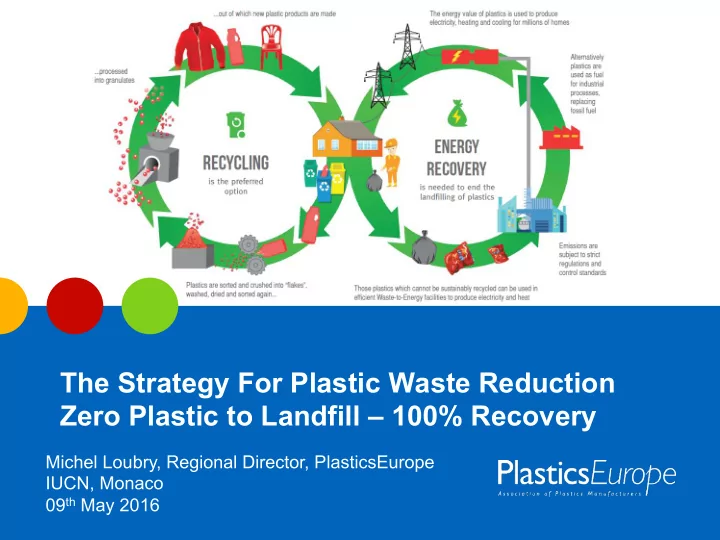
The Strategy For Plastic Waste Reduction Zero Plastic to Landfill – 100% Recovery

Michel Loubry, Regional Director, PlasticsEurope IUCN, Monaco 09th May 2016

slide-2
SLIDE 2

Plastics are part of daily live…

2

slide-3
SLIDE 3

Global plastics production is growing – however, Europe remains stable

3

slide-4
SLIDE 4

4

slide-5
SLIDE 5

Packaging, Building & Construction and Automotive are the top 3 plastic markets

5

slide-6
SLIDE 6

Example: Plastics packaging When more is less

Without plastics, retailers’ fleets would make 50% more journeys

GLASS JARS

36% IS

PACKAGING PLASTIC POUCHES

3.56%

IS PACKAGING

On average only 1 to 3% of the weight of a packaged product in plastics comes from the packaging:

  • A plastic film of 2g packages 200g of cheese
  • A plastic Bottle of 35g packages 1.5 liter of drinks

Inclusive the logistic packaging, it grows up to 3.56% on average

slide-7
SLIDE 7

Packaging becomes lighter for same content

7

Weight

  • f packaging

20 years ago Weight

  • f packaging

Today Weight reduction Weight

  • f the

Content Yoghurt cup 5,8 g 4,8 g

  • 17 %

125 g Bottled water 40 g 25 g

  • 38 %

1500 g Vegetable bag 20 g 3,5 g

  • 82 %

5000 g Cooked meal tray 40 g 23 g

  • 40 %

300 g PSE fish tray 100 g 87 g

  • 13 %

3000 g

Source: Elipso, the French association of flexible packaging

slide-8
SLIDE 8

Improper use of landfills Behavior Environmental pollution and its reasons

à Environmental pollution is a behavioral problem and a problem of bad waste management

Waste collection systems working badly Improper use of landfills Behavior

Plastics are too Valuable to be wasted! It is a Resource… ”My Waste is Your Material”: Eco-Industry

slide-9
SLIDE 9

ALL recovery options apply for plastics

Reuse Mechanical Recycling Chemical Recycling Energy Recovery Disposal

Waste Consumer Objects Plastics Materials derived from oil and gas

Prevent Reuse Recycle Recover Landfill

slide-10
SLIDE 10

Zero Plastics to Landfill is a challenging but worthwhile objective

2 4 6 8 10 12 14 16

2005 2010 2012 2020 2025 2030 2037

Trend-line (extrapolation) Zero Plastics to Landfill

Post-consumer Plastic waste landfilled in Europe:

Decrease from 2005 - 2012

in million tonnes

  • 26%

Source: Consultic, 2013

slide-11
SLIDE 11

Plastics recycling is the preferred option…

11

slide-12
SLIDE 12

July 1, 2006 credit: NOAA ONMS

Key Message from the Industry:

The organizations … are firmly committed to the principle that plastics do not belong in the world’s oceans and should not be littered -- plastics should be responsibly used, reused, recycled and finally recovered for their energy value. - Declaration of the Global Plastics Associations for Solutions on

Marine Litter, since 2011

12

slide-13
SLIDE 13

Plastics Industry is part of the solution

Global Action Plan of the plastics industry committed to around 185 projects targeting mainly at 1. Education to prevent Marine Litter 2. Waste Management improvement 3. Research for solutions 4. Plastic pellet containment www.marinelittersolutions.com

slide-14
SLIDE 14

Prevent marine litter at source by

14

Proper waste collection Mindful Product Design Conscious people behavior

Research Projects Knowledge Sharing

Supporting actions: Plastics Industry supports 40+ projects in Europe today.

slide-15
SLIDE 15

Raise awareness and achieve responsible people behaviour

15

Outdoor Sports Vacation Into the neighborhood Effective tools for awareness & education Educate school kids

slide-16
SLIDE 16

Plastics industry is taking responsibility for proper plastic pellet containment

16

slide-17
SLIDE 17

Pellet Loss Prevention in Europe Milestones and signatories of OCS

2005 2011 2013 2014 2015 2016 1985

J.V. Franecker conducts first Pellet Reports in Sea Birds

GER: 1 NL: 1 AT: 1 FR: 2

Start OCS in US

Marine Litter Declaration, 34 asso- ciations sign

Q1: 21

1992

EPA, USA, pellet loss preventio n report

Associations in EU: Producer Companies Converter &

  • ther companies

UK: 2 EU: 1 FI: 1 SE: 1 DK: 1

Q4: 14 > 100 Start in EU

  • w. internal

Zero Pellet Loss Producer start in Pan-EU w. Operation Clean Sweep > 60 > 40 Q4: 11 Q4: 8 BPF, UK 1st EU OCS Q2: 0 Q1: 16

slide-18
SLIDE 18

Microplastics (incl. Plastic Pellets) in Fulmar Guts, Franeker

slide-19
SLIDE 19

Conclusions

  • A combination of Resource Efficiency, Waste

Management and Litter Prevention are key to create a sustainable use of our resources.

  • Improved waste management: proper waste

collection, a phase out of landfills for plastics by 2025 will drive value of plastics, open up opportunities for further recovery and induce reduction of littering.

  • Prevention of littering during use of goods is key:
  • Provide the right collection capacities & educate to enable

responsible individual behavior

  • Industry emissions are equally unacceptable: Pellet Loss

Prevention measures like OCS is taking place country by country.

19

slide-20
SLIDE 20