The Square Kilometre Array Radio Telescope Project : An Overview - - PowerPoint PPT Presentation

the square kilometre array radio telescope project an
SMART_READER_LITE
LIVE PREVIEW

The Square Kilometre Array Radio Telescope Project : An Overview - - PowerPoint PPT Presentation

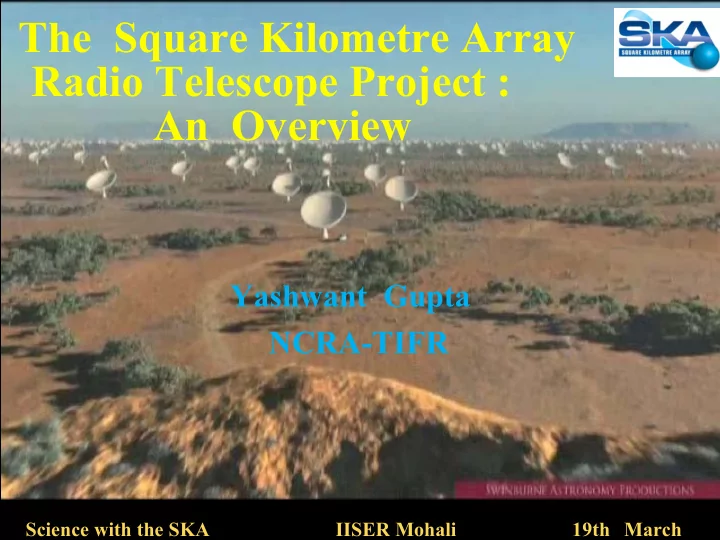
The Square Kilometre Array Radio Telescope Project : An Overview Yashwant Gupta NCRA-TIFR Science with the SKA IISER Mohali 19th March Background : what is the SKA ? The SKA is the most

slide-1
SLIDE 1

The Square Kilometre Array Radio Telescope Project : An Overview

Yashwant Gupta NCRA-TIFR

Science with the SKA IISER Mohali 19th March

slide-2
SLIDE 2

Background : what is the SKA ?

  • The SKA is the most ambitious Radio

The SKA is the most ambitious Radio Astronomy project ever attempted Astronomy project ever attempted

  • 1 square km (1,000,000 sq m) collecting

1 square km (1,000,000 sq m) collecting area (~ 30 x GMRT !) area (~ 30 x GMRT !)   ~ 3000 small ~ 3000 small sized antennas, with larger field of view sized antennas, with larger field of view

  • High resolution

High resolution   antennas spread out antennas spread out

  • ver distances up to 3000 km, but
  • ver distances up to 3000 km, but

connected in real-time (by optical fibre) connected in real-time (by optical fibre)

  • Wide frequency range: 70 MHz - 10 GHz

Wide frequency range: 70 MHz - 10 GHz

  • Location : Australia AND South Africa

Location : Australia AND South Africa (radio quiet regions, far away from (radio quiet regions, far away from human habitat) human habitat)

  • Total estimated cost s for full SKA :

Total estimated cost s for full SKA : Phase I : 650 M Euros Phase I : 650 M Euros Total : ~ 1.5 billion Euros (?) Total : ~ 1.5 billion Euros (?)

Sensitivities of radio telescopes over the years The SKA will be 50x better than today’s best !

slide-3
SLIDE 3

SKA Design & Technologies

  • Receptor stations spread out over a

Receptor stations spread out over a region of 3000 km ; highly compact & region of 3000 km ; highly compact & dense central core region dense central core region

  • Multiple detector technologies to cover

Multiple detector technologies to cover the large frequency range : dishes (high the large frequency range : dishes (high frequency), sparse & dense aperture frequency), sparse & dense aperture arrays (low & mid frequencies) arrays (low & mid frequencies)

  • Extensive optical fibre network

Extensive optical fibre network (petabits/sec ) : > total internet traffic) (petabits/sec ) : > total internet traffic)

  • State of the art low noise electronics &

State of the art low noise electronics & real-time signal processing real-time signal processing

  • Supercomputing capability (petaflops)

Supercomputing capability (petaflops) for post processing requirements for post processing requirements

  • Complex telescope management structure

Complex telescope management structure

slide-4
SLIDE 4

Full SKA : Reference Design Layout

slide-5
SLIDE 5

SKA : System schematic

slide-6
SLIDE 6

Science with the SKA

  • Five frontline science drivers for the full SKA :

Five frontline science drivers for the full SKA : 1. DARK ENERGY, cosmology, galaxy evolution , cosmology, galaxy evolution – mapping the – mapping the cosmic distribution of hydrogen & understanding what is dark energy cosmic distribution of hydrogen & understanding what is dark energy 2. WAS EINSTEIN RIGHT ? -- strong-field tests of gravity using

  • - strong-field tests of gravity using

pulsars & black holes pulsars & black holes 3. COSMIC MAGNETISM – what generates the magnetic fields in – what generates the magnetic fields in space ? space ? 4. 4. probing the probing the “DARK AGES” – how were the first black holes & stars – how were the first black holes & stars formed ? formed ? 5. 5. the the “CRADLE OF LIFE” – search for complex molecules (the – search for complex molecules (the building blocks of life), Search for Extra-Terrestrial Intelligence building blocks of life), Search for Extra-Terrestrial Intelligence (SETI) (SETI) Serendipitous science : the power and sophistication of the SKA will provide : the power and sophistication of the SKA will provide plenty of opportunities for new, unexpected discoveries ! plenty of opportunities for new, unexpected discoveries !

slide-7
SLIDE 7

Science with the SKA

Now being updated with a Now being updated with a new & more comprehensive new & more comprehensive version that is due for version that is due for completion by the end of this completion by the end of this year year

slide-8
SLIDE 8

SKA Phase I

  • Full SKA is a very ambitious project; for ease of implementation, it

Full SKA is a very ambitious project; for ease of implementation, it has been split into phases has been split into phases

  • SKA Phase I :

SKA Phase I :

  • ~ 10% of full SKA

~ 10% of full SKA

  • Frequency coverage : 70 MHz to 3 (10) GHz

Frequency coverage : 70 MHz to 3 (10) GHz

  • Max baseline : 200 km

Max baseline : 200 km

  • 2 key science goals : EoR ; Pulsars & Gravity (+ minor goals)

2 key science goals : EoR ; Pulsars & Gravity (+ minor goals)

  • All infrastructure and designs to keep in mind the full SKA

All infrastructure and designs to keep in mind the full SKA

  • Total cost estimate : ~ 650 M Euro (Rs. 4550 cr)

Total cost estimate : ~ 650 M Euro (Rs. 4550 cr)

  • Selection of site has happened (May 2012) and the project will be

Selection of site has happened (May 2012) and the project will be located in Australia and South Africa located in Australia and South Africa

  • 3 part telescope : SKA-LOW, SKA-MID & SKA-SURVEY

3 part telescope : SKA-LOW, SKA-MID & SKA-SURVEY

  • Detailed design & definition phase : 2012 -- 2016 (~ 90 M Euros)

Detailed design & definition phase : 2012 -- 2016 (~ 90 M Euros)

  • Construction phase : 2017 – 2022 (~ 550 M Euros)

Construction phase : 2017 – 2022 (~ 550 M Euros)

slide-9
SLIDE 9

Realisation Plans for SKA-I

slide-10
SLIDE 10

SKA : Governance & Management

slide-11
SLIDE 11

SKA-I : Management Structure

  • Present management structure (2012 onwards) is as follows:

Present management structure (2012 onwards) is as follows:

  • The

The SKA Project Office SKA Project Office (HQ in Manchester, UK) coordinates all (HQ in Manchester, UK) coordinates all the technical activities the technical activities

  • The work is divided into

The work is divided into work packages for different elements work packages for different elements

  • f the SKA telescope
  • f the SKA telescope
  • At a higher level, the affairs are managed & guided by the

At a higher level, the affairs are managed & guided by the SKA SKA Organisation Organisation : Board of Directors, representatives from scientific : Board of Directors, representatives from scientific community and funding agencies of each member nation; Full community and funding agencies of each member nation; Full Members vs Associate Members Members vs Associate Members

  • Presently :

Presently : Ten nations with Ten nations with Full Membership -- Australia,

  • - Australia,

Canada, China, Germany, Italy, The Netherlands, New Zealand, Canada, China, Germany, Italy, The Netherlands, New Zealand, South Africa, Sweden, UK. South Africa, Sweden, UK.

  • India at present is an Associate Membership – looking to change

shortly to Full Membership.

slide-12
SLIDE 12

SKA-I : Design Process

  • Design of the SKA is being undertaken by global consortia, acting as

Design of the SKA is being undertaken by global consortia, acting as contractors to the central SKAOffice. contractors to the central SKAOffice.

  • SKA Office has direct control of the system engineering process,

SKA Office has direct control of the system engineering process, receiving and reviewing designs from consortia, monitor progress, receiving and reviewing designs from consortia, monitor progress, analysing and allocating Earned Value etc. analysing and allocating Earned Value etc.

  • SKA Office issued a baseline conceptual design to serve as starting

SKA Office issued a baseline conceptual design to serve as starting point for design, based on previous work and CoDRs. point for design, based on previous work and CoDRs.

  • 10 consortia formed to undertake the design.

10 consortia formed to undertake the design.

  • First major target is the Preliminary Design Review (PDR) scheduled

First major target is the Preliminary Design Review (PDR) scheduled at the end of this year (2014). at the end of this year (2014).

  • Inputs from the design and cost estimates from the work by the

Inputs from the design and cost estimates from the work by the consortia will be used to rebaseline the design – by early 2015. consortia will be used to rebaseline the design – by early 2015.

  • SKA Office holds the design authority for the project.

SKA Office holds the design authority for the project.

slide-13
SLIDE 13

SKA-I : Work Packages

  • Following are

Following are led by SKA Office : led by SKA Office :

  • Management

Management

  • Science

Science

  • System Design and system engineering

System Design and system engineering

  • Maintenance & Support and Operations

Maintenance & Support and Operations

  • Following are carried out by Work Package Consortia :

Following are carried out by Work Package Consortia :

  • Dish Array

Dish Array

  • Aperture Arrays

Aperture Arrays

  • Signal and Data Transport (including synchronisation and timing)

Signal and Data Transport (including synchronisation and timing)

  • Central Signal Processor

Central Signal Processor

  • Science Data Processor

Science Data Processor

  • Telescope Manager

Telescope Manager

  • Infrastructure, including power

Infrastructure, including power

  • Assembly, Integration and Verification

Assembly, Integration and Verification

  • Additional packages on Advanced Instrumentation Programmes

Additional packages on Advanced Instrumentation Programmes (to be integrated with Dish & AA WPs) by WP Consortia : (to be integrated with Dish & AA WPs) by WP Consortia :

  • Mid Frequency Aperture Array

Mid Frequency Aperture Array

  • Wide Band Single Pixel Feeds

Wide Band Single Pixel Feeds

slide-14
SLIDE 14

SKA : Governance & Management

slide-15
SLIDE 15

SKA : Timelines

slide-16
SLIDE 16

Importance of the SKA

  • The SKA will revolutionise astronomy with exotic science

The SKA will revolutionise astronomy with exotic science capabilities capabilities

  • The SKA project will spawn new developments in many technology

The SKA project will spawn new developments in many technology areas : antennas, signal transport, signal processing, computing, areas : antennas, signal transport, signal processing, computing, software, data archiving… software, data archiving…   the “IT telescope” the “IT telescope”

  • Besides benefiting the astronomy community, the SKA project will

Besides benefiting the astronomy community, the SKA project will generate significant opportunities for industry : structural, generate significant opportunities for industry : structural, electronics, computing, software, infrastructure facilities etc. electronics, computing, software, infrastructure facilities etc.

  • The SKA is a global collaborative project : every country with

The SKA is a global collaborative project : every country with interest and expertise in astronomy is planning participation in the interest and expertise in astronomy is planning participation in the SKA in a big way SKA in a big way

  • It is imperative that India express its interest & stake its rightful claim

to be part of this mega-project .

  • We need to prepare the Indian astronomical community to be ready
slide-17
SLIDE 17

Thank You for your attention ! Thank You for your attention !